Tag Archives: AI

If executive offsites are so valuable, why do we only have one or two a year?

Executive offsites have been part of running a business for decades because they work. Leaders wouldn’t continue investing the time, money, and energy it takes to step away from the day-to-day business if they didn’t.

Organizations have become increasingly distributed, while AI has dramatically expanded what leadership teams can accomplish together between meetings. Together, those changes make this a good time to extend one of leadership’s most valuable practices.

Most people think of an executive offsite as a stand-alone event. It’s better understood as one part of a continuous leadership collaboration process. Every meeting ideally begins well before it starts and ends long after it is over. Executive offsites are no exception.
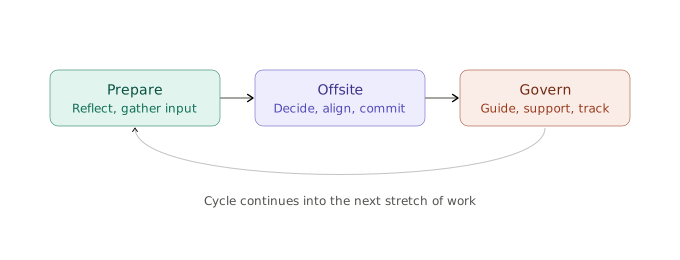
The offsite is one stage in a continuous cycle, not a standalone event.

Leadership collaboration begins well before the meeting. Leaders reflect, develop points of view, gather and provide input, compare perspectives, organize and assess the team’s thinking, and arrive prepared to engage. During the offsite they collaborate intensely, synthesize perspectives, make decisions, and develop shared understanding. Afterward, ideas continue to mature, initiatives become governable implementation plans, and leaders guide, support, and govern their execution.

Most leaders develop their thinking on their own. Few have learned to become genuinely interested in how others see the same situation or to deliberately draw out one another’s thinking, compare perspectives, challenge assumptions, and build stronger ideas together. Yet that is how leadership teams develop stronger thinking. The quality of a leadership team’s decisions and actions reflects how well the team develops its collective thinking. Developing shared understanding is one of leadership’s primary responsibilities.

Alignment is Clarity Reached Jointly.

If shared understanding is what makes executive offsites valuable, why develop it only once or twice a year?
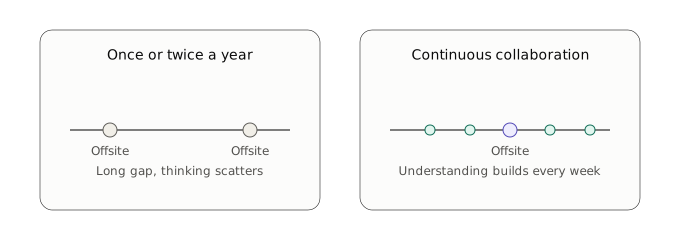
Shared understanding built once or twice a year, versus built continuously.

What This Looks Like

Imagine a leadership team preparing for an executive offsite to evaluate a major strategic initiative.

The relevant experience and insight already exist across the leadership team and key stakeholders, but remain distributed across people, functions, and perspectives.

Traditionally, organizations rely on interviews, workshops, surveys, and experienced facilitators or organization development professionals to draw out, organize, challenge, and synthesize that thinking. Those practices remain invaluable. The Leadership Workspace makes many of those practices continuously available, allowing leadership teams and the advisors who support them to apply them whenever they are needed, not just when an offsite is scheduled.

Leaders and key stakeholders each complete an Enterprise Change Framework in the Leadership Workspace. As they work, IVOA asks questions, offers suggestions, and helps strengthen each person’s thinking. Team members then use the Workspace to compare perspectives, explore and consolidate promising ideas, and compare those ideas with positions inferred from existing organizational materials such as the company’s website, management presentations, and strategic documents.

By the time leaders gather, they are already working from a richer shared understanding. Instead of spending much of the meeting discovering what people think, they can spend their time strengthening ideas, making decisions, and building commitment. Just as importantly, the effort required to prepare for a high-quality leadership conversation becomes low enough that organizations can convene whenever needed, not only once or twice a year.

Leadership Is Becoming More Distributed

Organizations have always sought to turn good ideas into realized benefits. Executive offsites contribute because they improve the journey from idea to benefit. They create the time and space for leaders to think together before acting together.

Today’s organizations operate in a far more distributed environment than when executive offsites first became common practice. Leadership now spans people, teams, functions, partners, technologies, and locations. As organizations become more distributed, opportunities to step away from day-to-day work and develop shared understanding together become even more valuable.

At the same time, the pace and complexity of modern organizations increasingly call for leadership collaboration to continue between meetings, carrying shared understanding into governable action. Continuous leadership collaboration has therefore become one of leadership’s defining disciplines.

Until recently, sustaining that discipline required experienced facilitators, organization development professionals, interviews, workshops, surveys, and significant preparation and follow-through. Those practices remain invaluable. They have also been difficult to apply continuously. The Leadership Workspace makes many of those practices available as part of every leadership team’s everyday way of working.

Making Continuous Leadership Collaboration Practical

Advances in AI have now made a different way of working practical. The Leadership Workspace shown in Figure 3 is available today. See how leadership teams use the Leadership Workspace to develop shared understanding, carry it into governable action, and accelerate the journey from idea to benefit in the Leadership Workspace Tour.

Just as AI is dramatically accelerating the journey from idea to product in software development, it is beginning to accelerate the journey from idea to benefit in leadership.
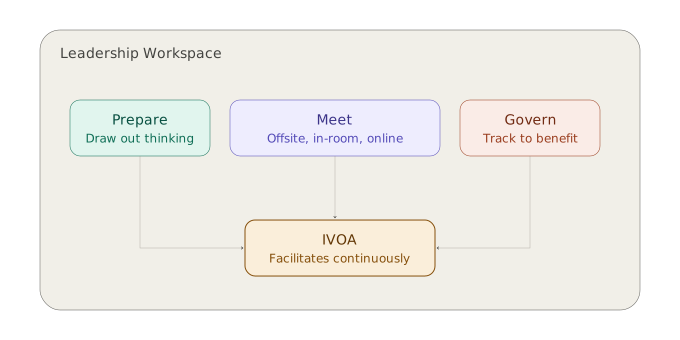
IVOA supports leaders continuously as they prepare, meet, and govern.

Leadership teams can now continuously develop shared understanding in a shared Leadership Workspace. Acting much like an experienced facilitator and organization development advisor, IVOA (IntelliVen Operations Advisor) helps teams draw out their thinking, develop shared understanding, and strengthen ideas as they evolve.

When leadership teams arrive at an executive offsite, they no longer begin with a blank page. Individual thinking has already been drawn out. Collective thinking has already begun to emerge. Important questions have already surfaced.

The offsite becomes an opportunity to strengthen thinking, resolve differences, make decisions, build commitment, and accelerate progress.

The Future of Leadership

When the meeting ends, the work continues. Ideas continue to mature. Initiatives evolve into governable implementation plans. Leadership teams establish the guidance, support, and governance needed to realize the benefits they seek.

Shared understanding becomes shared action.

Then something even more important begins to happen.

Leaders develop a different way of leading. They become interested in one another’s thinking. They learn to draw out perspectives, strengthen ideas, and continuously develop shared understanding.

Over time that behavior becomes habit. The habit becomes culture. Leadership collaboration becomes a continuous way of working.

Executive offsites remain one of the most valuable tools available to leadership teams. They always will.

The Leadership Workspace simply removes the offsite as the limiting factor in how often leadership teams can develop shared understanding, strengthen decisions, and carry them into governable action. Instead of concentrating much of that work into one or two events each year, leaders can now improve the journey from idea to benefit continuously.

Organizations have always competed through products, services, and strategies. Increasingly, they will also compete through how effectively their leaders develop shared understanding and carry it into action.

That capability produces what we call Structured Coherence: leaders, teams, initiatives, and governance continuously reinforcing one another through shared understanding carried into governable action.

Continue Exploring the Future of Leadership

If this perspective resonates, you may also enjoy:

Prompt Engineering: How We Put Generative AI to Work For Our Business

Summary:

In just six prompt engineering iterations we achieved real business value with generative Artificial Intelligence in that we are now able to:

  • Significantly reduce the time required to review and assess client submissions using our WHAT-WHO-WHY rubric.
  • Provide a comprehensive evaluation and quality suggestions for each entry.
  • Make explicit and accessible our assessment and recommendations logic that had not previously been made clear to those we work with.
  • Increase our capacity to provide service.
  • Quickly and easily incorporate new data and insights into our process.

While we found it doable, prompt engineering required careful attention to detail and follow-through to identify and address what worked and what did not work at each step.

Now we have a fantastic starting point from which we can easily apply our facilitation skills to deliver even higher levels of value to leadership teams.

Background

Large Language Models such as Bing and Bard have received a lot of attention for their ability to chat intelligently (or so it seems!) about almost anything. However, there are not yet many examples of chatbots providing real business value.

At IntelliVen, we wanted to test generative AI’s ability to improve the quality of our work while simultaneously lowering costs. We are pleased to have found that chatbots can generate significant business value.

In this post, our goal is to share how we achieved business value using generative AI so that readers can build on our efforts and push our thinking (and their own thinking!) even further in this rapidly evolving discipline.

The key to what we achieved is Prompt Engineering, an iterative process by which we created a suitable and reusable prompt for our use case.

Prompt Engineering Definition

Prompt engineering is the process of designing and refining prompts to improve the performance of AI models. It involves techniques like using the right words, format, length, and parameters to coax the best performance from an AI model given its training data.

Prompt engineering can also include providing pertinent background, such as:

  • The profile of the person inputting content.
  • What perspective to take when assessing input.
  • The profile of persons who will read the output.
  • What types of output are requested.
  • What indicates high quality output.

Especially when you plan to interact with a chatbot for the same purpose on a recurring basis, it is critical to invest in prompt engineering to ensure you get the highest value results.

Use Case

At Intelliven, we help leaders and their teams architect, build, govern, and change their organizations. The cornerstone to our approach is to first align leaders and their teams on the definition of their business; that is:

  • WHAT the organization provides.
  • WHO buys what they provide.
  • WHY buyers choose to purchase from the company.

PREPARATION: We first ask the leader and their top team to each independently fill out the W-W-W template with their perspective on the three dimensions that define their business. We assess individual responses for clarity and specificity and then compare responses to identify what is common and what is different between them.

For every submission we:

  • Compare each response against a rubric that outlines what each element of the W-W-W should and should not contain to come up with at least three helpful pieces of feedback.
  • Analyze the frequency of terms used to identify differences and similarities across submissions.

FACILITATION:  Next we facilitate a session (or sessions) in which the leader collaborates with their team to align on what should and should not be included in a clear and concise definition of their business which then serves as input to virtually every aspect of their business.

It takes a consultant with significant expertise (of which there are but a few) about a half-hour per entry to internalize submitted input, apply their best thinking, and document their assessment of each submission. Depending on the size of the group, this process may take up to half-a-day per organization.

Prompt Evolution

Our goal was to see how much AI could help us with preparation, which includes intake, assessment, recommendations, and documentation for each entry. The following table summarizes six iterations of prompt engineering towards this end:

Value Delivered

We found that generative AI effectively added value to all four preparation steps (intake assessment, recommendations, and documentation), AND generated better and more comprehensive results; and it did so almost instantly.

Specifically, generative AI:

  • Makes the logic we previously used intuitively explicit for our consultants and clients. In other words, the chatbot explains why it made the assessment and suggestions it did.
  • Saves time and cost by dramatically reducing the effort required to assess input and document results.
  • Produces a high-quality guide our consultants can use to facilitate the collaborative process with leadership teams to reach alignment on a consolidated version.
  • Comprehensively applies all facets of our assessment rubric to every submission with no additional cost or effort. Previously we were content to stop after identifying just one or two salient points!
  • Enables us to present assessments and suggestions with more friendly and readily received language than we tend to draft on our own.
  • Integrates with the full comprehensive set of up-to-date world knowledge in its suggestions when we use a bot that is connected to the internet and pointed to content on our site.
  • Easily updates response logic with new case data or when we update the assessment rubric.

Note that, even though it has great value, we do not plan to sell our prompt or to charge for its use. Rather we have integrated it into the W-W-W method to:

  • Enhance the quality of our assessment, suggestions, and facilitation.
  • Increase the number of people able to do what our best do.
  • Dramatically lower the time and cost to do what we do.
  • Increase the attractiveness of our offering to prospects.

Considerations

While AI provides great value, it is important to:

  • Know when to stop. When a prompt is activated more than a couple of iterations on a given input, the chatbot’s responses tend to go in circles that add little-to-no additional value.
  • Check everything carefully. Many times generative AI makes up content which we have learned to interpret as indicating that “something along these lines is needed here”. For example it will make up a role in an organization for the buyer when the submitted entry does not identify one.
  • Never take the chatbot’s output as a final answer. Use it simply as quality input to the collaborative process.
  • Note that different chatbots give wildly different responses to the same prompt and the same bot is apt to give a different response to a resubmission. While initially concerning, we learned to consider each response as one more round of input for collaborators to consider.
  • Chatbot responses offer little in the way of creativity or imagination except when it makes things up instead of pointing out gaps. Responses are simply a complete and comprehensive application of facts and rules. Creativity and imagination come from the leader and team … not the machine!

Next Steps

We are preparing to share soon the results of using our AI-powered WHAT-WHO-WHY assessment and recommendation engine on a real case study.

To try out our engine for yourself:

Fill out and submit a WHAT-WHO-WHY Template to run your case through our process!

Additional Resources

How AI Chatbots Can Boost Your Content Creation

AI chatbots such as ChatGPT and Bard can help you create better content faster and more easily by providing relevant feedback, reasoning and resources. This post shares tips and considerations for using AI chatbots to develop content gleaned from experience during a recent IntelliVen content and community development project for a San Francisco-based, fast-growing startup Augmented Reality (AR) accessory company.

Value of Using AI Chatbots for Content Creation

  • Accelerated learning: The chatbots offered helpful tips to improve content for marketing emails, including high-level as well as specific suggestions pertinent to the project. For example, when asked how to optimize messages to first-time consumers to stimulate engagement, the chatbot provided input on how to personalize emails, welcome new consumers, and share educational materials that pushed my thinking in helpful ways..
  • Draft reviews: While using AI for first-draft creation is common, I prefer to create first drafts of my content and then invite the chatbots to review and provide suggestions for its improvement, which I consider in the context of my goals. The result is a work product that is authentic to my voice and intention yet benefits from AI suggestions for improvement that I can ignore, take as is, or modify to use as I feel appropriate.
  • Shared logic: Some chatbots shared not just replies to my prompts, but also the logic behind their reply. Understanding how the chatbot comes up with its response makes it easier to discern whether the feedback is applicable for my use case.
  • Shared sources: When asked, the chatbots sometimes share links that point me to source material, which enables me to learn more about a specific topic on which I am not already expert from the source page which allows me to confirm its reliability.

Considerations for Using AI Chatbots for Content Creation

  • Maintain focus: You need to maintain focus on your goals and ownership of your content throughout the process. Sometimes, the chatbot may over-index edits on one area of potential improvement or provide language that doesn’t align with the brand. It is important to never take the content provided at face value, and to maintain a critical eye throughout. Remember, in the end it is YOUR work, not that of the chatbot.
  • Keep privacy in mind: It is a good idea to keep privacy in mind when using AI chatbots. Because we large language learning models may integrate prompt content into their learning, it can be important to de-identify anything that could be sensitive or abused. I would like to find a chatbot service that confirms it does not send prompts back to the learning model so that it can be readily used when confidentiality is important.

Conclusion

AI chatbots are powerful tools that can boost your content creation by offering valuable assistance and insights. They can help accelerate learning, review drafts, share sources, and share logic.

However, you also need to maintain focus on your goals and keep privacy in mind when using them.

Happy writing!

Breanna DiGiammarino

See also by Breanna: 4 Steps to Engaging Communities to Build Better Products