Executive offsites have been part of running a business for decades because they work. Leaders wouldn’t continue investing the time, money, and energy it takes to step away from the day-to-day business if they didn’t.
Organizations have become increasingly distributed, while AI has dramatically expanded what leadership teams can accomplish together between meetings. Together, those changes make this a good time to extend one of leadership’s most valuable practices.
Most people think of an executive offsite as a stand-alone event. It’s better understood as one part of a continuous leadership collaboration process. Every meeting ideally begins well before it starts and ends long after it is over. Executive offsites are no exception.
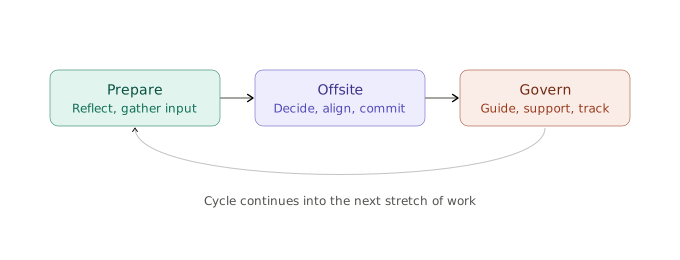
Leadership collaboration begins well before the meeting. Leaders reflect, develop points of view, gather and provide input, compare perspectives, organize and assess the team’s thinking, and arrive prepared to engage. During the offsite they collaborate intensely, synthesize perspectives, make decisions, and develop shared understanding. Afterward, ideas continue to mature, initiatives become governable implementation plans, and leaders guide, support, and govern their execution.
Most leaders develop their thinking on their own. Few have learned to become genuinely interested in how others see the same situation or to deliberately draw out one another’s thinking, compare perspectives, challenge assumptions, and build stronger ideas together. Yet that is how leadership teams develop stronger thinking. The quality of a leadership team’s decisions and actions reflects how well the team develops its collective thinking. Developing shared understanding is one of leadership’s primary responsibilities.
Alignment is Clarity Reached Jointly.
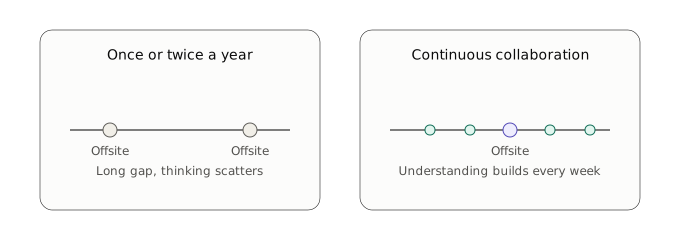
If shared understanding is what makes executive offsites valuable, why develop it only once or twice a year?
What This Looks Like
Imagine a leadership team preparing for an executive offsite to evaluate a major strategic initiative.
The relevant experience and insight already exist across the leadership team and key stakeholders, but remain distributed across people, functions, and perspectives.
Traditionally, organizations rely on interviews, workshops, surveys, and experienced facilitators or organization development professionals to draw out, organize, challenge, and synthesize that thinking. Those practices remain invaluable. The Leadership Workspace makes many of those practices continuously available, allowing leadership teams and the advisors who support them to apply them whenever they are needed, not just when an offsite is scheduled.
Leaders and key stakeholders each complete an Enterprise Change Framework in the Leadership Workspace. As they work, IVOA asks questions, offers suggestions, and helps strengthen each person’s thinking. Team members then use the Workspace to compare perspectives, explore and consolidate promising ideas, and compare those ideas with positions inferred from existing organizational materials such as the company’s website, management presentations, and strategic documents.
By the time leaders gather, they are already working from a richer shared understanding. Instead of spending much of the meeting discovering what people think, they can spend their time strengthening ideas, making decisions, and building commitment. Just as importantly, the effort required to prepare for a high-quality leadership conversation becomes low enough that organizations can convene whenever needed, not only once or twice a year.
Leadership Is Becoming More Distributed
Organizations have always sought to turn good ideas into realized benefits. Executive offsites contribute because they improve the journey from idea to benefit. They create the time and space for leaders to think together before acting together.
Today’s organizations operate in a far more distributed environment than when executive offsites first became common practice. Leadership now spans people, teams, functions, partners, technologies, and locations. As organizations become more distributed, opportunities to step away from day-to-day work and develop shared understanding together become even more valuable.
At the same time, the pace and complexity of modern organizations increasingly call for leadership collaboration to continue between meetings, carrying shared understanding into governable action. Continuous leadership collaboration has therefore become one of leadership’s defining disciplines.
Until recently, sustaining that discipline required experienced facilitators, organization development professionals, interviews, workshops, surveys, and significant preparation and follow-through. Those practices remain invaluable. They have also been difficult to apply continuously. The Leadership Workspace makes many of those practices available as part of every leadership team’s everyday way of working.
Making Continuous Leadership Collaboration Practical
Advances in AI have now made a different way of working practical. The Leadership Workspace shown in Figure 3 is available today. See how leadership teams use the Leadership Workspace to develop shared understanding, carry it into governable action, and accelerate the journey from idea to benefit in the Leadership Workspace Tour.
Just as AI is dramatically accelerating the journey from idea to product in software development, it is beginning to accelerate the journey from idea to benefit in leadership.
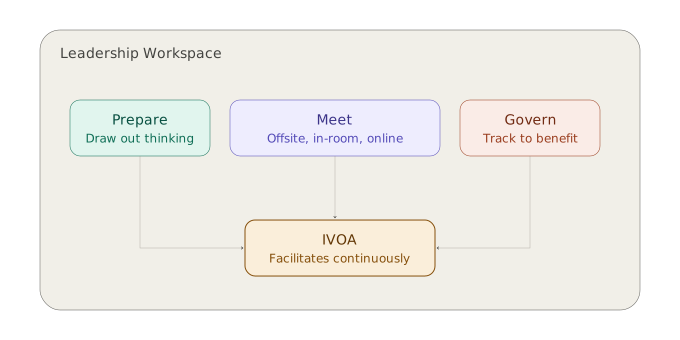
Leadership teams can now continuously develop shared understanding in a shared Leadership Workspace. Acting much like an experienced facilitator and organization development advisor, IVOA (IntelliVen Operations Advisor) helps teams draw out their thinking, develop shared understanding, and strengthen ideas as they evolve.
When leadership teams arrive at an executive offsite, they no longer begin with a blank page. Individual thinking has already been drawn out. Collective thinking has already begun to emerge. Important questions have already surfaced.
The offsite becomes an opportunity to strengthen thinking, resolve differences, make decisions, build commitment, and accelerate progress.
The Future of Leadership
When the meeting ends, the work continues. Ideas continue to mature. Initiatives evolve into governable implementation plans. Leadership teams establish the guidance, support, and governance needed to realize the benefits they seek.
Shared understanding becomes shared action.
Then something even more important begins to happen.
Leaders develop a different way of leading. They become interested in one another’s thinking. They learn to draw out perspectives, strengthen ideas, and continuously develop shared understanding.
Over time that behavior becomes habit. The habit becomes culture. Leadership collaboration becomes a continuous way of working.
Executive offsites remain one of the most valuable tools available to leadership teams. They always will.
The Leadership Workspace simply removes the offsite as the limiting factor in how often leadership teams can develop shared understanding, strengthen decisions, and carry them into governable action. Instead of concentrating much of that work into one or two events each year, leaders can now improve the journey from idea to benefit continuously.
Organizations have always competed through products, services, and strategies. Increasingly, they will also compete through how effectively their leaders develop shared understanding and carry it into action.
That capability produces what we call Structured Coherence: leaders, teams, initiatives, and governance continuously reinforcing one another through shared understanding carried into governable action.
Continue Exploring the Future of Leadership
If this perspective resonates, you may also enjoy:
- Take the Leadership Workspace Tour to see how leadership teams continuously develop shared understanding and move ideas into benefits.
- The Arc of Leadership explores why leadership itself is evolving in an increasingly distributed world.
- Manage to Lead Executive Education learn to lead the way the next generation of organizations will need to be led.