

Effective meeting management increases organization performance and efficiency. Conversely, poorly managed meetings drain resources and hinder progress. This post explores the three stages of a successful meeting, outlines key meeting roles, and provides strategies to develop and implement a robust meeting plan that enhances the likelihood of success.
Stages of an Effective Meeting
All meetings progress through three serial stages: the ramp-up, the meeting itself, and the follow-up. Successful meetings begin when they are first conceived and planning starts, and they conclude well after they are over.
Ramp-Up: Preparing for Success
The Ramp-Up gets meeting stakeholders involved so that when the meeting starts they hit the ground running. The idea is to bring to the forefront of their thinking matters which will be covered in the meeting so that they walk-in prepared, with a point of view, and ready to participate and not just wing-it, work on-the-fly or off-the-cuff.
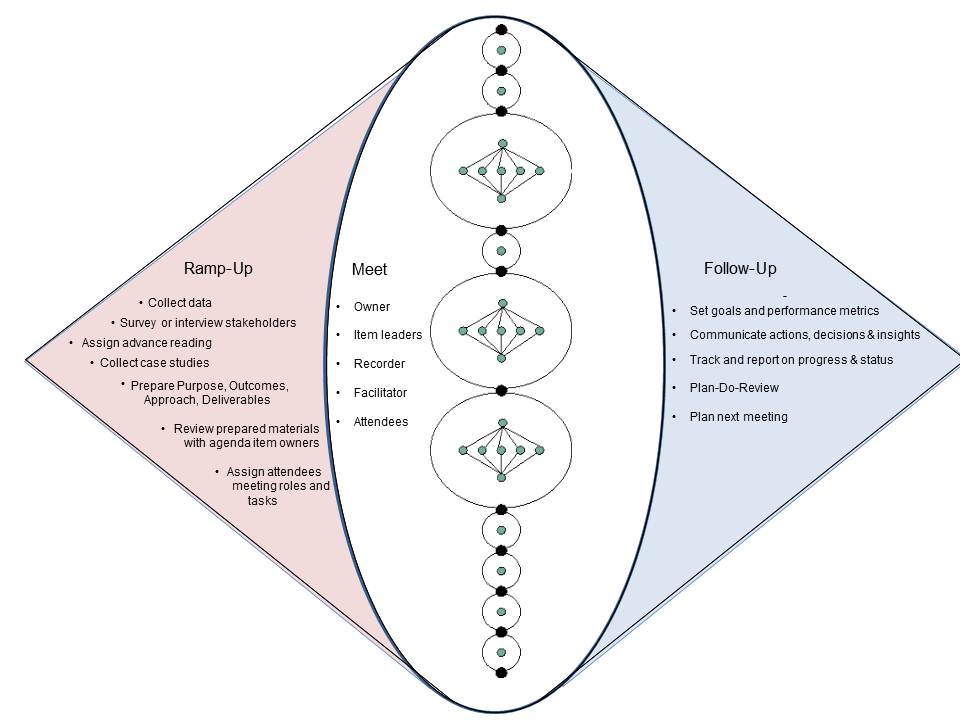
At left is Ramp-Up, where preparation happens. The central oval signifies the Meeting Itself, from start to finish. At right is Follow-Up, focusing on post-meeting actions and progress tracking.
To effectively bring attendees “into the room” before the meeting, the Meeting Owner, with assistance from the facilitator (see meeting roles below), should:
- Distribute the agenda and advance materials: Provide all participants with necessary documents and information ahead of time. This allows them to read, reflect, and formulate their thoughts. While not everyone may review all materials, those who do will set a standard, encouraging others to prepare to avoid appearing unprepared.
- Collaborate with agenda-item owners: Meet with those responsible for specific agenda items to review draft materials and ensure alignment with the meeting’s objectives. This increases the likelihood of achieving superior results by making sure each segment is on track to contribute effectively.
- Share the POAD (Purpose, Outcomes, Agenda, and Details): Invite attendees to comment on agenda items, suggest additional topics, and share insights on key issues. This fosters a sense of ownership and commitment to the meeting’s success, motivating participants to engage proactively.
Many meetings are part of a recurring series focused on specific subjects like managing a business unit, product, client relationship, or functional area (e.g., sales, marketing, development). Consistent excellence in preparation, facilitation, and follow-through across these meetings drives significant progress toward organizational goals.
The illustration below graphically depicts such a series of

meetings on a single subject such as product status meetings, a monthly Managers Meeting, quarterly Client Account reviews, weekly Strategic Initiative reviews, Policy Committee meetings, and All Hands meetings.
The idea is to see each meeting not as an isolated event but as integral to building on the one before and feeding the next. In this way a series of meetings provides a solid foundation for governance to ensure top performance on any aspect of operations.
Key Roles in Effective Meetings
Assigning clear roles is essential for the success of any meeting. While some individuals may fulfill multiple roles (e.g., the Scheduler might also be the Meeting Owner), certain roles are best performed by separate people. For instance, it’s challenging for one person to effectively serve as the Owner, Facilitator, and Recorder simultaneously.
Owner
The Owner initiates the meeting and is primarily responsible for defining its Purpose, Outcomes, Approach, and Deliverables (POAD). They develop the agenda, coordinate content and handouts, and ensure the meeting record is published upon completion.
Scheduler
The Scheduler handles the logistical aspects of the meeting. They schedule the meeting at a time that accommodates all required attendees, prepare the meeting space with necessary equipment and refreshments, and provide administrative support as needed.
Facilitator
The Facilitator works closely with the Meeting Owner to understand their objectives and ensures those goals are met during the meeting. They keep the meeting on track and on time, enforce agreed-upon ground rules, and foster an environment conducive to productive discussion.
Recorder
The Recorder documents action items, key insights, and decisions on a shared display visible to all participants during the meeting (e.g., whiteboard, flip chart, projector). After the meeting, they distribute a draft of the meeting record and assist the Meeting Owner in finalizing and distributing the official summary. (See the sample Meeting Record Template.)
Required Attendees
These are the individuals who must attend the meeting. If any required attendee cannot be present, the meeting should be rescheduled to ensure their participation. Some required attendees may also be responsible for preparing and presenting material during the meeting.
Optional Attendees
Optional Attendees are invited but their presence is not critical for the meeting to proceed. They may choose to attend based on their interest and availability.
Monitor
The Monitor observes and tracks individual and group behaviors relative to the agreed-upon meeting ground rules (see below). They provide feedback to help the group maintain effective meeting dynamics.
Craft A Meeting Plan
A successful meeting starts with a well-defined plan. The Meeting Owner, often collaborating with a Facilitator, trusted advisor, or key attendees, should document the meeting’s Purpose, Outcomes, Approach, and Deliverables (POAD).
Every meeting worth having should have a POAD. By preparing and sharing a document that elaborates on each section, you set clear expectations and guide participants toward achieving the desired results.
Being clear about your objectives dramatically improves the odds of attaining them. A well-defined POAD articulates exactly what you want from the meeting, significantly increasing the likelihood of success. Once the POAD is prepared, effective orchestration will lead to meeting success.
See Executive Session POAD for an example.
Purpose
The Purpose section explains why the meeting is being held, ensuring that attendees understand the reason for their participation both individually and as a group. To articulate the purpose effectively, complete the following sentence with as much specificity as possible:
“The purpose of the meeting is to...”
|
Purpose Examples |
The following examples finish the sentence above:
|
Outcomes
Targeted outcomes can be either hard or soft:
- Hard outcomes are tangible results you can see or touch, such as a decision made, a document produced, or a list compiled.
- Soft outcomes involve feelings or thoughts, like participants leaving the meeting feeling energized, motivated, or with a shared understanding.
To define targeted outcomes, answer the question:
“At the end of the meeting, what needs to occur for it to have been time well spent?”
Guidelines for Defining Outcomes:
- Ensure the meeting outcomes support and advance the broader objectives of the organization.
- Focusing on a concise list keeps the meeting targeted and manageable.
- Present the outcomes visibly during the meeting to encourage discussion and agreement among participants.
|
Hard Outcome Examples
|
|
|
Soft Outcome Examples |
|
Approach
The Approach outlines the steps the meeting will follow to accomplish its Purpose and achieve its Outcomes. It encompasses not only the agenda items during the meeting but also the actions taken before and after to ensure success.
Each element of the Approach should include:
- Link to Purpose and Outcomes: Clearly connect each step to the meeting’s objectives.
- Assigned Responsibility: Identify who is responsible for each task to ensure accountability.
- Topic and Leader: Specify the subject matter and the person leading that segment.
- Timing: Indicate the start and end times for each agenda item to keep the meeting on schedule.
- Related Materials: Provide any documents or resources needed for that segment.
Characteristics of a Well-Planned Agenda:
- Balanced Topics: Mix high-energy items with more intensive discussions to maintain engagement.
- Time for Thoughtful Discussion: Allocate sufficient time for in-depth dialogue on important issues.
- Scheduled Breaks: Include breaks in longer meetings to keep participants refreshed.
- Clear Expectations: Clarify whether each agenda item is to inform, generate input, or reach a decision, so attendees know how to engage.
Deliverables
Good meetings produce specific deliverables that feed back into the organization, enhancing operations in meaningful ways. Examples of deliverables include:
- Clarified Responsibilities: A clear understanding of who executive team members rely on for specific tasks.
- Promotion Decisions: A definitive decision on whom to promote within the organization.
- Client Outreach Plan: A list of important calls to make to existing clients, along with scripted messages for each.
- Prospect Engagement Strategy: Detailed plans outlining who will speak with key prospects, about what topics, how the conversations will be conducted, and when.
- Design Implementation Approach: An agreed-upon approach for implementing a key new feature.
Tips to Enhance Meeting Effectiveness
Implementing the following tips can significantly improve the quality and outcomes of your meetings:
- Ensure your meeting does not under-perform for one of these eight specific reasons.
- Reflect the organization’s desired culture in all phases of the meeting to reinforce values and expected behaviors.
- Start the meeting with a check-in and ice-breaker to bring attendees “into the room” mentally and help them become comfortable with one another.
- Agree on a signal—such as raising a hand or turning a nameplate on end—to indicate a desire to contribute, ensuring orderly and inclusive participation.
- Establish a discreet signal for attendees to point out when ground rules are being violated, promoting self-regulation and adherence to agreed-upon norms.
- Arrive before the meeting starts and stay after it ends to take advantage of important informal interactions that can enhance relationships and understanding.
- Begin the meeting promptly, even if not all attendees are present, to show respect for those who are punctual and to emphasize the importance of timeliness. End the meeting at the scheduled time to honor participants’ commitments.
- Consider implementing punctuality incentives, such as a small penalty for late arrivals, to encourage timeliness and reinforce the value of everyone’s time.
- If the meeting is scheduled during a meal time, provide food or inform attendees in advance to bring their own, eat beforehand, or plan to eat afterward.
- Continuously monitor the meeting’s progress. The Meeting Owner and Facilitator should assess whether the meeting’s Purpose and Outcomes are on track, steering the discussion accordingly and adjusting the agenda if necessary to focus on achieving the most critical goals.
Open the Meeting
At the start, the meeting Owner, with the Facilitator, should:
- Welcome Attendees and thank them for coming.
- Introduce the Recorder and Facilitator.
- Review the agenda. Be sure Attendees understand what is coming and give them a chance to ask questions and propose last minute upgrades.
- Review the targeted Outcomes.
- The Owner starts the meeting but does not dominate it.
Guide Meeting
- If the meeting is one of a series, set the context, summarize the work of previous meetings, and review the status of key action items, results, and impacts.
- Keep discussion focused on planned agenda items. Use a “parking lot” on a shared-display (news print, white board, etc.) to record topics or comments not on agenda for later processing.
- Look to the Facilitator to make adjustments if conversation gets off track or loses steam and to watch the clock and keep on schedule.
- Ask attendees how to handle unexpected circumstances and needs such as breaking from the agenda or overrunning the meeting end time.
Ground Rules
At the beginning of each meeting the facilitator asks the group to agree on and commit to follow meeting ground-rules (see: Post on Meeting Ground-Rules). Add or adjust rules as appropriate to give power and ownership to the group and to accommodate special circumstances. Appoint an attendee to monitor performance relative to the ground-rules. If a rule violation occurs, agree on whether and how the monitor should intervene; e.g., by flashing a signal (for example, holding up a yellow card).
If the Monitor fails to intervene when a violation occurs, the group brings it to the Monitor’s attention and asks them to follow the agreement. If the Monitor does not agree or consistently fails to perform the function, the role should be reassigned. If a single person gets more than three exceptions, they may be asked to leave the meeting. If they fail to leave, the meeting may be adjourned at the discretion of the group and or the meeting Owner.
Close the Meeting
Effectively closing a meeting is as crucial as its preparation and execution. Consider these guidelines to ensure a strong and productive conclusion:
- Respect everyone’s schedule by concluding at the agreed-upon time. Summarize the meeting’s successes to leave participants feeling positive and energized.
- Before adjournment, have the Recorder read the key decisions, insights, and action items captured during the meeting. This ensures all attendees agree on what was discussed and committed to.
- Clearly outline the next steps, specifying who is responsible for each action item and the expected completion timelines.
- Schedule the follow-up meeting while all key participants are present to ensure maximum attendance and continued momentum.
- Inform attendees when they will receive the draft and final versions of the meeting record, so they know when to provide feedback and when to act on the finalized plans.
- Decide how attendees should discuss the meeting with others in the organization. Establishing a consistent message maintains clarity and prevents misinformation.
Follow-Up: Ensure Actions Lead to Results
A meeting’s success doesn’t end when attendees leave the room; the Follow-Up stage is crucial for translating decisions and action items into tangible results that enhance organization performance. Effective follow-up ensures that all agreed-upon tasks are completed, maintaining momentum and accountability.
Key Steps in the Follow-Up Process:
- Distribute the Meeting Record Promptly
- The Recorder works closely with the Meeting Owner to document action items, key insights, and decisions during the meeting using a shared display visible to all participants (e.g., whiteboard, flip chart, projector). Together, they compile and edit the meeting notes to ensure all critical information is accurately captured.
- Within a few days after the meeting, the finalized meeting notes are distributed to all attendees using the Meeting Record Template. It’s important to note that the meeting record does not need to include who said what during the discussions. Instead, it should focus on recording the key decisions made, insights gained, and action items agreed upon during the meeting.
- Assign Action Items Clearly
- Ensure each action item has a clearly assigned owner who is accountable for its completion.
- Agree on timelines that are achievable and aligned with organizational priorities.
- Identify any support or resources needed to accomplish the tasks.
- Monitor Progress Regularly
- Set up brief meetings or status updates to review progress on action items.
- Implement project management tools or dashboards to monitor the completion of tasks.
- Foster an environment where team members feel comfortable discussing obstacles or requesting assistance.
- Provide Support and Guidance
- The Meeting Owner and Facilitator should remain accessible to provide guidance, clarify expectations, and assist with challenges.
- Encourage collaboration among team members to utilize diverse skills and expertise.
- Acknowledge and Celebrate Achievements
- Acknowledge when action items are completed to reinforce positive behavior and motivate the team.
- Highlight how the completed actions contribute to organization performance and goals.
Meeting Follow Up Culture
Viewing each meeting as part of an ongoing process rather than an isolated event reinforces the importance of follow-up. Consistent and diligent follow-up:
- Establishes a culture where commitments are taken seriously, and individuals are responsible for their contributions.
- Keeps everyone informed and aligned, reducing misunderstandings and duplicated efforts.
- Ensures that decisions lead to actions, and actions lead to measurable improvements in operations.
See Also
For a more comprehensive coverage of how to have a great meeting please also see How to Make Meetings Work, by Michael Doyle and David Straus.