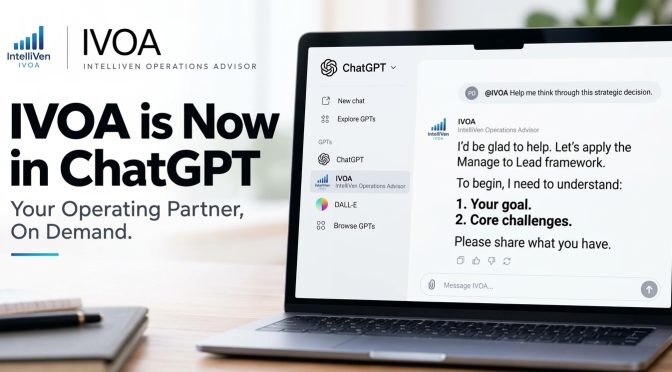
An on-demand thinking partner that brings proven operating experience and Manage to Lead methods directly into ChatGPT.
OpenAI has approved IntelliVen Operations Advisor (IVOA) for public availability as a ChatGPT plugin. Leaders, teams, coaches, and consultants can now access and apply IntelliVen’s Manage to Lead (MtL) knowledge, methods, templates, tutorials, and rubrics directly in their ordinary ChatGPT conversations.
Leaders regularly face consequential decisions, challenging problems, and opportunities when designing, building, running, growing, governing, or changing a business. Having an experienced operating partner who can challenge assumptions, test ideas, ask questions that might otherwise go unasked, and help turn good thinking into effective action can make a big difference.
IVOA is like having a senior operating partner at your side, available whenever you need a thinking partner. It draws on IntelliVen’s Manage to Lead system, developed by codifying the practices and lessons learned from more than a dozen highly successful operating executives. IVOA makes accumulated operations knowledge, experience, and discipline accessible through ChatGPT to help leaders, coaches, and those who support them work through difficult issues, improve plans and work products, make better decisions, and determine what to do next.
IVOA is even more useful when working with others. It helps team members develop their thinking independently, compare perspectives, identify and resolve consequential differences, and agree on direction and plans. It also helps teams establish the practices needed to guide, support, and govern performance.
Whether working alone or with others, IVOA helps leaders get clear about what they aim to accomplish, align on where they stand now, and put in place the plans and practices needed to drive performance.
When to Use IVOA Instead of ChatGPT Alone
ChatGPT provides broad general intelligence and is useful for a wide range of management and leadership work.
IVOA adds IntelliVen’s integrated Manage to Lead knowledge, methods, logic, and discipline. It brings together the templates, tutorials, and rubrics developed and refined through years of experience leading organizations and working with executive teams.
IVOA applies these methods to help users:
- Make assumptions explicit and distinguish evidence from inference.
- Evaluate work against established criteria and identify how to improve it.
- Compare independent points of view without losing consequential differences.
- Translate intended outcomes into plans, initiatives, and measures.
- Prepare for the reviews and conversations through which leaders guide, support, and govern performance.
The aim is to help leaders develop better thinking, produce better work, and make better decisions, together.
Use ChatGPT for general intelligence. Invoke IVOA when you want that intelligence disciplined by Manage to Lead.
Five Ways to Put IVOA to Work
IVOA explains its methods and helps you apply them to real situations as you work. Here are five practical examples.
Get Clear About Purpose
IVOA can help articulate an organization’s purpose by clarifying what it provides, who it serves, and the problem or need its offering addresses for those people.
Give IVOA a website, management presentation, or other source material and ask it to infer a draft WHAT-WHO-WHY. Compare that with the team’s own versions to surface agreement, gaps, and important differences. Then ask IVOA to suggest a consolidated version that reflects the strongest shared thinking while preserving consequential differences for the team to resolve.
Try asking:
@IVOA Infer our WHAT-WHO-WHY from our website. Explain your reasoning, identify your assumptions, and suggest what we should clarify or improve.
You can also give IVOA a draft Mandate and ask it to assess the organization’s intended direction and performance expectations against the Manage to Lead rubric.
Improve Leadership Work with MtL Rubrics
IVOA can assess WHAT-WHO-WHY statements, Mandates, Change Frameworks, and other leadership work products.
It applies relevant MtL rubrics, explains its assessments, and recommends improvements.
Try asking:
@IVOA Assess this Mandate using the Manage to Lead rubric. Score it, explain your assessment, and suggest the changes that would most improve it [entered mandate].
Revise the work and ask IVOA to assess it again. Repeat until you are ready to share it with others.
This makes IVOA useful as an iterative thinking partner, helping leaders prepare stronger work before bringing it to their teams.
Compare Perspectives and Build Alignment
One of IVOA’s most useful applications is to compare and synthesize independently prepared input from multiple people.
Suppose six executives each prepare their own description of what the organization should accomplish, or the attributes they want in their next CEO.
Give their submissions to IVOA and ask it to identify agreements, differences, additional considerations, and issues requiring resolution.
Try asking:
@IVOA Compare these six independently prepared descriptions of the attributes we want in our next CEO. Identify where they agree, where they materially differ, and suggest a consolidated version. Preserve consequential disagreements for the team to resolve: [enter descriptions in sequence or in a table or screen shot]
The same approach works with WHAT-WHO-WHY, Mandates, Change Frameworks, Mirror input, team priorities, and other structured leadership work.
Alignment comes from making differences visible and resolving the ones that matter.
IVOA helps teams prepare for those conversations and make better use of the time they spend together.
Plan and Implement Change
IVOA can help leaders determine how to move from their current situation (NOW) to a desired future (NEXT).
Using Manage to Lead Enterprise and Initiative Change Frameworks, IVOA helps identify promising initiatives, intended outcomes, actions, measures, ownership, and checkpoints.
After entering WHAT-WHO-WHY, Mandate, and ECF, try asking:
@IVOA Given our WHAT-WHO-WHY, Mandate, and current situation, suggest initiatives that could help us move from NOW to NEXT. Explain your reasoning and help us evaluate which initiatives offer the greatest value.
Once an initiative is selected, IVOA can help develop its Change Framework, implementation plan, measures, and milestones.
Guide, Support, and Govern Performance
Developing a good plan is only part of the job. Leaders must also help their teams carry it out, learn from experience, address obstacles, and adjust course.
IVOA can help prepare and improve materials for operations reviews, leadership meetings, and initiative checkpoints.
It can also turn meeting transcripts into concise records of decisions, insights, actions, owners, and matters requiring follow-up.
Try asking:
@IVOA Help our executive team establish an ongoing review process for our functions, markets, and strategic initiatives. Recommend who should meet with whom, about what, when, and how progress should be reviewed.
IVOA can help make the practices of ongoing management and governance more systematic and effective.
How to Install and Use IVOA in ChatGPT
OpenAI has approved IVOA for public availability through the ChatGPT Plugin Directory.
To get started:
- Open the IVOA plugin page.
- Select Install plugin.
- Return to an ordinary ChatGPT conversation.
Once installed, ChatGPT automatically uses IVOA when it determines that its specialized knowledge is relevant to your request. You can also invoke IVOA explicitly whenever you want Manage to Lead knowledge, methods, and logic applied to the response.
To invoke it, type @IVOA in the ChatGPT message box, select IntelliVen Operations Advisor from the displayed options, and continue with your request.
For example:
@IVOA Help me improve this strategic plan: [enter or upload strategic plan]
You do not need to invoke IVOA for every follow-up in a continuing conversation when the context is clear. But explicitly calling it removes ambiguity about whether you want Manage to Lead guidance.
IVOA and the Leadership Workspace
The IVOA plugin makes Manage to Lead guidance broadly accessible to individuals working in ChatGPT.
For leadership teams doing substantial work together, IntelliVen also provides the Leadership Workspace.
IVOA helps you think. The Leadership Workspace helps a team codify, compare, refine, communicate, and maintain its shared thinking.
An individual can use IVOA in ChatGPT to work through a leadership challenge, develop ideas, and improve work products.
The Leadership Workspace provides a persistent, shared environment where team members independently prepare their thinking, compare submissions, reconcile differences, and maintain the agreements they reach.
It supports WHAT-WHO-WHY, Mandates, Enterprise and Initiative Change Frameworks, team scoring, measures, and other shared leadership work.
IVOA is also available within the Workspace, where its guidance can be applied to the team’s accumulated organizational context and work products.
Together, they help teams establish and maintain the habits and practices of Manage to Lead.
See How Leadership Teams Build and Maintain Shared Clarity for an introduction to the Workspace and how teams use it.
Try IVOA on Something You Are Working on Now
The easiest way to appreciate what IVOA can do is to use it on something you are working on now.
Start with a Mandate, strategic plan, Change Framework, meeting agenda, or leadership question. Ask IVOA to assess your thinking, identify what deserves attention, and help you make progress.
If you would like to learn more about IVOA, Manage to Lead, or how the Leadership Workspace can support your team, please get in touch.
And if you use IVOA, I would very much like to hear what works, what does not, and what you wish it could do. Your experience and suggestions will help guide its continued development.
Peter DiGiammarino
IntelliVen, L.L.C.
Get Clear. Align. Grow. Together.
IVOA Frequently Asked Questions
What is IVOA?
IVOA is IntelliVen Operations Advisor, a ChatGPT plugin that applies Manage to Lead methods, templates, tutorials, and rubrics to leadership, operations, and governance work.
How do I install IVOA?
Follow the public IVOA plugin link and select Install plugin.
How do I use IVOA in ChatGPT?
ChatGPT may invoke IVOA automatically when relevant. To call it explicitly, type @IVOA and then enter your request.
Do I need to use @IVOA for every prompt?
No. ChatGPT can continue using the context of an ongoing conversation, but using @IVOA makes it explicit that you want Manage to Lead guidance applied.
What can IVOA help with?
Among other things, IVOA can help develop and assess WHAT-WHO-WHY, Mandates and Change Frameworks; consolidate team input; apply MtL rubrics; and extract decisions and action items from meeting transcripts.
How can my leadership team use IVOA together?
IVOA can help individual leaders and teams think through issues, assess work, consolidate perspectives, and apply Manage to Lead methods. For teams that want a structured place to develop and maintain shared thinking, the IntelliVen Leadership Workspace provides a collaborative environment for WHAT-WHO-WHY, Mandates, Change Frameworks, initiatives, measures, team input, and related leadership work.
Learn about the Leadership Workspace
Where can I learn how to use Manage to Lead?
IntelliVen offers Manage to Lead training for leaders and leadership teams. Participants learn the habits, practices, tools, and governance methods behind IVOA and apply them to real organizational work.
IVOA can then serve as an ongoing advisor as those methods are put into practice.
Learn about Manage to Lead training
Can IntelliVen help our team apply these methods?
Yes. IntelliVen works with CEOs and leadership teams through coaching, consulting, team alignment, strategy and planning sessions, and ongoing operating and governance support.
IVOA and the Leadership Workspace support the work, but the objective is the same: help leadership teams get clear, align, and grow together.