

Blog

Revenue Leads Expenses

By Peter DiGiammarino

Most leadership teams know the problem. They set an annual revenue target, build spending around it, and move forward as if the planned revenue inflow is already on its way. If revenue later develops more slowly than hoped, the organization is forced to pull back, delay hires, cut initiatives, and explain why the original plan … Continue reading Revenue Leads Expenses

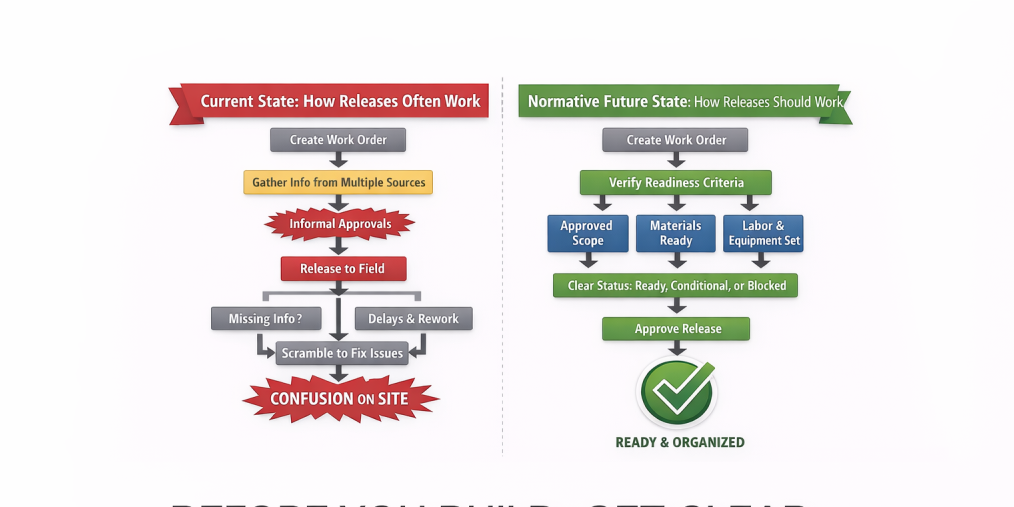
Before You Build, Get Clear

By Peter DiGiammarino

Before You Build, Get Clear AI makes it easier than ever to build, prototype, and automate. It does not make it any less important to think. When the cost of building drops, the cost of building the wrong thing rises. Remember Peter Drucker’s aphorism that ends wtih “… are you doing the right thing?” That is … Continue reading Before You Build, Get Clear

Finding the CEO for What Comes Next

By Peter DiGiammarino

An IntelliVen Insight by Eric Palmer. AI is not a feature cycle. It is a reset of SaaS economics. Eric Palmer, a highly successful Senior Operating Partner with more than 30 years of experience leading private, public, private equity-owned, and venture-backed companies, recently shared what he is seeing across  software businesses. Eric uses and has … Continue reading Finding the CEO for What Comes Next

Time Horizon Discipline

By Peter DiGiammarino

Leaders often say: “We don’t have enough time.” “We’re far from our goals.” “Everything feels urgent.” Most of the time, the issue is not time. It is a mismatch between the decision and the planning horizon. Manage to Lead is built on clarity and disciplined change. Time horizon discipline is part of that clarity. Different … Continue reading Time Horizon Discipline

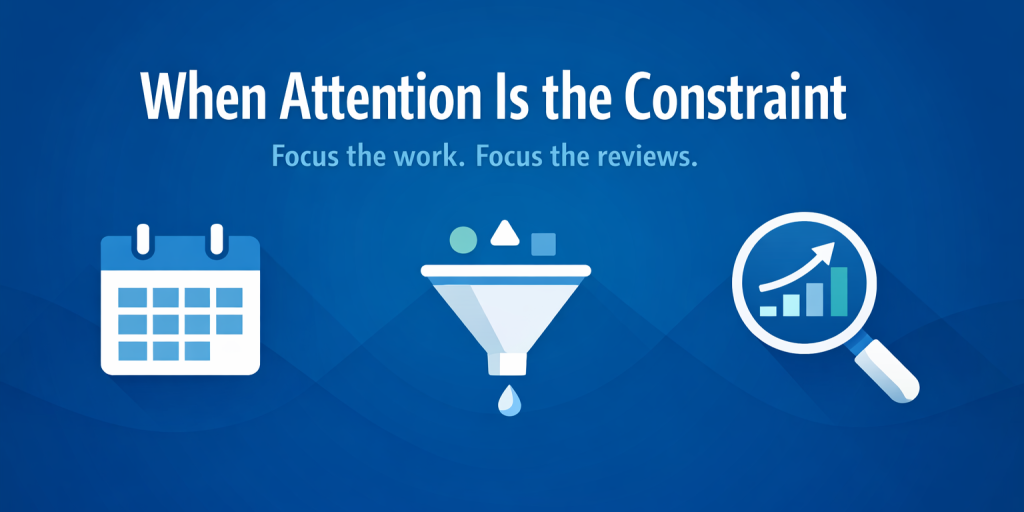
When Attention Is the Constraint, Focus the Work and the Reviews

By Peter DiGiammarino

Most things go wrong because leaders are spread too thin, not because the work is impossible. When the volume of initiatives outstrips reviewer capacity, important items get little or no attention. Meetings slip. Mental presence drops. The fix is to match what we take on to the attention we can invest, and to raise the … Continue reading When Attention Is the Constraint, Focus the Work and the Reviews

The Architecture of Resilience: How Early Labor Silences Fear in High-Stakes Leadership

By Peter DiGiammarino

By: Richard Block From a very early age, working was a given. It was simply what you did. In reflecting on these early experiences and contrasting them with the lives of my children and grandchildren, I see a significant divide. The loss isn’t just in the paycheck; it is in the “patterns of behavior” that … Continue reading The Architecture of Resilience: How Early Labor Silences Fear in High-Stakes Leadership

From Tool to Teammate: Six Practices That Make AI Work for Us

By Peter DiGiammarino

At IntelliVen, we work from a defined body of leadership and management practice: the Manage to Lead (MtL) System. It is documented in our text, taught in our classes, and organized into more than sixty tools and templates and 70 insights and tutorials. We use these tools every day with clients and trainees and we are … Continue reading From Tool to Teammate: Six Practices That Make AI Work for Us

When there’s no right answer: get input, get commitment, then decide

By Peter DiGiammarino

Calls about who the team counts on for what are hard. Leaders worry about making valued people feel overlooked or diminished. Direct reports mostly want clarity, fair reasoning, and as much scope and recognition as they can reasonably earn. This post offers a way to handle those tensions: get input one-on-one, secure commitment to support … Continue reading When there’s no right answer: get input, get commitment, then decide

Say the Same Words. Mean the Same Things.

By Peter DiGiammarino

Walk into almost any leadership meeting and you will hear the same words: Vision. Strategy. Mandate. Values. Culture. Everyone nods. Everyone is confident they understand. Then you listen a little longer and realize something important: People are using the same words to mean different things … and different words to mean the same things. That … Continue reading Say the Same Words. Mean the Same Things.

Steering Committees: Engaging Stakeholders for Guidance, Commitment, and Growth

By Peter DiGiammarino

Note: A complementary reading for MtL Module 8 Get Help Leaders who “get help” know success comes not from going it alone but from surrounding themselves with structures that strengthen thinking, accountability, and action. In Manage to Lead, we emphasize the value of an Accountability Board, Advisory Board, Coach, and Peer Group. There is another … Continue reading Steering Committees: Engaging Stakeholders for Guidance, Commitment, and Growth

How organizations evolve.

By Peter DiGiammarino | June 1, 2012

There are three to keep in mind with respect to how organizations evolve. There Is No One Right Organization The organization that will work is the one a group decides to make work, after much study and debate, despite its flaws. It is easy to make any organization fail. It is harder to make one … Continue reading How organizations evolve.

How to make sure every top team member does one thing right.

By Peter DiGiammarino | May 30, 2012

CEOs should consider the following when assigning tasks to leadership team members: Members of the leadership team are likely to be the most capable people in the organization and therefore among the most important to deploy optimally. Each needs to be especially clear about what is most important for them to do and then spend … Continue reading How to make sure every top team member does one thing right.

Role Clarity

By Peter DiGiammarino | May 24, 2012

The CEO of a successful organization ensures that their inner circle of leaders, or Core Leadership Team, are individually and collectively clear about their relative strengths and on what the group counts on from each of them to be successful. The exercise below is a structured and straightforward way to make expectations explicit and to … Continue reading Role Clarity

Form a Core Leadership Team to guide and drive peak performance.

By Peter DiGiammarino | May 23, 2012

No one leader, and not even any two, has the breadth of competence and depth of capacity to do anything of much significance alone. Successful organizations usually have a core leadership team of three to seven top executives who are diverse in terms of skills, perspective, and experience yet aligned in an unyielding pursuit of … Continue reading Form a Core Leadership Team to guide and drive peak performance.

How to increase the accuracy of revenue forecasts.

By Peter DiGiammarino | May 14, 2012

Revenue Forecasts asserts that a certain amount of revenue will be earned in a certain period of time with a certain probability that the actual revenue earned in the period will be within a certain tolerance of the forecast.  For example, management may forecast that there is a 90% chance of actual revenue being not … Continue reading How to increase the accuracy of revenue forecasts.

How to get, and stay, in control of operations.

By Peter DiGiammarino | May 10, 2012

Leaders who are in control of operations compare their organization’s actual performance results to: Past results to know whether their organization is trending up, down or sideways. The results other organizations that are doing things similar to theirs achieve in order to know how well they are doing relative to industry benchmarks, especially relative to … Continue reading How to get, and stay, in control of operations.

Personal Alignment

By Peter DiGiammarino | May 7, 2012

Great leaders learn what each direct report likes to do and what s/he is good at doing in order to help each decide to want to do what s/he is good at and likes doing. It is worth the considerable effort and thoughtful analysis required because it increases the odds of executive engagement, happiness, and high-performance . … Continue reading Personal Alignment

Know the definition of strategy to help everyone stay on the same page.

By Peter DiGiammarino | May 6, 2012

The following are definitions of phrases that use the word strategy. They provide a useful way to think about the term and matters directly related to it: Strategy is what people in an organization plan to do in order to “win” whatever game they are playing. Strategic thinking is how decisions and actions are made … Continue reading Know the definition of strategy to help everyone stay on the same page.

UMass Commonwealth Honors College Awards Presentation Dinner Speaker

By Peter DiGiammarino | May 4, 2012

UMass Commonwealth Honors College Awards Presentation Whether on campus or in the workplace, effective leadership involves seven disarmingly simple truths, says alumnus Peter F. DiGiammarino ’75. As the Eleanor Bateman Alumni Scholar in Residence for spring 2012, DiGiammarino led two events during which he offered advice on becoming an effective leader. Leaders, he explained, “get loose.” Top … Continue reading UMass Commonwealth Honors College Awards Presentation Dinner Speaker

University of Massachusetts 2012 Bateman Scholar in Residence Public Lecture

By Peter DiGiammarino | April 28, 2012

At University of Massachusetts 2012 Bateman Scholar Public Lecture, IntelliVen founder and CEO PeterD presented a 45 minute lecture that summarizes 35 years of insight gleaned from successfully helping dozens of organizations get on track to long-term growth and performance, generally in the role of leader or an adviser to the founder, owner, investor, and/or the CEO of … Continue reading University of Massachusetts 2012 Bateman Scholar in Residence Public Lecture

Five Questions to Outline Organization Strategy

By Peter DiGiammarino | April 10, 2012

WHAT IS STRATEGY? There are many ways to use the word strategy and it conjures up different things for different people in different contexts. What for example is the difference between strategic thinking and a strategic initiative and strategic planning? (For an answer see this taxonomy of strategic terms.) Leaders who are asked: “What is your strategy?” … Continue reading Five Questions to Outline Organization Strategy

How leaders should think about the importance of determining what is most important to change next.

By Peter DiGiammarino | April 4, 2012

Over time, organizations perform at some level.  After start-up things fall into place leading to a period of rapid growth. The rate of growth eventually slows and then plateaus perhaps due to new technology that spawns competition or maybe due to the organization slowing down in the face of its increased scope, scale, and complexity … Continue reading How leaders should think about the importance of determining what is most important to change next.