
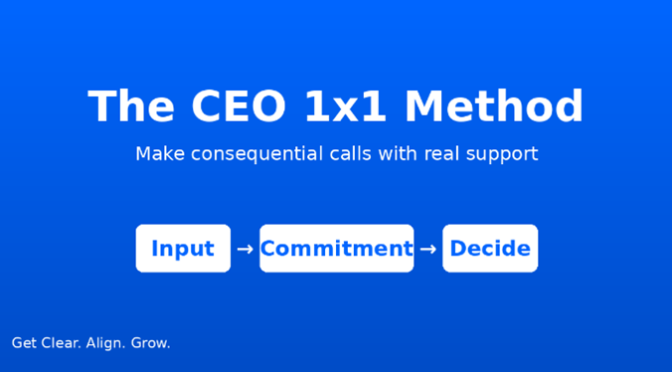
Calls about who the team counts on for what are hard. Leaders worry about making valued people feel overlooked or diminished. Direct reports mostly want clarity, fair reasoning, and as much scope and recognition as they can reasonably earn. This post offers a way to handle those tensions: get input one-on-one, secure commitment to support the outcome, then decide and lead alignment.
Before you decide on a consequential call about who the team counts on for what, check in one-on-one with those who will be most impacted. Use these 1x1s to get their best thinking and secure an explicit commitment to support the outcome, whichever way you go. Then decide, own it, and lead everyone to align and execute. Remember: there is no single “right” organization. What works is what your team commits to make work. Don’t chase the perfect answer; make a sound call and then make the call right.
Start each 1×1 by setting context. Explain the decision you have to make and why it matters now. Ask them to set aside self‑interest and give you their best view of what to do and why. Probe for what you may be missing, the main risks, and how they would mitigate them. Listen hard. You are not asking them to decide for you; you are gathering the input you need to make the decision you are accountable to make.
Close every 1×1 with a clear ask for commitment to support whatever you decide. Say plainly that it is your job to decide and that, when you do, you expect full support either way. Make sure they know that support means words and deeds, in the room and outside the room. If they hesitate, stay with it. Surface concerns now, while you can still use them. If after a real conversation they cannot commit, that is useful data about whether they are on this team for this next phase.
After you decide, announce the decision and the reasoning at a level that lets reasonable people understand how you got there. Remind the team of the commitments made in 1x1s. Set the expectation that leaders will be visibly and consistently supportive, especially when they share the decision with their teams. Organizations change best slowly because change is hard on people, so favor steady, incremental moves and keep everyone clear on what is happening, why, and what you need from them. Sometimes it is better to roll out a major change as a series of smaller changes over a longer period.
If support slips, use a three‑step response that matches the moment:
- First slip: private reset. Meet one-on-one to reaffirm the decision and what support looks like—words and deeds, in the room and outside the room. Ask for explicit recommitment. If they hesitate, stay with it. Surface concerns now, while you can still use them. Leave with a clear “yes.”
- Second slip: public correction. In the moment and in front of others, restate the decision and the expectation to align. Keep it short, neutral, and firm. Move the conversation back on track.
- Third slip: in or out. Meet privately, with your inner circle if helpful, and make the choice explicit: be fully in and support the path we chose, or step out. This is about whether they are part of the team that moves forward in a specific way. If not, help them out.
Two mindsets make this work. First, own the call. Do not attribute the decision to advisors, the board, or the market. Once you know, own it. Second, get help without becoming dependent on it. Invite strong input and dissent, and then decide. Disagreement before the decision is input. After the decision, alignment is the standard.
How organizations evolve
Organizations are not fixed. Treat structure and roles as means to an end, and expect them to change as you grow.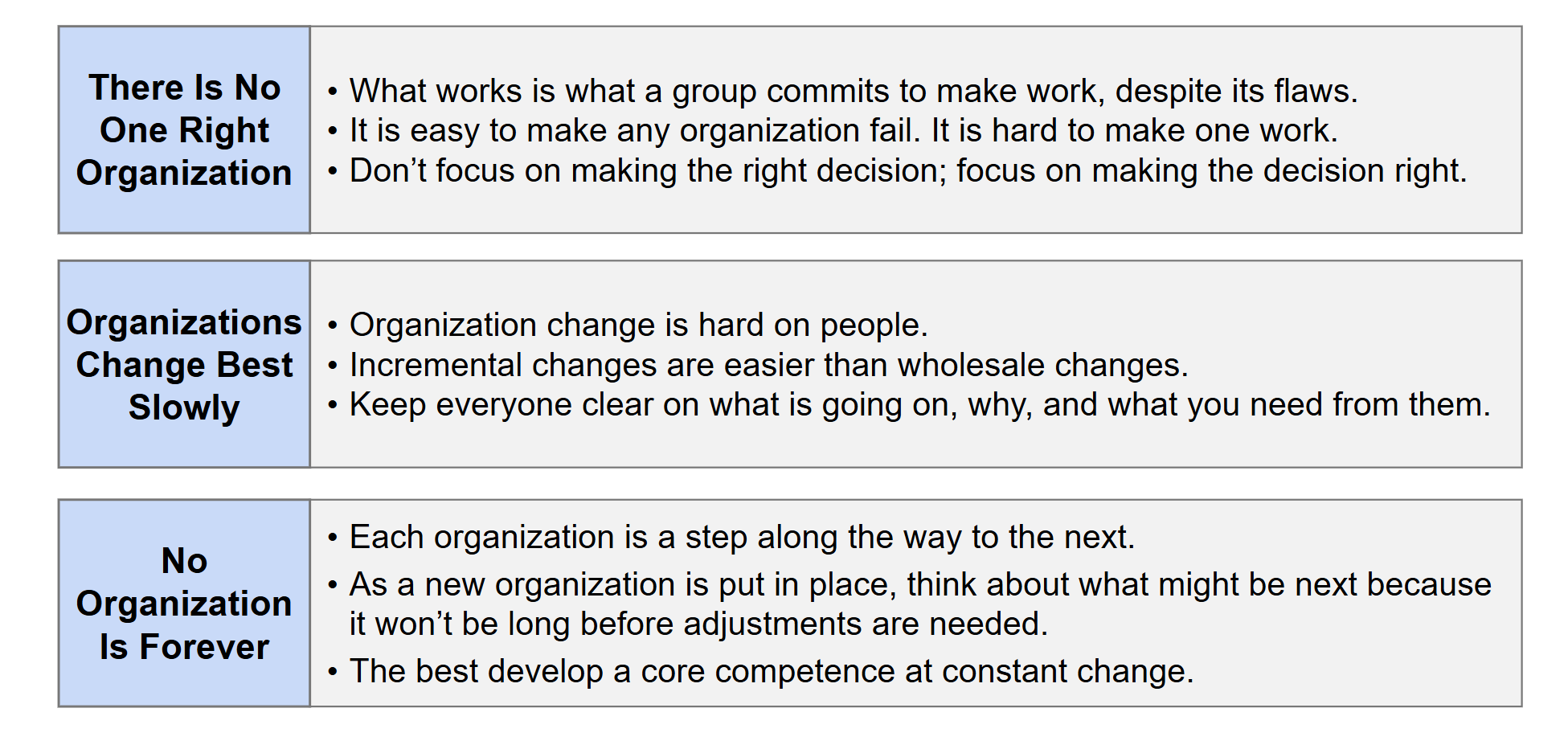 A short script you can adapt
- “I need to make this decision. Before I do, give me your best thinking—what do you recommend and why? What am I missing? When I decide, can I count on your full support either way?“
- “If you can’t commit, tell me now and we’ll address it. After I decide, we speak with one voice and execute.“
Why this works is straightforward. Everyone is heard and treated with respect. Commitment is explicit, not assumed. You show up as decisive and fair. And if misalignment appears, you handle it quickly and cleanly.
Next steps
- Run the 1x1s. Use the script above. Capture each leader’s recommendation and explicit commitment in writing.
- Book an IntelliVen workshop for your ELT. A focused 60–90-minute session to practice the Input → Commitment → Decide method on a real decision. Includes prep and a follow‑up plan.
- Enroll in Manage to Lead (MtL) training. Apply the seven truths and the W‑W‑W framework to your strategy and org design.
- Share the “How organizations evolve” section with your ELT. Ask each leader to name one risk and one action to support the change.
- Set a cadence checkpoint. For the next four ELT meetings, include a 10‑minute alignment check on this decision.
- Want help? Invite IntelliVen to facilitate your first round of 1x1s or the in‑or‑out conversation.
Get Clear. Align. Grow.