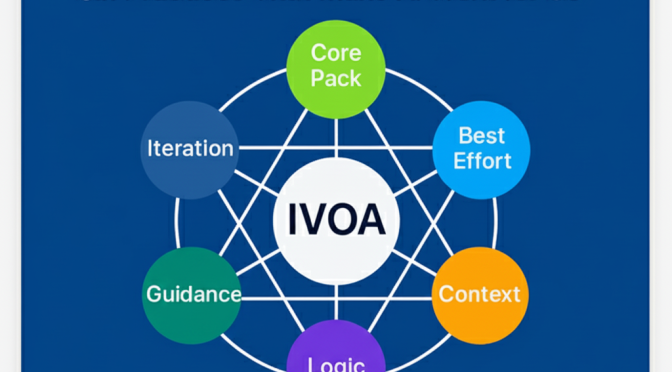
At IntelliVen, we work from a defined body of leadership and management practice: the Manage to Lead (MtL) System. It is documented in our text, taught in our classes, and organized into more than sixty tools and templates and 70 insights and tutorials. We use these tools every day with clients and trainees and we are gradually giving each one AI support.
Key points
- We turned a defined body of work (Manage to Lead) into an AI teammate, IVOA.
- What you load into AI and how you use it matters most: a focused core pack, clear logic, simple ground rules.
- The same six practices can turn your content, tools, and methods into an AI teammate.
- The payoff is on-demand access for many more people with higher quality and consistency.
AI, in the form of our custom GPT, IntelliVen Operations Advisor (IVOA), has become a working teammate we did not know we needed or could afford. Grounded in our MtL text and tool tutorials, IVOA extends our thinking and lifts the quality and consistency of our work. Hours become minutes, and the output is sharper and more thorough.
Serious content is moving this way. Professors and authors will pair their books, courses, and toolkits with AI teammates that know their material, use their language, and sit beside the users of their work (leaders for us; scientists for a science professor) as they think, decide, and act.
This makes the originator’s best thinking available on demand to anyone, anywhere, at any time, with no enrollment required. Much of the IP is free to access. Revenue comes from deeper engagement: subscriptions for full access and community features, and paid classes and consulting to apply the knowledge and logic to real cases. That is the shift from tool to teammate.
What follows is what we have done with MtL so far and six practices that make AI work for us: three to set up a teammate like IVOA and three to use it well. IVOA is something we use extensively in our own work, and it is equally open and available for anyone to use or adapt.
SET UP
These three steps prepared IVOA to perform as part of our team and are the same steps you can use to turn your own body of work into an AI teammate. In the configuration window that opened when we set up the GPT, we:
- Loaded a small Core Pack as its working knowledge base
- Uploaded logic tutorials so it thinks the way we do
- Set default behaviors so tone and structure fit our brand
The Core Pack is our MtL textbook plus about a dozen of our curated tutorials, templates, and e-books, each under 10 pages. These materials and the ground rules persist in IVOA’s configuration, so we don’t need to upload or restate them each time we use it.
1. Loaded a knowledge base
On advice from participants in our Manage to Lead (MtL) Executive Alignment System for Operations and Governance training program, we loaded the Core Pack, our MtL text, e-book, tutorials, and prompt logic into IVOA. The impact was immediate.
Consider the contrast when we ask IVOA versus a generic AI: “What’s the purpose of a business?”
IVOA (MtL-aligned):
The purpose of a business is to solve a specific problem for a specific customer set.
- Purpose is external: it’s about the customer’s problem, not your internal motivations.
- Teams that stay clear on WHAT they deliver, to WHOm, and WHY the buyer chooses them execute better and grow faster.
Generic AI:
Provide goods or services to customers, generate profit, create jobs, and contribute to the economy.
Same question. Both answers are reasonable English. Only one is tight enough, and specific enough, to guide how leaders think, talk, and act.
2. Uploaded logic
We configured IVOA with the guts of Manage to Lead: detailed tool logic, what “good” looks like, common failure modes, and the assess-and-suggest moves we use across the tools. When it works on a task, it runs the same checks and upgrades we use with clients, not generic internet advice.
It also runs those checks more consistently and exhaustively than we do; where a human often stops once something is “good enough,” IVOA keeps applying the full set of tests and upgrades without getting tired or impressed with itself. That logic base changes how it sees and improves work.
Here is what that looks like on a simple WHAT–WHO–WHY.
Example: IVOA sharpening a WHAT–WHO–WHY
We asked IVOA to assess an early draft W-W-W for a “leadership training” offer.
Draft:
- WHAT: Leadership training for managers who need to be more strategic
- WHO: Mid-level managers in growing organizations
- WHY: They are too focused on tasks and need to operate more strategically
IVOA’s assessment surfaced several issues and concrete upgrades.
Feedback on clarity and specificity
WHAT
- “Leadership training” is a service, which is good, but it is broad. Name the deliverables a buyer can point to (for example, program format, length, and core components).
- The phrase “for managers who need to be more strategic” mixes in WHO and WHY. Keep WHAT focused on the offer itself, not on audience or motivation.
WHO
- “Mid-level managers” describes participants, not the buying decision-maker. Specify the role that approves budget (for example, Head of L&D, CHRO, BU leader) and add simple qualifiers such as organization size and context.
- Tighten targeting by using traits like pain, urgency, economics, authority, and advocacy.
WHY
- The draft states the problem (“too focused on tasks”) but not why buyers choose this offer over alternatives. Frame WHY in the buyer’s words, with evidence where possible.
- A crisp, customer-voiced WHY anchors growth and alignment; teams that describe WHAT, WHO, and WHY the same way perform better.
Suggested upgraded WHAT–WHO–WHY
- WHAT: A 12-week strategic leadership program that combines cohort workshops, on-the-job applied projects, and 1:1 coaching, with toolkits and manager-sponsor check-ins.
- WHO: Head of Learning & Development or Business Unit leader responsible for developing mid-level managers in organizations of ~500–5,000 employees.
- WHY: They choose us to reliably shift managers from task execution to strategic operating behaviors through applied work tied to their business, with measurable improvements in planning, delegation, and cross-functional outcomes; strong internal references and repeat sponsorship reduce adoption risk.
Notes to strengthen further
- Add simple qualifiers to WHO (industry focus, region, typical team size) and score best buyers on pain, urgency, economics, authority, and advocacy to tighten the ideal customer profile.
- Bolster WHY with proof points buyers trust (for example, internal references, completion-to-application rates), keeping the focus on the buyer’s reasons, not your beliefs.
Why this matters
- A specific, shared W-W-W keeps teams aligned on purpose and choices.
- Clarity on WHAT, WHO, and WHY is foundational to better execution and growth.
Without uploaded logic
We also ran the same draft W-W-W through a general-purpose AI assistant.
It told us, in effect: “This is a very clear and concise statement of purpose. It covers the three W’s and only needs minor refinement.” It praised the draft, offered some marketing polish, and suggested using it as-is as a mission or elevator pitch.
IVOA did something very different. It:
- Flagged that WHAT mixed service, audience, and motivation and pushed us to name concrete deliverables
- Pointed out that WHO described participants, not the buying decision-maker, and asked us to specify the role and simple qualifiers like size and context
- Reframed WHY from “the problem” to “why buyers choose us over alternatives,” and nudged us toward buyer-voiced language and proof points
- Produced a sharper, more specific W-W-W that we could actually use to target, sell, and deliver
Both AIs wrote in fluent, confident English. The difference is that IVOA is tuned to our Manage to Lead logic and tools. It does not just sound right. It pushes our thinking to be right for the way we run and grow organizations.
If you want to see this in your own context, try this sequence:
- Write your current WHAT–WHO–WHY.
- Paste it into your favorite general AI assistant and ask for feedback.
- Paste the same W-W-W into IntelliVen Operations Advisor (IVOA) and ask it to assess and upgrade it.
- Then ask IVOA to compare its assessment with the other AI’s response and explain the differences.
The value is not that it writes nicely. It is that it knows the logic, tools, and standards behind the work and helps you apply them. The same AI teammate we use in our work is available for anyone to use or adapt.
3. Configured ground rules
When we configured IVOA, we set clear ground rules for tone, structure, length, and emphasis. We gave these instructions once. We override them only when a task needs a different style.
With guidance
“Use a direct, executive tone. Short paragraphs. Bullets by default. No filler. Focus on operational impact and next actions.”
→ Output fits our brand.
Without guidance
The AI invents its own style (which can be annoying!).
Example default ground rules to paste into GPT config:
- Tone: direct and executive; warm when appropriate.
- Length: be concise; short paragraphs.
- Altitude: start with a high-level summary; add detail on request.
- Format: bullets by default; numbers only when sequence matters.
- Structure for substantial replies: Context and aim; What we see; What to do next; Risks and tradeoffs; Optional variants or examples.
- Emphasis: actions, owners, timing, concrete examples.
- Avoid: em dashes, tropes, filler, sycophancy, purple prose. Use plain language.
USAGE
With setup complete, day-to-day work is straightforward. The next three steps set context for the task, share our best current draft, and iterate line by line until the result is crisp and on target.
4. Set context
Before asking IVOA for help, we share everything relevant about the situation. It doesn’t need to be organized or polished. Completeness beats polish:
- Role
- Audience
- Stakes
- Constraints
- What’s working
- What’s not
- Why it matters
- Who cares
- Etc.
With context
“I’ll be addressing a cross-functional leadership team that’s behind on customer onboarding. They’re feeling pressure on service levels. I want to open by acknowledging that pressure and the opportunity ahead if we align on the few priorities that matter. Tone should be direct, not rah-rah.”
→ It sounds like us.
Without context
“Draft an intro for my conference talk on building a team.”
→ Generic, motivational filler.
Power comes from knowing your world: role, audience, situation, goals, style, what matters most. We use our Core language when it fits and skip the frameworks when they don’t help.
5. Draft best effort
We use AI as a performance multiplier, not a blank-page generator. A rough outline, memo, bullet list, or old deck is enough to start. Give it something to sharpen and it will. Tell it what’s working, and what isn’t, in your draft.
With a starting point
“Uploaded is the current job description and here is where the CEO is frustrated […]. Rewrite to highlight expected leadership behavior and desired outcomes.”
→ We get an on-target draft.
Without a starting point
“Write a job description for our COO.”
→ Might be fine, but generic.
6. Iterate
Iteration turns a good draft into a ready asset. Lead with focused passes, then keep what works and tune what doesn’t.
With iteration
- We read and refine with specific notes: “Tighten the second paragraph.” “Swap these two points.” “Raise the stakes in the opening.” “Cut jargon.” “Add a concrete example here.”
- We work paragraph by paragraph. We avoid whole-document rewrites. We lock improved sections and move on.
- We ask for one or two alternatives when a paragraph is close but not quite there.
- We run a zoom-out pass after paragraph edits. We check sequence and placement, merge overlaps, trim repeats, and fix transitions. We rebalance if one paragraph got over-developed in isolation.
- We use the right tools. A canvas editor for inline comments. Side-by-side views to compare versions and keep the best parts.
- We run a quality check. We confirm every word says what we mean, remove filler, and fix lines that sound good but are not accurate or relevant.
Example prompts:
- “Revise paragraph 3 for clarity; keep the ideas; cut 20%; offer 2 alternatives.”
- “Tighten paragraph 2 to three short sentences; keep key terms; offer 2 tone variants (direct, warmer).”
- “Zoom out: propose a better section order for flow to decision; list what you moved and why.”
- “Find and merge redundancies; flag any paragraphs with overlapping content; keep the stronger phrasing.”
Without iteration
We accept the first draft and leave quality on the table.
Summary points
- Short, focused passes beat one big rewrite.
- Lock improvements as you go.
- Always zoom out after tightening parts.
- Read every word before you ship.
- When what you do becomes guidance or a template, add it to the Core Pack.
Try IVOA
IVOA is live and available for everyone to use.
- At intelliven.com → RESOURCES → IVOA
- In ChatGPT: Explore GPTs → search “IntelliVen Operations Advisor (IVOA)”
Start by asking: “What can you help me with?”
Ways to work with and learn IVOA
- Follow instructions in this IVOA Tutorial.
- Use the IVOA Sandbox for a structured way to apply the MtL System of tools, habits, and practices. Contact IntelliVen for a free org code to give it a try.
- Enroll in a Manage to Lead Training Program (next cohorts launch in January and April).
- Work side by side with us through executive coaching or consulting.
We welcome questions, suggestions, and feedback.
Get Clear. Align. Grow.