

Participants in IntelliVen’s Manage to Lead (MtL) program sometimes ask: “Why do we need to work on process maps?” It’s a fair question. The answer is that process mapping is not theory or busywork — it’s a practical tool you use on your own organization to turn hidden confusion into shared clarity. What follows explains how and why it works.
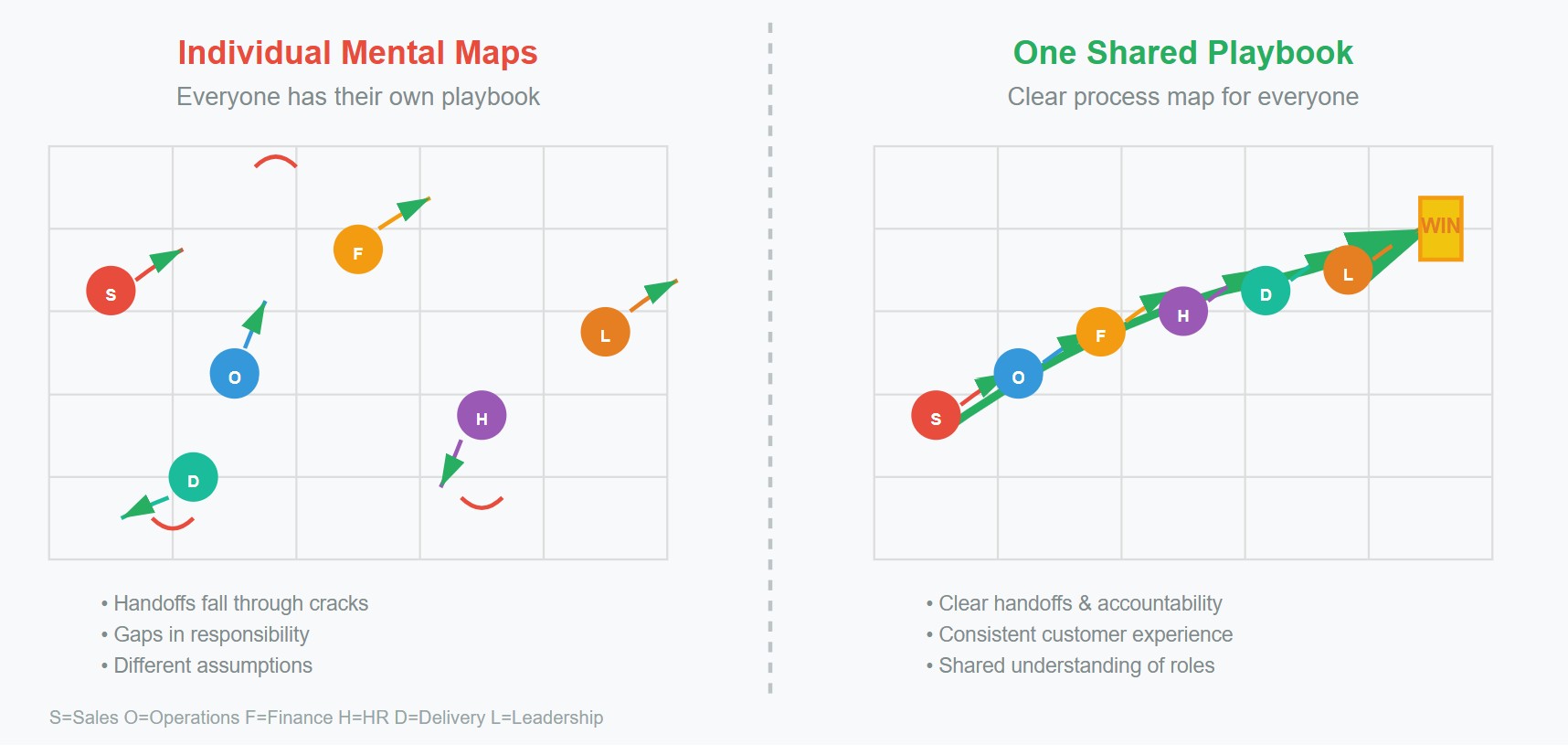
Every team member operates with their own mental map of how work gets done. The problem is, those maps rarely match. When they stay hidden, confusion builds, errors repeat, and opportunities slip away. Process maps transform scattered assumptions into one clear picture everyone can see, use, and improve together.

Turn Individual Mental Maps Into One Shared View
Organizations are an ecosystem of activities. Sales, delivery, support, finance, and HR leaders each hold pieces of the whole. Ask ten people how a key workflow happens across functions—say, onboarding a new customer—and you may hear ten different answers.
The same fragmentation shows up inside functions too: two sales reps handling similar opportunities may qualify leads or prepare proposals in completely different ways, even though the organization has learned a best practice for how it should be done.
When leaders work with their teams to draft a process map, a good first step is for each person to draw their own version of how the work gets done. Those maps reveal the similarities and differences in how people think the process works.
Looking at them side by side sparks discussion and exposes assumptions that would otherwise stay hidden. Collaborating to reconcile those views into a single, explicit picture reduces misunderstandings, strengthens alignment, and sets the stage for systematic improvement.
This aligns with the IntelliVen “Get Clear” truth: clarity is the first step to higher performance. Without it, even the best strategy gets lost in translation.

Make Handoffs, Gaps, and Choke Points Explicit
Once the flow of work is on paper (or screen), weak spots stand out. Teams can see:
-
Handoffs where work might fall between the cracks.
-
Gaps where no one is clearly responsible.
-
Choke points where one role or tool becomes a bottleneck.
-
Redundancies where two people are doing the same thing.
-
Error-prone steps where mistakes often creep in.
-
Measures—formal or informal—that indicate whether things are on track.
In day-to-day operations, these issues hide in plain sight. People learn to work around them. But a process mapping exercise surfaces them for open discussion.
This step mirrors the “NOW” stage of IntelliVen’s Change Framework. Leaders and teams must start with a clear-eyed view of how things currently work before they can chart a better “NEXT.”
Examine for Potential Breakthroughs
Mapping processes is not just about fixing problems. It’s about discovering opportunities.
When the whole flow is visible, leaders can ask:
-
What would happen if we automated this step?
-
Could two teams combine efforts to reduce time and cost?
-
Are we measuring what matters most?
-
Where could a small shift create disproportionate gains?
Sometimes, the exercise reveals breakthroughs. For example, moving a routine approval up in the process can cut cycle time in half. Or spotting a recurring customer question may inspire a new self-service product feature.
Organizations that grow successfully over time are those that consistently find and exploit such breakthroughs. Process maps are a tool to make them visible.
Ensure the Whole Team Plays the Game the Same Way to Win
Strategy is about how to win. Operations is about how to play the game. To succeed, the two must connect.
Process maps make the “playbook” explicit. They allow everyone—leaders, managers, staff, and partners—to see the same game board and understand their role on it. This alignment ensures:
- Consistency: Consistency makes it easier to ensure everyone follows best practices and onboard new people. Consider an organization where half the professionals operate at peak effectiveness while the other half lag. If the whole team consistently applied the practices of the top performers, overall output and impact would rise dramatically. Process modeling is a step toward making that possible.
- Efficiency: A shared map keeps teams from having to inventing steps or duplicate effort which frees time and energy for higher-value work. Efficiency in this sense isn’t just about speed — it’s about reducing rework, avoiding missteps, and channeling resources where they matter most.
-
Accountability: With a clear, shared process, everyone knows what’s expected of them and when. Instead of relying on memory, assumptions, or informal workarounds, roles and responsibilities are visible. This makes it easier to spot when something is off track and to coach or support people in real time, building trust and confidence across the team.
-
Scalability: Growth is hard when every new person has to “figure it out” on their own. A well-documented process gives newcomers a tested playbook so they can contribute faster and more reliably. It also allows leaders to delegate with confidence, knowing the approach will hold up even as volume increases or teams expand.
In IntelliVen terms, process maps help teams collaborate to “Get Clear and Get Aligned.” They make it easier for leaders to contract with their teams, govern effectively, and review performance against clear expectations.
Practical Tips for Leaders
If you’re considering introducing process mapping, here are some practical guidelines:
-
Start with one important process. Don’t try to map everything at once.
-
Involve people who do the work. They know the reality better than managers.
-
Keep it simple at first. Boxes, arrows, and labels are enough to start.
-
Use present tense. Describe how things actually happen now, not how they should.
-
Capture both formal and informal steps. Workarounds often carry key insights.
-
After mapping, ask: “What can we stop, start, or change to improve performance?”
-
Revisit maps as your organization evolves. A process that works today may need adjustment tomorrow.
Closing Thought
Working on process maps is not busywork. It is a leadership act. It shows commitment to clarity, alignment, and continuous improvement. It turns hidden assumptions into shared understanding. It shines light on bottlenecks and opportunities. And it ensures that your whole team is indeed playing the same game, the same way, to win together.
In short: process maps help leaders Get Clear. Align. Grow.
Put These Ideas Into Practice
In the Manage to Lead (MtL) program, you don’t just study tools like process mapping — you apply them directly to your own organization. YOUR CASE IS THE COURSE. By working hands-on with proven frameworks, you and your team surface hidden assumptions, sharpen execution, and accelerate performance. Learn more about the MtL program here »