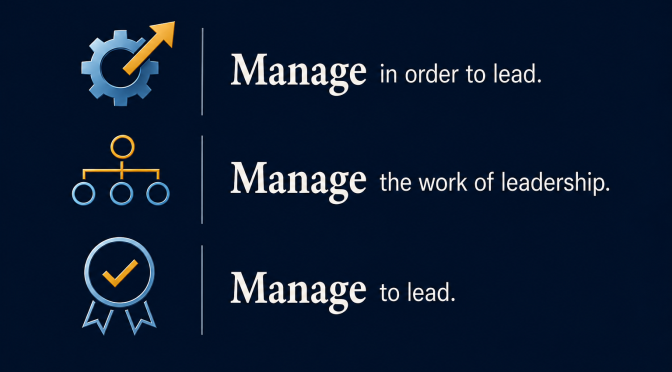
Manage to Lead is an integrated leadership operating system.
Its purpose is to help leadership teams create the conditions under which organizations achieve their potential to perform and grow. It provides an integrated leadership operating system through which leadership teams think, work, and lead together.
Whether the organization is an entire company, a business, a function, a unit, or an initiative, the leadership challenge is fundamentally the same. Leadership teams must develop a shared understanding of what they seek to accomplish, where they are relative to accomplishing it, what must change, and how they will work together to accomplish it.
The system is organized into three integrated parts. Each builds upon the previous one, and together they help leadership teams create the conditions under which organizations continually improve performance and accelerate growth.
Every element of Manage to Lead helps leadership teams answer one of a small number of essential leadership questions.
What are we trying to accomplish? Where are we now? What must change? How will we execute? How will we create the conditions for others to succeed?
Together, these elements provide one coherent way for leadership teams to answer those questions.
Leadership Team Disciplines
Leadership begins with how leadership teams think and work together.
Organizations perform best when leadership teams share a common understanding of what they seek to accomplish, where they are relative to accomplishing it, what must change, and how they will work together to accomplish it.
Leadership teams develop these capabilities through disciplined leadership conversations, making thinking visible, and developing shared ways of thinking and working.
The first series of essays explores these disciplines because they create the foundation from which all other leadership work proceeds.
Leadership Team Work
Once leadership teams develop shared understanding, they can apply it to the work of leading the organization.
The second series explores how leadership teams establish a shared definition of success, understand their organization’s current and future reality, determine what must change, govern execution, and continually strengthen organization performance.
Leadership Stewardship
Leadership teams create the greatest value by creating the conditions under which others throughout the organization can successfully lead. They provide governance, coaching, peer support, subject matter expertise, learning opportunities, and the right mix of leadership capabilities for the organization’s stage of development, strategic ambitions, and current challenges.
Those responsibilities strengthen leadership throughout the organization. The third series explores how leadership teams fulfill that stewardship responsibility.
One Integrated System
Although these three parts can be described separately, they function together.
Leadership Team Disciplines develop shared understanding. Leadership Team Work applies that shared understanding to improve organization performance. Leadership Stewardship extends those capabilities throughout the organization by creating the conditions under which others can successfully lead.
Together they form one integrated leadership operating system that helps leadership teams create the conditions under which organizations perform at their best.
The essays that follow explore each part in turn.