
People sometimes ask what I mean by Manage to Lead.
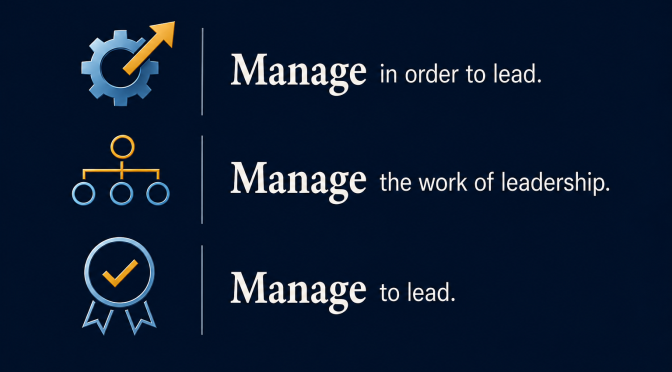
The answer is that the name was chosen intentionally as a triple entendre. It conveys three related but distinct ideas that have shaped my thinking about leadership for over fifty years.
The first meaning is that people manage in order to lead.
Leadership grows through disciplined management. Leaders learn to better manage themselves, then the work of leadership, and ultimately help leadership teams manage how they think and work together. In this sense, management is one of the disciplines through which leadership is developed.
The second meaning is that the work of leadership must be managed.
Leadership teams create value by creating the conditions under which others can successfully lead businesses, functions, units, and initiatives throughout the organization. Those conditions include shared understanding, disciplined conversations, thoughtful governance, coaching, peer support, learning, and the collective capability required to accomplish important work. Creating and continually strengthening those conditions is itself the work of leadership, and it deserves to be managed with the same discipline organizations apply to every other critical function.
The third meaning is simply to “manage” to lead.
Like the expression, “They managed to complete the assignment,” it speaks to succeeding at something worthwhile that requires effort, discipline, and persistence.
Leadership is a capability that can be continually developed. Anyone can become a better leader by learning to better manage themselves, their leadership team, and the work of leadership. Manage to Lead exists to help people do exactly that.
That philosophy has guided my work since my graduate research at MIT Sloan in the mid-1970s. My thesis explored an early version of an idea that has shaped everything I have done since: organizations perform best when leaders are clear about what they seek to accomplish, why it matters, and how they engage others in accomplishing it.
Over the ensuing decades, those ideas were tested, refined, challenged, and expanded through leading organizations, advising leadership teams, conducting research, and developing what ultimately became Manage to Lead.
Today, I would state that proposition a little differently: Leadership teams create the greatest value by creating the conditions under which others can successfully lead.
The first and most important of those conditions is a shared understanding of what the organization seeks to accomplish, where it is relative to accomplishing it, what must change, and how people will work together to accomplish it. Organizations perform best when leadership teams share that understanding.
Everything in Manage to Lead exists to help leadership teams create those conditions.
The essays that follow begin with the disciplines through which leadership teams develop shared understanding and shared ways of thinking and working together. They then explore the work leadership teams manage together to improve organization performance before turning to the stewardship through which leadership teams create and sustain the conditions that enable others throughout the organization to succeed.