Tag Archives: organization development

How Manage to Lead Fits Together

Manage to Lead is an integrated leadership operating system.

Its purpose is to help leadership teams create the conditions under which organizations achieve their potential to perform and grow. It provides an integrated leadership operating system through which leadership teams think, work, and lead together.

Whether the organization is an entire company, a business, a function, a unit, or an initiative, the leadership challenge is fundamentally the same. Leadership teams must develop a shared understanding of what they seek to accomplish, where they are relative to accomplishing it, what must change, and how they will work together to accomplish it.

The system is organized into three integrated parts. Each builds upon the previous one, and together they help leadership teams create the conditions under which organizations continually improve performance and accelerate growth.

Every element of Manage to Lead helps leadership teams answer one of a small number of essential leadership questions.

What are we trying to accomplish? Where are we now? What must change? How will we execute? How will we create the conditions for others to succeed?

Together, these elements provide one coherent way for leadership teams to answer those questions.

Leadership Team Disciplines

Leadership begins with how leadership teams think and work together.

Organizations perform best when leadership teams share a common understanding of what they seek to accomplish, where they are relative to accomplishing it, what must change, and how they will work together to accomplish it.

Leadership teams develop these capabilities through disciplined leadership conversations, making thinking visible, and developing shared ways of thinking and working.

The first series of essays explores these disciplines because they create the foundation from which all other leadership work proceeds.

Leadership Team Work

Once leadership teams develop shared understanding, they can apply it to the work of leading the organization.

The second series explores how leadership teams establish a shared definition of success, understand their organization’s current and future reality, determine what must change, govern execution, and continually strengthen organization performance.

Leadership Stewardship

Leadership teams create the greatest value by creating the conditions under which others throughout the organization can successfully lead. They provide governance, coaching, peer support, subject matter expertise, learning opportunities, and the right mix of leadership capabilities for the organization’s stage of development, strategic ambitions, and current challenges.

Those responsibilities strengthen leadership throughout the organization. The third series explores how leadership teams fulfill that stewardship responsibility.

One Integrated System

Although these three parts can be described separately, they function together.

Leadership Team Disciplines develop shared understanding. Leadership Team Work applies that shared understanding to improve organization performance. Leadership Stewardship extends those capabilities throughout the organization by creating the conditions under which others can successfully lead.

Together they form one integrated leadership operating system that helps leadership teams create the conditions under which organizations perform at their best.

The essays that follow explore each part in turn.

The Meaning of Manage to Lead

People sometimes ask what I mean by Manage to Lead.

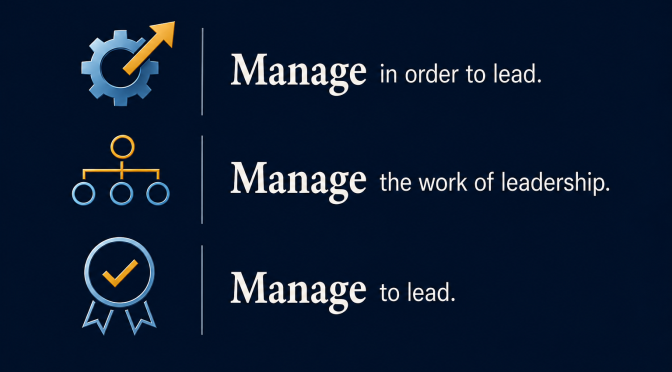
The answer is that the name was chosen intentionally as a triple entendre. It conveys three related but distinct ideas that have shaped my thinking about leadership for over fifty years.

The first meaning is that people manage in order to lead.

Leadership grows through disciplined management. Leaders learn to better manage themselves, then the work of leadership, and ultimately help leadership teams manage how they think and work together. In this sense, management is one of the disciplines through which leadership is developed.

The second meaning is that the work of leadership must be managed.

Leadership teams create value by creating the conditions under which others can successfully lead businesses, functions, units, and initiatives throughout the organization. Those conditions include shared understanding, disciplined conversations, thoughtful governance, coaching, peer support, learning, and the collective capability required to accomplish important work. Creating and continually strengthening those conditions is itself the work of leadership, and it deserves to be managed with the same discipline organizations apply to every other critical function.

The third meaning is simply to “manage” to lead.

Like the expression, “They managed to complete the assignment,” it speaks to succeeding at something worthwhile that requires effort, discipline, and persistence.

Leadership is a capability that can be continually developed. Anyone can become a better leader by learning to better manage themselves, their leadership team, and the work of leadership. Manage to Lead exists to help people do exactly that.

That philosophy has guided my work since my graduate research at MIT Sloan in the mid-1970s. My thesis explored an early version of an idea that has shaped everything I have done since: organizations perform best when leaders are clear about what they seek to accomplish, why it matters, and how they engage others in accomplishing it.

Over the ensuing decades, those ideas were tested, refined, challenged, and expanded through leading organizations, advising leadership teams, conducting research, and developing what ultimately became Manage to Lead.

Today, I would state that proposition a little differently: Leadership teams create the greatest value by creating the conditions under which others can successfully lead.

The first and most important of those conditions is a shared understanding of what the organization seeks to accomplish, where it is relative to accomplishing it, what must change, and how people will work together to accomplish it. Organizations perform best when leadership teams share that understanding.

Everything in Manage to Lead exists to help leadership teams create those conditions.

The essays that follow begin with the disciplines through which leadership teams develop shared understanding and shared ways of thinking and working together. They then explore the work leadership teams manage together to improve organization performance before turning to the stewardship through which leadership teams create and sustain the conditions that enable others throughout the organization to succeed.

Leadership Conversations Start Before They Begin

This essay builds on the ideas introduced in The Leadership Team’s Most Important Asset.

Leadership teams create enormous value through conversation because conversation is the primary way they develop, maintain, and continually strengthen a shared understanding of the organization they lead.

A leadership team can complete a meeting, make a decision, and still leave without developing shared understanding. Differences become apparent later, when one leader believes “grow” means entering a new market while another believes it means increasing share in the current one, for example.

Leadership conversations take place in meetings, at offsites, through online exchanges, over the phone, on Zoom, or in the hallway. Some unfold in a single interaction. Others develop over days or weeks through an ongoing conversation. In every case, great leaders create the conditions that enable people to prepare, contribute, and learn together.

The form and duration of leadership conversations vary. The discipline through which they build shared understanding does not. Every important leadership conversation benefits from thoughtful preparation, genuine inquiry, and disciplined follow-through.

Great leadership conversations start before they begin. An executive review begins very differently when everyone has already studied the same information, reflected on its implications, and arrived prepared to explain what they see.

Every important leadership conversation begins when someone accepts responsibility for creating the conditions for its success. The conversation leader clarifies the purpose of the conversation, the outcomes it should produce, how the work will unfold, who should participate, what preparation is required, and how the team’s understanding should advance. Background information is assembled. Advance materials are shared with time for thoughtful participant preparation.

When the conversation calls for preparation, participants review the advance material, reflect on its implications, develop a point of view worth contributing, and are invited to begin sharing questions and observations before the conversation formally begins. This way, everyone arrives prepared to make their thinking visible and equally committed to understanding how others see things.

Facilitators guide the conversation and the way people engage with one another. Recorders work closely with the conversation leader to ensure the team’s evolving shared understanding is accurately articulated, thoughtfully refined, and memorialized. Every role prepares differently because every role contributes differently to the team’s shared understanding.

Great leadership conversations continue long after people stop talking. Leaders reflect on what they have learned, fulfill the commitments they have made, test their assumptions against reality, and carry that learning into the conversations, decisions, and actions that follow.

From Individual Thinking to Shared Understanding 

Preparation, facilitation, and follow-through matter because they create the conditions in which individual thinking can be shared, examined, and refined until shared understanding emerges. Leadership conversations create value to the extent that they surface, strengthen, and integrate the thinking people bring to them.

Much of what guides a leader’s decisions remains invisible.

  • Assumptions.
  • Observations.
  • Experience.
  • Questions.
  • Concerns.
  • Possibilities.

Each influences judgment, yet much of it remains unspoken.

Leadership teams often leave meetings knowing what they decided without having developed a shared understanding of why they reached that conclusion. Over time, different interpretations emerge because the thinking behind the decision was never fully shared. What appeared to be shared understanding turns out to have been only shared agreement.

Making thinking visible changes the nature of the conversation. Leaders explain their conclusions as well as the observations, assumptions, and reasoning that produced them. Others respond. Similarities become clearer. Differences become easier to explore. The team gradually develops an understanding that is richer than any individual perspective. Shared understanding begins to emerge.

Leadership Is a Learning Process

Organizations are often described as learning organizations. Organizations do not learn; people learn, and leadership teams learn together. The distinction matters because leadership is the continual process of improving a team’s individual and collective understanding until its members can make independent decisions and take actions that reinforce one another.

Most organizations already possess far more knowledge, experience, and insight than they effectively put to work. It resides in the observations, expertise, judgment, and experience of individual leaders. Leadership’s challenge is to surface that thinking, examine it together, refine it, and integrate it into a shared understanding that is richer than any individual could have developed alone.

In most situations, sufficient understanding can be developed by leadership teams that learn from one another while listening carefully to customers, employees, partners, and outside experts. Leadership’s responsibility is to uncover the best collective understanding that can be developed and help the organization act from it.

The Next Conversation

Leadership conversations shape the understanding from which the organization will act next. Because people think differently, every conversation is an opportunity to make those differences visible, learn from them, and build an understanding that enables the organization to move forward together. Every conversation leaves the organization with a stronger, weaker, or unchanged shared understanding. Great leadership teams ensure it is stronger because tomorrow’s decisions will be made from it.

Manage to Lead Essays
Essays exploring how leadership teams build shared understanding and improve organizational performance.

Next: Making Thinking Visible
How leadership teams learn together by revealing the thinking behind their conclusions.

The Leadership Team’s Most Important Asset

Leadership teams talk for hours on strategy, priorities, budgets, talent, and performance. Turning those discussions into coordinated action is agonizingly difficult.

The core reason is simple: leaders rarely operate from a shared reality.

Even large, well-run organizations are known to spend significant time and money, including on consultants, to evaluate whether they are “ready for change.” Change readiness, it turns out, comes down to a shared state of mind.

Specifically, organizations perform best when their leadership teams share a common understanding across four critical dimensions:

  • What they seek to accomplish
  • The reality they face
  • What should happen next
  • How they will guide and govern execution

Shared understanding is a leadership team’s most vital asset. The larger and more distributed an organization becomes, the less it can rely on proximity, hierarchy, or informal conversations to create alignment.

Unlike capital, technology, or top talent, it cannot be bought, borrowed, or commissioned. Shared understanding must be built. It develops when leaders make their own thinking visible, become genuinely curious about the thinking of others, and continually refine their perspective until the team shares one vision.

Teams can survive on fragmented understanding, but they also waste immense energy overcoming the friction it creates. Today, as leadership teams become more diverse, distributed, and specialized, shared understanding can no longer be left to circumstance. Leaders have to create and sustain it deliberately.

Why Shared Understanding Matters

Imagine four members of a leadership team leaving a strategy meeting after missing their Q1 plan, realizing Q2 and Q3 are now at risk. The team agrees the organization should move into the higher end of its market. Each leader leaves with a different understanding of what is required:

  • The CEO believes the priority is to immediately pursue opportunities in high-end target prospects.

  • The CFO believes the organization should either secure incremental funds to invest or expand its credit facility.

  • The COO believes success depends on upskilling customer success personnel to manage large-scale projects.

  • The Chief People Officer launches a search for experienced enterprise salespeople and account management leadership talent.

None of these actions is unreasonable. Each reflects the legitimate perspective of a functional leader. The problem is that the team has not developed a shared understanding of what success requires from each of them right now.

The Two Futures

Without Shared Understanding

Over the following weeks, each executive makes sound decisions within their own domain, but those decisions clash. The CEO commits to opportunities the organization cannot yet deliver. The CFO holds off on approving needed investments until financing is secured. The COO strives to force large-scale project management onto a team lacking aptitude for it. The Chief People Officer sets up interviews before the team agrees on required capabilities.

Resources are committed before demand is validated. Opportunities stall, capabilities are built for customers who have yet to appear, and confidence erodes as another quarter slips away.

With Shared Understanding 

Suppose, instead, the leadership team agrees on a unified principle where the organization moves into the higher end of the market only as customer demand is validated and revenue leads investment.

  • The CEO works closely with prospective customers to validate demand before committing.

  • The CFO expands borrowing capacity so financing is available should demand warrant it.

  • The COO strengthens delivery capabilities in step with demonstrated customer needs.

  • The Chief People Officer pipelines talent, timing actual hires to match validated demand.

Shared understanding enables leaders to exercise sound independent judgment that reinforces the judgment of others. As uncertainty unfolds, the organization responds coherently.

Shared understanding is a leadership team’s most important asset.

Building Shared Understanding

Shared understanding rarely emerges from a single meeting or off-site. It develops gradually as leaders make their thinking visible, test assumptions, draw each other out, and challenge one another respectfully.

High-performing leadership teams continually use an explicit diagnostic to evaluate their alignment:

Questions High-Performing Teams Constantly Re-Answer

  1. What are we trying to accomplish?

  2. What business are we really in?

  3. What must change right now?

  4. What should we do next?

  5. How will we know whether we are succeeding?

  6. How will we maintain alignment as conditions change?

Organizations usually struggle because leaders answer these key questions differently, even in subtle ways, without realizing it. These differences can cause big problems downstream. The work of leadership is to bring individual answers into the open, compare them candidly, and refine them until they become a shared understanding.

Leadership conversations are investments of valuable time and energy. To extract maximum value from these meetings, leaders need to learn to deliberately prepare, heighten consciousness and behavior during conversation, and ensure disciplined follow-up. Each conversation leaves the team with a stronger, weaker, or unchanged shared understanding. High-performing leadership teams are intentional about ensuring it is stronger.

Every Leadership Team Has a Choice

How leaders respond to differing perspectives largely determines how the organization performs:

  • Assuming: Some leaders are content to be oblivious to differences in perspective, taking alignment for granted until conflicting priorities and failed execution force the issue.

  • Living with it: Others recognize differences but accept friction as the inevitable cost of doing business.

  • Prescribing: Others dictate what everyone should think. That may produce compliance, but it rarely produces the richer understanding that emerges when diverse perspectives are explored and refined together.

  • Cultivating: High-performing leaders actively seek out the thinking of their peers while making their own explicit. They foster an environment where executives continuously share, test, and refine their views to build a collective perspective far richer than any individual could create alone.

A Leadership Imperative

Leadership’s responsibility is to continually improve the understanding from which decisions and actions flow.

Organizations that do this well develop a different way of working together. Thinking becomes more visible. Curiosity becomes habitual. Assumptions are tested rather than protected. Disagreements become more productive. Decisions and actions increasingly reinforce one another.

Over time, those behaviors become the organization’s leadership culture.

That culture, built one leadership conversation at a time, may become a leadership team’s most enduring competitive advantage.

Manage to Lead Essays
Essays exploring how leadership teams build shared understanding and improve organizational performance.

This essay introduces why shared understanding is leadership’s most important asset. The next essay explores how leadership conversations develop and strengthen that shared understanding.

From Vision to Action! How to Align Your Team and Execute Your Plan

In today’s rapidly evolving landscape, having a clear and well-defined strategy to win the game you are playing is critical. It’s the roadmap that guides your organization towards its goals and ensures that every action and decision aligns with your vision.

However, crafting and implementing an effective strategy can be a complex and daunting task. This is where the IntelliVen Strategy and Planning Offsite comes into play.

Why the Strategy and Planning Offsite with IntelliVen?

If you’re at the helm of an organization, you understand the importance of strategic planning. You also know that it’s not enough to simply have a strategy; strategy needs to be translated into a practical operating plan that guides your team’s actions throughout the year. The IntelliVen Strategy and Planning Offsite helps leaders like you bridge the gap between strategy development and successful execution. 

The Strategy and Planning Offsite empowers you and your executive team with:

  • Clarity: Achieve a clear and common understanding of your organization’s current state, the case for change, and your target next state.
  • Strategic Initiatives: Identify strategic initiatives that will propel your organization from its current state to where you aspire to be next and prioritize actions that will close the gap based on their impact and feasibility, culminating in a roadmap for implementation.
  • Resource Allocation: Determine roles, responsibilities, and resource requirements for your most important initiatives. This includes allocating the staff, time, money, and other resources needed to make them a reality.
  • Financial Alignment: Align your financial and operational plans with your strategic initiatives. This ensures that your strategic initaitives are not side-jobs to be done as time permits but, instead, are woven into the mainstream of day-to-day activities.
  • Effective Communication: Develop a clear communication strategy to convey your vision and plan to all stakeholders, including your board, investors, employees, and partners.

The Outcomes

Working with IntelliVen Senior Oprating Partners, leaders will achieve key outcomes from their Strategy and Planning Offsite:

  • Alignment:  Participants agree on your current state, case for change, target state, and the necessary actions for each strategic initiative.
  • Implementation Readiness: Lay the groundwork for the successful implementation of strategic initiatives, and establish a governance process understood and agreed upon by all participants. 
  • Team Cohesion: Participants leave the offsite with a deeper understanding of each other and a stronger commitment to the organization’s mission and leadership.

Get Started with IntelliVen

If you’re ready to take your organization  to the next level, it’s time to consider the IntelliVen Strategy and Planning OffsiteContact us to learn more about how our team can help you identify and reach your strategic goals for the long-term.

Invest in your organization’s long-term future with the IntelliVen Strategy and Planning Offsite.
Contact us now!