One of the hardest things for an owner/founder/operator to do is motivate others to perform and grow to their full potential. Watch how the pride and endurance of a race horse transforms a struggling team into winners in this inspiring scene from Seabiscuit.
Click to see a short inspiring clip from Seabiscuit.
Equity models are strategic because: “Who gets What” defines“Who You Are!” That is, the way owners share value with those who create it has a profound impact on the firm and the owners’ ability to attract, retain, and reward senior talent.
Private companies often use a variety of innovative tools, individually or in combination, to navigate and conquer major changes brought on by the urgent concerns of affordability, competency, and succession or “equity inflection points”. Continue reading Equity Rules→
Do you wonder what is the easiest, least expensive, and most flexible approach an owner/founder/operator can use to attract and motivate top talent? This post introduces Mark C Bronfman’s article on using Profits Interests vs Options to install simple, flexible, and highly effective executive incentive plans.
Profits Interest and why we need it
Founders who still own and run their businesses may bring on executives to get to the next level and/or to free themselves from being a slave to their success. The challenge is how to provide incoming executives with attractive upside at low cost, risk, and complexity to the owner, founder.
Profits Interests, an ownership and incentive planning solution under current US tax law, are often the right and best approach. This powerful equity incentive plan requires no buy-in; is not taxable at grant or vesting; and, its capital liquidations are taxed as capital gains
SUBJECT: Input on an opportunity to bid for a strategic project
I just got off the phone with the President of the top player in our target vertical market west of the Mississippi:
Opportunity: They are going to let an RFP in two weeks to six or fewer strategy consulting firms.
Scope: Strategy, culture, change management, marketing, and messaging. (Yes; they’ve combined it all; and Yes they want one winner to be their partner as they transform).
Budget: Over $1M in first-year contracted services.
Term: It’s a multi-year award.
Qualifications: It’s right up our alley, the CEO know us (me) but has never been a client, our lack of local presence is a good thing because they want a firm with great experience and NOT just someone local.
Process: Responses will be due six weeks after the RFP is issued, and orals will be in two months with the winner selected by year-end.
Please share thoughts on how to think this through. We want to win as always and this has big implications for our firm if we do win. We have NOT decided to bid. We will do a bid/no-bid process once we see the RFP.
Business school students have to decide their course of study from day-1 … and the choice makes all the difference. The first decision almost always comes down to operations vs finance:
The allure of finance is working with money to buy and sell companies. Success is when a small stake in a large transaction generates a healthy payday in a short time.
The attraction of operations is working with people to build and run something of value that is eventually realized through a sale, financing, or public offering.
Finance looks like the fast track to great wealth and has attracted top MBA students for decades. Operations looks like a long, hard road with a massive payday only for the few with enough dedication, talent, time, and luck to pull off a successful start-up from scratch.
While the economy needs both financiers and operators, the promise of quick and large returns has left the world short of the talent it needs to drive growth of quality organizations.
Top operators get clear about what they seek to accomplish, build and align a team to achieve specific goals, and provide governance and drive over a sustained period to accomplish them. Those who master the art have a high probability of creating wealth for investors, founders, and top teams responsible for the success.
The operations path should be of interest to more top students but it may not be because few understand how it works and where the payoff comes from.
Financiers make multiple bets hoping one will pay off big. Whether one does or does not, the odds of eventual success are good relative to those who start their own ventures and essentially put all their chips on one bet.
A clever and capable operator can improve the odds by throwing in with:
An early-stage venture that is ready to get past the squirrel-cage of a startup and positioned to grow.
A going concern that is underperforming relative to its potential (i.e., most organizations!).
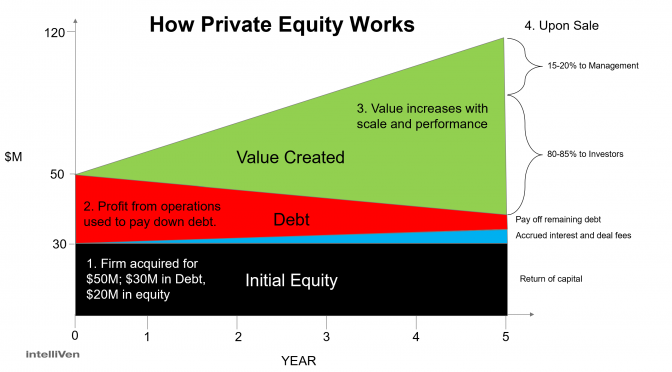
Both courses of study prepare the student to create value in which investors, operating leaders, and their teams participate as summarized in the figure below.
Click the figure for more.
Successful operators take an equity stake in ventures in which they know they can add value and where there does not have to be a grand slam to get a decent payday for those who helped make it happen.
While the payoff is likely not as glamorous or quick, it has higher odds of occurring for operators who know how to build organizations that reliably grow and perform over the long haul.
The best and brightest MBA students should seriously consider operations as a path to help the world, and to help themselves, get on a fast-track to creating value by building, not just financing, organizations, jobs, and people who perform and grow to their full potential.
Public company equity-based pay practices, such as stock, restricted stock, and employee stock options are often a poor fit for private companies committed to reward leaders for performance and growth and to motivate leadership and capital succession.
Equity based programs that make sense and work well in a public company come with many ills for private companies: they can be costly, tax-inefficient, static, ineffective, and sometimes downright unfair. In the worst case, equity pay practices can derail the owners’ plans for growth and succession.
Dynamic synthetic equity presents a more tailored solution for private companies interested in leadership and capital succession. Restricted stock and employee stock options often distort outcomes for private companies. Consider that:
The underlying stock price in a private company gyrates as owners enter and exit from, for example, a living or a death buyout or even a recapitalization. Stock price can jump 50% – unjustly rewarding the owners of true equity awards.