From a very early age, working was a given. It was simply what you did. In reflecting on these early experiences and contrasting them with the lives of my children and grandchildren, I see a significant divide. The loss isn’t just in the paycheck; it is in the “patterns of behavior” that only develop when a young person is forced to confront intensity.
I’ve realized that these jobs did something more than teach me skills…they removed the damaging power of fear. Because I had already faced the “worst” of manual labor and high-pressure environments, I was able to function at a higher level in later life. When intense situations arose, the anxiety that paralyzes others simply wasn’t present.
The Patterns of Performance
Systems Thinking (The Paper Route): I learned that a moment of calm preparation prevents hours of frantic, low-quality effort. By rubber-banding my papers before I started, I cut my delivery time in half.
The Courage to Pivot (Sorting Eggs): Clearing “crap” off a conveyor belt taught me the visceral feeling of being in the wrong place. This gave me the courage to jump out of the window—literally—and walk away from situations that offered no growth.
The Power of Staying (The Dairy Farm): When 17 out of 20 coworkers quit a grueling 3:30 AM milking job, I stayed. I learned that intensity is temporary, and there is a quiet, powerful authority that comes to those who refuse to quit.
Negotiating for Value (The Hot Dog Ring): I refused to play football without a scholarship. I held my ground and negotiated a “Presidential Honor Grant” and a hot dog concession. That concession paid for my wife Freya’s wedding ring—we still call it “The Hot Dog Ring.”
Conclusion: The Absence of Fear
Looking back in my 80s, the most valuable product of these jobs wasn’t the money. It was the psychological foundation. By the time I reached the intense stages of my professional career, I was operating with a distinct advantage: a damaging amount of fear simply was not present. When you have already hand-milked cows in the dark or stood on a derrick in a Texas oil field, you don’t panic when the stakes get high. You simply function. These early jobs didn’t just teach me how to work; they taught me how to be calm when the world is in a rush.
Author Bio
With a career spanning over six decades, Richard Block has navigated the complexities of business and leadership by applying the grit and resilience he forged in the oil fields and farms of his youth. New York-based investor and mentor and former President and Chairman of MeadWestvaco Corp.’s consumer packaging division. Previously Founder and CEO of Impac and AGI, Inc., an international packaging company. Pioneer of employee empowerment, open office culture, and true transparency.
Featured on the cover of Inc. magazine for his leadership and development of AGI’s corporate culture.
Currently on the Board of Directors of the non-profits Phoenix House, Getting Out and Staying Out, and STEM for Harlem and actively engaged in multiple nonprofits. Richard has a motivation to help individuals (e.g. has visited Rikers Island over 100 times).
Effective meeting management increases organization performance and efficiency. Conversely, poorly managed meetings drain resources and hinder progress. This post explores the three stages of a successful meeting, outlines key meeting roles, and provides strategies to develop and implement a robust meeting plan that enhances the likelihood of success.
Stages of an Effective Meeting
All meetings progress through three serial stages: the ramp-up, the meeting itself, and the follow-up. Successful meetings begin when they are first conceived and planning starts, and they conclude well after they are over.
Ramp-Up: Preparing for Success
The Ramp-Up gets meeting stakeholders involved so that when the meeting starts they hit the ground running. The idea is to bring to the forefront of their thinking matters which will be covered in the meeting so that they walk-in prepared, with a point of view, and ready to participate and not just wing-it, work on-the-fly or off-the-cuff.
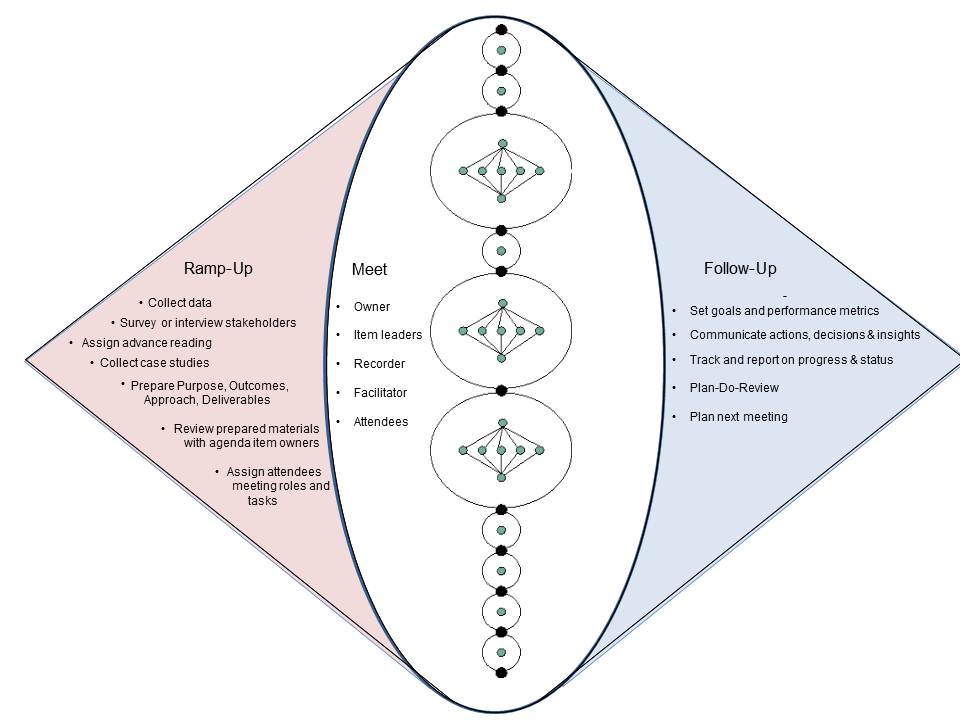
Every Meeting has Three Parts
At left is Ramp-Up, where preparation happens. The central oval signifies the Meeting Itself, from start to finish. At right is Follow-Up, focusing on post-meeting actions and progress tracking.
To effectively bring attendees “into the room” before the meeting, the Meeting Owner, with assistance from the facilitator (see meeting roles below), should:
Distribute the agenda and advance materials: Provide all participants with necessary documents and information ahead of time. This allows them to read, reflect, and formulate their thoughts. While not everyone may review all materials, those who do will set a standard, encouraging others to prepare to avoid appearing unprepared.
Collaborate with agenda-item owners: Meet with those responsible for specific agenda items to review draft materials and ensure alignment with the meeting’s objectives. This increases the likelihood of achieving superior results by making sure each segment is on track to contribute effectively.
Share the POAD (Purpose, Outcomes, Agenda, and Details): Invite attendees to comment on agenda items, suggest additional topics, and share insights on key issues. This fosters a sense of ownership and commitment to the meeting’s success, motivating participants to engage proactively.
Many meetings are part of a recurring series focused on specific subjects like managing a business unit, product, client relationship, or functional area (e.g., sales, marketing, development). Consistent excellence in preparation, facilitation, and follow-through across these meetings drives significant progress toward organizational goals.
The illustration below graphically depicts such a series of
A Series of Well-run Meetings Provides a Platform for Continuous Improvement
meetings on a single subject such as product status meetings, a monthly Managers Meeting, quarterly Client Account reviews, weekly Strategic Initiative reviews, Policy Committee meetings, and All Hands meetings.
The idea is to see each meeting not as an isolated event but as integral to building on the one before and feeding the next. In this way a series of meetings provides a solid foundation for governance to ensure top performance on any aspect of operations.
Key Roles in Effective Meetings
Assigning clear roles is essential for the success of any meeting. While some individuals may fulfill multiple roles (e.g., the Scheduler might also be the Meeting Owner), certain roles are best performed by separate people. For instance, it’s challenging for one person to effectively serve as the Owner, Facilitator, and Recorder simultaneously.
Owner
The Owner initiates the meeting and is primarily responsible for defining its Purpose, Outcomes, Approach, and Deliverables (POAD). They develop the agenda, coordinate content and handouts, and ensure the meeting record is published upon completion.
Scheduler
The Scheduler handles the logistical aspects of the meeting. They schedule the meeting at a time that accommodates all required attendees, prepare the meeting space with necessary equipment and refreshments, and provide administrative support as needed.
Facilitator
The Facilitator works closely with the Meeting Owner to understand their objectives and ensures those goals are met during the meeting. They keep the meeting on track and on time, enforce agreed-upon ground rules, and foster an environment conducive to productive discussion.
Recorder
The Recorder documents action items, key insights, and decisions on a shared display visible to all participants during the meeting (e.g., whiteboard, flip chart, projector). After the meeting, they distribute a draft of the meeting record and assist the Meeting Owner in finalizing and distributing the official summary. (See the sample Meeting Record Template.)
Required Attendees
These are the individuals who must attend the meeting. If any required attendee cannot be present, the meeting should be rescheduled to ensure their participation. Some required attendees may also be responsible for preparing and presenting material during the meeting.
Optional Attendees
Optional Attendees are invited but their presence is not critical for the meeting to proceed. They may choose to attend based on their interest and availability.
Monitor
The Monitor observes and tracks individual and group behaviors relative to the agreed-upon meeting ground rules (see below). They provide feedback to help the group maintain effective meeting dynamics.
Craft A Meeting Plan
A successful meeting starts with a well-defined plan. The Meeting Owner, often collaborating with a Facilitator, trusted advisor, or key attendees, should document the meeting’s Purpose, Outcomes, Approach, and Deliverables (POAD).
Every meeting worth having should have a POAD. By preparing and sharing a document that elaborates on each section, you set clear expectations and guide participants toward achieving the desired results.
Being clear about your objectives dramatically improves the odds of attaining them. A well-defined POAD articulates exactly what you want from the meeting, significantly increasing the likelihood of success. Once the POAD is prepared, effective orchestration will lead to meeting success.
The Purpose section explains why the meeting is being held, ensuring that attendees understand the reason for their participation both individually and as a group. To articulate the purpose effectively, complete the following sentence with as much specificity as possible:
“The purpose of the meeting is to...”
Purpose
Examples
The following examples finish the sentence above:
“…decide whether to include post-award deliverables in Vendor Portal.”
“…review plans and progress towards developing more business at the Department of Homeland Security.”
“…review the progress towards completing assigned tasks on the Citibank installation to identify risks and mitigation strategies”
“…determine what is most important to change next to maintain targeted growth trajectory.”
Outcomes
Targeted outcomes can be either hard or soft:
Hard outcomes are tangible results you can see or touch, such as a decision made, a document produced, or a list compiled.
Soft outcomes involve feelings or thoughts, like participants leaving the meeting feeling energized, motivated, or with a shared understanding.
To define targeted outcomes, answer the question:
“At the end of the meeting, what needs to occur for it to have been time well spent?”
Guidelines for Defining Outcomes:
Ensure the meeting outcomes support and advance the broader objectives of the organization.
Focusing on a concise list keeps the meeting targeted and manageable.
Present the outcomes visibly during the meeting to encourage discussion and agreement among participants.
Hard Outcome
Examples
Design specifications for a new feature of our product.
A list of things we want to keep the same in our organization.
A chart showing who at NASA we want to talk to about what in order to get on track to delivering more value there.
A chart showing who at a known new prospect we need to talk to in order to be sure they understand ways to increase productivity in their operation and where we fit in.
Soft Outcome
Examples
Participants leave feeling energized.
Meeting owner feels supported by their team and by management.
Management is assured that their assigned team is on track to complete their work on time, on target, and on budget.
Approach
The Approach outlines the steps the meeting will follow to accomplish its Purpose and achieve its Outcomes. It encompasses not only the agenda items during the meeting but also the actions taken before and after to ensure success.
Each element of the Approach should include:
Link to Purpose and Outcomes: Clearly connect each step to the meeting’s objectives.
Assigned Responsibility: Identify who is responsible for each task to ensure accountability.
Topic and Leader: Specify the subject matter and the person leading that segment.
Timing: Indicate the start and end times for each agenda item to keep the meeting on schedule.
Related Materials: Provide any documents or resources needed for that segment.
Characteristics of a Well-Planned Agenda:
Balanced Topics: Mix high-energy items with more intensive discussions to maintain engagement.
Time for Thoughtful Discussion: Allocate sufficient time for in-depth dialogue on important issues.
Scheduled Breaks: Include breaks in longer meetings to keep participants refreshed.
Clear Expectations: Clarify whether each agenda item is to inform, generate input, or reach a decision, so attendees know how to engage.
Deliverables
Good meetings produce specific deliverables that feed back into the organization, enhancing operations in meaningful ways. Examples of deliverables include:
Clarified Responsibilities: A clear understanding of who executive team members rely on for specific tasks.
Promotion Decisions: A definitive decision on whom to promote within the organization.
Client Outreach Plan: A list of important calls to make to existing clients, along with scripted messages for each.
Prospect Engagement Strategy: Detailed plans outlining who will speak with key prospects, about what topics, how the conversations will be conducted, and when.
Design Implementation Approach: An agreed-upon approach for implementing a key new feature.
Tips to Enhance Meeting Effectiveness
Implementing the following tips can significantly improve the quality and outcomes of your meetings:
Reflect the organization’s desired culture in all phases of the meeting to reinforce values and expected behaviors.
Start the meeting with a check-in and ice-breaker to bring attendees “into the room” mentally and help them become comfortable with one another.
Agree on a signal—such as raising a hand or turning a nameplate on end—to indicate a desire to contribute, ensuring orderly and inclusive participation.
Establish a discreet signal for attendees to point out when ground rules are being violated, promoting self-regulation and adherence to agreed-upon norms.
Arrive before the meeting starts and stay after it ends to take advantage of important informal interactions that can enhance relationships and understanding.
Begin the meeting promptly, even if not all attendees are present, to show respect for those who are punctual and to emphasize the importance of timeliness. End the meeting at the scheduled time to honor participants’ commitments.
Consider implementing punctuality incentives, such as a small penalty for late arrivals, to encourage timeliness and reinforce the value of everyone’s time.
If the meeting is scheduled during a meal time, provide food or inform attendees in advance to bring their own, eat beforehand, or plan to eat afterward.
Continuously monitor the meeting’s progress. The Meeting Owner and Facilitator should assess whether the meeting’s Purpose and Outcomes are on track, steering the discussion accordingly and adjusting the agenda if necessary to focus on achieving the most critical goals.
Open the Meeting
At the start, the meeting Owner, with the Facilitator, should:
Welcome Attendees and thank them for coming.
Introduce the Recorder and Facilitator.
Review the agenda. Be sure Attendees understand what is coming and give them a chance to ask questions and propose last minute upgrades.
Review the targeted Outcomes.
The Owner starts the meeting but does not dominate it.
Guide Meeting
If the meeting is one of a series, set the context, summarize the work of previous meetings, and review the status of key action items, results, and impacts.
Keep discussion focused on planned agenda items. Use a “parking lot” on a shared-display (news print, white board, etc.) to record topics or comments not on agenda for later processing.
Look to the Facilitator to make adjustments if conversation gets off track or loses steam and to watch the clock and keep on schedule.
Ask attendees how to handle unexpected circumstances and needs such as breaking from the agenda or overrunning the meeting end time.
Ground Rules
At the beginning of each meeting the facilitator asks the group to agree on and commit to follow meeting ground-rules (see: Post on Meeting Ground-Rules). Add or adjust rules as appropriate to give power and ownership to the group and to accommodate special circumstances. Appoint an attendee to monitor performance relative to the ground-rules. If a rule violation occurs, agree on whether and how the monitor should intervene; e.g., by flashing a signal (for example, holding up a yellow card).
If the Monitor fails to intervene when a violation occurs, the group brings it to the Monitor’s attention and asks them to follow the agreement. If the Monitor does not agree or consistently fails to perform the function, the role should be reassigned. If a single person gets more than three exceptions, they may be asked to leave the meeting. If they fail to leave, the meeting may be adjourned at the discretion of the group and or the meeting Owner.
Close the Meeting
Effectively closing a meeting is as crucial as its preparation and execution. Consider these guidelines to ensure a strong and productive conclusion:
Respect everyone’s schedule by concluding at the agreed-upon time. Summarize the meeting’s successes to leave participants feeling positive and energized.
Before adjournment, have the Recorder read the key decisions, insights, and action items captured during the meeting. This ensures all attendees agree on what was discussed and committed to.
Clearly outline the next steps, specifying who is responsible for each action item and the expected completion timelines.
Schedule the follow-up meeting while all key participants are present to ensure maximum attendance and continued momentum.
Inform attendees when they will receive the draft and final versions of the meeting record, so they know when to provide feedback and when to act on the finalized plans.
Decide how attendees should discuss the meeting with others in the organization. Establishing a consistent message maintains clarity and prevents misinformation.
Follow-Up: Ensure Actions Lead to Results
A meeting’s success doesn’t end when attendees leave the room; the Follow-Up stage is crucial for translating decisions and action items into tangible results that enhance organization performance. Effective follow-up ensures that all agreed-upon tasks are completed, maintaining momentum and accountability.
Key Steps in the Follow-Up Process:
Distribute the Meeting Record Promptly
The Recorder works closely with the Meeting Owner to document action items, key insights, and decisions during the meeting using a shared display visible to all participants (e.g., whiteboard, flip chart, projector). Together, they compile and edit the meeting notes to ensure all critical information is accurately captured.
Within a few days after the meeting, the finalized meeting notes are distributed to all attendees using the Meeting Record Template. It’s important to note that the meeting record does not need to include who said what during the discussions. Instead, it should focus on recording the key decisions made, insights gained, and action items agreed upon during the meeting.
Assign Action Items Clearly
Ensure each action item has a clearly assigned owner who is accountable for its completion.
Agree on timelines that are achievable and aligned with organizational priorities.
Identify any support or resources needed to accomplish the tasks.
Monitor Progress Regularly
Set up brief meetings or status updates to review progress on action items.
Implement project management tools or dashboards to monitor the completion of tasks.
Foster an environment where team members feel comfortable discussing obstacles or requesting assistance.
Provide Support and Guidance
The Meeting Owner and Facilitator should remain accessible to provide guidance, clarify expectations, and assist with challenges.
Encourage collaboration among team members to utilize diverse skills and expertise.
Acknowledge and Celebrate Achievements
Acknowledge when action items are completed to reinforce positive behavior and motivate the team.
Highlight how the completed actions contribute to organization performance and goals.
Meeting Follow Up Culture
Viewing each meeting as part of an ongoing process rather than an isolated event reinforces the importance of follow-up. Consistent and diligent follow-up:
Establishes a culture where commitments are taken seriously, and individuals are responsible for their contributions.
Keeps everyone informed and aligned, reducing misunderstandings and duplicated efforts.
Ensures that decisions lead to actions, and actions lead to measurable improvements in operations.
See Also
For a more comprehensive coverage of how to have a great meeting please also see How to Make Meetings Work, by Michael Doyle and David Straus.
A leader’s success hinges on two critical responsibilities:
Achieving clarity about what they want from each team member.
Effectively communicating their clarity.
Too often, leaders neglect to take the time to define their expectations, leading to confusion and misalignment within the team.
Stephen Covey’s principle of “Begin with the End in Mind” underscores the importance of knowing precisely what you want to achieve before taking action. In leadership, this means clearly articulating the goals and outcomes expected from each team member.
When leaders lack clarity, they cannot expect their team to deliver the desired results. This lack of clarity often stems from the mistaken belief that team members will intuitively understand what is required of them. However, without explicit guidance, team members may interpret goals differently, leading to inconsistency and inefficiency.
Clarity dramatically increases the likelihood of achieving desired outcomes. One might consider this principle in the context of prayer: when we are clear about what we ask for, it likely subliminally enhances our focus and aligns our actions with our intentions, potentially increasing the chances of achieving what we seek, with or without divine intervention. Similarly, in leadership, a leader who is clear and communicates that clarity empowers their team to work toward a shared vision, enhancing collaboration and performance.
Consequently, leaders must prioritize getting clear about their expectations and engaging in rich communication with every member of their team. By doing so, they lay the groundwork for a verbal contract that guides team members toward success, ultimately achieving the leader’s and the organization’s goals..
Contract
Once a leader is clear about what they want from a team member, they should initiate one-on-one conversations to communicate precisely what the team relies on them to achieve. During these discussions, the leader must ensure:
The assignment is clear and unambiguous.
They believe the person can accomplish the task.
They want the person to take on the task.
After explaining, the leader asks the team member to repeat back what they heard to confirm understanding. Repeat this process until both parties are aligned. The leader must also verify that the team member genuinely wants to complete the task and believes in their ability to do so.
This mutual understanding forms a verbal contract, establishing the team member’s commitment to the task, which is then documented in their performance goals.
Two additional factors ensure success:
Resources: The leader provides necessary resources such as time, training, personnel, funding, accountability reviews, and advisors to support the team member.
Incentives: The leader motivates the team member by offering rewards like praise, performance bonuses, promotions, or celebratory events (e.g., dinner with the boss or a trip) upon successful completion.
The following graphic presents a way to visualize the steps outlined:
Supervisor-Team Member Contracting
Govern
The primary reason things go wrong is lack of management attention. A wise leader regularly checks in to ensure that front-line actions align with expectations. Make it clear that you are on your team member’s side and that your sole interest is their success. Offer tangible support to demonstrate your commitment, such as sharing your best thinking in the form of notes or drawings or providing key insights and ideas. Encourage your direct report to internalize your input and develop it further as if it were their own.
Effective governance involves regular, structured check-ins between leaders and their direct reports. Leaders should schedule consistent one-on-one meetings with each team member, ideally lasting around 90 minutes and occurring weekly or bi-weekly. Choose a time that is easy to keep, such as 7:30 a.m. every other Monday, and make it a priority to hold these meetings consistently. Reschedule only if necessary and commit to making up any missed sessions. While meetings may occasionally take less time than scheduled, any time saved is valuable.
These meetings should be focused and free from distractions or competing agendas. Avoid combining them with meals, though informal lunches together are beneficial for relationship-building.
During the Meeting:
Team Member’s Presentation:
Review Priorities and Progress: The team member presents their priorities and progress from the previous period, supported by metrics. The leader’s role is to ask questions like, “How is it going?” and “How do you know?”
Discuss Top Priorities: The team member outlines their top three to five priorities. Engage in a detailed discussion about these items, emphasizing what is happening and how it is progressing. The leader should actively demonstrate support and teamwork, offering resources, training, introductions, and other assistance as needed.
Agree on Next Steps: Collaboratively decide on the top items, next steps, and specific actions to be taken. The leader should also determine how they can assist in achieving these goals.
Leader’s Presentation:
Share Leader’s Priorities: In about 15 minutes, the leader shares their top three to five priorities. This transparency keeps the team member informed and involved in the bigger picture, helping them understand what the leader is doing for the team’s benefit.
Discuss and Solicit Input: Discuss the points raised until there is mutual clarity. Invite input and advice from the team member, valuing their perspective and insights.
Commit to Follow-Up: The leader commits to keeping the team member informed about any developments related to their discussion and what the leader is doing that may affect them.
By setting aside regular time for these focused conversations, leaders can maintain alignment, foster collaboration, and ensure everyone is working toward shared goals. This structured approach reinforces a sense of team unity and enhances overall performance.
The following graphic is a way to visualize the steps outlined above:
One-on-One Meetings between Manager and Team Member are key to governing for success.
Summary
Failing to both contract and govern effectively is a recipe for calamity. Without clear agreements and regular oversight, teams are likely to encounter misalignment, confusion, and inefficiency. Contracting ensures that expectations are explicit and mutually understood, establishing a strong foundation for success. Governing maintains focus and momentum by providing the guidance and support necessary to navigate challenges. Together, these practices empower leaders to create a cohesive and high-performing team. By prioritizing both contracting and governing, leaders can avoid pitfalls, foster collaboration, and drive their organization toward achieving its goals. Neglecting these essential practices leaves teams vulnerable to chaos and missed opportunities.
A common challenge faced by leaders is the struggle to advance strategic initiatives due to the overwhelming demands of day-to-day responsibilities. This issue often arises because initiatives are viewed as discretionary tasks rather than integral components of job roles. Addressing this requires a shift in perception and management strategy to ensure that strategic objectives are embedded into the organization’s daily operations.
The Problem
Most companies create strategy.
Few companies turn strategy into execution.
Almost no companies monitor execution.
Tips for Success
Acknowledge the Dominance of Daily Tasks: Daily responsibilities frequently overshadow long-term strategic improvements. Recognizing this reality is the first step in addressing the imbalance between immediate tasks and strategic goals.
Integrate Initiatives into Job Responsibilities: Strategic initiatives must be treated as essential duties, not optional ones. Embedding these responsibilities into job descriptions and performance metrics ensures they are prioritized on par with other daily tasks. This integration mandates that participation in strategic initiatives is not just encouraged but required.
Empower and Enforce Accountability: Establish a leadership team to oversee the implementation of strategic initiatives to ensure that there is a clear line of accountability. This team is responsible for ensuring that all members understand their roles in these initiatives are crucial and will be evaluated as part of their performance assessments.
Deploy Execution and Monitoring Support: Establish a Program Management Office (PMO) to help develop execution plans with clear deliverables and deadlines. The PMO provides ongoing support and accountability, ensuring timely and accurate reporting to identify needs that must be addressed to ensure initiatives receive necessary help and support.
Limit the Number of Initiatives: To prevent dilution of focus and resources, it is critical to limit the number of simultaneous initiatives. This approach helps individuals to concentrate fully on achieving significant progress without the burden of juggling multiple priorities.
Align with Performance Objectives: Strategic initiatives should be clearly outlined in the performance objectives of the relevant roles. This alignment emphasizes the importance of these tasks and ensures they receive due attention and resources, mitigating the risk of being neglected due to daily pressures.
Success Formula
Set Strategy (Get Clear)
Plan Execution (Align)
Execute (Do)
Monitor (Review)
Summary
The pressures of daily operations can easily overshadow strategic initiatives unless these initiatives are ingrained as non-discretionary components of job responsibilities. By making strategic tasks part of performance goals, limiting their number, and providing oversight and accountability, organizations can create a culture where strategic progress is as routine as any other daily activity. This structured approach ensures that strategic initiatives are actively pursued and not sidelined, promoting sustained organization growth and improved effectiveness.
Leaders are often confronted with complex decisions that can shape the trajectory of their organizations. Amidst the pressure to find the “right” answer, it’s easy to become mired in indecision, oscillating between various options and seeking input from every possible source.
However, true growth as a leader lies not in the pursuit of a singular solution, but in the willingness to embrace uncertainty, seek collective wisdom, and cultivate a mindset of continuous adaptation.
The Fallacy of the “Right” Answer
In the face of complex organizational challenges, there is rarely a single, universally “right” answer. Every solution carries its own strengths and weaknesses, and what works in one context may falter in another. Leaders who cling to the notion of a perfect solution risk paralysis and missed opportunities. Instead, successful leaders recognize that any solution can succeed if embraced and executed with commitment and alignment.
Fostering Alignment and Commitment
Rather than unilaterally imposing a decision, effective leaders engage their teams in a collaborative process. By seeking input, listening to diverse perspectives, and securing collective buy-in, leaders create a foundation for success, regardless of the specific path chosen. When team members feel heard and valued, they are more likely to take ownership and work collectively towards making the chosen solution a success.
Embracing Continuous Change
No organizational structure or strategy is permanent; as circumstances evolve, so too must the organization. Successful leaders understand that change is inevitable and cultivate a mindset of continuous adaptation. Rather than viewing each new strategy or structure as a static endpoint, they embrace it as a steppingstone towards the next iteration, constantly evolving to meet changing demands and opportunities.
The Growth Mindset
At the heart of effective leadership lies a growth mindset – a willingness to acknowledge one’s own limitations and actively seek out the expertise and wisdom of others. Leaders need not have all the answers; instead, true leadership lies in recognizing what one doesn’t know and proactively seeking out the knowledge and guidance necessary to make informed decisions.
By embracing this mindset, leaders unlock a path of continuous personal and professional development, fostering an environment of ongoing learning and growth within their organizations.
Summary
In an ever-changing business landscape, the most effective leaders are those who embrace uncertainty, foster alignment and commitment within their teams, and cultivate a mindset of continuous adaptation and growth. By letting go of the pursuit of a singular “right” answer and instead seeking collective wisdom, leaders can transcend the limitations of their own knowledge and experience, unlocking the collective potential of their organizations.
Ultimately, the willingness to embrace uncertainty and seek help is not a sign of weakness but a testament to true leadership strength – a catalyst for personal growth, organizational resilience, and long-term success.