Tag Archives: governance

MtL Alumni: Strategy Offsites Start Before You Go

Great strategy discussions start before people walk into the room.

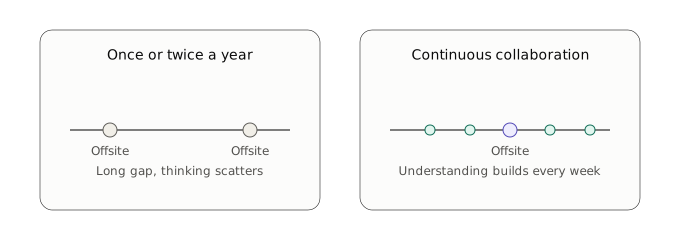
As planning season approaches, remember that the best discussions never begin when leadership gathers for an offsite. They begin weeks earlier.

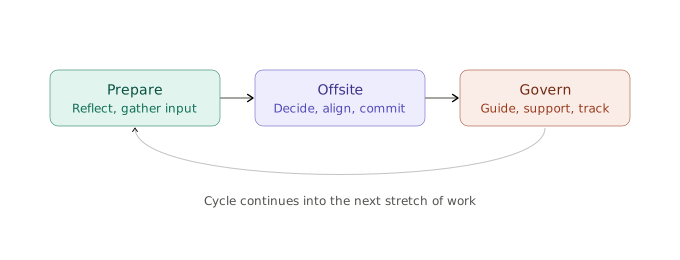
Strong teams clarify and share their thinking before they meet. They compare perspectives, challenge assumptions, sharpen priorities, and work together toward a shared understanding of what they seek to accomplish, where they are now, and what is most important to do next.

Because you’ve participated in a Manage to Lead training program, you already know the methods that support this work.

  • You know how WHAT-WHO-WHY clarifies purpose and Ideal Customer Profile (ICP).
  • You know the importance of agreeing on a Mandate.
  • You know how an Enterprise Change Framework helps leaders align around where things are now, why they must change, where they want to be next, and what needs to happen to get there.

A Pleasant Surprise

We’ve recently had the opportunity to watch several teams apply these methods as part of their planning, operations, and governance processes.

What has been encouraging is not just the quality of the outputs:

  • It’s what happens to the conversations.
  • The most important change isn’t in the plans.
  • It’s in how leaders work together.

What surprised us most

We expected teams to produce better plans.

We did not expect people to become more interested in understanding what their colleagues were thinking.

That shift in behavior may be the most important outcome of all.

People became more interested in understanding what their colleagues were thinking. In short, teams improved both what they accomplished and how they worked together. That observation has reinforced something we’ve believed for a long time.

Structured Cohesion in a Distributed World

Manage to Lead is primarily about helping leaders work together effectively. Tools and technology support that work by providing structure and shared language.

Their greatest value, however, comes from helping leadership teams build habits that create clarity, alignment, accountability, and coherence in a distributed world.

In today’s highly distributed organizations, that capability is increasingly important. Teams operate across functions, time zones, competing priorities, and often in different ways. These are all okay and necessary, provided there is an ongoing commitment to bring individual thinking back to the team in a way others can understand, challenge, and build upon.

Success depends less on being in the same room and more on sharing the same understanding. We’ve started referring to this as structured cohesion: creating shared understanding and alignment such that people work independently while moving forward together. When structured cohesion exists, teams require less coordination because they share more understanding.

Introducing the MtL Leadership Workspace

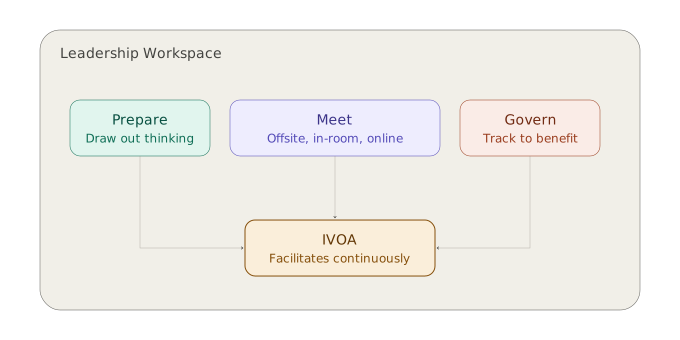
To help leadership teams apply Manage to Lead methods more consistently, we recently introduced the MtL Leadership Workspace, powered by the IntelliVen Operations Advisor (IVOA) GPT.

Built around the same methods and disciplines taught in Manage to Lead, the workspace provides guidance, feedback, and facilitation support as teams clarify priorities, align perspectives, prepare for reviews, refine initiatives, capture decisions, and stay connected to what matters most.

The workspace helps teams continue the conversation between offsites, review meetings, and workshops. It supports both real-time and asynchronous collaboration, helping leadership teams stay aligned even when they are highly dispersed.

The goal is straightforward: Make it easy for teams to work before they convene so they can have better conversations when they come together. At the same time, the workspace improves preparation, documentation, follow-through, and shared understanding of decisions and commitments.

As alumni, you already know the methods. The MtL Leadership Workspace simply provides another way to use them with your team.

Learning Doesn’t End with the Cohort

Past Manage to Lead participants are welcome to enroll in future cohorts at no charge.

Great leadership teams are always learning. Every cohort brings new experiences, new questions, and new insights that strengthen our collective understanding and help us continue to Get Clear. Align. Grow. Together.

As you prepare for your next planning session, strategy discussion, or major initiative, we invite you to explore the MtL Leadership Workspace.

The workspace can help your team clarify priorities, develop and refine WHAT-WHO-WHY, align around Mandate, build Enterprise and Initiative Change Frameworks, prepare for planning discussions, capture insights, and strengthen accountability between meetings. It is particularly useful in supporting the continuous work of getting clear, aligning, and growing, together.

Getting started is simple. Select Workspace from the IntelliVen main menu:

  1. Create an account
  2. Name a workspace
  3. Invite team members
  4. Share your thinking using the Manage to Lead tools

The workspace provides guidance and facilitation support along the way, helping teams make progress wherever they are, in real time or asynchronously.

We want teams to be able to experiment and learn without barriers, so a generous amount of capacity is available at no cost. Organizations that need additional usage, advanced capabilities, or broader deployment can contact IntelliVen to discuss options.

Great strategy discussions start before people walk into the room. The MtL Leadership Workspace gives teams a place to do that work together. We look forward to seeing how you apply these practices to your next challenge and continue building the habits that help teams

Get Clear. Align. Grow. Together.

Suggested Additional Reading

Your Team’s Leadership Workspace is Now Available

For years, IntelliVen has helped leaders:

Get Clear. Align. Grow. Together.

Effective leadership requires clear thinking, disciplined execution, and alignment across decisions and actions.

With this post, we announce the availability of the IntelliVen Leadership Workspace, a collaborative environment that brings together the Manage to Lead tools with AI-guided support to help leadership teams draw out and share their thinking, decide what to do, and act together.

The Leadership Workspace gives teams a shared place to develop, refine, communicate, and govern the core elements that drive organization performance and growth.

Work begins with the organization’s Mandate and Purpose through WHAT-WHO-WHY. It continues through Enterprise and Initiative Change Frameworks, strategic initiatives, heat maps, governance, executive reviews, and performance management.

Organizations today operate in a distributed, networked world. Teams span functions, locations, and increasingly, different ways of working. As organizations grow, maintaining alignment and shared understanding becomes a leadership challenge in its own right.

The Leadership Workspace helps teams create and maintain structured coherence across leadership, strategy, initiatives, execution, and governance. Leaders compare thinking, surface differences, refine ideas, and build shared understanding. Over time, teams develop common language, strong decision-making habits, and a more disciplined way of working that manifests as an evolution in leadership culture.

Each Workspace combines the proven Manage to Lead tools with AI-guided assessment, refinement, inference, consolidation, and collaboration support. Teams use it to strengthen their thinking, improve alignment, guide execution, and govern performance.

The result is a practical environment where leadership teams can sustain alignment and coordinated action in a distributed, networked world.

Leadership teams are invited to create and collaborate in their own Workspace to:

• Define and refine their Mandate

• Clarify purpose using WHAT-WHO-WHY

• Develop and communicate Enterprise and Initiative Change Frameworks

• Launch, guide, support, and govern strategic initiatives

• Visualize priorities and tradeoffs with Heat Maps

• Conduct Executive Reviews

• Compare thinking across leaders

• Surface hidden misalignment

• Consolidate toward shared positions

• Assess, challenge, refine, infer, and improve thinking with AI

• Generate recommendations for moving from NOW to NEXT

The Leadership Workspace helps teams get clear, align, and execute through periods of growth, change, and inflection.

Getting started is simple:

• Select WORKSPACE from the IntelliVen menu

• Create an account and an organization code of your choice

• Invite others into your Workspace

• Start working

No setup project.

No implementation effort.

Simply enter your thinking and submit it for assessment, feedback, and suggestions.

Substantial usage capacity is available at no cost. Organizations that require additional capacity may upgrade as needed. Organizations with unique requirements are welcome to contact IntelliVen to discuss tailored arrangements.

For those who want to accelerate adoption, training is available through the Manage to Lead Enterprise Leadership System for Governance and Operations.

We built the Leadership Workspace to help leadership teams develop the clarity, alignment, governance, and execution capability required to thrive in today’s distributed world.

Get Clear. Align. Grow. Together.

We hope you find it useful.

Peter DiGiammarino

When Attention Is the Constraint, Focus the Work and the Reviews

Most things go wrong because leaders are spread too thin, not because the work is impossible. When the volume of initiatives outstrips reviewer capacity, important items get little or no attention. Meetings slip. Mental presence drops. The fix is to match what we take on to the attention we can invest, and to raise the quality of how we review.

If right-sizing is not possible now, decide what will be reviewed and what will run without review for a period. Make the risk explicit. Set an escalation path. Define when an item re-enters reviews as capacity or leverage grows.

Focus the work

Start by counting real review slots that leaders can cover with preparation and follow-through. That number caps the active portfolio. Then triage:

  • A-items are mission-critical. Each has a named executive sponsor, clear measures, and regular executive reviews with explicit asks.
  • B-items are managed by metrics. Escalate by exception.
  • C-items are owner-run with coaching on demand and a light touch.

This puts scarce attention where it lifts results most.

Focus the reviews

Specialize attendance to increase leverage. Assign one executive sponsor to each A-item. Do not require every executive at every review. Form a small coverage group and rotate as needed. Use pre-briefs so the review starts before the meeting: the sponsor shares questions, context, and what a good decision looks like.

In the session, reviewers create safety, listen first, get clear, and then push thinking with best advice and guidance. Reviewees come prepared to learn, are willing to pivot, and implement feedback fast. Use simple ground rules: everyone participates, one conversation at a time, stay mentally present.

Set a simple operating rhythm

Set review cadence thoughtfully; do not schedule by the passage of time alone. For example:

  • Units: review monthly at first, then every other month, then quarterly as performance stabilizes.
  • Functions: set cadence based on stability and rate of change.
  • Initiatives: review at launch and at key milestones, and never allow more than six months between reviews.

Raise the quality of prep

Distribute a high-quality pre-read 24–48 hours before the meeting. Keep it as short as possible and only as long as necessary, with detail in appendices. The pre-read should answer five questions:

  • What we said we would do.
  • What we did.
  • What happened.
  • What we learned.
  • What we plan to do next.

Add attachments only when they inform a decision.

Reduce risk proactively

Make explicit forecasts against success targets, even when confidence is low. Call out dependencies (what must go right) and constraints. Offer fallback options and  the triggers to use them.

Risks and guardrails

  • People may feel B and C work is abandoned. Publish simple dashboards, define escalation paths, and time-box re-entry to A-status.
  • Sponsors can become bottlenecks. Rotate coverage and keep optional executives available for spikes.
  • Meeting quality can drift. Reaffirm ground rules, coach reviewers and reviewees, and pause to “helicopter up” if the conversation gets stuck.

Start by estimating attention capacity and applying the A/B/C triage to your current list. Then schedule the next cycle of reviews with clear sponsors and pre-read expectations. Get clear. Align. Grow.

See also

Contract & Govern: The Keys to Leadership Success

A leader’s success hinges on two critical responsibilities:

  • Achieving clarity about what they want from each team member.
  • Effectively communicating their clarity.

Too often, leaders neglect to take the time to define their expectations, leading to confusion and misalignment within the team.

Stephen Covey’s principle of “Begin with the End in Mind” underscores the importance of knowing precisely what you want to achieve before taking action. In leadership, this means clearly articulating the goals and outcomes expected from each team member.

When leaders lack clarity, they cannot expect their team to deliver the desired results. This lack of clarity often stems from the mistaken belief that team members will intuitively understand what is required of them. However, without explicit guidance, team members may interpret goals differently, leading to inconsistency and inefficiency.

Clarity dramatically increases the likelihood of achieving desired outcomes. One might consider this principle in the context of prayer: when we are clear about what we ask for, it likely subliminally enhances our focus and aligns our actions with our intentions, potentially increasing the chances of achieving what we seek, with or without divine intervention. Similarly, in leadership, a leader who is clear and communicates that clarity empowers their team to work toward a shared vision, enhancing collaboration and performance.

Consequently, leaders must prioritize getting clear about their expectations and engaging in rich communication with every member of their team. By doing so, they lay the groundwork for a verbal contract that guides team members toward success, ultimately achieving the leader’s and the organization’s goals..

Contract

Once a leader is clear about what they want from a team member, they should initiate one-on-one conversations to communicate precisely what the team relies on them to achieve. During these discussions, the leader must ensure:

  • The assignment is clear and unambiguous.
  • They believe the person can accomplish the task.
  • They want the person to take on the task.

After explaining, the leader asks the team member to repeat back what they heard to confirm understanding.  Repeat this process until both parties are aligned. The leader must also verify that the team member genuinely wants to complete the task and believes in their ability to do so.

This mutual understanding forms a verbal contract, establishing the team member’s commitment to the task, which is then documented in their performance goals.

Two additional factors ensure success:

  • Resources: The leader provides necessary resources such as time, training, personnel, funding, accountability reviews, and advisors to support the team member.
  • Incentives: The leader motivates the team member by offering rewards like praise, performance bonuses, promotions, or celebratory events (e.g., dinner with the boss or a trip) upon successful completion.

The following graphic presents a way to visualize the steps outlined:

Supervisor-Team Member Contracting

Govern

The primary reason things go wrong is lack of management attention. A wise leader regularly checks in to ensure that front-line actions align with expectations. Make it clear that you are on your team member’s side and that your sole interest is their success. Offer tangible support to demonstrate your commitment, such as sharing your best thinking in the form of notes or drawings or providing key insights and ideas. Encourage your direct report to internalize your input and develop it further as if it were their own.

Effective governance involves regular, structured check-ins between leaders and their direct reports. Leaders should schedule consistent one-on-one meetings with each team member, ideally lasting around 90 minutes and occurring weekly or bi-weekly. Choose a time that is easy to keep, such as 7:30 a.m. every other Monday, and make it a priority to hold these meetings consistently. Reschedule only if necessary and commit to making up any missed sessions. While meetings may occasionally take less time than scheduled, any time saved is valuable.

These meetings should be focused and free from distractions or competing agendas. Avoid combining them with meals, though informal lunches together are beneficial for relationship-building.

During the Meeting:

Team Member’s Presentation:

  • Review Priorities and Progress: The team member presents their priorities and progress from the previous period, supported by metrics. The leader’s role is to ask questions like, “How is it going?” and “How do you know?”
  • Discuss Top Priorities: The team member outlines their top three to five priorities. Engage in a detailed discussion about these items, emphasizing what is happening and how it is progressing. The leader should actively demonstrate support and teamwork, offering resources, training, introductions, and other assistance as needed.
  • Agree on Next Steps: Collaboratively decide on the top items, next steps, and specific actions to be taken. The leader should also determine how they can assist in achieving these goals.

Leader’s Presentation:

  • Share Leader’s Priorities: In about 15 minutes, the leader shares their top three to five priorities. This transparency keeps the team member informed and involved in the bigger picture, helping them understand what the leader is doing for the team’s benefit.
  • Discuss and Solicit Input: Discuss the points raised until there is mutual clarity. Invite input and advice from the team member, valuing their perspective and insights.
  • Commit to Follow-Up: The leader commits to keeping the team member informed about any developments related to their discussion and what the leader is doing that may affect them.

By setting aside regular time for these focused conversations, leaders can maintain alignment, foster collaboration, and ensure everyone is working toward shared goals. This structured approach reinforces a sense of team unity and enhances overall performance.

The following graphic is a way to visualize the steps outlined above:

One-on-One Meetings between Manager and Team Member are key to governing for success.

Summary

Failing to both contract and govern effectively is a recipe for calamity. Without clear agreements and regular oversight, teams are likely to encounter misalignment, confusion, and inefficiency. Contracting ensures that expectations are explicit and mutually understood, establishing a strong foundation for success. Governing maintains focus and momentum by providing the guidance and support necessary to navigate challenges. Together, these practices empower leaders to create a cohesive and high-performing team. By prioritizing both contracting and governing, leaders can avoid pitfalls, foster collaboration, and drive their organization toward achieving its goals. Neglecting these essential practices leaves teams vulnerable to chaos and missed opportunities.

Note

Maximizing the Value of Review Meetings

Periodic reviews are critical for keeping important initiatives, functions, and projects on track in an organization. However, maximizing the value from review meetings takes thoughtful effort from both the reviewers and those presenting their work (the reviewees).

Too often, one or both do not put in the necessary preparation or exhibit good practices during the review resulting in an unproductive meeting. By understanding and executing on the key responsibilities for each role, reviews can be transformed into productive learning experiences.

Responsibilities of the Reviewer

  • As a reviewer, you have the vital role to create an environment conducive to an open and honest discussion. This starts well before the meeting with your careful review of pre-read materials. Your job is to develop informed questions and hypotheses to pressure test during the meeting itself.
  • A best practice is to share your initial questions and perspective with the reviewee in advance. This allows them to understand where you are coming from, hone their thinking, and essentially start the review meeting before it officially begins. Provide framing upfront for a more productive dialogue in the review.
  • Once in the meeting, resist the urge to jump straight to your pre-conceived notions. Instead, actively listen to the reviewee’s presentation with an open mind. Ask clarifying questions to ensure you fully understand the current state and ask well formulated questions to push up thinking, before offering opinions or advice. The best reviewers make the reviewee feel heard and can see the situation through their eyes.
  • With a common understanding established, it’s then time for hard questions. Don’t hold back . Say what needs to be said and apply pressure to the reviewee’s thinking. Challenge assumptions, probe for gaps or inconsistencies, and push to consider alternative perspectives. However, do it in a constructive way, being careful to separate the person from the points.
  • Finally, provide clear guidance on the path forward, explaining your thought process. Remain open to final thoughts from the reviewee before setting expectations. Keep the review a two-way dialogue, i.e., a quest for truth!.

Responsibilities of the Reviewee

  • Presenting during a high-stakes review meeting is highly stressful. However, reviewees must resist the urge to treat it as a one-way presentation. Effective reviewees embrace the meeting as a collaborative problem-solving session by being vulnerable and open to feedback.
  • The preparation should focus not just on materials summarizing the current state, but also anticipating the tough questions reviewers are likely to ask. Be ready to back up your assumptions, analysis, and recommendations with data and reasoning. At the same time, avoid being overly attached to your original ideas and be open to altogether change coursing course based on the discussion.
  • During the meeting, reviewees should temporarily park their leadership responsibilities. Resist giving into the urge to justify everything. Instead, actively listen (i.e., repeat back to the speaker what you heard) to be sure you understand reviewers’ perspectives, concerns and recommendations with a beginner’s mindset, as if hearing it for the first time. Ask clarifying questions, take detailed notes, and extend the discussion with a genuine desire to learn.
  • With reviewers’ guidance absorbed, the hard work is still ahead. Reviewees must internalize and promptly act on the suggestions, including updating plans and re-doing analysis as needed.

Summary

High quality reviews are hard work for both parties. Reviewers must create a psychologically safe environment, genuinely understand the current state before reacting, and then push reviewees’ thinking while providing clear guidance.

Reviewees in turn must be vulnerable, keeping an open mind to altogether pivot based on the discussion and immediately implement the feedback through more work. Shirking these responsibilities leads to disastrous review meetings that simply check a box. Whereas, embracing the mindsets and following the suggestions above turns reviews into powerful tools for accelerating success.

See Also