Category Archives: People Matters

Posts related to the people side of strategy and operations

Embracing Uncertainty: A Leader’s Path to Growth and Adaptability

Leaders are often confronted with complex decisions that can shape the trajectory of their organizations. Amidst the pressure to find the “right” answer, it’s easy to become mired in indecision, oscillating between various options and seeking input from every possible source.

However, true growth as a leader lies not in the pursuit of a singular solution, but in the willingness to embrace uncertainty, seek collective wisdom, and cultivate a mindset of continuous adaptation.

The Fallacy of the “Right” Answer

In the face of complex organizational challenges, there is rarely a single, universally “right” answer. Every solution carries its own strengths and weaknesses, and what works in one context may falter in another. Leaders who cling to the notion of a perfect solution risk paralysis and missed opportunities. Instead, successful leaders recognize that any solution can succeed if embraced and executed with commitment and alignment.

Fostering Alignment and Commitment

Rather than unilaterally imposing a decision, effective leaders engage their teams in a collaborative process. By seeking input, listening to diverse perspectives, and securing collective buy-in, leaders create a foundation for success, regardless of the specific path chosen. When team members feel heard and valued, they are more likely to take ownership and work collectively towards making the chosen solution a success.

Embracing Continuous Change

No organizational structure or strategy is permanent; as circumstances evolve, so too must the organization. Successful leaders understand that change is inevitable and cultivate a mindset of continuous adaptation. Rather than viewing each new strategy or structure as a static endpoint, they embrace it as a steppingstone towards the next iteration, constantly evolving to meet changing demands and opportunities.

The Growth Mindset

At the heart of effective leadership lies a growth mindset – a willingness to acknowledge one’s own limitations and actively seek out the expertise and wisdom of others. Leaders need not have all the answers; instead, true leadership lies in recognizing what one doesn’t know and proactively seeking out the knowledge and guidance necessary to make informed decisions.

By embracing this mindset, leaders unlock a path of continuous personal and professional development, fostering an environment of ongoing learning and growth within their organizations.

Summary

In an ever-changing business landscape, the most effective leaders are those who embrace uncertainty, foster alignment and commitment within their teams, and cultivate a mindset of continuous adaptation and growth. By letting go of the pursuit of a singular “right” answer and instead seeking collective wisdom, leaders can transcend the limitations of their own knowledge and experience, unlocking the collective potential of their organizations.

Ultimately, the willingness to embrace uncertainty and seek help is not a sign of weakness but a testament to true leadership strength – a catalyst for personal growth, organizational resilience, and long-term success.


See Also

Gain the Ultimate Leadership Edge: The Art of Helicoptering Up

As an emerging leader, you’re likely facing a number of high-stakes situations – important meetings, presentations, negotiations, and other career-defining moments. In these pressure-filled scenarios, it’s easy to get caught up in the moment, reacting instinctively rather than consciously guiding your actions toward your desired outcomes.

This is where the leadership technique of “helicoptering up” can be a game-changer. By learning to periodically step back and observe yourself objectively from an outsider’s perspective, you can gain invaluable insight that allows you to course-correct in real time and maximize your performance.

Here’s how it works:

Imagine you’re in the middle of a crucial meeting with a potential client. As you’re speaking, making arguments, and responding to questions, take a mental pause and picture yourself floating up above the room, watching the scene unfold from a distance. What do you see?

Are you demonstrating the confidence, poise, and command of the situation that you had envisioned? Or are you coming across as anxious, uncertain, or unfocused? Are you effectively guiding the conversation toward your objectives, or getting sidetracked by tangents?

This “helicopter” view gives you crucial objectivity that’s difficult to achieve when you’re fully immersed in the action. It allows you to see yourself as others see you, to identify areas where you may be falling short, and to make immediate adjustments to your approach.

Perhaps you realize you’re speaking too quickly out of nerves, causing you to stumble over your words. Or you notice your body language is closed off, causing the client to seem disengaged. By making a conscious effort to slow down, make more eye contact, and project an air of relaxed confidence, you can steer the meeting back on track.

The benefits of this practice extend beyond the moment at hand. After the high-stakes situation has concluded, take a few minutes to again “helicopter up” and reflect on how it went.:

  • What did you do well?
  • Where could you have improved?
  • What will you do differently next time?

This after action assessment is critical for continuous improvement. The more you consciously practice helicoptering up, both during and after key events, the more instinctive and valuable the technique will become. Over time, you’ll find yourself naturally shifting into that elevated perspective, allowing you to make real-time adjustments that elevate your performance.

Of course, developing this skill doesn’t happen overnight. It takes concerted effort and practice. One effective strategy is to set periodic mental “alarms” during important meetings or interviews – perhaps every 10 or 15 minutes. When that alarm goes off, immediately shift into helicopter mode and assess the situation.

Don’t just observe passively, though. Be prepared to take action. If you identify an area that needs improvement, make a concrete plan to address it. Maybe it’s making a point to ask more engaging questions, or to speak more slowly and clearly. Perhaps you realize you need to be more assertive in steering the conversation. Whatever the case, use that elevated perspective to inform tangible steps you can take to get things back on track.

The key is to avoid simply observing the situation objectively, then falling back into the same patterns. Helicopter up, identify areas for improvement, and then immediately implement those changes. This active, iterative process is what transforms the helicopter technique from a passive exercise into a powerful leadership tool.

Mastering this skill takes time and practice, but the payoff is immense. By regularly stepping back to view yourself and the situation with clear-eyed objectivity, you gain an invaluable superpower as an emerging leader. You’re able to monitor your performance, make real-time adjustments, and keep yourself firmly centered on your goals – even in the midst of high-pressure, high-stakes scenarios.

So the next time you find yourself in a critical meeting, presentation, or negotiation, don’t get caught up in the intensity of the moment. It just might be the difference between an average performance and an exceptional one.

See Also

Emerging Leaders: Mastering Group Process for Success

As an emerging leader, the ability to effectively navigate group work is a critical skill. Too often, we find ourselves in situations where groups become mired in the easy tasks, neglecting the more challenging but equally important aspects of the work. In this post, we will explore key strategies to help you and your teams break this pattern and achieve greater success in group settings.

Allocate Time for Reflection

Groups frequently struggle to allocate time for “reflecting” at the end of a task. The tendency is to focus on the more tangible “sharing” component, leaving little room for the deeper contemplation that can unlock valuable insights. As an emerging leader, it is essential to recognize the importance of this reflective phase and ensure that it is intentionally built into your group’s process so that you glean the lessons learned.

Proactive Process Planning

Groups assigned a task need to take ownership of managing their time and process (see next point) during breakout sessions, rather than relying on external instructions. This speaks to the crucial skill of proactive process planning. Effective groups take the time upfront to outline their approach (see below), allocate time for each step, and establish mechanisms for monitoring progress. This not only ensures that all necessary tasks are completed but also fosters a sense of shared responsibility and accountability within the team.

Balancing Time and Priorities

To illustrate this point, here is a sample time allocation for a group task:

  • 1′ Confirm team common understanding of the breakout task/outcome
  • 1′ Agree on the process to use and how to monitor it (i.e., assign roles for timekeeping and notetaking)
  • [allotted time less 5′ for process steps shown above and below]’ 
  • 1′ Decide who will report and how (if needed to save the whiteboard when working in a Zoom breakout room)
  • 2′ Reflect as a team on your process before returning to the larger group

This example demonstrates the importance of carefully balancing time and priorities. By allocating specific durations for each step, the group ensures that they not only complete the core task but also set aside time for the vital reflection phase. As an emerging leader, you can adapt and apply this approach to your own group contexts, tailoring the time allotments to suit your specific needs and the task to be completed.

Leadership Through Process Ownership

Effective groups take ownership of their process. Rather than relying on external prompts or instructions, successful groups proactively plan, monitor, and adjust their approach as needed. This, in itself, is an act of leadership. By guiding your group through this process, you demonstrate your ability to facilitate productive collaboration, foster a sense of shared responsibility, and drive meaningful outcomes.

As an emerging leader, mastering group dynamics is a crucial step in your professional development. By embracing the strategies outlined in this post – recognizing the importance of reflection, proactively planning your process, balancing time and priorities, and taking ownership of your group’s approach – you can position yourself and your teams for greater success in collaborative settings. Remember, leadership is not just about individual performance; it is about empowering and guiding others to achieve their full potential.

See Also

Balancing Act: Navigating the Complex Interplay Between a Portfolio CEO and Private Equity Managing Directors

This post is based on remarks IntelliVen CEO, Peter DiGiammarino, made about what Private Equity Operations partners do for portfolio CEOs at a National Private Equity International Operating Partners Forum Panel Discussion in Sentry Center, New York City.

Panel Topic

A view from the portfolio company CEO on:

  • Management autonomy and sponsor inclusion; striking the right balance.
  • Engaging with the General Partner over the life of the transaction.

Opening Remarks

Beyond getting deals done and setting up financing, there are three things an operations professional counts on from their private equity investor:

  • Governance– i.e., provide a consistent point of accountability to report on: what we said we would do, what we did, what happened, what we learned, and what we plan to do next; we count on you to ask good questions to push up our thinking and give us your best advice.
  • Access– i.e., help secure the money, people, partners, clients, best practices, knowledge, etc. needed to be successful.

A team is a group of people working together to achieve a common goal.  If everyone sinks or swims together the investor team and the operating team aggregate to form the deal team.

The CEO’s job is to get the most out of all available resources to achieve the best possible result in the shortest possible time. Those on the investor team are there for the CEO to draw-in and leverage as best they can, just like any other resource. Why then does it often seem that the investor team and the operating team are competing rather than working together?

Consider a real example:  After five years with a successful exit for a top Private Equity firm, I stayed on as Chairman leaving my protegee in the role of first-time CEO with new investors. The organization’s single largest client-program was unexpectedly and abruptly lost in the first week, then the macro environment changed dramatically, and the new sales pipeline stalled.

The business fell way off plan:

  • The private equity investors were rocked and so prepared and asked the best questions they could come up with to push up the team’s thinking and spark insights.
  • The management team was shaken and felt on the verge of losing owner confidence, their jobs, and the opportunityof a lifetime. They listened carefully to every question, answered what they could in the moment, and diligently followed-up afterwards almost as if coming up with the right answers would prove that things were about to get back on track.

Things did not get back on track. Instead there was  escalating uncertainty, concern, and trepidation.

The investment team did not want, or even think that they knew how, to run the business, but the management team was lured into thinking that the investors thought they did know how to manage the business! Consequently, well-intended questions from the owners:

  • Were out-of-step with what the CEO thought was right to do.
  • Left the CEO off-balance and wasting time trying to please.

Board interactions became ordeals to manage rather than fertile ground for good ideas that stimulate effective action. The operating team expended energy resisting what they thought their investor thought was right to do rather than on what the team thought was right to do.

What investors need, want, and deserve when things get off track is the new plan and for the business to perform on or ahead of that plan.  I met with the investor team and separately with the CEO to remind them all that a CEO either:

  • Has a plan and so knows what to do and is doing it.

or

  • Does not have a planand is (or, should be) driving hard to put one together.

At the same time, the board is either:

  • Supporting the CEO.

or

  • Changing the CEO.

Trouble comes when the CEO thinks they have a plan, but has not communicated it well and when investors think they are being supportive, but their actions say otherwise.

When the CEO says “the world has changed”, investors should ask for the new plan and make it safe for the CEO to say:  “The plan needs to be pulled together“.  Urge the CEO to work with their team, investors, and advisers to come up with a plan everyone believes in … and do it soon!  Agree on a date and when it comes, review the plan as you would any investment.

  • If you are comfortable with the plan and with the CEO’s ability to execute against it, say: “OK, proceed as described!” and then support and help the CEO in every way you can.

or

  • If the plan is not good or you lack confidence in its execution then say: “Not OK” and proceed to move them out.

To finish the story, the investors gave their new CEO time to work with his team to develop and present a coherent plan that they support and the business is back and performing well.

The lesson is that while investors are part of the deal team, they are not part of the management operating team.  The best investors know, appreciate, and respect that operating competence is a high-order and rare skill and that investors do not have that skill.  They may be operating-oriented deal guys, but they are still deal guys.  Their job is to find, hire, put in place, develop, and support an operating team.

Some operating teams are not experienced enough to know that investors are not operators and that many, if not most, investors find it hard to resist dabbling in operations.  When neither speaks well the language of the other, things can get bogged down or confused.  There is a role on the operating team and/or on the investor team for someone who speaks both languages.

That is, the operating-oriented deal guy (i.e., attendees of this conference) and/or the deal-oriented operating guy (such as myself) can improve the odds of success by helping owners and operators to better understand each other and work better together to improve the odds of better results, sooner.

Related posts

Dual-Track Goal Setting: Harmonizing Management Ambition with Stakeholder Assurance

The best approach to setting annual performance goals for an organization is to simultaneously pursue two paths, one for the management team and one for the board, investors, and lenders as outlined below.

Stakeholder Plan: The Under-Promise-Over-Deliver Approach

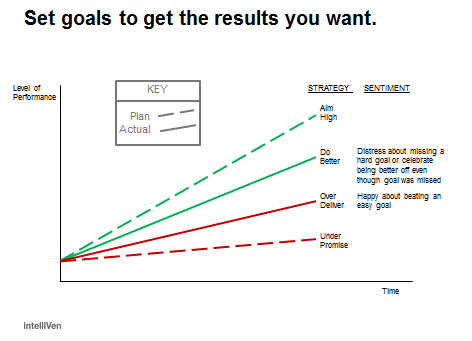
Set goals to get the results you want base
Figure-1: Under Promise and Over Deliver

Target Audience: Board, Bankers, and Investors

Objective: Manage downside risk while maintaining credibility.

Strategy: Present conservative, achievable targets to ensure a high probability of meeting or exceeding expectations. This approach builds trust and reassures stakeholders about the management team and their investment, offering a solid foundation for the future.

Outcome: Exceeding conservative estimates provides a reason for celebration and reinforces stakeholder confidenceas suggested by the under-promise and over-deliver lines graphed in Figure-1.

Management Plan: The Aim-High-Do-Better Method

Set goals to get the results you want full
Figure-2: Aim High and Do Better

Target Audience: Internal Management and Operating Teams

Objective: Maximize team performance and drive to achieve top-tier results.

Strategy: Set aggressive, yet attainable goals, understanding that they might be achieved 75-80% of the time. This encourages teams to stretch their capabilities and innovate, often leading to superior results compared to a conservative approach even when the goal is not attained.

Adaptation: If mid-period results deviate significantly, either above or below, from plan, be prepared to revise the goals to maintain momentum and direction through the rest of the performance period.

Outcome: Even if actual results fall slightly short of ambitious goals, the organization often ends up in a stronger position than if it had set more cautious targets as suggested by the aim-high and do-better lines added to the graph in Figure-2.

Summary: The Dual-Faceted Approach for Business Growth

  • Key Insight: Leaders of growing businesses should adopt a dual strategy in goal setting. Internally, aggressive but achievable goals fuel motivation and high performance, while externally, conservative, and intelligent goal setting satisfies the risk-averse nature of bankers and investors.
  • Result: This balanced approach ensures robust operational performance while maintaining the confidence and support of external financial stakeholders.