TL;DR
-
Investors’ first question is always your Ideal Customer Profile (ICP). If you can’t answer crisply, nothing else matters.
-
Most teams treat ICP as one question, but it’s really three:
WHAT do you provide?
WHO must have it now?
WHY do they choose you over alternatives?
-
Mis-alignment on any leg stalls growth—marketing targets the wrong buyers, product builds the wrong features, sales can’t close.
-
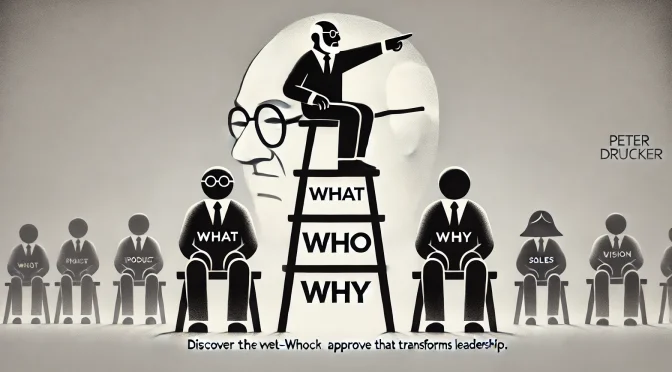
Drucker’s biographer calls IntelliVen’s WHAT–WHO–WHY framework “an innovation that changes the value of leadership.” It’s exactly the clarity Drucker preached.
-
Why teams still struggle: cognitive overload, functional bias (product vs. sales vs. vision), and thinking ICP is “one-and-done.”
-
IntelliVen’s MtL System + AI-powered IVOA Sandbox crowdsources input, exposes misalignment, and guides teams to a shared ICP they revisit continuously.
-
Results when everyone shares the same ICP: faster sales ramps, sharper product decisions, lower CAC, higher LTV—one enterprise software firm grew from start-up to a valuation of $2+ B.
-
Takeaway: Treat your ICP as a living strategic asset. Use WHAT–WHO–WHY to align your team, revisit it often, and growth will follow.
The Hidden Failure Pattern
Pursue any professional financing or acquisition, and you’ll face the same first question: “Who’s your ideal customer?” It sounds like a simple question deserving a simple answer. But it’s not.
Most funding requests and transactions stall right here. Without a crisp answer, investors and buyers move on. What’s more troubling is that even after securing funding or sale, ICP clarity remains the make-or-break factor for sustained success. CB Insights, for example, found that more than a third of all startup failures stem from unclear market fit: companies that never nailed their Ideal Customer Profile.
It turns out that even seasoned executives struggle with the ICP challenge. As a result, they’re inefficiently burning resources in predictable ways:
- Selling to customers who will never buy.
- Wasting time closing sales with customers who will not reach target Lifetime Value.
- Building features for people who don’t need them.
- Crafting messages that resonate with no one in particular because they’re trying not to exclude anyone rather than focusing on the ideal.
The right solution for the wrong customer fails. The wrong solution for the right customer fails. While these may seem like execution problems, they are really clarity and alignment problems.
Most people think that a query to describe their ICP is one question requiring one answer, whereas it is really three interconnected questions at once:
- WHAT do you deliver?
- WHO needs it most?
- WHY do they choose you?
Like a three-legged stool, if answers to any of the three is out of sync with one or both of the others, the cornerstone of the business caves-in. Marketing targets the wrong prospects. Sales struggles to close strategic deals in preference for deals of no strategic value (i.e., they are a waste of time!). Product builds features nobody wants. Teams pull in different directions, and so on.
What Would Drucker Say?
Peter Drucker, the father of management science, famously said, “The purpose of a business is to create a customer.” But what would the father of modern management think of our approach to tackling today’s ICP challenge?
We didn’t have to guess. Dr. Elizabeth Haas Edersheim (Drucker’s personally chosen biographer, former McKinsey senior partner, and MIT Sloan Ph.D.) joined our recent workshop. When asked what Drucker would think of our WHAT-WHO-WHY framework, her response was immediate:
“Peter defined innovation not as having a new idea, but by how much it changes the value delivered to customers. Your WHAT-WHO-WHY approach does exactly that—it fundamentally enhances the value leaders deliver. Drucker would have loved this because it clarifies purpose, aligns teams, and dramatically amplifies their collective impact.”
She continued:
“Drucker was deeply human-centric. Your method of bringing everyone to shared understanding of WHAT, WHO, and WHY doesn’t just clarify strategy—it unlocks human energy inside organizations. People can finally work with real purpose and clarity.”
Why Smart Teams Still Struggle
If the framework is straightforward, why do even experienced leaders find ICP clarity elusive? Three reasons:
Cognitive overload. Holding three interconnected dimensions in mind at once is mental work. Teams unconscious simplify, losing crucial nuance.
Functional bias. People gravitate toward their expertise. Product leaders obsess over WHAT. Sales focuses on WHO. Visionaries champion WHY. Without deliberate integration, teams optimize their piece while missing the whole.
Static thinking. Most treat ICP as a one-time exercise. But your ideal customer evolves as you do. The best-performing organizations revisit and refine their WHAT-WHO-WHY with regularity: embedding the framework into leadership rhythms, strategy sessions, and go-to-market planning.
Case Example
Here’s what happens when teams get the framework right. A consulting firm was stuck at $9M revenue, walking away from acquisition offers because they couldn’t get to their $12M target. Their WHAT-WHO-WHY was “we do stuff for money.”
After defining their true WHAT-WHO-WHY (visually stimulating strategy facilitation for U.S. Federal Government leaders who want to make a difference, accomplish missions, and get promoted), everything changed.
Four years later, they sold for $30M+.
But that’s just the beginning. Another company started using WHAT-WHO-WHY clarity at $15M revenue. They kept refining the framework through five private equity hold cycles. Today? North of $2 billion valuation.
The pattern isn’t luck. It’s what happens when organizations use clarity as a strategic asset, not a checkbox.
Whether you’re leading a startup seeking Series A, a nonprofit pursuing major donors, a church building community engagement, or a Fortune 500 division defending market share, the challenge remains the same. Every organization at every stage needs to answer the same three questions with precision. The framework works across all business models, capital structures, and geographies because the fundamental human need for clarity and alignment is universal.
Beyond the Foundation
Here’s what most people miss: WHAT-WHO-WHY clarity is powerful, but the framework is just the first element of what high-performing teams need.
Think of it as Truth #2 in our Manage to Lead system. It’s preceded by understanding your current context and followed by five more integrated truths about how teams actually execute and scale. Each builds on the others. Skip one, and even the best strategy stumbles.
The companies that outperform don’t just get their ICP right. They master the full sequence: how to assess where they stand, align everyone around the right priorities, plan change that works, execute without losing momentum, and remove the barriers that stop most teams from reaching their potential.
The Real Test
Your WHAT-WHO-WHY isn’t just a statement. The framework is a decision-making filter. When the framework is right, tough choices become obvious. Resource allocation gets clearer. Teams move faster because they’re no longer debating fundamentals.
When teams at inflection points (scaling, pivoting, fundraising, integrating new leadership) start with WHAT-WHO-WHY clarity, they compress months of alignment work into weeks. Not because the framework is magic, but because it surfaces and resolves the disconnects that otherwise create expensive detours.
Your Next Move
If you’re leading through change, start with the foundation. Download our WHAT-WHO-WHY template, or request access to the IntelliVen Sandbox where your team can work through this together—with AI-powered feedback that accelerates the iteration process.
But remember: the framework is just the beginning. The teams that win understand that clarity is built, not discovered. And building clarity requires more than one framework. Building clarity requires a system.
Get Clear. Align. Grow.
Ready to see what aligned clarity can unlock for your team?
• Explore the full Manage-to-Lead System at IntelliVen.com
• Request a 10-day IVOA Sandbox trial—just contact us and we’ll set you up
• Watch the 40-minute workshop Dr. Edersheim attended and hear her remarks firsthand
About the Author
Peter DiGiammarino has helped hundreds of leadership teams architect breakthrough performance across private, public, VC-backed, and PE-owned companies. His Manage to Lead system distills decades of operating experience into seven enduring truths and 60+ practical tools that guide teams through critical inflection points.