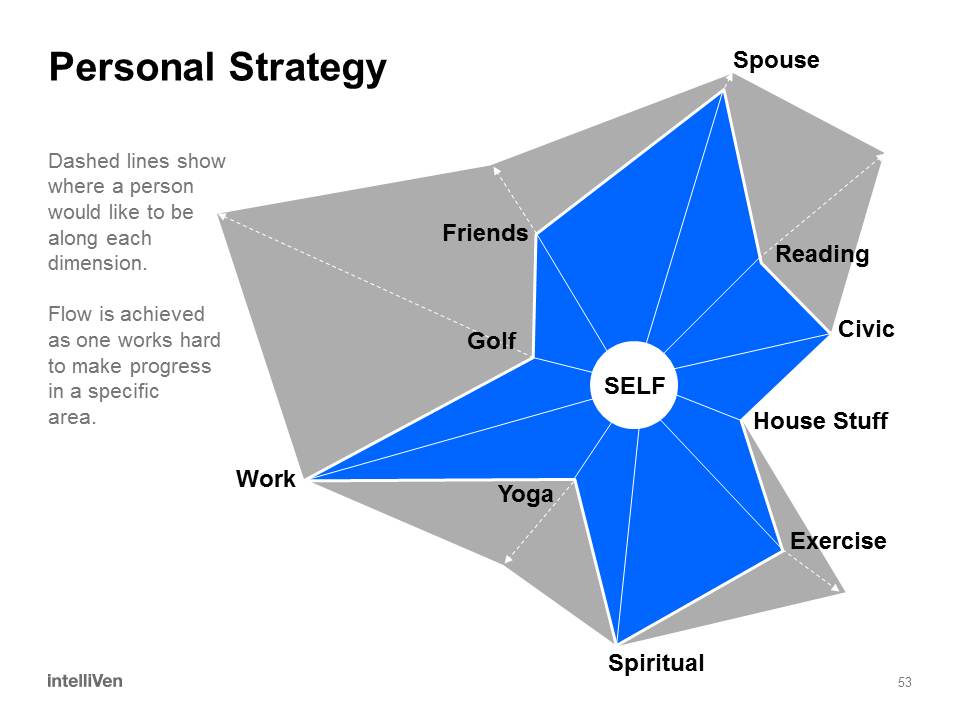
While putting full attention on accomplishing one thing increases the odds that the thing will be done well, it is all too easy for the career minded professional to end up doing nothing other than their work!
They would be wise to realize that top performers at all levels make time for other things such as family, recreation, exercise, spiritual development, and even volunteer work.
CEOs should consider the following when assigning tasks to leadership team members:
Members of the leadership team are likely to be the most capable people in the organization and therefore among the most important to deploy optimally.
Each needs to be especially clear about what is most important for them to do and then spend the lion-share of their time doing it.
If something is important to do, then someone important ought to be in charge of getting it done.
Each member of the top team ought to be in charge of something important.
It is not possible to be personally responsible for more than one or two important things at a time.
The idea is to ensure that at least what well-deployed leaders focus on goes well and to model how things should be done for the rest of the organization. Think of it this way: leadership team members don’t have to get everything right, but they each have to get something right.
The Problem
Most people, including even most top leaders, instinctively choose to spend their time doing many more than one or two things, possibly because in their minds:
Doing many things increases the odds that something will go well.
Having too many things to do gives a great excuse for not being successful at any particular thing.
The need to think hard about how to spend time is replaced by the much easier rule to spend time based on demands of the next email, text, tweet, phone call, conversation, knock on the door, etc.
Having so many things vying for attention makes a leader feel powerful and busy, often to the point of having a “Hero complex”.
On the other hand, having many things to do means the most important people do not meet their goals because:
Each task gets too little time, attention, and effort.
Each leader works hard, but gets little done, gets tired, loses confidence, and feels ineffective yet has an inflated sense of self importance.
The CEO’s job is to make clear what is most important for each leadership team member to do and to arrange for them to do it, and little-to-nothing else, even though it may cause leadership team members to feel a greater risk of failure.
The Solution
To solve the problem, the CEO should:
Work with each leader to rank their assignments in priority order.
Ask if the odds of success on the most important task would go up if the leadership team member were to spend more time on it. The answer will likely be “Yes”.
Tell the leader to spend all their time on their top priority task until the odds of success would not get any better with any more time on it.
Most leaders will shudder at the thought of having so little to do as they realize it is now incumbent on them to be successful at just one important task. It occurs quickly that they might not be successful. When they ask: “What if I fail?” the CEO should express so much confidence that the leader will succeed that s/he will absolve her/him of such risk and promise to assign yet another important task should she/he fail at this one.
The CEO should add that if the leader puts everything into completing an assigned task, but fails on six different tasks in sequence, then, and only then,maybe it will be time to discuss whether there is good fit with the organization.
The intent is to put the fear of failure far into the future to free the the leader to concentrate on the task they have been asked to do and not on the downside consequences of failure. The fear of failure thus moves from the leader to the CEO who is then highly motivated to provide assistance, resources, governance, and incentives to maximize the odds of success.
Related Points
When a matter comes up for discussion, ask if it is important. If it is, then ask who is in charge of making sure it goes well. If no one comes to mind then assign someone or second guess its importance.
When speaking with someone on the leadership team, ask what important thing they are responsible for completing. If nothing comes to mind then it is fair to wonder why they are on the leadership team.
If something is not important then no one should even be thinking about it.
The points presented in this post align well with Steven Covey’s parable about Big Rocks. and the first three principles of his7 Habits for Effective People: end in mind, first things first, and be proactive.
The CEO of a successful organization ensures that their inner circle of leaders, or Core Leadership Team, are individually and collectively clear about their relative strengths and on what the group counts on from each of them to be successful.
The exercise below is a structured and straightforward way to make expectations explicit and to open channels of communication between them enabling them to provide each other advice, guidance, feedback and support in a way that is efficient, edifying, and empowering to all involved.
Preparation
Ask executive team members to read the following IntelliVen posts in preparation for this exercise:
Before a break at an off-site, or in a meeting just for this, allot up to three hours for the exercise described below.
Set up
Ask each executive to print their name at the top of a sheet of newsprint laying on a table or hanging on the wall.
Under their name have them write the heading: Good at:
1/3 from the top write: What we count on from you:
1/2 way from the top write: Best Advice:
Data collection
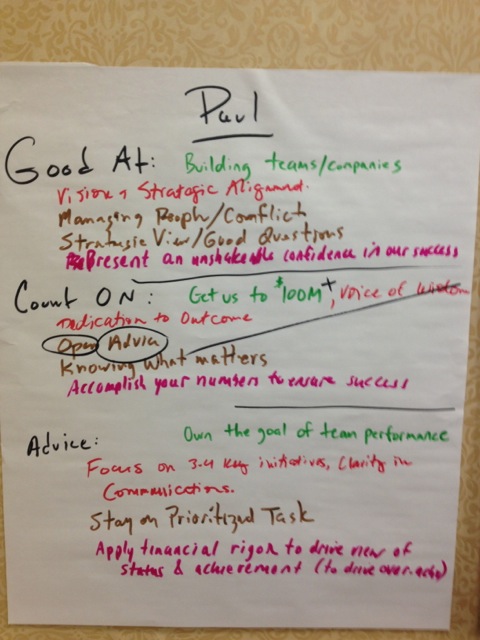
Example sheet for one of five executives who used the process described.
Ask each executive to move to the sheet to their right and fill in each of the three sections for the person whose name appears at the top. When everyone has finished writing, repeat the previous step for the next person to the right until each is standing back at the page with their name on it. Add additional newsprint if more space to write is needed.
Process
Step 1: Good At
Once everyone has recorded thier entries for all of the others, ask everyone to read carefully what is written under their name in theGood At section and then ask them to get ready to answer the following questions:
What clarifying questions do you have?
Do you agree that you are good at the things noted?
Are there other things you are good at that are missing?
Are there things you are surprised to see listed?
Have each person in-turn to read outloud what is written for them followed by their answers to the four questions above. Discuss what is said with the group until clarity is achieved and then move on to the next person.
Step 2: Count On
Once each executive has had a turn procesing the first section, ask them all to read carefully to themselves what is written under their name in the Count On section and then ask them to get ready to respond to the following:
Would you like to ask any clarifying questions?
Do you agree that listed items are your responsibility?
Is anything you are responsible for missing?
Do any of your items conflict with each other or with what is listed for others?
Are things listed consistent with what you are good at such that you can be successful doing them and such that your organization is getting highest-and-best use from you and your talents?
Ask each executive in turn to read outloud what is written for them and address the five questions above. Facilitate discussion until clarity is achieved and then move on to the next person until everyone has had a turn.
Step 3: Best Advice
Finally, ask them to read carefully to themselves what is written under Best Advice. Ask one executive to select one Best Advice item and invite her/him to:
Ask for clarification or explanation about what is meant by what is written.
Work hard to draw out what others have to say.
Not to be defensive in any way.
Repeat back what they hear to be sure they understand.
Iterate with the group until they are all clear, and until the group knows they are clear about what is being said and until all agree it is time to move on to the next point.
Repeat the process with the first Best Advice items for the next executive. When everyone has processed their first Best Advice item, start again with a second item and repeat until all items have been covered for each executive.
Step 4: Summary
Ask the group to discuss:
What they noticed during this exercise?
What they individually, and as a group, learned about their roles and the roles of others.
What was learned about how much they have to share with each other and how to do so?
Ask if a similar exercise should be done from time to time with their group and perhaps with other groups in which they work.
Bonus
If the group is feeling good from the exercise and there is energy for one more question, consider asking each executive to write down and then talk through what they feel is important for them to get better at in order to live up to the team’s expectations.
Pedagogy
A fundamental human need is to be known and understood by others. Steps 1 and 2 help each group member to feel known and understood by their teammates which creates the opportunity for a rich flow of information between them.
Step 3 builds on, and takes advantage of, the comfort established in Steps 1 and 2. The result is a deep sense of closeness and connectedness which allows each member of the group to share openly with the others and to be aggressively interested in what others have to say to them. Group members are thus able and inclined to help each other fulfill their potential individually and collectively in the press of day-to-day activity and not just at an offsite.
The exercise can and should be repeated from time to time to keep leaders synchronized and aligned. The best leaders will follow suit with similar exercises with their own teams. The odds of success with this exercise are dramatically improved when it is facilitated by a trained Organization Development professional.