Tag Archives: sales

Don’t go to the conference stupid!

While it’s possible that a qualified sales prospect might be seated next to you at a conference session or visit your booth, relying solely on chance encounters isn’t a smart strategy. The odds are just too slim to make random interactions a primary reason for attending.

The true value of attending an industry conference multiplies when it’s approached as a well-planned, strategic platform. A team committed to making the most of the experience can leverage the event before, during, and after to maximize its impact.

To maximize the opportunity, proactively engage with targeted executives ahead of the event. Every interaction is a chance to establish a meaningful connection around a shared interest—the conference itself. Use these moments to gather insights, influence thinking, and further cultivate interest in your organization’s offerings.

Along these lines:

    • Identify Targeted Prospects: Before the conference, research who will attend from your targeted prospects and arrange one-on-one meetings. Review advance materials to see who will speak, chair, host, or plan the event. Ask the organizers for a list of registered attendees from both this and last year’s conferences. Reach out to the individuals who are of interest to you and schedule a meeting—whether it’s for coffee, a drink, dinner, or a social function. Don’t wait until the conference begins; schedules for high-demand attendees will fill up fast.
    • Engage Executives from Targeted Organizations: Identify executives from companies that would benefit from attending the conference and personally invite them. Offer to assist with their travel arrangements, share a cab, or even sit together on the plane or train. After the event, follow up to discuss key takeaways and insights.
    • Host a Reception: Plan a reception to feature new offerings, insights, or thought leadership. Invite both current clients and prospective clients to enjoy the content as well as cocktails or hors d’oeuvres. It’s a great way to deepen relationships and engage with potential clients in a more relaxed environment.
    • Use Interactive Databases: Many conferences have online platforms that function like social networks, allowing you to filter attendees by criteria such as industry, geography, or role. Use these tools to identify potential connections and reach out through direct mail or messaging.
    • Foster Online Engagement: Encourage your team and contacts to participate in an online conversation before, during, and after the event. Follow the event’s official hashtag and key accounts. Share insights, quotes from sessions, and feedback throughout the conference. This online activity can help build a broader connection and keep the conversation going long after the event ends.

In addition to generating qualified sales leads, a conference provides a valuable opportunity to:

    • Position Your Team as Industry Leaders: Develop and showcase individual team members by having them emcee the conference, host a session, give a presentation, moderate or sit on a panel, deliver a keynote address, or sign and distribute original publications. These roles help establish your team as thought leaders in the industry.
    • Assess Competitors and Industry Trends: Use the event to observe other industry players and how they position themselves in the market. This insight will help you understand your competitive landscape and identify opportunities to differentiate your organization.
    • Enhance Your Company’s Reputation: Ensure your organization is recognized as an influential industry player by prospects, clients, competitors, partners, and suppliers. Active participation at conferences builds your brand’s authority and credibility.
    • Identify Potential Talent: Conferences are also great venues to spot strong candidates for recruitment. Keep an eye out for top industry talent and consider how they might fit into key roles within your team.

Finally, use the conference as an opportunity to develop, test, refine, and implement a screening script for those who visit your booth or attend sessions and social functions. It’s inefficient to engage deeply with everyone you encounter, as only a small percentage will be qualified prospects worth pursuing further.

Instead, shift the odds in your favor by quickly identifying and screening out individuals who aren’t a good fit. Then, use the time you would have spent with them to focus on identifying key prospects. Once you’ve pinpointed those individuals, find ways to be where they will be and make yourself known to them.

Five Steps to Turn a Prospect into a Sale

Developing a systematic approach to cultivating demand for its products and services is a key step in the evolution of every successful organization. Many early-stage leaders long for a silver-bullet solution; that is, they look to hire someone with a lot of contacts and an extroverted personality to hit the market and drum-up demand.  Such efforts usually fail.

Leaders cannot count on building a scalable demand creation system by hiring one super-salesman after another. There are simply not enough to go around. A better strategy is to figure out for themselves how to create demand for their offerings and then hire and train others to follow their lead.

What follows is a sure-fire method to systematically turn prospects into customers that every executive, client manager, product manager, and sales professional can and should add to their tool set.  It takes a lot of work to prepare properly and to execute well in a teaching-mindset, instead of a selling one, but those who are up to the task will be well-rewarded.

Step-1: Describe what you think your prospect is trying to accomplish.

Use all the data about a top prospect you can get your hands on to describe what problem they seeks to solve that your organization can help with.

Arrange a face-to-face meeting with the person in charge of solving the problem, for whom solving it is strategic, and who has the budget and business case to do so. After opening pleasantries, ask the following question in a nice way: Would you like to know what I think you think is the most important thing you are trying to do right now?”.

You can be sure of a positive response. It is human nature to want to know what someone else thinks you think. At the same time, no one expects what gets said to be 100% correct. They might even chuckle at that thought that you could come close knowing what they think. As a result, your prospect is sure to be interested in hearing what you have to say, even if just for the entertainment value!

This gives you a safe opening to lay out your best articulation of what you think they are trying to do. The beauty of this approach is that to the extent you get it right you gain credibility and, if you get it wrong, you get credit for trying and you will almost always get helpful input to get it right!  If you are right, or reasonably close, continue on to Step-2.

Step-2: Describe what others who have done the same found difficult.

Resist the temptation to sell at this point. Do not talk about how hard or important it is for the prospect to do what they are trying to do.  Doing so will invite resistance and cause the conversation to come to a grinding halt. Instead, talk about others to keep the conversation in a safe space and to invite the prospect to fully engage. Odds are they will lean forward and listen intently because you just might know what you are talking about and say something important.

Now is the time for you to make a good impression with a clear and articulate summary of what you know about the subject. Do not talk about your own organization or your products and services (i.e., resist the urge to start selling) and do not talk about the prospect’s organization or problems. Focus the conversation only on other organizations and what they have struggled with in a way that brings home just how hard it is to do this important thing well and to reveal that you know a great deal about how to do what needs to be done.

Sprinkle specific details about others with whom your prospect is likely to be familiar. Even better is if the examples relate to feared or hated competitors or to organizations the prospect admires and would like to emulate. While it does not matter in general if what you share comes from first-hand experience, from others you know or have worked with, or even from case literature, it is more genuine and adds more to your credibility if it is clear that you have had personal involvement.

In addition to building credibility, the objective of this step is to confirm that your prospect does indeed have the problem you are prepared to solve. If you start by saying:

Do you have problem X?

You run the risk that the prospect is reluctant to share the truth.  Instead, say:

Organization A had problem X”

Thereby creating the opportunity for your prospect to volunteer:

That’s amazing … we have the same issue!”

The net effect is to build your credibility while drawing out important information for you to use later.

Step-3: Describe how the best have succeeded.

Lay out the approach that the best use to accomplish what the prospect is trying to do. Odds are thatthey will be all ears as you help them see what important things they do not already know, but that they could know if you were on the team. On the other hand, if it turns out that they already know, and are already doing, what the best do then they may not be a good prospect after all.

Here, too, mention how you have personally been involved in some of the “best” cases. Remember that you always have three things to possibly sell:

  • Your company.
  • Your service or product offering.
  • Yourself.

Selling yourself is the easiest and most important of the three and this is your chance to sell yourself and make the sale. Your competence, engaging approach, and evidence of your experience make or break the sale at this point.

Step-4: Describe alternative courses of action.

Given what you know now about your prospect and what others have done, you are now in position to share alternative courses of action that could be followed. There are almost always at least three choices:

  • Continue as if you had never appeared.
  • Try to  follow the best practices you have presented without outside help.
  • Work with a knowledgeable third party to navigate the course you have outlined.

If what the prospect seeks to accomplish is truly important and the stakes are high, it would be foolish to continue as if you had never appeared. If it is hard to go it alone, then the obvious decision should be to get outside help assuming outside help is available and at a price that makes sense relative to the value of accomplishing the objective and the cost of failure.

The prospect could search for others to work with or they could work with you because you are:

  • Present in-person at that very moment.
  • The one who revealed the best path.
  • Brimming with credibility due to the way you made the case.

At this point, you have masterfully created the right time and place to share your approach to addressing the problem with high odds of landing a new customer in the following final step.

Step-5: Recommend next steps.

Use your best judgment to recommend which of the alternatives they should follow. Lay out what the prospect should do, what the prospect should have you do or provide, and what value that leads to for their organization. Make clear that what you would do is an important part of what your organization does and that it would be an honor to turn them from a prospect into a customer and under what terms.

If the prospect says: “no”, to retaining you then it is time to start selling. As they say: “selling begins when you hear the word ‘no’!” While so doing, be sure to learn the basis for resistance so you can factor it into your approach for next time.

On the other hand, if you hear:  “yes”, then you have made a sale by teaching and not by selling. Celebrate briefly and then proceed to package what you have done for future use and train others to so the same.

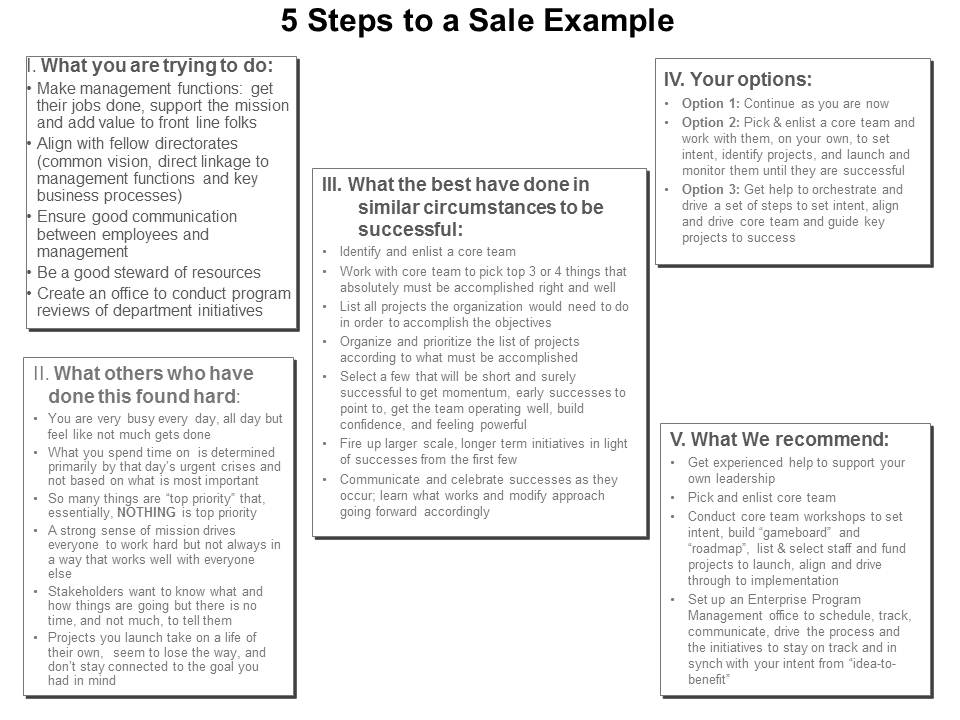
Example

The graphic below presents key points related to each of the five steps in a real example used by a firm that sold program management and governance services to top government agencies.

See Also

Five Steps to a Sale slide presentation

Three Steps to Selling a Services Work Plan

Whose problem is sales

Prospect to Customer Marketing