



Blog

When Attention Is the Constraint, Focus the Work and the Reviews

By Peter DiGiammarino

Most things go wrong because leaders are spread too thin, not because the work is impossible. When the volume of initiatives outstrips reviewer capacity, important items get little or no attention. Meetings slip. Mental presence drops. The fix is to match what we take on to the attention we can invest, and to raise the … Continue reading When Attention Is the Constraint, Focus the Work and the Reviews

The Architecture of Resilience: How Early Labor Silences Fear in High-Stakes Leadership

By Peter DiGiammarino

By: Richard Block From a very early age, working was a given. It was simply what you did. In reflecting on these early experiences and contrasting them with the lives of my children and grandchildren, I see a significant divide. The loss isn’t just in the paycheck; it is in the “patterns of behavior” that … Continue reading The Architecture of Resilience: How Early Labor Silences Fear in High-Stakes Leadership

From Tool to Teammate: Six Practices That Make AI Work for Us

By Peter DiGiammarino

At IntelliVen, we work from a defined body of leadership and management practice: the Manage to Lead (MtL) System. It is documented in our text, taught in our classes, and organized into more than sixty tools and templates and 70 insights and tutorials. We use these tools every day with clients and trainees and we are … Continue reading From Tool to Teammate: Six Practices That Make AI Work for Us

When there’s no right answer: get input, get commitment, then decide

By Peter DiGiammarino

Calls about who the team counts on for what are hard. Leaders worry about making valued people feel overlooked or diminished. Direct reports mostly want clarity, fair reasoning, and as much scope and recognition as they can reasonably earn. This post offers a way to handle those tensions: get input one-on-one, secure commitment to support … Continue reading When there’s no right answer: get input, get commitment, then decide

Say the Same Words. Mean the Same Things.

By Peter DiGiammarino

Walk into almost any leadership meeting and you will hear the same words: Vision. Strategy. Mandate. Values. Culture. Everyone nods. Everyone is confident they understand. Then you listen a little longer and realize something important: People are using the same words to mean different things … and different words to mean the same things. That … Continue reading Say the Same Words. Mean the Same Things.

Steering Committees: Engaging Stakeholders for Guidance, Commitment, and Growth

By Peter DiGiammarino

Note: A complementary reading for MtL Module 8 Get Help Leaders who “get help” know success comes not from going it alone but from surrounding themselves with structures that strengthen thinking, accountability, and action. In Manage to Lead, we emphasize the value of an Accountability Board, Advisory Board, Coach, and Peer Group. There is another … Continue reading Steering Committees: Engaging Stakeholders for Guidance, Commitment, and Growth

Process Maps Turn Confusion Into Clarity

By Peter DiGiammarino

Participants in IntelliVen’s Manage to Lead (MtL) program sometimes ask: “Why do we need to work on process maps?” It’s a fair question. The answer is that process mapping is not theory or busywork — it’s a practical tool you use on your own organization to turn hidden confusion into shared clarity. What follows explains … Continue reading Process Maps Turn Confusion Into Clarity

Purpose and Goals: Why You Need Both W-W-W and Mandate

By Peter DiGiammarino

W-W-W and Mandate: Two Distinct Tools, Both Essential When working on their business, leaders sometimes ask: Which sequence is right? W-W-W → Mandate Mandate → W-W-W Both sequences work. You need to work on both. W-W-W is about purpose. It clarifies identity by answering three simple but interconnected questions: WHAT do we provide? WHO do … Continue reading Purpose and Goals: Why You Need Both W-W-W and Mandate

What Would Peter Drucker Think of Your ICP?

By Peter DiGiammarino

TL;DR Investors’ first question is always your Ideal Customer Profile (ICP). If you can’t answer crisply, nothing else matters. Most teams treat ICP as one question, but it’s really three: WHAT do you provide? WHO must have it now? WHY do they choose you over alternatives? Mis-alignment on any leg stalls growth—marketing targets the wrong … Continue reading What Would Peter Drucker Think of Your ICP?

Use the IntelliVen Operations Advisor GPT to GET CLEAR and ALIGN

By Peter DiGiammarino

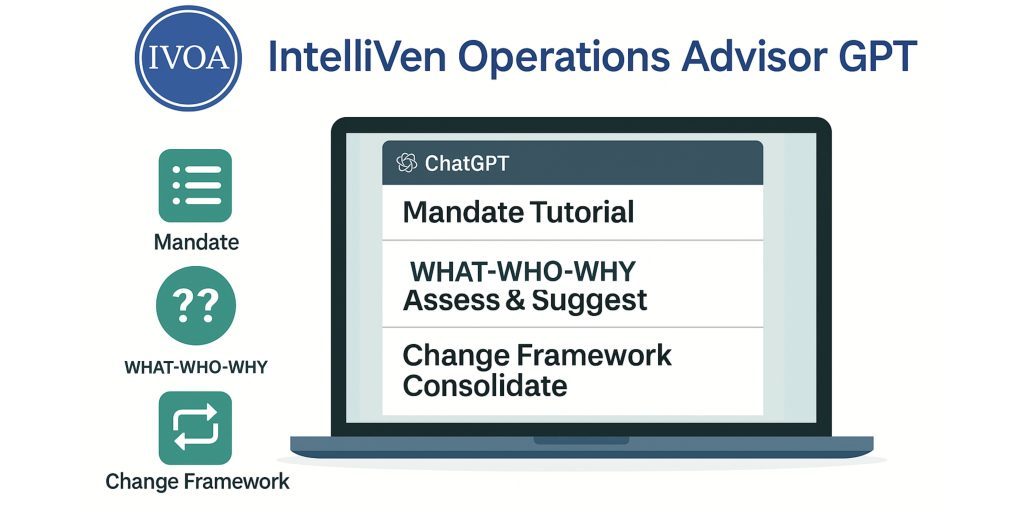
IntelliVen Manage to Lead tools now run on AI. Meet the IntelliVen Operations Advisor (IVOA) GPT. Tap into your familiar Mandate, WHAT-WHO-WHY, and Change Framework tools right inside ChatGPT—guided by our AI-trained Manage to Lead logic. It’s free for now—try it today: Go to: intelliven.com and open the RESOURCES menu tab. Select: IVOA  (you may … Continue reading Use the IntelliVen Operations Advisor GPT to GET CLEAR and ALIGN

How to administer annual salary actions in a fair and rational manner.

By Peter DiGiammarino | January 19, 2013

Labor costs are the largest expense for many organizations and so should be carefully and responsibly managed; every salary action should be taken seriously.  Nothing affects organization culture more than how people are paid. Less experienced managers and leaders may use salary actions as a way to keep staff happy thinking, perhaps, that they are … Continue reading How to administer annual salary actions in a fair and rational manner.

How to give employees feedback while also showing they are known and appreciated.

By Peter DiGiammarino | January 17, 2013

In order for an organization to grow, it is important for each person who works there to get and stay on track to career success. Towards that end, an annual appraisal process evaluates each employee’s performance and growth and provides employees feedback, guidance, and direction for development. Less experienced leaders may count on managers to … Continue reading How to give employees feedback while also showing they are known and appreciated.

How Core Leaders get clear about what problem their organization solves for whom.

By Peter DiGiammarino | January 6, 2013

Core Leaders who all describe the problem their organization solves for whom in the same way are apt to provide more consistent guidance and direction and so increase the odds of better performance across the board. To get clear or to test for clarity, invite each Core Leader to: Read and reflect on background related … Continue reading How Core Leaders get clear about what problem their organization solves for whom.

How to think about where competencies that generate great value fit in organizations as they evolve.

By Peter DiGiammarino | December 19, 2012

The application of behavioral psychology to organizations over the past 60 years or so has given rise to Organization Development tools, methods, and principles.  University programs and training labs have taught thousands of professionals in the rapidly evolving discipline.  Many of those trained wonder where they fit in the organizations that employ them. To set … Continue reading How to think about where competencies that generate great value fit in organizations as they evolve.

Growth is Good and Money Matters

By Peter DiGiammarino | December 3, 2012

Some students preparing to enter the work force and some early-stage professionals launching their career seek lines of pursuit that steer clear of what they believe to be the seamy, cut-throat, greedy world of business. A course of study in, for example, Organization Development that leads to a career in Human Resources for a non-profit, … Continue reading Growth is Good and Money Matters

How to decide what problem to solve.

By Peter DiGiammarino | November 13, 2012

An organization exists to solve a problem for people that have that problem. Organizations that seek to perform and grow are wise to be thoughtful about what problem to solve. Specifically, it is easiest for an organization to grow if the problem it solves is Important, Pervasive, and Persistent. It also helps if the solution … Continue reading How to decide what problem to solve.

How to increase the odds of successful high-stakes behavior change.

By Peter DiGiammarino | November 5, 2012

One way to get people to behave differently than they are used to doing is to tell them what to do and expect them to do it (as suggested by Figure-1). Clearly communicating target behavior is a good first step

How to Run a Great Strategic Initiatives Offsite Work Session

By Peter DiGiammarino | October 31, 2012

Many organizations embrace the need for their leaders to convene offsite, for a day or two, in order to advance their ability to achieve a desired future state and to improve group performance by crystallizing and preparing to launch one or more Strategic Initiative.  The best organizations know that to achieve optimum results such a session is … Continue reading How to Run a Great Strategic Initiatives Offsite Work Session

How organization leaders can make important changes while also developing the next generation of leaders.

By Peter DiGiammarino | October 22, 2012

Every organization has room to improve.  Most organization leaders know improvement is needed as well as how specifically they would like to evolve but do not have the time or energy to bring their clear ideas to fruition because they are short on leadership capacity. There is almost always a great deal of untapped capacity … Continue reading How organization leaders can make important changes while also developing the next generation of leaders.

How to find free, simple, and effective ways to optimize employee performance.

By Peter DiGiammarino | September 27, 2012

Jose Luis Romero, who lives and works in Mexico and who is an expert in the area of Employee Performance Optimization, teaches middle and upper level managers free, simple and the most effective ways to optimize employee performance. Jose Luis’ content is interesting and useful. For example, see his collection of mission statements and subscribe to his “Leader Newsletter” to receive … Continue reading How to find free, simple, and effective ways to optimize employee performance.

How entering executives can increase the odds of successful transition.

By Peter DiGiammarino | September 14, 2012

Fast-growing and otherwise successful organizations often outpace the rate at which they can groom and grow senior executives to keep up with the need to guide and govern increased scale and complexity of operations. Consequently, they bring top talent in from the outside. As outlined in a previous IntelliVen post, a senior hire is hardly … Continue reading How entering executives can increase the odds of successful transition.

How to talk about leaders and organizations for success.

By Peter DiGiammarino | September 2, 2012

Those in charge of any organization for success — no matter how large or small — and those who aspire to hold leadership roles, are wise to use terms and phrases in precise ways in order to be clear about what they think, say, and do.  This post compiles a number of such terms in one … Continue reading How to talk about leaders and organizations for success.