Category Archives: People Matters

Posts related to the people side of strategy and operations

How to Find a Job

It is a job to find a job … and most of those who are Open-to-Work do not do it well; in part because there is little time to find a new job while employed and, when unemployed, a sense of despondence, depression, or desperation may make it hard to perform at peak levels.

Three iterative steps can turn the average job seeker into their own search executive in charge of a stress-free campaign that is guaranteed to find a job and to grow as a professional from the experience.

STEP I: Get clear about what you want to do next.

Most do not get clear about what they want to do next because it is hard to do and because they do not want to rule anything out. Perhaps they hope to be pleasantly surprised by the jobs that others will just happen to offer them if they remain open.

Unfortunately, things do not usually work this way, except by sheer luck, especially for those well into their career. Asking a prospective employer to study a resume and propose a job is like a chef handing a restaurant patron a list of ingredients and asking what they would like to eat. It is too hard to do and the more experience and skills there are to look at, the worse the problem.

The odds of getting the job you want increase dramatically when you are clear about what you want. The preferred approach is to describe the ideal job in order to force a prospective employer to think about you in the context of something specific. This brings to mind corresponding openings if they exist and, if not, jobs that are near to it are likely to surface, first in the reader’s mind and then in conversation.

Job seekers need to get to the point where they can:

    • Describe their ideal job in a single written paragraph or in a few bullets.
    • Orally describe their ideal job in 30 seconds or less.
    • Smoothly work their 30-second message into casual conversation.
      Three Steps to Hire an Employer
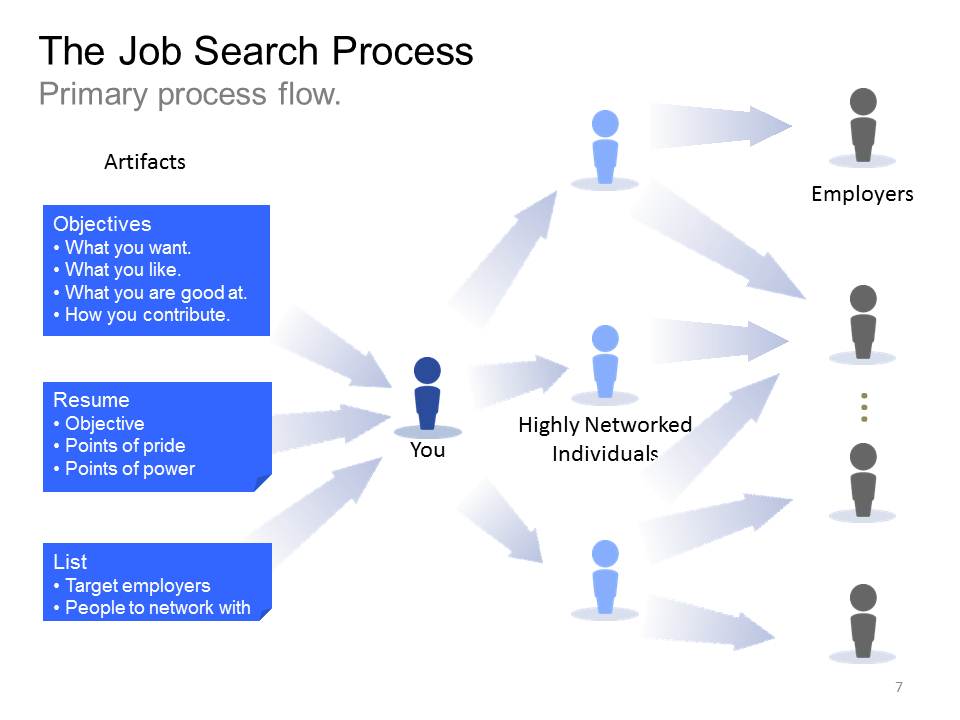
      Three Steps to Hire an Employer

STEP II: List ideal employers.

Do some research to come up with a list of named organizations at which it would be great to have your ideal next job. Select organizations that are thriving in an industry and in a geography of great interest. There is no point chasing jobs only to reject them in the end because they are not in an area of keen interest or in the right location.

It is best to be in the location in which you want to work. If the target location is not where you currently reside, arrange for an extended stay in your target location in order to immerse yourself in the area and not be dashing in and out.

Step III: List highly networked people you can connect with.

Compile a list of people who may be able to refer you to leaders in any of your target organizations. Ideal referrers are themselves successful and highly networked. Such people almost always have time to help someone make a productive connection.

Start connecting with those on your list by spending about an hour with a person you already know who might be a good referrer, perhaps over lunch, and follow this script:

    • Tell them about yourself and what you ideally want to do. Tell them directly that you seek their best advice and unvarnished counsel.
    • Show them your list of people you have targeted to network with. Let them offer to help connect you to those they know and to add to the list others that you hadn’t thought of.
    • Show them the list of organizations at which you might like to work. Let them react. By this point they should be tuned-in to you and to what you seek. This is the moment in which their best advice will flow. Listen carefully and draw them out fully. Do not refute or otherwise disrupt their flow. Record what is said word for word. At some point they are likely to lift up from looking at your list and say something like: “You know who you ought to speak with ….”.The best possible outcome is for them to get someone with a need to call you to discuss what you want to talk them about, so urge them to have those who come to their mind contact you; or at least to let them know that you have been encouraged to make contact.

Refine the definition of your ideal job, list of referrers, and target organizations based on input received and iterate through the three steps. Keep a running, prioritized list of the top prospective jobs. Focus on the top few prospects until an offer is received or until another opportunity emerges that belongs in the top-three.

When your receive an offer, use it as leverage to push other prospects to finally make offers as well. Your choice is then to either accept one of the offers (before you do, read these tips!) or start the process over again!
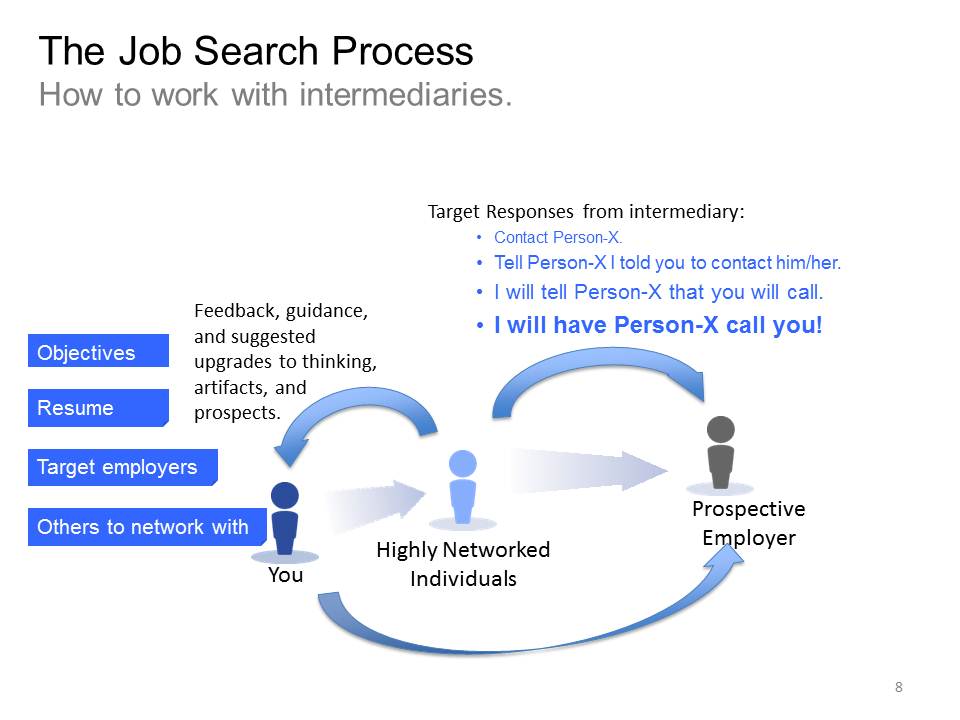
Three Steps to Hire an Employer - Networking Flow
Networking Flow

Note that in addition to helping to find a job, this approach also:

    • Develops networking skills.
    • Increases the extent to which you are networked.
    • Provides access to information that will be useful later.
    • Is fun, interesting and edifying.
    • Teaches how to sell … in this case you sell yourself but the steps work no matter what you have to sell.

The button below is to the above content presented in a Powerpoint slide deck.

Download Interview Questions

Related Posts

How to Sync Your Leadership Team’s Skills with Organizational Growth

If you are a CEO or a senior leader of a growing organization, you know how critical it is to have the right mix of skills, knowledge, and behaviors among your top team to drive growth and performance.

How do you adapt your team’s composition and dynamics to match the needs and demands at different stages of organization growth and change? How do you develop your collective leadership skills and capabilities as a team?

If you are looking for answers to these questions, the IntelliVen Strategic Executive Team Development Program is right for you. IntelliVen is the leading provider of leadership team development programs for organizations that want to achieve breakthrough performance and growth.

Strategic Executive Team Development Workshop

Our workshop differs in three ways:

  • We work with executive teams not just stand-alone individual leaders using multi-rater data.
  • We assess your team’s strengths and gaps, and tailor your development plan, to match ideal team skill-mix by stage of maturity.
  • We look forward, not backward. We help you envision the skill mix you need next and create an action plan to get it.

Skill Mix

There is no one-size-fits-all formula for building a successful executive team. Rather, there is a success norm by stage that indicates what skills are most relevant and important.

For example, at early stages of maturity, an organization needs executives with strong technical skills, entrepreneurial mindsets, and creative problem-solving abilities. At later stages, executives with operational excellence and stakeholder management skills are critical.

Strategic Executive Team Development Program:

  • Helps you assess where your team stands given success norms by stage.
  • Illuminates individual executive and team strengths and opportunities comparing them to success norms.
  • Targets hiring, development, and succession needs.
  • Provides an action plan to develop each executive for fast-track team performance improvement to fuel business growth.

About the Author

Dr. Brent Green is an organization psychology professional with a focus on individual executive and team performance, and system improvement. He has over 25 years experience in strategic leadership and organization assessment, training and development, evaluation, strategic wellness program design, and performance coaching.

Contact Dr. Brent Green, Principal for a no-obligation preliminary discussion about your team’s performance and growth.

Beyond the Paycheck: An Employee Guide to A Dream Job

Employee satisfaction is influenced by factors well beyond the paycheck. Research highlights the crucial role of elements like company culture, leadership quality, opportunities to advance critical skills, and career advancement opportunities in influencing workplace contentment across various income levels.

As Open Sourced Workplace notes, organizational culture, leadership behavior, skill development, and career advancement are intertwined, laying the groundwork for workspaces that promote growth, innovation, and employee engagement​​.

Non-monetary job characteristics that matter:

People

A key to a fulfilling job is the energy exchange among colleagues. Working with people who invigorate and inspire leads to a more enjoyable and productive work environment. It’s crucial to find a workplace where interactions are mutually energizing, fostering a positive atmosphere where employees look forward to engaging with each other.

Growth

A job with a growing company in an expanding industry offers vast opportunities for career advancement. However, it’s important the company manages its growth effectively. Rapid growth inevitably strains quality and culture. Ideal workplaces balance growth with maintaining a positive culture and outstanding performance, ensuring that expansion doesn’t compromise the quality of work or the workforce’s camaraderie.

Flexibility

The modern workplace recognizes flexibility as a key component of job appeal, particularly among younger generations. Companies offering flexible working arrangements, such as flexitime or tailored work schedules, cater to a workforce seeking balance and autonomy. This flexibility reflects a culture of trust and adaptability.

Wellness

Corporate wellness initiatives demonstrate commitment to a company’s human capital. Team outings, wellness programs, and gym memberships lead to fewer unhealthy days. Activities that bolster physical and mental health, like yoga or outdoor sports, enhance well-being and cognitive functioning, leading to greater productivity and workforce satisfaction.

Ownership

Employee share schemes effectively deepen engagement and loyalty. This sense of ownership translates to increased motivation and dedication, reducing turnover rates and boosting productivity, long-term company performance, and fostering unity and innovation. Most early stage professionals under-value ownership opportunities such that companies that take the time to educate and demonstrate the value of ownership are more.

Creativity

Even small businesses with limited resources, can offer unique compensation methods. Assisting with student loan payments, free meals, and opportunities for continuous learning are creative ways to show commitment to employee well-being and professional growth. Such initiatives enhance job satisfaction, retention, and the company’s reputation, especially in rapidly changing technological industries.

Conclusion

While a competitive salary is essential, a range of creative compensation methods can significantly enhance job satisfaction and productivity. Incorporating wellness programs, flexible work options, employee ownershp, and continuous learning and advancement opportunities transforms a regular posting into a dream job. These benefits reflect a company’s commitment to its employees and contribute to a dynamic, innovative, and cohesive workplace culture​​​​.

SEE ALSO

How to find a job

Resume Writing Tips

Ways to Improve Your Resume

What to do when the hiring manager says name your terms.

Tips for those Seeking their Next Job

Six P’s to peak meeting performance.

Transform the way you participate in board sessions, executive reviews, operating meetings, design and code walkthroughs, All Hands meetings, interviews, and more! Adopt the **Six Ps** for enhanced individual and group performance.Formula for Success - Intelliven

Prepare

Read materials sent in advance with enough lead-time to reflect on their content. If you are the meeting owner, make it easy for attendees to prepare, and for you and your team to step-back and develop perspective, by distributing background materials at least two days ahead.

Show uP

Attend! You cannot contribute if you do not attend both physically (even if electronically) and mentally. The most common reason meetings under-perform is that key participants, usually the most senior, are called away at the last minute to attend to urgent matters. There is no better formula for increasing the odds that the matter covered in the meeting they missed will someday cause its own urgency instead of smoothly performing to its highest potential.

Remember that all meetings start before they begin and end well after they are over. Those that come late and leave early may successfully convey how busy and important they are but at the high cost of missing more than they realize in terms of what they get, and what they could give, in order to ensure the best possible results.

Pay Attention

When someone talks: listen.  Stay in-the-moment and concentrate to understand fully what is said. Do not allow your mind to wander, check for messages, or go on mute to simultaneously take another call or address other matters on the side.

Once a key thought or two have passed you by, it can be difficult to get back into the flow of what is being said. The more senior you are, the higher the stakes are to paying attention. Doing so ensures you will not waste the group’s time catching you up on what has already been covered when you re-engage and it is the only way to ensure that important opportunities to provide input and guidance are not missed.

To concentrate, it helps to write-down the exact words being said as they are spoken. Do not generalize, paraphrase, or add value; just write what you hear to stay focused. Another method is to play-back silently in your mind words spoken as they are heard. The objective is to hear and understand only what is said.

If what you hear does not make sense or otherwise leaves you with a question, check with the speaker to be sure you heard correctly. Chances are that if it helps you to check it out, it will help others as well. It also encourages the speaker to know they are being heard and listened to carefully.

Clarifying questions generally increase the odds that the group will reach a higher level of insight and understanding before offering recommendations, conclusions, or moving on to another point.

Think Powerfully

Give serious consideration to advance material, what is shared in the meeting, and what is said. Internalize, organize, and consolidate what you take in and compare with your own store of knowledge and prior experience to reach levels of insight and understanding that might help push the group’s work forward.

Develop a Point-of-View (PoV)

Push to go beyond taking in information and analyzing it in order to have a Point-of-View on the matter under discussion. If  you need more information, ask for it. On the other hand, do not  lock-in to a point-of-view too soon.  

Be sure to listen to all sides, ask clarifying  questions, think powerfully (i.e., critically), and then develop a Point-of-View. Both developing a PoV too soon and not developing a PoV at all, may signal laziness, lack of self-confidence, lesser ability (and that you may not belong in the meeting), and contribute to your own, and the group’s, under-performing.

Participate

Don’t just sit there … say something! That said, it is not a good use of the group’s time for you to think out loud or to speak just to hear yourself talk. Speak once you have paid attention, asked good clarifying questions, thought powerfully, and developed a Point-of-View worth sharing. Before speaking, edit what you plan to say in order to speak efficiently and not take too much air-time.

There is a lot going on inside the head of every participant at every meeting. No one gets all this right every meeting but it helps to have a plan and a method to consciously follow. Helicopter-up from time to time to reflect on how things are going. If you are not engaged and participating then why are you there at all?  

If you wonder how it is that someone like you could be in a position to contribute in such a forum, remember that the meeting organizer asked you to attend because they wanted your input and participation. Give yourself permission to be present and to participate fully. Try it, notice how it feels to participate, learn from the experience, and know that you will get better and find it easier and easier with practice.

Finally, push yourself to share what you have to say in the meeting and do not wait to whisper thoughts to one or two other attendees with whom you are most comfortable after the meeting ends and when it is too late for the group to benefit from what you have to share.

Conclusion: Make Every Meeting Count

Embrace these principles and notice the difference in your participation and the meeting’s outcome. Remember, your input is valued, so give yourself permission to be fully present and engaged.

Share your experiences and tips in the comments below!

See Also

Meeting Ground Rules

Meeting Records

Four Steps to a Smooth Transition

Below are four steps to smooth the transition out of a top role. It is critical to execute the steps in order. (See also: Transitions: Making Sense of Life’s Changes by William Bridges):

Get Out Clean

Most leaders are not experienced at dismissing someone, especially senior people, so your departure may be chaotic and traumatic for your manager and even for the HR folks involved, though not nearly as much as for you. They will have decided on who will tell you that you are leaving, why, and what they want you to do now.

Once the writing is on the wall, it is best not to fight it or to ask for another chance. Draw them out with clarifying questions until you fully understand what is going on, their reasoning, and their intentions. Write down everything they say, word for word, to stay focused and to jog your memory later.

Collect and organize your thoughts before you say or do anything else, especially something you might regret later. Your first objective is to get the best terms you can on the way out. Maintaining civility is your best strategy.

Empty your office and desk, process pending expense reimbursement requests, read through your employment contract and severance agreements to be sure you know what is due you and do what you need to do to get it.

Study your employment agreement and the firm’s policies. Explore similar recent termination cases to discover how the organization has treated others who were asked to leave. In the absence of a policy, or if there is a policy but it is not consistently followed, the firm’s actual actions are their de facto policy.

Don’t be vindictive and don’t demand any more than you are due according to consistently enforced company policy, your employment contract, or by law, except as a negotiating strategy to be sure you get what you are due. Unless there is blatant cause, stay away from lawsuits because they take a lot of time, money and exact a huge emotional toll.

If the most generous terms ever offered are better than the terms proposed in your case, draw attention to the precedent and ask for an explanation as to why it should not be the same in your case. Explain that you don’t want anything special, just what is fair based on past practices. For example, if you are a long-term employee given two weeks notice per the firm’s written policy but someone else was given two weeks plus an additional week for every year of service, you have good grounds to ask for similar treatment.

Your settlement negotiations will be eased if there is something the firm wants from you, such as a promise not to work for a competitor, your agreement not to sue them for age or other forms of discrimination, non-solicitation of their employees for hire, or your promise not to say bad things about the firm to recruits, competitors, or the press.

Determine who is to represent the firm on your case and focus your energy primarily on working with them to get out clean. More than likely, you will have more time to spend on this than they do, so you can be well prepared for any discussions. Talk to others who have had similar experiences. Seek professional legal counsel only if you feel particularly vulnerable and if you have resources to cover the expense. Most of the benefit may be that your lawyer will be happy to talk to you, though at a hefty hourly rate.

Things to remember to ask for:

  • Your computer and any other equipment that has
    become part of your life.
  • Funds to cover executive coaching, help with writing your resume, legal fees, and outplacement services.
  • Personal files and supplies.
  • Agreed upon wording for a reference that describes you and your departure in the best possible light.
  • Long-term forwarding of emails.
  • Continued use of postal, e-mail, voice mail, and secretarial services for a while.
  • Cash settlement of accrued vacation, sick days, and overtime.
  • Information on continuing your health insurance for up to 18 months under COBRA laws.

Consolidate Lessons Learned

Before rushing off to find your next job, take time to think through what happened in this job to determine what there is to learn from the experience. Were there warning signs? What could you have done to prevent it? Get past blaming everyone else. Be clear about what you were trying to do and what you had done to make it that way. Study the case to determine what went right and what went wrong.

Write down what you have come up with and review it with a close friend or advisor or two to be sure you are being honest with yourself and that you are seeing everything there is to see.

Follow the methodology laid out in this post led by an outside, impartial executive coach.

Do Something Special

Treat yourself to something that you wouldn’t normally do. Take a golf weekend or a trip to the mountains … anything to give you the sense of having had a special, relaxing period between jobs.

Figure Out Next Steps

Determine what you want to do next and read this post: “Three Steps to Hiring Yourself an Employer.”