
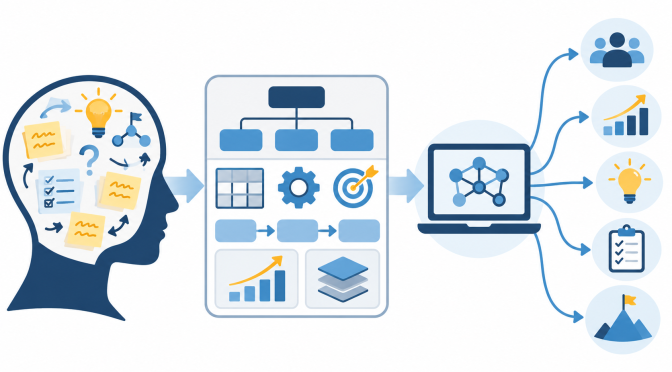
Many experienced consultants, coaches, advisors, leaders, authors, and educators believe they know how to do what they do. Usually they do know a great deal. They have accumulated experience, judgment, patterns, practices, instincts, and lessons over years of work. They recognize situations quickly, know what questions to ask, see things others miss, and often produce excellent results.
But there is an important distinction between having experience and having a knowledge system.
What is in your head is not yet a knowledge system. A knowledge system makes explicit what you know, why it works, how to apply it, what good looks like, and how others can use the same thinking consistently. It can be examined, tested, taught, shared, improved, and applied without depending entirely on the person who developed it.
AI is making that distinction much harder to ignore.
How systematic is what you think you know?
For years, capable professionals could get by quite well by “winging it.” A client presents a situation. You draw on experience, ask questions, recognize patterns, and offer guidance. Next month another client presents what appears to be a similar situation. Do you approach it the same way? Do you remember the reasoning that led you to the earlier recommendation? Would a colleague assess the situation similarly? Are you even using important terms to mean the same things?
Those questions expose something that has always been true: expertise that resides primarily in individual heads is difficult to make consistent, align across colleagues, transfer to others, or improve systematically.
Think of it as a rough analogy to the Capability Maturity Model. At the highest level of process maturity, an organization does not merely perform well because capable people know what to do. The process is explicit, measured, understood, repeatable, and continuously improved. Ask yourself the analogous question about your expertise: Is the way you access and apply what you know approaching that level of maturity?
Can you explain why one course of action is better than another? Can someone else apply the same logic and reach a compatible conclusion? Can you tell whether your own application today is better than it was a year ago? Can colleagues identify and work through genuine differences in their thinking rather than unknowingly operating from different assumptions?
If not, what you call knowledge may still depend heavily on memory, intuition, personal judgment, and improvisation. Those can all be valuable. But they are not the same as a coherent knowledge system.
Not everything that makes an experienced professional effective can or should be reduced to rules. Judgment, relationships, timing, political awareness, emotional intelligence, and the ability to read a situation remain important. A knowledge system does not replace those capabilities. It makes explicit what can be made explicit so that professional judgment can operate from a stronger, more consistent foundation.
AI raises the stakes
General-purpose AI is extraordinarily good at something experienced professionals have long been paid to do: absorb a situation, draw on a large reservoir of knowledge, recognize patterns, and generate plausible analysis and recommendations.
Generic AI makes improvisation widely available, which increases the value of expertise that is explicit, systematic, and consistently applied.
If your expertise is largely tacit, AI exposes how much of your value depends on what happens to come to mind in a particular situation. A general-purpose model can improvise too. It can generate polished analysis, frameworks, questions, coaching advice, meeting plans, and recommendations in seconds.
Our experience suggests an increasingly important divide. Professionals who make more of their knowledge explicit can use AI to extend their reach, improve consistency, support colleagues and clients, and strengthen how their expertise is applied. As general-purpose AI makes high-quality improvisation increasingly accessible, the value of explicit, systematic, and consistently applied expertise grows.
AI raises the stakes
General-purpose AI is extraordinarily good at something experienced professionals have long been paid to do: absorb a situation, draw on a large reservoir of knowledge, recognize patterns, and generate plausible analysis and recommendations.
Generic AI makes improvisation widely available, which increases the value of expertise that is explicit, systematic, and consistently applied.
If your expertise is largely tacit, AI exposes how much of your value depends on what happens to come to mind in a particular situation. A general-purpose model can improvise too. It can generate polished analysis, frameworks, questions, coaching advice, meeting plans, and recommendations in seconds.
AI can give a bad answer. A more difficult problem is that it can give an answer that sounds very good. Without a defined body of knowledge, logic, distinctions, and standards against which to assess the answer, how do you know whether it actually is good?
That creates an increasingly important divide. Professionals who can make their knowledge systematic can use AI to extend their reach, improve consistency, support colleagues and clients, and continuously strengthen how their expertise is applied. Those who continue to depend primarily on what they remember and improvise case by case will increasingly compete with generic AI doing much the same thing, only much faster.
AI needs something to work from
It is no longer a question of whether to use AI. The consequential question is: What body of knowledge and logic do I want AI to work from as it helps me think, decide, and act?
There are three practical answers:
- codify your own knowledge, logic, methods, and standards well enough for AI to work from them
- deliberately adopt a body of knowledge and practice developed by others that you understand and believe in
- use general-purpose AI where broad knowledge and good prompting are sufficient for the work at hand
The choice depends on the work. The more consequential the judgment, the more distinctive the expertise, and the more important consistency is across people and situations, the more valuable it becomes to give AI a defined body of knowledge and logic to work from.
That last option is easy and often useful. But it means the model is drawing primarily on its general training rather than on a coherent way of thinking about the work that you have deliberately chosen. Fluency and plausibility are not the same as sound guidance.
The first option offers enormous potential. If you can make explicit what you know, why it works, how to apply it, and what good looks like, AI can give that knowledge tremendous leverage. Instead of reconstructing your thinking for every situation, you can make it available repeatedly and consistently. Colleagues can work from the same foundation. Clients can use more of your thinking without requiring you to be present every moment. Different interpretations become visible and can be resolved. The knowledge itself can improve as experience accumulates.
There is just one catch: doing this well is much harder than uploading a collection of documents.
We learned this by doing it
At IntelliVen, we had a significant head start. We already worked from a defined body of leadership and management knowledge and practice called the Manage to Lead System. It is documented in our text, taught in our programs, embodied in more than sixty tools and templates, and supported by scores of tutorials and insights. IntelliVen consultants have used and refined this body of work for years with leaders and leadership teams.
Even with that foundation, turning Manage to Lead into something AI could apply reliably took considerable time, judgment, testing, refinement, and patience.
We had to determine what belonged in the core body of knowledge. We had to make the underlying logic and relationships among concepts more explicit. We had to establish standards for what strong work looks like and develop rubrics against which work could be assessed. We had to specify how the system should respond when information is incomplete, when ideas conflict, and when judgment rather than a formula is required.
In an earlier post, From Tool to Teammate: Six Practices That Make AI Work for Us, we described much of what we learned in that process. The essential lesson was that good AI support requires more than content. It requires knowledge, logic for applying the knowledge, and ground rules that govern how the knowledge and logic are used.
The result of that work is the IntelliVen Operations Advisor, or IVOA.
IVOA combines Manage to Lead knowledge with the logic for applying it. It can assess leadership work, suggest improvements, compare perspectives, consolidate ideas, surface differences, draw inferences from existing material, and help leaders determine what to do next.
IVOA is now available beyond the IntelliVen environment. As described in our recent post, IVOA Is Now Available as a ChatGPT Plugin, leaders, consultants, coaches, advisors, and others can bring Manage to Lead knowledge and logic directly into the ChatGPT conversations where they are already working.
That is an example of the leverage a knowledge system can create.
You do not necessarily need to build your own
The implications are especially important for consultants, coaches, and advisors whose expertise has developed primarily through experience rather than through a formal methodology.
Perhaps you have long thought that someday you should capture what you know so associates can use it, clients can learn from it, and you do not have to personally recreate the work every time. AI gives you a powerful new reason to do so.
If your own distinctive knowledge is central to the value you create, codifying it and making it AI-ready may be well worth the effort. Building a knowledge system makes the most sense when that knowledge is itself an important asset and worth the time required to codify, test, govern, maintain, and improve it. Our experience can help show what that requires.
Authors, educators, and others who have already captured much of what they know in books, courses, frameworks, or teaching materials have a head start. Their knowledge is already more explicit. Their next challenge is to make the underlying logic, distinctions, standards, and guidance for application explicit enough for AI to work with the material well rather than simply retrieve or summarize it.
For many consultants, coaches, and advisors, however, building a proprietary knowledge system from scratch may not be the best use of time. Another path is to choose an established knowledge system that fits the work you do and use it as the foundation against which you apply your own experience and judgment.
Choosing a knowledge system gives your experience a foundation that shapes how you interpret situations, what you look for, and how you apply what you know. When the system fits the work, it adds structure, depth, a common vocabulary, explicit logic, tested tools, and standards against which to think and act.
You give it structure, additional depth, a common vocabulary, explicit logic, tested tools, and standards against which to work.
That is one reason we have made Manage to Lead and IVOA broadly available.
A consultant or coach working with a leadership team does not need to spend years developing a complete leadership and management system before benefiting from one. The consultant or coach brings experience, relationships, judgment, and knowledge of the client situation. Manage to Lead provides a coherent leadership and governance operating system for understanding the organization, deciding what should happen next, and guiding how leaders work together to make it happen. IVOA makes that knowledge and logic available when and where it is needed.
From individual expertise to shared capability
The opportunity becomes even greater when more than one person is involved.
A consultant may believe one thing while a colleague believes another. Several members of a leadership team may all say they understand the organization’s strategy while actually holding materially different interpretations. People regularly use the same words to mean different things and different words to mean the same things.
Knowledge that has been made explicit gives people something they can examine together. Differences that were previously hidden can be surfaced. Assumptions can be tested. Reasoning can be compared. Better ideas can emerge. Shared understanding can be developed rather than assumed.
The IntelliVen Leadership Workspace is designed for this next level of application. IVOA applies Manage to Lead knowledge and reasoning while leaders work through Mandates, WHAT-WHO-WHY, Change Frameworks, initiatives, measures, governance, and other aspects of running and developing an organization. The Workspace accumulates the team’s thinking so the work can build on itself rather than repeatedly start over.
Individuals get leverage from a knowledge system. Teams get something more: a common system through which they can develop and maintain shared understanding.
Decide what AI will know when it works with you
AI creates a new and more useful form for professional knowledge. A book can explain what you know, a course can teach it, and a consultant can apply it personally. A well-developed knowledge system supported by AI can make the underlying thinking available to many people, consistently and when they need it.
That creates an uncomfortable but useful question for anyone whose livelihood depends on expertise: Is what you think you know explicit, coherent, and systematic enough for AI to give it leverage? If it is, make it AI-ready and use AI to extend what your knowledge can accomplish. If it is not, decide whether your distinctive expertise is valuable enough to justify the work required to make it systematic, or deliberately attach yourself to a knowledge system you believe in and bring your own experience and judgment to it.
For people whose work involves leading, managing, governing, growing, or changing organizations, Manage to Lead is one such system. IVOA makes its knowledge and logic available through AI, and the Leadership Workspace gives leaders and teams a place to apply it together.
The important thing is to choose. Otherwise general-purpose AI will choose the knowledge base for you.