Category Archives: Governance

MtL Alumni: Strategy Offsites Start Before You Go

Great strategy discussions start before people walk into the room.

As planning season approaches, remember that the best discussions never begin when leadership gathers for an offsite. They begin weeks earlier.

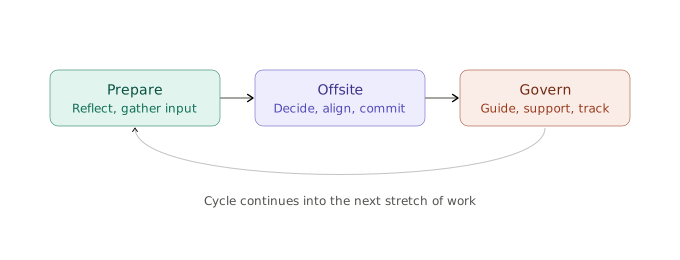
Strong teams clarify and share their thinking before they meet. They compare perspectives, challenge assumptions, sharpen priorities, and work together toward a shared understanding of what they seek to accomplish, where they are now, and what is most important to do next.

Because you’ve participated in a Manage to Lead training program, you already know the methods that support this work.

  • You know how WHAT-WHO-WHY clarifies purpose and Ideal Customer Profile (ICP).
  • You know the importance of agreeing on a Mandate.
  • You know how an Enterprise Change Framework helps leaders align around where things are now, why they must change, where they want to be next, and what needs to happen to get there.

A Pleasant Surprise

We’ve recently had the opportunity to watch several teams apply these methods as part of their planning, operations, and governance processes.

What has been encouraging is not just the quality of the outputs:

  • It’s what happens to the conversations.
  • The most important change isn’t in the plans.
  • It’s in how leaders work together.

What surprised us most

We expected teams to produce better plans.

We did not expect people to become more interested in understanding what their colleagues were thinking.

That shift in behavior may be the most important outcome of all.

People became more interested in understanding what their colleagues were thinking. In short, teams improved both what they accomplished and how they worked together. That observation has reinforced something we’ve believed for a long time.

Structured Cohesion in a Distributed World

Manage to Lead is primarily about helping leaders work together effectively. Tools and technology support that work by providing structure and shared language.

Their greatest value, however, comes from helping leadership teams build habits that create clarity, alignment, accountability, and coherence in a distributed world.

In today’s highly distributed organizations, that capability is increasingly important. Teams operate across functions, time zones, competing priorities, and often in different ways. These are all okay and necessary, provided there is an ongoing commitment to bring individual thinking back to the team in a way others can understand, challenge, and build upon.

Success depends less on being in the same room and more on sharing the same understanding. We’ve started referring to this as structured cohesion: creating shared understanding and alignment such that people work independently while moving forward together. When structured cohesion exists, teams require less coordination because they share more understanding.

Introducing the MtL Leadership Workspace

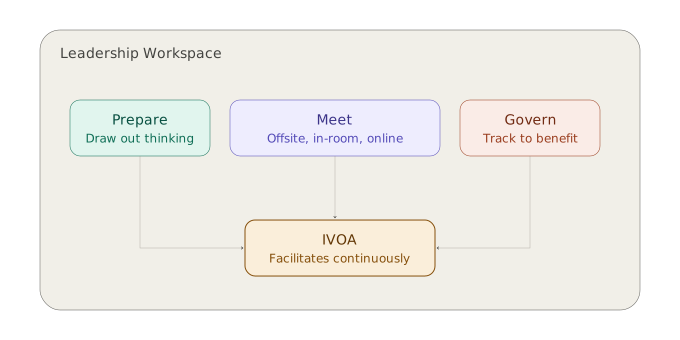
To help leadership teams apply Manage to Lead methods more consistently, we recently introduced the MtL Leadership Workspace, powered by the IntelliVen Operations Advisor (IVOA) GPT.

Built around the same methods and disciplines taught in Manage to Lead, the workspace provides guidance, feedback, and facilitation support as teams clarify priorities, align perspectives, prepare for reviews, refine initiatives, capture decisions, and stay connected to what matters most.

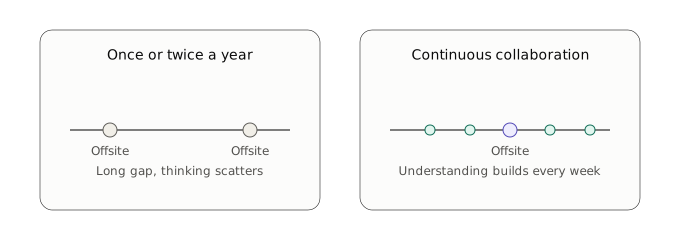
The workspace helps teams continue the conversation between offsites, review meetings, and workshops. It supports both real-time and asynchronous collaboration, helping leadership teams stay aligned even when they are highly dispersed.

The goal is straightforward: Make it easy for teams to work before they convene so they can have better conversations when they come together. At the same time, the workspace improves preparation, documentation, follow-through, and shared understanding of decisions and commitments.

As alumni, you already know the methods. The MtL Leadership Workspace simply provides another way to use them with your team.

Learning Doesn’t End with the Cohort

Past Manage to Lead participants are welcome to enroll in future cohorts at no charge.

Great leadership teams are always learning. Every cohort brings new experiences, new questions, and new insights that strengthen our collective understanding and help us continue to Get Clear. Align. Grow. Together.

As you prepare for your next planning session, strategy discussion, or major initiative, we invite you to explore the MtL Leadership Workspace.

The workspace can help your team clarify priorities, develop and refine WHAT-WHO-WHY, align around Mandate, build Enterprise and Initiative Change Frameworks, prepare for planning discussions, capture insights, and strengthen accountability between meetings. It is particularly useful in supporting the continuous work of getting clear, aligning, and growing, together.

Getting started is simple. Select Workspace from the IntelliVen main menu:

  1. Create an account
  2. Name a workspace
  3. Invite team members
  4. Share your thinking using the Manage to Lead tools

The workspace provides guidance and facilitation support along the way, helping teams make progress wherever they are, in real time or asynchronously.

We want teams to be able to experiment and learn without barriers, so a generous amount of capacity is available at no cost. Organizations that need additional usage, advanced capabilities, or broader deployment can contact IntelliVen to discuss options.

Great strategy discussions start before people walk into the room. The MtL Leadership Workspace gives teams a place to do that work together. We look forward to seeing how you apply these practices to your next challenge and continue building the habits that help teams

Get Clear. Align. Grow. Together.

Suggested Additional Reading

Your Team’s Leadership Workspace is Now Available

For years, IntelliVen has helped leaders:

Get Clear. Align. Grow. Together.

Effective leadership requires clear thinking, disciplined execution, and alignment across decisions and actions.

With this post, we announce the availability of the IntelliVen Leadership Workspace, a collaborative environment that brings together the Manage to Lead tools with AI-guided support to help leadership teams draw out and share their thinking, decide what to do, and act together.

The Leadership Workspace gives teams a shared place to develop, refine, communicate, and govern the core elements that drive organization performance and growth.

Work begins with the organization’s Mandate and Purpose through WHAT-WHO-WHY. It continues through Enterprise and Initiative Change Frameworks, strategic initiatives, heat maps, governance, executive reviews, and performance management.

Organizations today operate in a distributed, networked world. Teams span functions, locations, and increasingly, different ways of working. As organizations grow, maintaining alignment and shared understanding becomes a leadership challenge in its own right.

The Leadership Workspace helps teams create and maintain structured coherence across leadership, strategy, initiatives, execution, and governance. Leaders compare thinking, surface differences, refine ideas, and build shared understanding. Over time, teams develop common language, strong decision-making habits, and a more disciplined way of working that manifests as an evolution in leadership culture.

Each Workspace combines the proven Manage to Lead tools with AI-guided assessment, refinement, inference, consolidation, and collaboration support. Teams use it to strengthen their thinking, improve alignment, guide execution, and govern performance.

The result is a practical environment where leadership teams can sustain alignment and coordinated action in a distributed, networked world.

Leadership teams are invited to create and collaborate in their own Workspace to:

• Define and refine their Mandate

• Clarify purpose using WHAT-WHO-WHY

• Develop and communicate Enterprise and Initiative Change Frameworks

• Launch, guide, support, and govern strategic initiatives

• Visualize priorities and tradeoffs with Heat Maps

• Conduct Executive Reviews

• Compare thinking across leaders

• Surface hidden misalignment

• Consolidate toward shared positions

• Assess, challenge, refine, infer, and improve thinking with AI

• Generate recommendations for moving from NOW to NEXT

The Leadership Workspace helps teams get clear, align, and execute through periods of growth, change, and inflection.

Getting started is simple:

• Select WORKSPACE from the IntelliVen menu

• Create an account and an organization code of your choice

• Invite others into your Workspace

• Start working

No setup project.

No implementation effort.

Simply enter your thinking and submit it for assessment, feedback, and suggestions.

Substantial usage capacity is available at no cost. Organizations that require additional capacity may upgrade as needed. Organizations with unique requirements are welcome to contact IntelliVen to discuss tailored arrangements.

For those who want to accelerate adoption, training is available through the Manage to Lead Enterprise Leadership System for Governance and Operations.

We built the Leadership Workspace to help leadership teams develop the clarity, alignment, governance, and execution capability required to thrive in today’s distributed world.

Get Clear. Align. Grow. Together.

We hope you find it useful.

Peter DiGiammarino

Finding the CEO for What Comes Next

An IntelliVen Insight by Eric Palmer.
AI is not a feature cycle.
It is a reset of SaaS economics.

Eric Palmer, a highly successful Senior Operating Partner with more than 30 years of experience leading private, public, private equity-owned, and venture-backed companies, recently shared what he is seeing across  software businesses.

Eric uses and has contributed to the development of the Manage to Lead Executive Alignment System for Operations and Governance.

His perspective comes from inside boardrooms, executive searches, and portfolio performance reviews. It is direct.


Act 1: What Is Happening Inside PE-Backed SaaS Companies

Across portfolios, three pressures are converging.

Reinvention as AI-first, not AI-augmented

  • Many companies are using AI to optimize what already exists. That feels safe. It preserves roadmaps. It protects org structures.
  • It is not enough.
  • The companies gaining ground are redesigning around AI economics. That requires discontinuous change, not incremental improvement.

Pricing and economic disruption

  • Seat counts are declining. Usage-based economics are rising. AI inclusion without pricing discipline can destroy margin.
  • CFOs want predictability. Customers resist variability. Boards want growth and protection of uFCF.
  • The old SaaS model is under stress.

Bookings uncertainty

  • Buyers are hesitating. Some are delaying category decisions altogether, assuming today’s leaders may not be tomorrow’s.
  • Expansion is harder. Contraction is visible.
  • Incrementalism does not solve this.

Act 2: The CEO This Moment Demands

The traditional SaaS CEO profile is now necessary but insufficient.

Operational excellence. Team building. Customer focus.

All still required.

But the differentiator now is the ability to lead discontinuous change under pressure.

Eric identifies eight characteristics that matter most:

  • Conviction to lead transformation, not manage transition
  • Audacious goals that reorient behavior before the roadmap is complete
  • Ruthless resource reallocation, even mid-cycle
  • Willingness to reconfigure strong legacy leaders
  • AI fluency that reshapes economics, org design, and personal workflow
  • Commercial ownership of the seam between Product and GTM
  • Resilience under sustained, ambiguous pressure
  • Ability to move at board velocity in a PE environment

In his words, some CEOs optimize what is working.

The ones that win are willing to discontinue what is working in order to win what is next.

Eric also points out that AI-first professionals entering the workforce understand the technology. They have urgency. They have ambition.

What most lack are the leadership and management disciplines required to:

  • Align an executive team
  • Govern resource allocation
  • Make hard priority decisions
  • Integrate Product and GTM
  • Drive change across a fully formed organization

Technology fluency alone does not create durable enterprise value.

The missing ingredient is not more AI capability. It is executive alignment around Purpose, priorities, and resource allocation. That is the problem the Manage to Lead Executive Alignment System was built to solve.

AI capability without executive alignment produces motion.
AI capability with alignment produces performance.

The Question for Boards and Investors

  • Are we selecting for transformation or comfort?
  • Is our CEO AI fluent or AI enthusiastic?
  • Can our executive team reallocate resources without waiting for the next planning cycle?
  • Do we have alignment equal to our technical ambition?

The Variable That Determines Value Creation

Valuations are under pressure.

The path back is not cost cutting alone.

It is radical AI-oriented change that:

  • Accelerates productivity and uFCF
  • Increases RPE at unprecedented speed
  • Reinvests gains into top-line expansion

Those that are audacious and aligned will capture disproportionate share.

Some will.

Many will not.

The CEO is the variable.

Read Eric Palmer’s full article:
“Finding the CEO for What Comes Next.”

Dual-Track Goal Setting: Harmonizing Management Ambition with Stakeholder Assurance

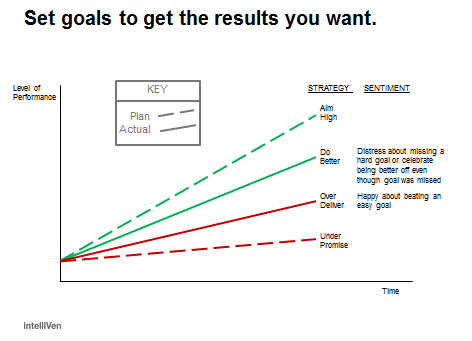
The best approach to setting annual performance goals for an organization is to simultaneously pursue two paths, one for the management team and one for the board, investors, and lenders as outlined below.

Stakeholder Plan: The Under-Promise-Over-Deliver Approach

Set goals to get the results you want base
Figure-1: Under Promise and Over Deliver

Target Audience: Board, Bankers, and Investors

Objective: Manage downside risk while maintaining credibility.

Strategy: Present conservative, achievable targets to ensure a high probability of meeting or exceeding expectations. This approach builds trust and reassures stakeholders about the management team and their investment, offering a solid foundation for the future.

Outcome: Exceeding conservative estimates provides a reason for celebration and reinforces stakeholder confidenceas suggested by the under-promise and over-deliver lines graphed in Figure-1.

Management Plan: The Aim-High-Do-Better Method

Set goals to get the results you want full
Figure-2: Aim High and Do Better

Target Audience: Internal Management and Operating Teams

Objective: Maximize team performance and drive to achieve top-tier results.

Strategy: Set aggressive, yet attainable goals, understanding that they might be achieved 75-80% of the time. This encourages teams to stretch their capabilities and innovate, often leading to superior results compared to a conservative approach even when the goal is not attained.

Adaptation: If mid-period results deviate significantly, either above or below, from plan, be prepared to revise the goals to maintain momentum and direction through the rest of the performance period.

Outcome: Even if actual results fall slightly short of ambitious goals, the organization often ends up in a stronger position than if it had set more cautious targets as suggested by the aim-high and do-better lines added to the graph in Figure-2.

Summary: The Dual-Faceted Approach for Business Growth

  • Key Insight: Leaders of growing businesses should adopt a dual strategy in goal setting. Internally, aggressive but achievable goals fuel motivation and high performance, while externally, conservative, and intelligent goal setting satisfies the risk-averse nature of bankers and investors.
  • Result: This balanced approach ensures robust operational performance while maintaining the confidence and support of external financial stakeholders.

Optimizing Your Board of Directors: A Guide for Fast-Growing Private Companies

Growing private companies often encounter challenges in establishing an effective board of directors. Typically, boards comprise well-meaning individuals who meet periodically, usually for a few hours up to a couple of days. However, these meetings frequently become sessions to celebrate company successes rather than critically examining company performance against its board-approved plans and strategic initiatives for the year.

For these companies, it’s vital to have a diverse board, including external directors who offer unbiased insights and prevent family / founder / owner dominance. Establishing clear governance policies and procedures is essential, as they define the roles and responsibilities of each board member. Moreover, regular board meetings focused on progress towards strategic goals, rather than on operating details, are crucial.

This post outlines best practices for efficient private company board meetings, ensuring that your time together is well-spent. We also provide a template for an effective board meeting agenda.

The Board Agenda – Your Roadmap to Efficiency

Preparation is Key

  • The board chair should distribute a draft agenda 4-5 days before the meeting, soliciting upgrades and additional topics.
  • Agendas must be clear, concise, and focused on performance metrics, strategic goals, and pressing issues.

Best Practices for Productive Meetings

  • Limit meetings to three hours to maintain focus and energy.
  • Introduce new items for information only, with decisions deferred to subsequent meetings after thoughtful review.
  • Distribute materials a day or two in advance, allowing members to come prepared.
  • Allocate time for informal interaction before and after the meeting to foster trust and collaboration.
  • Record and distribute key action items, decisions, and insights promptly after the meeting.

Agenda Template

  • 10-min: Administrative matters (e.g., by-law updates, approve minutes from prior meeting, etc.)
  • 15-min: CEO’s overview of the business state
  • 20-min: Financial performance review of actual results vs. plan and projections
  • 20–40-min/ea: Updates and discussion of strategic initiatives (up to three) and / or committee (e.g., compensation committee, governance committee, audit committee) reports
  • 10-20-min: New or walk-on items
  • 5-20-min: Future meeting topics
  • 5-min: Adjournment and reminders of meeting Action Items, Decisions, and Insights

This template is flexible and can be adjusted to fit the unique needs of your board.

Conclusion

Setting up and managing an efficient board for fast-growing private companies is both challenging and rewarding. By adopting these best practices and using a structured agenda, boards can offer valuable guidance and oversight, enhancing their collaboration with the management team.

See Also

Click the figure above for a summary of Accountability Board Support Characteristics

 About The Author

David Halwig, IntelliVen Co-Founder and President of Mid-Atlantic Region, provides strategic management consulting and advisory services to leaders whose organizations are at critical inflection points. David helps improve governance, leader development, strategic planning, and risk management. He also has substantial experience with merger and acquisition strategies, valuation, and transition approaches.  

Connect with David on LinkedIn