
Tag Archives: organization maturity

How to Sync Your Leadership Team’s Skills with Organizational Growth

If you are a CEO or a senior leader of a growing organization, you know how critical it is to have the right mix of skills, knowledge, and behaviors among your top team to drive growth and performance.

How do you adapt your team’s composition and dynamics to match the needs and demands at different stages of organization growth and change? How do you develop your collective leadership skills and capabilities as a team?
If you are looking for answers to these questions, the IntelliVen Strategic Executive Team Development Program is right for you. IntelliVen is the leading provider of leadership team development programs for organizations that want to achieve breakthrough performance and growth.

Strategic Executive Team Development Workshop

Our workshop differs in three ways:

  • We work with executive teams not just stand-alone individual leaders using multi-rater data.
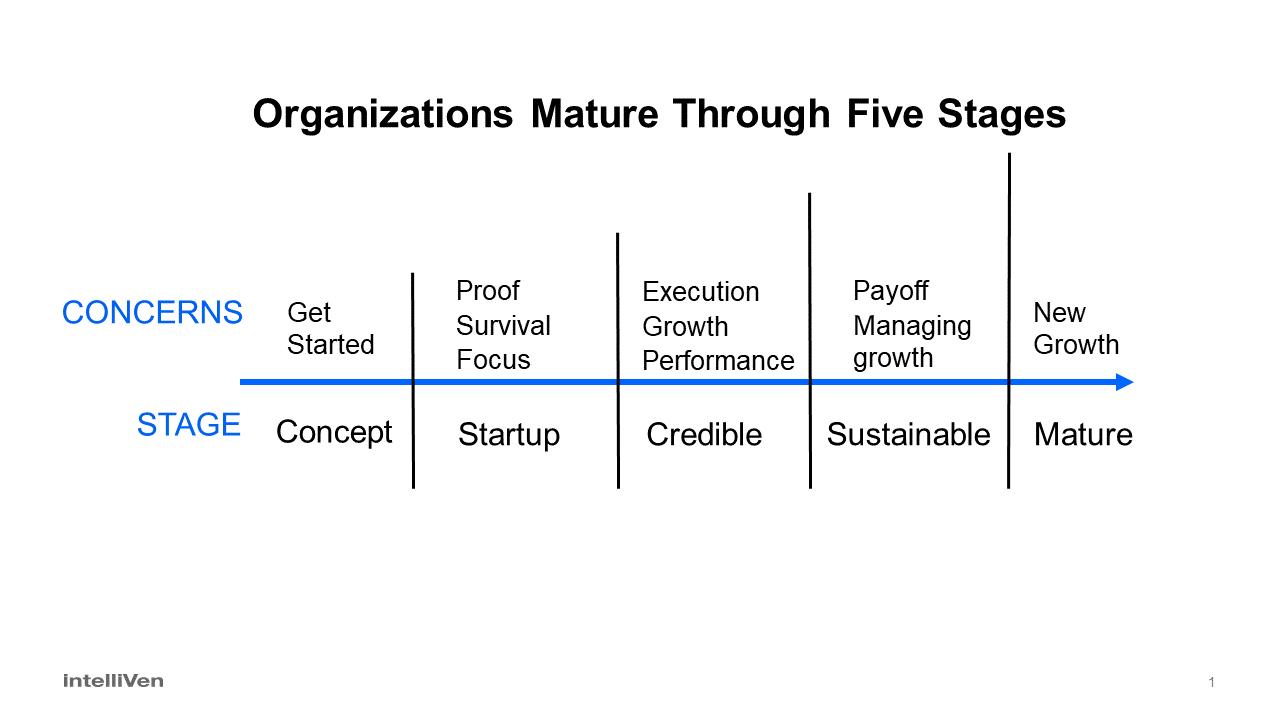
  • We assess your team’s strengths and gaps, and tailor your development plan, to match ideal team skill-mix by stage of maturity.
  • We look forward, not backward. We help you envision the skill mix you need next and create an action plan to get it.

Skill Mix

There is no one-size-fits-all formula for building a successful executive team. Rather, there is a success norm by stage that indicates what skills are most relevant and important.

For example, at early stages of maturity, an organization needs executives with strong technical skills, entrepreneurial mindsets, and creative problem-solving abilities. At later stages, executives with operational excellence and stakeholder management skills are critical.

Strategic Executive Team Development Program:

  • Helps you assess where your team stands given success norms by stage.
  • Illuminates individual executive and team strengths and opportunities comparing them to success norms.
  • Targets hiring, development, and succession needs.
  • Provides an action plan to develop each executive for fast-track team performance improvement to fuel business growth.

About the Author

Dr. Brent Green is an organization psychology professional with a focus on individual executive and team performance, and system improvement. He has over 25 years experience in strategic leadership and organization assessment, training and development, evaluation, strategic wellness program design, and performance coaching.

Contact Dr. Brent Green, Principal for a no-obligation preliminary discussion about your team’s performance and growth.
What an organization must do in order to perform and grow.

Imagine:

  • An organization that does not know how it will meet the demands of its current customers, or
  • An organization that has no idea where its next customer will come from, or
  • An organization that does not know how it will acquire resources needed to meet a surge in demand.

Such organizations exist and they are stuck. That is, their ability to perform and grow is severely constrained.

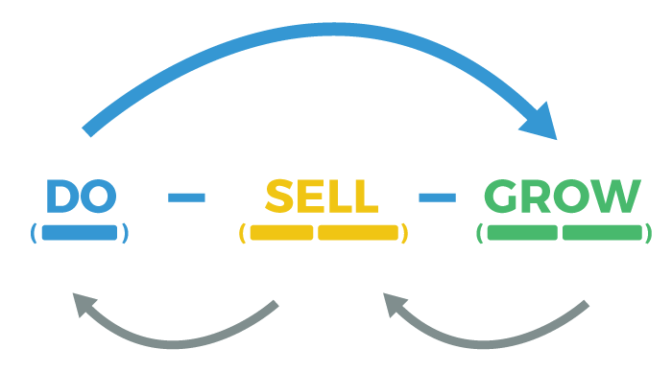
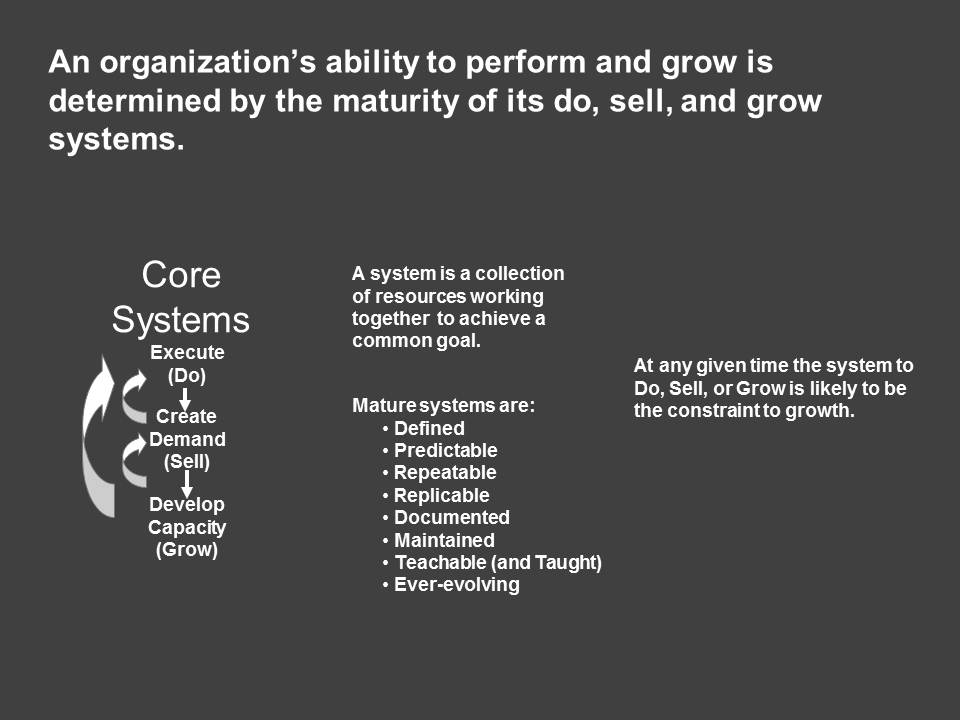
Organizations that experience sustained growth and high performance execute, create demand, and develop capacity in orderly, or systematic, ways. A system is a collection of resources working together to accomplish a common goal. The resources of an organization aggregate into three essential systems:

  • The Execution System, or what the organization does to Do what it does.
  • The Demand Creation System, or what the organization does to Sell what it does, including marketing, lead generation, sales, sales engineering, proposal writing, and sales support.
  • The Capacity Development System, or what the organization does to Grow, including training, recruiting, fund raising, performance assessment, goal setting, systems development, and process engineering.

Anything an organization does other than Do, Sell, or Grow, and that makes sense to continue doing, should be to facilitate, improve, or otherwise efficiently support its ability to Do, Sell, and Grow.

An organization that has execution problems essentially has no other problems because there is no point to growing or to landing new customers if the organization cannot even Do what it does to reliably deliver to customers it already has.  Without a way to capture, organize, and distribute its collective knowledge from serving customers, an organization may have just a collection of unconnected experiences such that every new customer may be a “whole new adventure”.  An organization that does not know for certain how it will meet delivery obligations runs serious risks and will find it difficult, if not impossible, to maintain control over the quality of its products and services.

Once there is a reliable way to execute, there is confidence to generate demand.  However, without a way to generate demand that is predictable, repeatable, replicable, documented, maintained, taught, and ever-evolving, the organization’s ability to Do and Grow is likely to be constrained by its ability to Sell.

When new sales cause demand to exceed delivery capacity, it must Grow capacity to deliver.  When capacity to deliver exceeds demand, it must Grow sales capacity.  A growing organization needs to be clear about how it will add capacity to Do and how it will add capacity to Sell.  For many organizations, this means identifying and cultivating sources of people, recruiting, and professional development.

At any time an organization’s ability to perform and grow tends to be constrained by one of the three core systems. Leadership’s job is to decide which system needs to evolve next and how.

For example, if a product provider generates more demand than can be handled by existing operations, then more production capacity is required.  Once production capacity is in place, sales capacity may need to expand in order to put the increased production capacity to work.  However, the amount of sales capacity should likely need to increase at a much slower rate than the rate of delivery capacity because a little more selling capacity should drive the need for a lot more delivery capacity.

In this sense, then, the evolution of Do, Sell, and Grow systems is iterative and staggered with execution capacity out in front of demand creation which is out in front of capacity to grow.

The larger and more complex an organization is, the more important it is for it to Do, Sell, and Grow in ways that are characteristic of more mature systems(see prior post on How growing organizations should go about evolving systems and processes); that is they need to be more:

  • defined,
  • predictable,
  • repeatable,
  • replicable,
  • documented,
  • maintained,
  • taught, and
  • revised to reflect lessons learned from experience.
Successful organizations systematically Do, Sell, and Grow
Figure 1: Successful organizations systematically Do, Sell, and Grow.

As summarized in Figure 1:

  • Organizations have three core systems to Do, Sell, and Grow what they do.
  • At any time one of the three core systems is likely constraining growth.
  • Leadership’s job is to determine which system is constraining growth and to develop that system to the point where it is no longer the constraint.
  • As an organization grows in size and/or complexity it is important for their Do, Sell, and Grow systems to mature.

See also: ISO 9000 (https://www.iso.org/iso/iso_9000/), Baldridge award program (https://www.nist.gov/baldrige/), CMMi (https://www.sei.cmu.edu/cmmi/), and other programs that encourage and help organization to improve the maturity of their systems and processes.