Category Archives: Operations

Maximizing the Value of Review Meetings

Periodic reviews are critical for keeping important initiatives, functions, and projects on track in an organization. However, maximizing the value from review meetings takes thoughtful effort from both the reviewers and those presenting their work (the reviewees).

Too often, one or both do not put in the necessary preparation or exhibit good practices during the review resulting in an unproductive meeting. By understanding and executing on the key responsibilities for each role, reviews can be transformed into productive learning experiences.

Responsibilities of the Reviewer

  • As a reviewer, you have the vital role to create an environment conducive to an open and honest discussion. This starts well before the meeting with your careful review of pre-read materials. Your job is to develop informed questions and hypotheses to pressure test during the meeting itself.
  • A best practice is to share your initial questions and perspective with the reviewee in advance. This allows them to understand where you are coming from, hone their thinking, and essentially start the review meeting before it officially begins. Provide framing upfront for a more productive dialogue in the review.
  • Once in the meeting, resist the urge to jump straight to your pre-conceived notions. Instead, actively listen to the reviewee’s presentation with an open mind. Ask clarifying questions to ensure you fully understand the current state and ask well formulated questions to push up thinking, before offering opinions or advice. The best reviewers make the reviewee feel heard and can see the situation through their eyes.
  • With a common understanding established, it’s then time for hard questions. Don’t hold back . Say what needs to be said and apply pressure to the reviewee’s thinking. Challenge assumptions, probe for gaps or inconsistencies, and push to consider alternative perspectives. However, do it in a constructive way, being careful to separate the person from the points.
  • Finally, provide clear guidance on the path forward, explaining your thought process. Remain open to final thoughts from the reviewee before setting expectations. Keep the review a two-way dialogue, i.e., a quest for truth!.

Responsibilities of the Reviewee

  • Presenting during a high-stakes review meeting is highly stressful. However, reviewees must resist the urge to treat it as a one-way presentation. Effective reviewees embrace the meeting as a collaborative problem-solving session by being vulnerable and open to feedback.
  • The preparation should focus not just on materials summarizing the current state, but also anticipating the tough questions reviewers are likely to ask. Be ready to back up your assumptions, analysis, and recommendations with data and reasoning. At the same time, avoid being overly attached to your original ideas and be open to altogether change coursing course based on the discussion.
  • During the meeting, reviewees should temporarily park their leadership responsibilities. Resist giving into the urge to justify everything. Instead, actively listen (i.e., repeat back to the speaker what you heard) to be sure you understand reviewers’ perspectives, concerns and recommendations with a beginner’s mindset, as if hearing it for the first time. Ask clarifying questions, take detailed notes, and extend the discussion with a genuine desire to learn.
  • With reviewers’ guidance absorbed, the hard work is still ahead. Reviewees must internalize and promptly act on the suggestions, including updating plans and re-doing analysis as needed.

Summary

High quality reviews are hard work for both parties. Reviewers must create a psychologically safe environment, genuinely understand the current state before reacting, and then push reviewees’ thinking while providing clear guidance.

Reviewees in turn must be vulnerable, keeping an open mind to altogether pivot based on the discussion and immediately implement the feedback through more work. Shirking these responsibilities leads to disastrous review meetings that simply check a box. Whereas, embracing the mindsets and following the suggestions above turns reviews into powerful tools for accelerating success.

See Also

Launching the First Cohort of the Enhanced “Manage to Lead: The Path to Breakthrough Performance” on Maven

We’re thrilled to announce that IntelliVen’s flagship course, Manage to Lead: The Path to Breakthrough Performance is about to debut on Maven with significant upgrades and enhancements.

Since it was developed for American University in 2010, the 10-module MtL course has empowered hundreds of leaders and their teams to achieve breakthrough  improvements in performance and growth. Today, we’re inviting you to be part of the inaugural cohort on Maven, where you’ll experience the program like never before.

What’s New

Our commitment to continuous improvement has led us to refine and enhance the course while also making it more accessible to more people. Each module is updated to reflect the latest thinking in organization and leadership development. If you’re looking to drive change through implementing strategic initiatives, MtL will equip you with the tools and methods you need to get the results you seek.

Special Introductory Offer

To celebrate the launch on Maven, we’re offering an exclusive introductory price of just $500 per student for leaders and their teams of three or more. This is a unique opportunity to access a transformative leadership journey at an exceptional value.

Join Manage to Lead: The Path to Breakthrough Performance for comprehensive learning. In ten carefully constructed modules you learn tools and methods for everything from setting vision and aligning resources, to motivating action.

  • Your Case IS the Course: Battle tested tools and methods apply directly to your leadership challenges for immediate improvement.
  • Learning Community: Engage with a diverse cohort of like-minded leaders, sharing insights and building networks.
  • Expert Guidance: Benefit from the wisdom and experience of successful outside reviewers and instructors.

Be Ready to Lead Differently

Join us as we embark on this journey to elevate leadership practices and achieve breakthrough improvement. The inaugural cohort on Maven is your chance to be at the forefront of leadership excellence.
To learn more and secure your spot, visit the course landing page: Manage to Lead – The Path to Breakthrough Performance on Maven.

Don’t miss out on this opportunity to transform your leadership and your organization. If you are an MtL alum, join for a refresher, and bring a friend! We can’t wait to welcome you to Manage to Lead The Path to Breakthrough Improvement.

Dual-Track Goal Setting: Harmonizing Management Ambition with Stakeholder Assurance

The best approach to setting annual performance goals for an organization is to simultaneously pursue two paths, one for the management team and one for the board, investors, and lenders as outlined below.

Stakeholder Plan: The Under-Promise-Over-Deliver Approach

Set goals to get the results you want base
Figure-1: Under Promise and Over Deliver

Target Audience: Board, Bankers, and Investors

Objective: Manage downside risk while maintaining credibility.

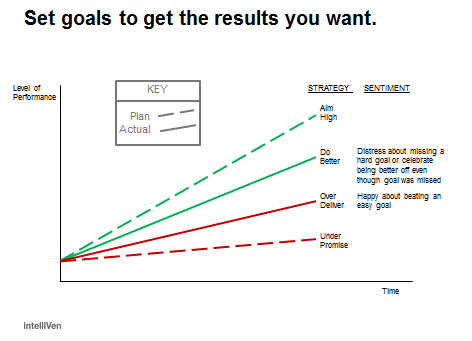
Strategy: Present conservative, achievable targets to ensure a high probability of meeting or exceeding expectations. This approach builds trust and reassures stakeholders about the management team and their investment, offering a solid foundation for the future.

Outcome: Exceeding conservative estimates provides a reason for celebration and reinforces stakeholder confidenceas suggested by the under-promise and over-deliver lines graphed in Figure-1.

Management Plan: The Aim-High-Do-Better Method

Set goals to get the results you want full
Figure-2: Aim High and Do Better

Target Audience: Internal Management and Operating Teams

Objective: Maximize team performance and drive to achieve top-tier results.

Strategy: Set aggressive, yet attainable goals, understanding that they might be achieved 75-80% of the time. This encourages teams to stretch their capabilities and innovate, often leading to superior results compared to a conservative approach even when the goal is not attained.

Adaptation: If mid-period results deviate significantly, either above or below, from plan, be prepared to revise the goals to maintain momentum and direction through the rest of the performance period.

Outcome: Even if actual results fall slightly short of ambitious goals, the organization often ends up in a stronger position than if it had set more cautious targets as suggested by the aim-high and do-better lines added to the graph in Figure-2.

Summary: The Dual-Faceted Approach for Business Growth

  • Key Insight: Leaders of growing businesses should adopt a dual strategy in goal setting. Internally, aggressive but achievable goals fuel motivation and high performance, while externally, conservative, and intelligent goal setting satisfies the risk-averse nature of bankers and investors.
  • Result: This balanced approach ensures robust operational performance while maintaining the confidence and support of external financial stakeholders.

How to Sync Your Leadership Team’s Skills with Organizational Growth

If you are a CEO or a senior leader of a growing organization, you know how critical it is to have the right mix of skills, knowledge, and behaviors among your top team to drive growth and performance.

How do you adapt your team’s composition and dynamics to match the needs and demands at different stages of organization growth and change? How do you develop your collective leadership skills and capabilities as a team?

If you are looking for answers to these questions, the IntelliVen Strategic Executive Team Development Program is right for you. IntelliVen is the leading provider of leadership team development programs for organizations that want to achieve breakthrough performance and growth.

Strategic Executive Team Development Workshop

Our workshop differs in three ways:

  • We work with executive teams not just stand-alone individual leaders using multi-rater data.
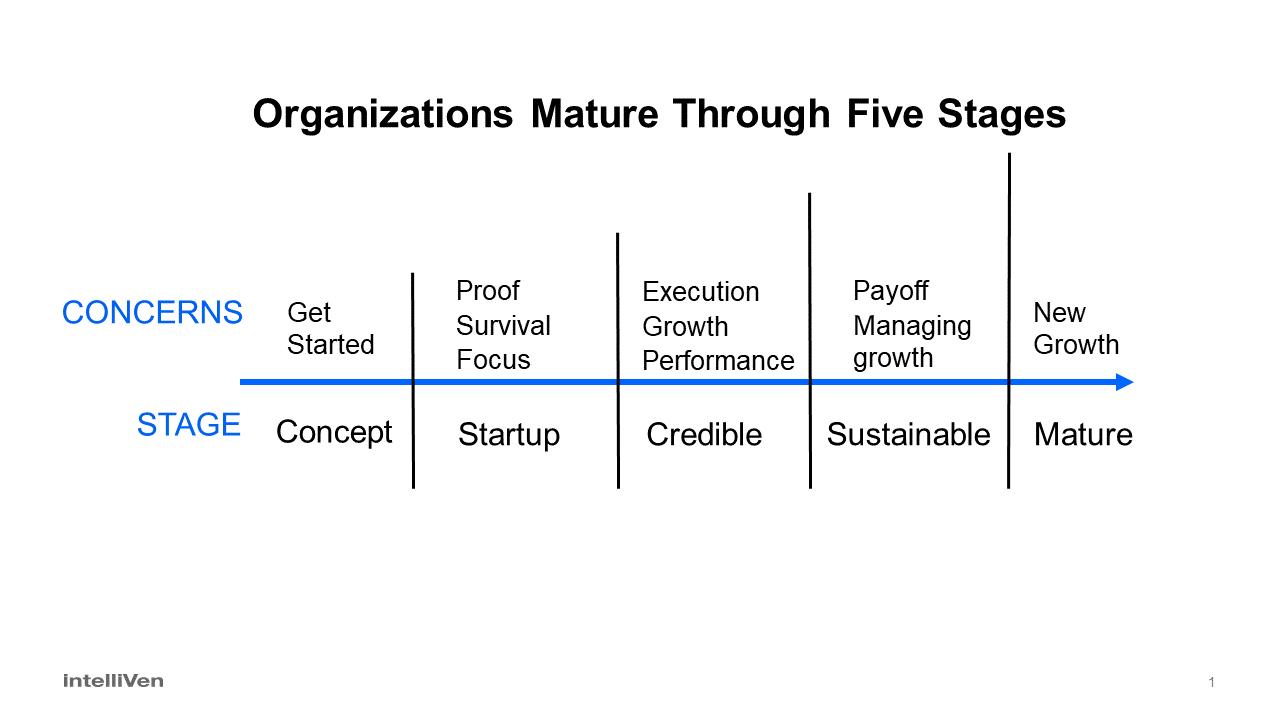
  • We assess your team’s strengths and gaps, and tailor your development plan, to match ideal team skill-mix by stage of maturity.
  • We look forward, not backward. We help you envision the skill mix you need next and create an action plan to get it.

Skill Mix

There is no one-size-fits-all formula for building a successful executive team. Rather, there is a success norm by stage that indicates what skills are most relevant and important.

For example, at early stages of maturity, an organization needs executives with strong technical skills, entrepreneurial mindsets, and creative problem-solving abilities. At later stages, executives with operational excellence and stakeholder management skills are critical.

Strategic Executive Team Development Program:

  • Helps you assess where your team stands given success norms by stage.
  • Illuminates individual executive and team strengths and opportunities comparing them to success norms.
  • Targets hiring, development, and succession needs.
  • Provides an action plan to develop each executive for fast-track team performance improvement to fuel business growth.

About the Author

Dr. Brent Green is an organization psychology professional with a focus on individual executive and team performance, and system improvement. He has over 25 years experience in strategic leadership and organization assessment, training and development, evaluation, strategic wellness program design, and performance coaching.

Contact Dr. Brent Green, Principal for a no-obligation preliminary discussion about your team’s performance and growth.

Prompt Engineering: How We Put Generative AI to Work For Our Business

Summary:

In just six prompt engineering iterations we achieved real business value with generative Artificial Intelligence in that we are now able to:

  • Significantly reduce the time required to review and assess client submissions using our WHAT-WHO-WHY rubric.
  • Provide a comprehensive evaluation and quality suggestions for each entry.
  • Make explicit and accessible our assessment and recommendations logic that had not previously been made clear to those we work with.
  • Increase our capacity to provide service.
  • Quickly and easily incorporate new data and insights into our process.

While we found it doable, prompt engineering required careful attention to detail and follow-through to identify and address what worked and what did not work at each step.

Now we have a fantastic starting point from which we can easily apply our facilitation skills to deliver even higher levels of value to leadership teams.

Background

Large Language Models such as Bing and Bard have received a lot of attention for their ability to chat intelligently (or so it seems!) about almost anything. However, there are not yet many examples of chatbots providing real business value.

At IntelliVen, we wanted to test generative AI’s ability to improve the quality of our work while simultaneously lowering costs. We are pleased to have found that chatbots can generate significant business value.

In this post, our goal is to share how we achieved business value using generative AI so that readers can build on our efforts and push our thinking (and their own thinking!) even further in this rapidly evolving discipline.

The key to what we achieved is Prompt Engineering, an iterative process by which we created a suitable and reusable prompt for our use case.

Prompt Engineering Definition

Prompt engineering is the process of designing and refining prompts to improve the performance of AI models. It involves techniques like using the right words, format, length, and parameters to coax the best performance from an AI model given its training data.

Prompt engineering can also include providing pertinent background, such as:

  • The profile of the person inputting content.
  • What perspective to take when assessing input.
  • The profile of persons who will read the output.
  • What types of output are requested.
  • What indicates high quality output.

Especially when you plan to interact with a chatbot for the same purpose on a recurring basis, it is critical to invest in prompt engineering to ensure you get the highest value results.

Use Case

At Intelliven, we help leaders and their teams architect, build, govern, and change their organizations. The cornerstone to our approach is to first align leaders and their teams on the definition of their business; that is:

  • WHAT the organization provides.
  • WHO buys what they provide.
  • WHY buyers choose to purchase from the company.

PREPARATION: We first ask the leader and their top team to each independently fill out the W-W-W template with their perspective on the three dimensions that define their business. We assess individual responses for clarity and specificity and then compare responses to identify what is common and what is different between them.

For every submission we:

  • Compare each response against a rubric that outlines what each element of the W-W-W should and should not contain to come up with at least three helpful pieces of feedback.
  • Analyze the frequency of terms used to identify differences and similarities across submissions.

FACILITATION:  Next we facilitate a session (or sessions) in which the leader collaborates with their team to align on what should and should not be included in a clear and concise definition of their business which then serves as input to virtually every aspect of their business.

It takes a consultant with significant expertise (of which there are but a few) about a half-hour per entry to internalize submitted input, apply their best thinking, and document their assessment of each submission. Depending on the size of the group, this process may take up to half-a-day per organization.

Prompt Evolution

Our goal was to see how much AI could help us with preparation, which includes intake, assessment, recommendations, and documentation for each entry. The following table summarizes six iterations of prompt engineering towards this end:

Value Delivered

We found that generative AI effectively added value to all four preparation steps (intake assessment, recommendations, and documentation), AND generated better and more comprehensive results; and it did so almost instantly.

Specifically, generative AI:

  • Makes the logic we previously used intuitively explicit for our consultants and clients. In other words, the chatbot explains why it made the assessment and suggestions it did.
  • Saves time and cost by dramatically reducing the effort required to assess input and document results.
  • Produces a high-quality guide our consultants can use to facilitate the collaborative process with leadership teams to reach alignment on a consolidated version.
  • Comprehensively applies all facets of our assessment rubric to every submission with no additional cost or effort. Previously we were content to stop after identifying just one or two salient points!
  • Enables us to present assessments and suggestions with more friendly and readily received language than we tend to draft on our own.
  • Integrates with the full comprehensive set of up-to-date world knowledge in its suggestions when we use a bot that is connected to the internet and pointed to content on our site.
  • Easily updates response logic with new case data or when we update the assessment rubric.

Note that, even though it has great value, we do not plan to sell our prompt or to charge for its use. Rather we have integrated it into the W-W-W method to:

  • Enhance the quality of our assessment, suggestions, and facilitation.
  • Increase the number of people able to do what our best do.
  • Dramatically lower the time and cost to do what we do.
  • Increase the attractiveness of our offering to prospects.

Considerations

While AI provides great value, it is important to:

  • Know when to stop. When a prompt is activated more than a couple of iterations on a given input, the chatbot’s responses tend to go in circles that add little-to-no additional value.
  • Check everything carefully. Many times generative AI makes up content which we have learned to interpret as indicating that “something along these lines is needed here”. For example it will make up a role in an organization for the buyer when the submitted entry does not identify one.
  • Never take the chatbot’s output as a final answer. Use it simply as quality input to the collaborative process.
  • Note that different chatbots give wildly different responses to the same prompt and the same bot is apt to give a different response to a resubmission. While initially concerning, we learned to consider each response as one more round of input for collaborators to consider.
  • Chatbot responses offer little in the way of creativity or imagination except when it makes things up instead of pointing out gaps. Responses are simply a complete and comprehensive application of facts and rules. Creativity and imagination come from the leader and team … not the machine!

Next Steps

We are preparing to share soon the results of using our AI-powered WHAT-WHO-WHY assessment and recommendation engine on a real case study.

To try out our engine for yourself:

Fill out and submit a WHAT-WHO-WHY Template to run your case through our process!

Additional Resources