Category Archives: Operations

How AI Chatbots Can Boost Your Content Creation

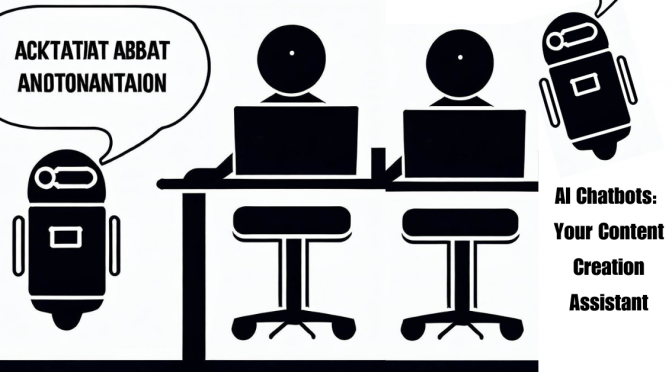
AI chatbots such as ChatGPT and Bard can help you create better content faster and more easily by providing relevant feedback, reasoning and resources. This post shares tips and considerations for using AI chatbots to develop content gleaned from experience during a recent IntelliVen content and community development project for a San Francisco-based, fast-growing startup Augmented Reality (AR) accessory company.

Value of Using AI Chatbots for Content Creation

  • Accelerated learning: The chatbots offered helpful tips to improve content for marketing emails, including high-level as well as specific suggestions pertinent to the project. For example, when asked how to optimize messages to first-time consumers to stimulate engagement, the chatbot provided input on how to personalize emails, welcome new consumers, and share educational materials that pushed my thinking in helpful ways..
  • Draft reviews: While using AI for first-draft creation is common, I prefer to create first drafts of my content and then invite the chatbots to review and provide suggestions for its improvement, which I consider in the context of my goals. The result is a work product that is authentic to my voice and intention yet benefits from AI suggestions for improvement that I can ignore, take as is, or modify to use as I feel appropriate.
  • Shared logic: Some chatbots shared not just replies to my prompts, but also the logic behind their reply. Understanding how the chatbot comes up with its response makes it easier to discern whether the feedback is applicable for my use case.
  • Shared sources: When asked, the chatbots sometimes share links that point me to source material, which enables me to learn more about a specific topic on which I am not already expert from the source page which allows me to confirm its reliability.

Considerations for Using AI Chatbots for Content Creation

  • Maintain focus: You need to maintain focus on your goals and ownership of your content throughout the process. Sometimes, the chatbot may over-index edits on one area of potential improvement or provide language that doesn’t align with the brand. It is important to never take the content provided at face value, and to maintain a critical eye throughout. Remember, in the end it is YOUR work, not that of the chatbot.
  • Keep privacy in mind: It is a good idea to keep privacy in mind when using AI chatbots. Because we large language learning models may integrate prompt content into their learning, it can be important to de-identify anything that could be sensitive or abused. I would like to find a chatbot service that confirms it does not send prompts back to the learning model so that it can be readily used when confidentiality is important.

Conclusion

AI chatbots are powerful tools that can boost your content creation by offering valuable assistance and insights. They can help accelerate learning, review drafts, share sources, and share logic.

However, you also need to maintain focus on your goals and keep privacy in mind when using them.

Happy writing!

Breanna DiGiammarino

See also by Breanna: 4 Steps to Engaging Communities to Build Better Products
Diligence Support for Federal Sector

If you are looking for opportunities to invest in firms that provide professional services and software to the U.S. federal government, you know how challenging it can be to assess the potential and risks of these businesses.

Working with the federal government is not just another market, it is more like a different planet. Everything is different. The language is different, money is different, and no one can tell anyone else what to do.

Mastering the art of developing coalitions of support is vital. In short, you need a partner who understands the unique dynamics and complexities of the federal market, and who can help you make informed and confident decisions.

Approach

That’s where IntelliVen Federal Diligence Support comes in. We are a team of senior operating partners with deep experience and insights in the federal sector, and we offer a range of services to help you evaluate and validate your investment targets, identify value creation drivers and how to activate them, and help you craft a compelling investment thesis.

Whether you need just a few questions answered, a comprehensive Go-to-Market diagnostic, a competitive landscape assessment, or a strategy roadmap, we can provide you with the data and guidance you need to make the best indication of interest or purchase offer.

We have worked with dozens of public, private, private equity owned, and venture capital backed companies in the federal space, and we have a proven track record of delivering high-quality results on or ahead of schedule and on, and usually well in excess, of targets.

Next Step

We know how to navigate the regulatory, contractual, and operational challenges of the federal sector, and we can help you identify and mitigate potential issues and risks. Our network of federal experts, thought leaders, and former government executives provide valuable insights and connections.

IntelliVen is not just another consulting firm. We are a partner who shares your vision and goals, and who can help you achieve them faster and more effectively. We are driven by our passion for helping leaders and their teams architect, build, govern, and change their organizations for breakthrough improvements in performance and growth.

We have developed a system of tools, workstreams, and tutorials based on what we have learned from running and growing dozens of successful organizations. We call it the Manage to Lead (MtL) System, and we use it to help owners, leaders, and teams to get clear about what they seek to accomplish; aligned on their purpose, roles, processes, and metrics; and on track to perform better and grow faster.

Contact IntelliVen founder and Managing Partner Peter DiGiammarino to learn how IntelliVen can help with your diligence needs in the federal market.

See Also

Compusearch Case Example

4 Steps to Engaging Communities to Build Better Products

Tech companies constantly need to decide which products and features they should develop next to drive the most value for users. Listening to and elevating the Voice of the Customer through a community-based approach is an ideal way to inform their decision-making, especially when better meeting current user needs accelerates value.

As David Spinks shares in his SPACES framework he developed with the CMX Team, communities are valuable to host organizations because they provide Support to members, input to Product development, Acquisition of new customers, Contribution to best practices, Engagement in the brand, and help each other Successfully derive maximum benefit from company products. 

Double-clicking on the goal to inform Product development, this post provides a guide for how to thoughtfully activate a community to decide which products and features to develop next.

The key to success is strategically connecting product team leaders and relevant community members so that leaders better understand user pain-points and commit to addressing them. 

For maximum impact, follow these four steps: Set your strategy, Prepare the Conversation, Hold the Event and Follow Up:

I. Set Your Strategy

  • Identify Top User Pain-Points: Assess the input collected from community members to determine the pain-points that keep users from achieving their goals. Scaled research is a good way to identify the most important pain points. I am sure there are AI tools that can help you analyze large quantities of data and pull up keywords and phrases that appear as challenges for your users. Let me know which ones you recommend!
  • Determine which Pain-Points to Address in Conversation: Share collected pain-points with relevant product managers to identify which are related to work already in progress and which are yet to be roadmapped. Top pain-points that are not already set to be addressed, or that are on the roadmap but not prioritized, are candidates for advocating on behalf of users to accelerate product-market fit.
  • Create Influence Goals: Strategize how to influence the product roadmap to include features that address community pain-points. In particular, determine who needs to understand the pain-points in order to rally resources to invest in addressing them and then determine the best way to communicate the essential need.

II. Prepare the Conversation

  • Recruit a handful of users  from your community (e.g. spanning geographies, topic areas, etc.) who product team members need to hear from in order to advance their understanding of, and commitment to, addressing the community pain-point. Be mindful to recruit users who represent the diversity of perspectives you want to advocate, including historically marginalized voices.
  • Deeply get to know recruited users via conversations with them about their goals, what is working and what is not working. Listen to and ask questions that elicit the stories that make their pain-points real.
  • Create a run-of-show for an event in which the recruited users share relevant personal stories that will remain in participants’ minds long after the event is over. Make sure the script feels natural to the user spokespersons and give them the chance to edit and internalize the content.

III. Hold the Event

  • Work with product team members to enlist their deep commitment to the success of the event and to jointly prepare relevant questions they can ask the users after they share their stories.
  • Hold the event in which you bring together users with key product stakeholders who need to hear the user stories. Ensure that community members have the chance to share key points via stories. Ask follow up questions to elicit points that you heard in preparation conversations that do not come up on their own.

IV. Follow Up

  • Debrief the event with product teammates without users present to discuss what was heard and what was learned, what options exist for addressing pain-points, what next steps are appropriate, and how the community can be most helpful. 
  • Facilitate ongoing connection between product team members and the community using co-design sessions and regular touchpoints to provide continuous feedback during product design, development, and testing.
  • Celebrate new features that go-to-market that address community pain-points, especially circling back to those who stepped-up to advocate for change by participating in events. This is a huge win for your organization and the community! 

There is nothing like intimate live conversations where stories bring to life the current barriers to user success and the potential future value that can be unlocked with the right product evolution. Check out this conversation with community leaders, external experts and a Meta VP filmed in the metaverse for a fun example! 

NOTES

Be sure to check with company policy and legal professionals to ensure user privacy is maintained and that the process aligns with relevant policies.

Breanna DiGiammarino has 15+ years  experience working with communities at Meta, Indiegogo and the Draper Richards Kaplan Foundation. She uses the process described in her post to evolve product offerings. Reach her on LinkedIn to keep the communities conversation going!

See Also by Breanna:

Will you make sure you and your team accomplish the most important thing in the coming year?

Leadership Offsites focus the top team for growth and performance as the current year closes and the next one starts. Offsites are typically of two types:

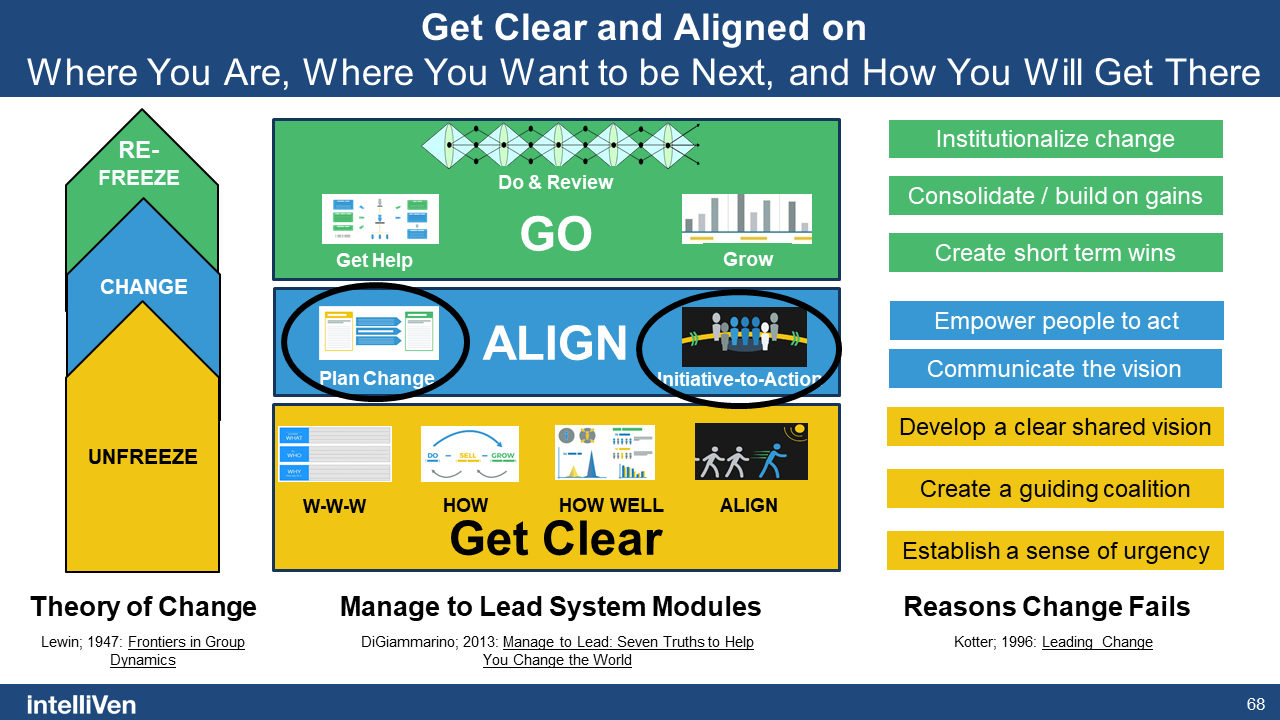
  • Plan Change – Identify what needs to be done differently to perform better and / or grow faster.
  • Initiative-to-ActionLaunch the most important initiative(s).

Kurt Lewin, the father of Organization Dynamics, taught that change happens in three stages: Unfreeze, Change, Refreeze.

John Kotter studied over one thousand initiatives to identify eight reasons change fails to happen as intended.

IntelliVen Manage to Lead System Modules integrate Lewin and Kotter insights to help leaders conceive and implement Planned Change as suggested in the figure below.

1. Collect Insights

IntelliVen Offsites (circled in the figure) start with an electronic survey and one-on-one interviews with top team members to gain insight into how the organization functions as a whole, and / or in the context of the single, most important initiative, with these questions:

  • How are things today?
  • What good things happen if we change and what bad things happen if we do not?
  • How would things be if the ideal change were successfully implemented?
  • What needs to be done to go from where we are today to where things would ideally be next?
  • What will make it hard to do what needs to be done?

2. Share Insights with Leader

We organize collected data for the Leader and:

  • Highlight important and surprising findings.
  • Prepare to share it with the full team.
  • Help the leader prepare to articulate Where the Organization has Been, Where it is Now, and Where it is Headed to capitalize on the opportunity afforded by the offsite for the Leader to Set Direction, Align Resources, and Motivate Action.

3. Facilitate Team Offsite

At the offsite, IntelliVen Senior Operating Partners guide the Leader and Team to review insights, align to reach consensus on each of the five topics, and to decide what needs to be done using the workplans and facilitation approaches described here:

Next Step

Schedule a Zoom session with PeterD to explore how IntelliVen Senior Operating Partners can help you and your team wrap up this year and get ready for the next as we have so successfully with many others over the years.

SEE ALSO

The #1 problem with teams is not what you think

Every leader needs to know that they and their team agree on the problem they solve for whom. While this seems simple enough, in practice almost nobody in their organization answers in exactly the same way, and even small differences can disrupt operations.

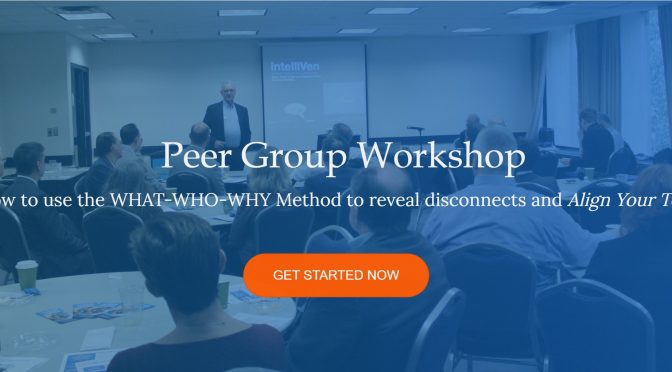
Examples, practice cases, and your own case reveal that even well-known firms have a WHAT-WHO-WHY that is surprisingly different than it seems. In the highly interactive WHAT-WHO-WHY Workshop, participants learn a tool and method they can use to reveal disconnects and align their team.

The WHAT-WHO-WHY method reveals disconnects and aligns your team.

The WHAT-WHO-WHY method has helped create $Billions in value and is 100% recommended by users.
You will learn to:

  • Describe any organization in terms of whose problem it solves.
  • Discover disconnects in your team’s thinking about their business.
  • Align your team’s thinking about their business.
  • Schedule a Zoom call with PeterD to see if the W-W-W Workshop is a good fit for your team or peer group.
  • Pass on to your group leader or facilitator.
  • Pass on to a colleague, family member, or friend to suggest they consider the W-W-W Workshop for their group or team.

For More Information

WHAT-WHO-WHY Workshop Overview

Manage to Lead System Introduction