Tag Archives: alignment

Say the Same Words. Mean the Same Things.

Walk into almost any leadership meeting and you will hear the same words:

  • Vision.
  • Strategy.
  • Mandate.
  • Values.
  • Culture.

Everyone nods. Everyone is confident they understand.

Then you listen a little longer and realize something important:

People are using the same words to mean different things …
and different words to mean the same things.

That small problem with language quietly becomes a big problem with performance.

Teams are smart and committed, yet they talk past each other because their mental maps are not the same.

This post introduces a simple fix: agree, explicitly, on what key words mean and commit that one word will not do the job of two, and two words will not mean the same thing.

Shared language is the first step to:
Get Clear. Align. Grow.

Language as a leadership tool

Words matter. Great leaders start by making sure everyone uses the same words in the same way.

When a leadership team shares precise meanings for core terms:

  • Decisions are faster because people are not debating definitions.
  • Priorities are clearer because everyone knows where each topic “lives.”
  • New leaders and staff get up to speed faster because there is one map, not many.

When meanings are fuzzy, the opposite happens:

  • “Vision” and “strategy” get blurred.
  • “Operations” and “management” are used interchangeably.
  • “Values” and “culture” are treated as the same thing.

The result is good people working hard on different versions of the job.


The Executive Alignment Map: one word, one meaning

At IntelliVen, we use the Executive Alignment Map below, where each of seven core words has an unambiguous meaning. The definitions are ours and offered for convenience. You don’t have to adopt them. What matters is that your team agrees on what each term means. Alignment begins with a shared vocabulary.

  • Vision: Where we are headed and why, about 10 or more years out.
  • Strategy: How we plan to win in the marketplace over the next 5 years or so.
  • Mandate: The milestone by when. The 3–5 year target that turns strategy into concrete ambitions.
  • Management: How we plan, build, and assign work so that the Mandate and Strategy get done.
  • Operations: How we do, sell, and grow every day to serve customers and deliver results.
  • Values: The beliefs that shape behavior and guide decisions, especially when tradeoffs are hard.
  • Culture: Values in action. How it actually feels to work here and with us.

Every organization has these elements. The key is to make them explicit, consistent, and shared by those who lead.

  • Vision is not a slogan.
  • Strategy is not an initiative.
  • Mandate is not a task list.
  • Values are not posters.
  • Culture is not a slide in the onboarding deck.

Once the top team adopts this shared map, everyone knows what conversation they are in and where it fits in the bigger picture.

Why this matters so much

Here is what tends to happen before there is a shared language:

  • A CEO says, “We need to revisit our strategy,” but what they really mean is the Mandate (the 3–5 year numbers and milestones). The team hears “new product bets” and “market moves” and they start working on something different.
  • HR talks about “culture work” but is really redesigning processes and management practices. Operations leaders hear this as “soft stuff” and disengage, even though the changes will affect them directly.
  • A board member asks for “more visibility into operations” and the team responds with detailed project plans (management) instead of how the business actually does, sells, and grows.

The words are familiar, so no one notices the disconnect right away. Yet misfires accumulate. Time and energy are lost. Frustration grows.

When a team decides, together, what each word means, three things change:

  • Conversations become shorter and more focused.
  • Disagreements become about real choices, not vocabulary.
  • People at every level gain confidence that they understand “how things work around here.”

One simple practice to try with your team

If you want to experience the power of shared language, try this:

Ask each member of your leadership team, privately, to write down their definition of:

    • Vision

    • Strategy

    • Mandate

    • Management

    • Operations

    • Values

    • Culture

Bring the definitions to your next offsite or leadership meeting.

Compare them side by side, either by hand or by feeding everyone’s entries into IntelliVen Operations Advisor (IVOA), and circle or highlight where they differ.

You will likely find that:

  • Some people skip a word completely and fold its meaning into another.
  • Some use the same word for very different ideas.
  • A few are surprisingly aligned, which gives you a head start.

From there, work as a group to settle on one short, shared definition for each word, using the Executive Alignment Map as a guide.

Document your final list. Use it in meetings, in onboarding, and in your MtL work. Refer back to it when discussions drift. Over time it becomes part of how you manage and lead.

Do not assume your words are their words

Not assuming that others use key words the same way you do is especially important when you work with people from a different organization, whether you have joined a new company, are serving a client, or are partnering with another team.

It is natural to assume that words like “strategy,” “plan,” “mandate,” or “operating model” mean what they meant in your last organization. Often they do not. Teams may use familiar terms in very local and specific ways.

In a new setting, it helps to:

  • Ask early how people use a few key words.
  • Listen for how those words show up in real conversations, not just in formal definitions.
  • Notice where your own definitions are different from theirs.
  • Decide whether to adopt their language, or to work together to reset a few key terms.

What matters most is that you do not assume. You surface differences in meaning early and work toward shared definitions instead of talking past each other for months.

Connecting to your MtL work

In the Manage to Lead system, “Get Clear” always comes first. Tools like:

  • WHAT–WHO–WHY (W-W-W)
  • Mandate
  • Change Framework

all work better when the team shares the same language.

Sorting out the terms covered in this post is just a start. Throughout MtL we unpack important words in a similar way. Each module highlights at least one key term that is easy to gloss over but matters a lot in practice. For example, in Module 4 we sort out the difference between a budget, a forecast, and a working view so leaders stop talking past each other when they talk about “the numbers.”

You can think of shared vocabulary as the foundation.
MtL tools are how you build on it to think, decide, and act.

If you are using MtL on Maven or working with IntelliVen advisors, consider making the Executive Alignment Map your first stop. Agree on the words. Agree on the meanings. Then build everything else on top.

Say the same words.
Mean the same things.
That is how you Get Clear. Align. Grow.

Next Step

If you want help putting this into practice with your leadership team, you can schedule a workshop with IntelliVen or enroll in a Manage to Lead (MtL) training program.

To explore what’s right for you, get in touch with us and we’ll follow up to discuss next steps.
Glossary of MtL Terms

Purpose and Goals: Why You Need Both W-W-W and Mandate

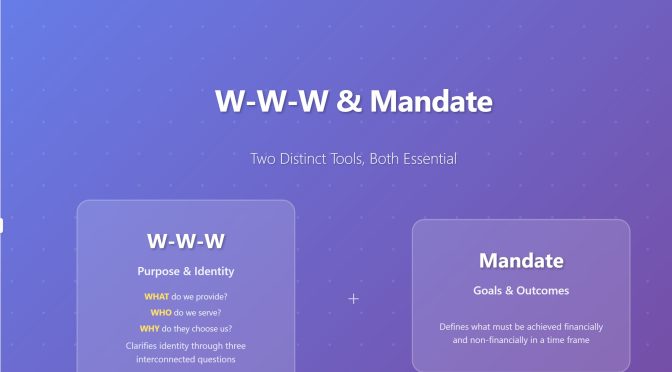
W-W-W and Mandate: Two Distinct Tools, Both Essential

When working on their business, leaders sometimes ask: Which sequence is right?

W-W-W → Mandate

Mandate → W-W-W

Both sequences work. You need to work on both.

W-W-W is about purpose. It clarifies identity by answering three simple but interconnected questions:

  • WHAT do we provide?
  • WHO do we serve?
  • WHY do they choose us?

This is the cornerstone of clarity, rooted in Drucker’s insight that the purpose of a business is to solve a problem for a customer.

The Mandate is about goals. It defines what must be achieved, financially and non-financially, in a time frame. It sets targets, aspirations, and milestones. Where W-W-W establishes identity, Mandate locks in success conditions.

Though related, they require distinct lines of thinking:

  • W-W-W = identity and purpose
  • Mandate = success conditions and commitments

Which comes first? Both sequences work:

  • Mandate first: If you like Covey’s “Begin with the end in mind,” Mandate lays out the outcomes that guide everything else.
  • W-W-W first: Ensures that goals tie back to a clearly expressed purpose.

What matters more is that teams use both. W-W-W brings clarity of purpose. Mandate brings clarity of outcomes. Together, they create a foundation for alignment, prioritization, and growth.

W-W-W and Mandate aren’t one-and-done — they evolve together and become the backbone of the story you tell, tailored to what you need to say and to whom.

So, whether you start with W-W-W or Mandate, don’t stop until you’ve done both. And remember, they aren’t “one and done.” As your organization grows, work on one will often lead you to refine the other. Together, they form the backbone of your storyboard — a foundation you can adapt depending on what you need to say, and to whom.

Put These Ideas Into Practice

In the Manage to Lead (MtL) program, you don’t just study tools like Mandate and WHAT-WHO-WHY, you apply them directly to your own organization. YOUR CASE IS THE COURSE. By working hands-on with proven frameworks, you and your team surface hidden assumptions, sharpen execution, and accelerate performance. Learn more about the MtL program here »

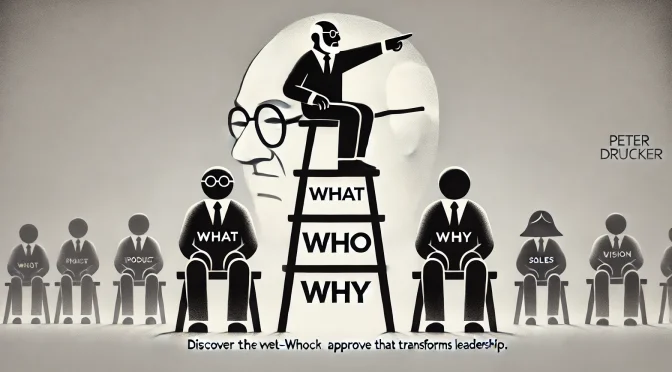
What Would Peter Drucker Think of Your ICP?

TL;DR

  • Investors’ first question is always your Ideal Customer Profile (ICP). If you can’t answer crisply, nothing else matters.

  • Most teams treat ICP as one question, but it’s really three:

WHAT do you provide?

WHO must have it now?

WHY do they choose you over alternatives?

  • Mis-alignment on any leg stalls growth—marketing targets the wrong buyers, product builds the wrong features, sales can’t close.

  • Drucker’s biographer calls IntelliVen’s WHAT–WHO–WHY framework “an innovation that changes the value of leadership.” It’s exactly the clarity Drucker preached.

  • Why teams still struggle: cognitive overload, functional bias (product vs. sales vs. vision), and thinking ICP is “one-and-done.”

  • IntelliVen’s MtL System + AI-powered IVOA Sandbox crowdsources input, exposes misalignment, and guides teams to a shared ICP they revisit continuously.

  • Results when everyone shares the same ICP: faster sales ramps, sharper product decisions, lower CAC, higher LTV—one enterprise software firm grew from start-up to a valuation of $2+ B.

  • Takeaway: Treat your ICP as a living strategic asset. Use WHAT–WHO–WHY to align your team, revisit it often, and growth will follow.

The Hidden Failure Pattern

Pursue any professional financing or acquisition, and you’ll face the same first question: “Who’s your ideal customer?” It sounds like a simple question deserving a simple answer. But it’s not.

Most funding requests and transactions stall right here. Without a crisp answer, investors and buyers move on. What’s more troubling is that even after securing funding or sale, ICP clarity remains the make-or-break factor for sustained success. CB Insights, for example, found that more than a third of all startup failures stem from unclear market fit: companies that never nailed their Ideal Customer Profile.

It turns out that even seasoned executives struggle with the ICP challenge. As a result, they’re inefficiently burning resources in predictable ways:

  • Selling to customers who will never buy.
  • Wasting time closing sales with customers who will not reach target Lifetime Value.
  • Building features for people who don’t need them.
  • Crafting messages that resonate with no one in particular because they’re trying not to exclude anyone rather than focusing on the ideal.

The right solution for the wrong customer fails. The wrong solution for the right customer fails. While these may seem like execution problems, they are really clarity and alignment problems.

Most people think that a query to describe their ICP is one question requiring one answer, whereas it is really three interconnected questions at once:

  • WHAT do you deliver?
  • WHO needs it most?
  • WHY do they choose you?

Like a three-legged stool, if answers to any of the three is out of sync with one or both of the others, the cornerstone of the business caves-in. Marketing targets the wrong prospects. Sales struggles to close strategic deals in preference for deals of no strategic value (i.e., they are a waste of time!). Product builds features nobody wants. Teams pull in different directions, and so on.

What Would Drucker Say?

Peter Drucker, the father of management science, famously said, “The purpose of a business is to create a customer.” But what would the father of modern management think of our approach to tackling today’s ICP challenge?

We didn’t have to guess. Dr. Elizabeth Haas Edersheim (Drucker’s personally chosen biographer, former McKinsey senior partner, and MIT Sloan Ph.D.) joined our recent workshop. When asked what Drucker would think of our WHAT-WHO-WHY framework, her response was immediate:

“Peter defined innovation not as having a new idea, but by how much it changes the value delivered to customers. Your WHAT-WHO-WHY approach does exactly that—it fundamentally enhances the value leaders deliver. Drucker would have loved this because it clarifies purpose, aligns teams, and dramatically amplifies their collective impact.”

She continued:

“Drucker was deeply human-centric. Your method of bringing everyone to shared understanding of WHAT, WHO, and WHY doesn’t just clarify strategy—it unlocks human energy inside organizations. People can finally work with real purpose and clarity.”

Why Smart Teams Still Struggle

If the framework is straightforward, why do even experienced leaders find ICP clarity elusive? Three reasons:

Cognitive overload. Holding three interconnected dimensions in mind at once is mental work. Teams unconscious simplify, losing crucial nuance.

Functional bias. People gravitate toward their expertise. Product leaders obsess over WHAT. Sales focuses on WHO. Visionaries champion WHY. Without deliberate integration, teams optimize their piece while missing the whole.

Static thinking. Most treat ICP as a one-time exercise. But your ideal customer evolves as you do. The best-performing organizations revisit and refine their WHAT-WHO-WHY with regularity: embedding the framework into leadership rhythms, strategy sessions, and go-to-market planning.

Case Example

Here’s what happens when teams get the framework right. A consulting firm was stuck at $9M revenue, walking away from acquisition offers because they couldn’t get to their $12M target. Their WHAT-WHO-WHY was “we do stuff for money.”

After defining their true WHAT-WHO-WHY (visually stimulating strategy facilitation for U.S. Federal Government leaders who want to make a difference, accomplish missions, and get promoted), everything changed.

Four years later, they sold for $30M+.

But that’s just the beginning. Another company started using WHAT-WHO-WHY clarity at $15M revenue. They kept refining the framework through five private equity hold cycles. Today? North of $2 billion valuation.

The pattern isn’t luck. It’s what happens when organizations use clarity as a strategic asset, not a checkbox.

Whether you’re leading a startup seeking Series A, a nonprofit pursuing major donors, a church building community engagement, or a Fortune 500 division defending market share, the challenge remains the same. Every organization at every stage needs to answer the same three questions with precision. The framework works across all business models, capital structures, and geographies because the fundamental human need for clarity and alignment is universal.

Beyond the Foundation

Here’s what most people miss: WHAT-WHO-WHY clarity is powerful, but the framework is just the first element of what high-performing teams need.

Think of it as Truth #2 in our Manage to Lead system. It’s preceded by understanding your current context and followed by five more integrated truths about how teams actually execute and scale. Each builds on the others. Skip one, and even the best strategy stumbles.

The companies that outperform don’t just get their ICP right. They master the full sequence: how to assess where they stand, align everyone around the right priorities, plan change that works, execute without losing momentum, and remove the barriers that stop most teams from reaching their potential.

The Real Test

Your WHAT-WHO-WHY isn’t just a statement. The framework is a decision-making filter. When the framework is right, tough choices become obvious. Resource allocation gets clearer. Teams move faster because they’re no longer debating fundamentals.

When teams at inflection points (scaling, pivoting, fundraising, integrating new leadership) start with WHAT-WHO-WHY clarity, they compress months of alignment work into weeks. Not because the framework is magic, but because it surfaces and resolves the disconnects that otherwise create expensive detours.

Your Next Move

If you’re leading through change, start with the foundation. Download our WHAT-WHO-WHY template, or request access to the IntelliVen Sandbox where your team can work through this together—with AI-powered feedback that accelerates the iteration process.

But remember: the framework is just the beginning. The teams that win understand that clarity is built, not discovered. And building clarity requires more than one framework. Building clarity requires a system.

Get Clear. Align. Grow.

Ready to see what aligned clarity can unlock for your team?
• Explore the full Manage-to-Lead System at IntelliVen.com
• Request a 10-day IVOA Sandbox trial—just contact us and we’ll set you up
• Watch the 40-minute workshop Dr. Edersheim attended and hear her remarks firsthand

About the Author

Peter DiGiammarino has helped hundreds of leadership teams architect breakthrough performance across private, public, VC-backed, and PE-owned companies. His Manage to Lead system distills decades of operating experience into seven enduring truths and 60+ practical tools that guide teams through critical inflection points.

Embracing Uncertainty: A Leader’s Path to Growth and Adaptability

Leaders are often confronted with complex decisions that can shape the trajectory of their organizations. Amidst the pressure to find the “right” answer, it’s easy to become mired in indecision, oscillating between various options and seeking input from every possible source.

However, true growth as a leader lies not in the pursuit of a singular solution, but in the willingness to embrace uncertainty, seek collective wisdom, and cultivate a mindset of continuous adaptation.

The Fallacy of the “Right” Answer

In the face of complex organizational challenges, there is rarely a single, universally “right” answer. Every solution carries its own strengths and weaknesses, and what works in one context may falter in another. Leaders who cling to the notion of a perfect solution risk paralysis and missed opportunities. Instead, successful leaders recognize that any solution can succeed if embraced and executed with commitment and alignment.

Fostering Alignment and Commitment

Rather than unilaterally imposing a decision, effective leaders engage their teams in a collaborative process. By seeking input, listening to diverse perspectives, and securing collective buy-in, leaders create a foundation for success, regardless of the specific path chosen. When team members feel heard and valued, they are more likely to take ownership and work collectively towards making the chosen solution a success.

Embracing Continuous Change

No organizational structure or strategy is permanent; as circumstances evolve, so too must the organization. Successful leaders understand that change is inevitable and cultivate a mindset of continuous adaptation. Rather than viewing each new strategy or structure as a static endpoint, they embrace it as a steppingstone towards the next iteration, constantly evolving to meet changing demands and opportunities.

The Growth Mindset

At the heart of effective leadership lies a growth mindset – a willingness to acknowledge one’s own limitations and actively seek out the expertise and wisdom of others. Leaders need not have all the answers; instead, true leadership lies in recognizing what one doesn’t know and proactively seeking out the knowledge and guidance necessary to make informed decisions.

By embracing this mindset, leaders unlock a path of continuous personal and professional development, fostering an environment of ongoing learning and growth within their organizations.

Summary

In an ever-changing business landscape, the most effective leaders are those who embrace uncertainty, foster alignment and commitment within their teams, and cultivate a mindset of continuous adaptation and growth. By letting go of the pursuit of a singular “right” answer and instead seeking collective wisdom, leaders can transcend the limitations of their own knowledge and experience, unlocking the collective potential of their organizations.

Ultimately, the willingness to embrace uncertainty and seek help is not a sign of weakness but a testament to true leadership strength – a catalyst for personal growth, organizational resilience, and long-term success.

See Also

Ten Steps to Drive Change from the Inside

If you are frustrated by an organization resistant to embracing a change you believe is right, consider using the following steps as a road map to seeing your ideas through to reality:

Get Clear.

Write-up and share your point of view. While what you have in mind may seem clear to you, it likely is not yet to others. Writing about what you want to happen forces you to work out the logical progression of thought and to fill in the details to tell the story in a way others can understand. Share what you write with others to test for clarity and ask for help to make it clearer.

Focus on value.

Emphasize the business value your change would generate in terms others, especially those in positions of authority, can understand and appreciate.

Set the context for change.

Use the change framework to explain how what you have in mind to change exists today, why it needs to change, how it will be in the future, what must be done to get from here to there, and what will be difficult about effecting the change.

Continue reading Ten Steps to Drive Change from the Inside