Tag Archives: governance

When Attention Is the Constraint, Focus the Work and the Reviews

Most things go wrong because leaders are spread too thin, not because the work is impossible. When the volume of initiatives outstrips reviewer capacity, important items get little or no attention. Meetings slip. Mental presence drops. The fix is to match what we take on to the attention we can invest, and to raise the quality of how we review.

If right-sizing is not possible now, decide what will be reviewed and what will run without review for a period. Make the risk explicit. Set an escalation path. Define when an item re-enters reviews as capacity or leverage grows.

Focus the work

Start by counting real review slots that leaders can cover with preparation and follow-through. That number caps the active portfolio. Then triage:

  • A-items are mission-critical. Each has a named executive sponsor, clear measures, and regular executive reviews with explicit asks.
  • B-items are managed by metrics. Escalate by exception.
  • C-items are owner-run with coaching on demand and a light touch.

This puts scarce attention where it lifts results most.

Focus the reviews

Specialize attendance to increase leverage. Assign one executive sponsor to each A-item. Do not require every executive at every review. Form a small coverage group and rotate as needed. Use pre-briefs so the review starts before the meeting: the sponsor shares questions, context, and what a good decision looks like.

In the session, reviewers create safety, listen first, get clear, and then push thinking with best advice and guidance. Reviewees come prepared to learn, are willing to pivot, and implement feedback fast. Use simple ground rules: everyone participates, one conversation at a time, stay mentally present.

Set a simple operating rhythm

Set review cadence thoughtfully; do not schedule by the passage of time alone. For example:

  • Units: review monthly at first, then every other month, then quarterly as performance stabilizes.
  • Functions: set cadence based on stability and rate of change.
  • Initiatives: review at launch and at key milestones, and never allow more than six months between reviews.

Raise the quality of prep

Distribute a high-quality pre-read 24–48 hours before the meeting. Keep it as short as possible and only as long as necessary, with detail in appendices. The pre-read should answer five questions:

  • What we said we would do.
  • What we did.
  • What happened.
  • What we learned.
  • What we plan to do next.

Add attachments only when they inform a decision.

Reduce risk proactively

Make explicit forecasts against success targets, even when confidence is low. Call out dependencies (what must go right) and constraints. Offer fallback options and  the triggers to use them.

Risks and guardrails

  • People may feel B and C work is abandoned. Publish simple dashboards, define escalation paths, and time-box re-entry to A-status.
  • Sponsors can become bottlenecks. Rotate coverage and keep optional executives available for spikes.
  • Meeting quality can drift. Reaffirm ground rules, coach reviewers and reviewees, and pause to “helicopter up” if the conversation gets stuck.

Start by estimating attention capacity and applying the A/B/C triage to your current list. Then schedule the next cycle of reviews with clear sponsors and pre-read expectations. Get clear. Align. Grow.

See also

Contract & Govern: The Keys to Leadership Success

A leader’s success hinges on two critical responsibilities:

  • Achieving clarity about what they want from each team member.
  • Effectively communicating their clarity.

Too often, leaders neglect to take the time to define their expectations, leading to confusion and misalignment within the team.

Stephen Covey’s principle of “Begin with the End in Mind” underscores the importance of knowing precisely what you want to achieve before taking action. In leadership, this means clearly articulating the goals and outcomes expected from each team member.

When leaders lack clarity, they cannot expect their team to deliver the desired results. This lack of clarity often stems from the mistaken belief that team members will intuitively understand what is required of them. However, without explicit guidance, team members may interpret goals differently, leading to inconsistency and inefficiency.

Clarity dramatically increases the likelihood of achieving desired outcomes. One might consider this principle in the context of prayer: when we are clear about what we ask for, it likely subliminally enhances our focus and aligns our actions with our intentions, potentially increasing the chances of achieving what we seek, with or without divine intervention. Similarly, in leadership, a leader who is clear and communicates that clarity empowers their team to work toward a shared vision, enhancing collaboration and performance.

Consequently, leaders must prioritize getting clear about their expectations and engaging in rich communication with every member of their team. By doing so, they lay the groundwork for a verbal contract that guides team members toward success, ultimately achieving the leader’s and the organization’s goals..

Contract

Once a leader is clear about what they want from a team member, they should initiate one-on-one conversations to communicate precisely what the team relies on them to achieve. During these discussions, the leader must ensure:

  • The assignment is clear and unambiguous.
  • They believe the person can accomplish the task.
  • They want the person to take on the task.

After explaining, the leader asks the team member to repeat back what they heard to confirm understanding.  Repeat this process until both parties are aligned. The leader must also verify that the team member genuinely wants to complete the task and believes in their ability to do so.

This mutual understanding forms a verbal contract, establishing the team member’s commitment to the task, which is then documented in their performance goals.

Two additional factors ensure success:

  • Resources: The leader provides necessary resources such as time, training, personnel, funding, accountability reviews, and advisors to support the team member.
  • Incentives: The leader motivates the team member by offering rewards like praise, performance bonuses, promotions, or celebratory events (e.g., dinner with the boss or a trip) upon successful completion.

The following graphic presents a way to visualize the steps outlined:

Supervisor-Team Member Contracting

Govern

The primary reason things go wrong is lack of management attention. A wise leader regularly checks in to ensure that front-line actions align with expectations. Make it clear that you are on your team member’s side and that your sole interest is their success. Offer tangible support to demonstrate your commitment, such as sharing your best thinking in the form of notes or drawings or providing key insights and ideas. Encourage your direct report to internalize your input and develop it further as if it were their own.

Effective governance involves regular, structured check-ins between leaders and their direct reports. Leaders should schedule consistent one-on-one meetings with each team member, ideally lasting around 90 minutes and occurring weekly or bi-weekly. Choose a time that is easy to keep, such as 7:30 a.m. every other Monday, and make it a priority to hold these meetings consistently. Reschedule only if necessary and commit to making up any missed sessions. While meetings may occasionally take less time than scheduled, any time saved is valuable.

These meetings should be focused and free from distractions or competing agendas. Avoid combining them with meals, though informal lunches together are beneficial for relationship-building.

During the Meeting:

Team Member’s Presentation:

  • Review Priorities and Progress: The team member presents their priorities and progress from the previous period, supported by metrics. The leader’s role is to ask questions like, “How is it going?” and “How do you know?”
  • Discuss Top Priorities: The team member outlines their top three to five priorities. Engage in a detailed discussion about these items, emphasizing what is happening and how it is progressing. The leader should actively demonstrate support and teamwork, offering resources, training, introductions, and other assistance as needed.
  • Agree on Next Steps: Collaboratively decide on the top items, next steps, and specific actions to be taken. The leader should also determine how they can assist in achieving these goals.

Leader’s Presentation:

  • Share Leader’s Priorities: In about 15 minutes, the leader shares their top three to five priorities. This transparency keeps the team member informed and involved in the bigger picture, helping them understand what the leader is doing for the team’s benefit.
  • Discuss and Solicit Input: Discuss the points raised until there is mutual clarity. Invite input and advice from the team member, valuing their perspective and insights.
  • Commit to Follow-Up: The leader commits to keeping the team member informed about any developments related to their discussion and what the leader is doing that may affect them.

By setting aside regular time for these focused conversations, leaders can maintain alignment, foster collaboration, and ensure everyone is working toward shared goals. This structured approach reinforces a sense of team unity and enhances overall performance.

The following graphic is a way to visualize the steps outlined above:

One-on-One Meetings between Manager and Team Member are key to governing for success.

Summary

Failing to both contract and govern effectively is a recipe for calamity. Without clear agreements and regular oversight, teams are likely to encounter misalignment, confusion, and inefficiency. Contracting ensures that expectations are explicit and mutually understood, establishing a strong foundation for success. Governing maintains focus and momentum by providing the guidance and support necessary to navigate challenges. Together, these practices empower leaders to create a cohesive and high-performing team. By prioritizing both contracting and governing, leaders can avoid pitfalls, foster collaboration, and drive their organization toward achieving its goals. Neglecting these essential practices leaves teams vulnerable to chaos and missed opportunities.

Note

Maximizing the Value of Review Meetings

Periodic reviews are critical for keeping important initiatives, functions, and projects on track in an organization. However, maximizing the value from review meetings takes thoughtful effort from both the reviewers and those presenting their work (the reviewees).

Too often, one or both do not put in the necessary preparation or exhibit good practices during the review resulting in an unproductive meeting. By understanding and executing on the key responsibilities for each role, reviews can be transformed into productive learning experiences.

Responsibilities of the Reviewer

  • As a reviewer, you have the vital role to create an environment conducive to an open and honest discussion. This starts well before the meeting with your careful review of pre-read materials. Your job is to develop informed questions and hypotheses to pressure test during the meeting itself.
  • A best practice is to share your initial questions and perspective with the reviewee in advance. This allows them to understand where you are coming from, hone their thinking, and essentially start the review meeting before it officially begins. Provide framing upfront for a more productive dialogue in the review.
  • Once in the meeting, resist the urge to jump straight to your pre-conceived notions. Instead, actively listen to the reviewee’s presentation with an open mind. Ask clarifying questions to ensure you fully understand the current state and ask well formulated questions to push up thinking, before offering opinions or advice. The best reviewers make the reviewee feel heard and can see the situation through their eyes.
  • With a common understanding established, it’s then time for hard questions. Don’t hold back . Say what needs to be said and apply pressure to the reviewee’s thinking. Challenge assumptions, probe for gaps or inconsistencies, and push to consider alternative perspectives. However, do it in a constructive way, being careful to separate the person from the points.
  • Finally, provide clear guidance on the path forward, explaining your thought process. Remain open to final thoughts from the reviewee before setting expectations. Keep the review a two-way dialogue, i.e., a quest for truth!.

Responsibilities of the Reviewee

  • Presenting during a high-stakes review meeting is highly stressful. However, reviewees must resist the urge to treat it as a one-way presentation. Effective reviewees embrace the meeting as a collaborative problem-solving session by being vulnerable and open to feedback.
  • The preparation should focus not just on materials summarizing the current state, but also anticipating the tough questions reviewers are likely to ask. Be ready to back up your assumptions, analysis, and recommendations with data and reasoning. At the same time, avoid being overly attached to your original ideas and be open to altogether change coursing course based on the discussion.
  • During the meeting, reviewees should temporarily park their leadership responsibilities. Resist giving into the urge to justify everything. Instead, actively listen (i.e., repeat back to the speaker what you heard) to be sure you understand reviewers’ perspectives, concerns and recommendations with a beginner’s mindset, as if hearing it for the first time. Ask clarifying questions, take detailed notes, and extend the discussion with a genuine desire to learn.
  • With reviewers’ guidance absorbed, the hard work is still ahead. Reviewees must internalize and promptly act on the suggestions, including updating plans and re-doing analysis as needed.

Summary

High quality reviews are hard work for both parties. Reviewers must create a psychologically safe environment, genuinely understand the current state before reacting, and then push reviewees’ thinking while providing clear guidance.

Reviewees in turn must be vulnerable, keeping an open mind to altogether pivot based on the discussion and immediately implement the feedback through more work. Shirking these responsibilities leads to disastrous review meetings that simply check a box. Whereas, embracing the mindsets and following the suggestions above turns reviews into powerful tools for accelerating success.

See Also

Dual-Track Goal Setting: Harmonizing Management Ambition with Stakeholder Assurance

The best approach to setting annual performance goals for an organization is to simultaneously pursue two paths, one for the management team and one for the board, investors, and lenders as outlined below.

Stakeholder Plan: The Under-Promise-Over-Deliver Approach

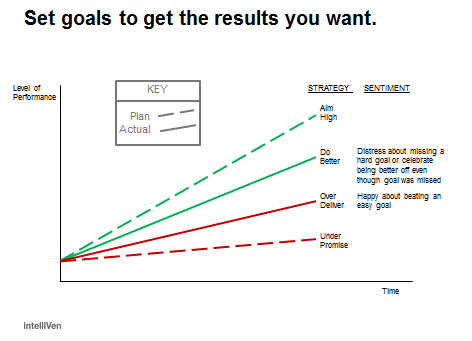
Set goals to get the results you want base
Figure-1: Under Promise and Over Deliver

Target Audience: Board, Bankers, and Investors

Objective: Manage downside risk while maintaining credibility.

Strategy: Present conservative, achievable targets to ensure a high probability of meeting or exceeding expectations. This approach builds trust and reassures stakeholders about the management team and their investment, offering a solid foundation for the future.

Outcome: Exceeding conservative estimates provides a reason for celebration and reinforces stakeholder confidenceas suggested by the under-promise and over-deliver lines graphed in Figure-1.

Management Plan: The Aim-High-Do-Better Method

Set goals to get the results you want full
Figure-2: Aim High and Do Better

Target Audience: Internal Management and Operating Teams

Objective: Maximize team performance and drive to achieve top-tier results.

Strategy: Set aggressive, yet attainable goals, understanding that they might be achieved 75-80% of the time. This encourages teams to stretch their capabilities and innovate, often leading to superior results compared to a conservative approach even when the goal is not attained.

Adaptation: If mid-period results deviate significantly, either above or below, from plan, be prepared to revise the goals to maintain momentum and direction through the rest of the performance period.

Outcome: Even if actual results fall slightly short of ambitious goals, the organization often ends up in a stronger position than if it had set more cautious targets as suggested by the aim-high and do-better lines added to the graph in Figure-2.

Summary: The Dual-Faceted Approach for Business Growth

  • Key Insight: Leaders of growing businesses should adopt a dual strategy in goal setting. Internally, aggressive but achievable goals fuel motivation and high performance, while externally, conservative, and intelligent goal setting satisfies the risk-averse nature of bankers and investors.
  • Result: This balanced approach ensures robust operational performance while maintaining the confidence and support of external financial stakeholders.

How to connect the Top-of-the-House to the FrontLine

When top leaders are informed, thinking critically, and engaged enough to provide guidance and direction, things tend to go pretty well. That is, things get done better, sooner, and more smoothly when leaders pay attention. This note describes an efficient way for top leaders to get and stay up-to-speed, see and understand what is going on, ask questions and think critically, develop a point-of-view, and provide advice and guidance on their organization’s most important functions, projects, and initiatives.

Nearly all of the things that cause activities and initiatives to go off track (see Kotter’s list of eight reasons initiatives fail) could be averted if someone in a position of authority had been involved enough to give guidance along the way.  It is hard, though, for leaders to stay sufficiently engaged even in the most important activities and initiatives because it takes time and focused attention that is easily diverted to other urgent matters.

It Pays to Pay Attention

There are a lot of reasons why a given activity or initiative might be considered important.  For example, it may be relatively large; risky; involve skills, technology, and methods that are new to the organization; have the potential for great leverage in terms of intellectual property development, revenue generation, cost savings, or skill development.  When an activity or initiative is important, it is also important that the effort stays on track, on time, and on-budget!

The best way to ensure on track, on time and on-budget performance are for top leaders to regularly review with those responsible for completing the activity or initiative how things are going.  Doing so provides an opportunity for:

  • Activity and initiative leaders to step back from the press of day-to-day in order to pull together a consolidated picture of what they are doing to share with others in a safe environment, to challenge their thinking, and to provide advice and counsel on strategy, focus, next steps, and to provide guidance, ideas, and resources that can be brought to bear so as to increase the odds of success.
  • Top leaders to stay in touch with what is going on with frontline activity. Any important activity (e.g., delivery, sales, development, marketing, strategic initiatives, etc.) should be reviewed regularly to keep leaders informed about what is going on and for leaders to efficiently provide guidance and direction, consolidate insights across activities, and to drive cross-sharing of resources, insights, and ideas in the best interest of the organization as a whole.

Informal communication on progress is not enough. Neither are occasional one-on-one chats.  It is important that those in charge of the function or initiative need to be asked to prepare to brief others on their efforts in a scheduled forum where the activity or initiative is the only agenda. Even better is when others from across and outside the organization with a stake in performance or with relevant past experience and knowledge are also in attendance.

Review Agenda

  • what we said we’d do
  • what we did
  • what happened
  • what we learned
  • what we plan to do next

Leaders set the tone for reviews to ensure that they serve their intended purpose (see: Review POAD) and that they are not done just for the sake of it and to be sure they do not become a “show and tell” exercise.  Reviewers must make it safe for those whose work is being discussed to embrace the process and seek input from participants because what is being reviewed is what the organization does and deserves input from the best the organization as to offer.

Leaders ask questions to:

  • Draw out clarity
  • Give advice

A review is an efficient and smart way for leaders to keep close to what is really going on and to increase the odds that important work gets done well.  Reviewers must not look to find fault or assign blame.  Instead, they strive to understand what is really going on and to find the best way to improve performance and learn the most.

Reviews also:

  • Provide visibility for key staff.
  • Create high-stakes circumstances that push up performance.
  • Create a forum for executives to model the behavior they want others to emulate.
  • Reveal important lessons and insights to share with other teams and initiatives.

Reviews are successful when:

  • The Project Manager (PM) and the project team feel:
    • They have successfully stepped back from the press of the usual day-to-day to pull together what they are doing into a consolidated whole and shared it with a team of supportive professionals who themselves have reviewed advance materials, showed up, paid attention, participated, and supported the team by challenging its thinking, offering the best advice, and providing access to resources that can be helpful (such as written materials, outside experts, training, and time that will help improve performance).
    • That the preparation process, the review meeting itself, and the follow-up will help them achieve project objectives better, faster, and more smoothly.
  • Management is enlightened with respect to what was reviewed; specifically, what is working, what is not, and what needs to be done and learned as a result
  • The organization’s best ideas, thinking, resources, and skills have been brought to bear.
  • Participants feel:
    • Supported, appreciated, enlightened, engaged, heard, and respected.
    • Appropriate next steps have been lined up in the face of the realities and understanding reached.
  • The PM understands and internalizes:
    • The group’s best thinking in terms of what can be done to most improve performance and/or lower risk and is committed to making that happen
    • The top few actions necessary to follow through
    • What others will specifically do to support these efforts.
    • An open discussion of status leads to the fertilization of ideas across the organization.
  • Top leaders collaborate in support of the PM on front-line work.
  • The work is completed successfully or it is going so well that reviews are no longer needed to ensure success!

Related Posts

8 Reasons Why Reviews Under-perform

Notes and Tips on how to Run a Great Meeting.

Meeting Record

Editor’s note: Updated for 2020, originally posted March 2012.