Periodic reviews are critical for keeping important initiatives, functions, and projects on track in an organization. However, maximizing the value from review meetings takes thoughtful effort from both the reviewers and those presenting their work (the reviewees).
Too often, one or both do not put in the necessary preparation or exhibit good practices during the review resulting in an unproductive meeting. By understanding and executing on the key responsibilities for each role, reviews can be transformed into productive learning experiences.
Responsibilities of the Reviewer
As a reviewer, you have the vital role to create an environment conducive to an open and honest discussion. This starts well before the meeting with your careful review of pre-read materials. Your job is to develop informed questions and hypotheses to pressure test during the meeting itself.
A best practice is to share your initial questions and perspective with the reviewee in advance. This allows them to understand where you are coming from, hone their thinking, and essentially start the review meeting before it officially begins. Provide framing upfront for a more productive dialogue in the review.
Once in the meeting, resist the urge to jump straight to your pre-conceived notions. Instead, actively listen to the reviewee’s presentation with an open mind. Ask clarifying questions to ensure you fully understand the current state and ask well formulated questions to push up thinking, before offering opinions or advice. The best reviewers make the reviewee feel heard and can see the situation through their eyes.
With a common understanding established, it’s then time for hard questions. Don’t hold back . Say what needs to be said and apply pressure to the reviewee’s thinking. Challenge assumptions, probe for gaps or inconsistencies, and push to consider alternative perspectives. However, do it in a constructive way, being careful to separate the person from the points.
Finally, provide clear guidance on the path forward, explaining your thought process. Remain open to final thoughts from the reviewee before setting expectations. Keep the review a two-way dialogue, i.e., a quest for truth!.
Responsibilities of the Reviewee
Presenting during a high-stakes review meeting is highly stressful. However, reviewees must resist the urge to treat it as a one-way presentation. Effective reviewees embrace the meeting as a collaborative problem-solving session by being vulnerable and open to feedback.
The preparation should focus not just on materials summarizing the current state, but also anticipating the tough questions reviewers are likely to ask. Be ready to back up your assumptions, analysis, and recommendations with data and reasoning. At the same time, avoid being overly attached to your original ideas and be open to altogether change coursing course based on the discussion.
During the meeting, reviewees should temporarily park their leadership responsibilities. Resist giving into the urge to justify everything. Instead, actively listen (i.e., repeat back to the speaker what you heard) to be sure you understand reviewers’ perspectives, concerns and recommendations with a beginner’s mindset, as if hearing it for the first time. Ask clarifying questions, take detailed notes, and extend the discussion with a genuine desire to learn.
With reviewers’ guidance absorbed, the hard work is still ahead. Reviewees must internalize and promptly act on the suggestions, including updating plans and re-doing analysis as needed.
Summary
High quality reviews are hard work for both parties. Reviewers must create a psychologically safe environment, genuinely understand the current state before reacting, and then push reviewees’ thinking while providing clear guidance.
Reviewees in turn must be vulnerable, keeping an open mind to altogether pivot based on the discussion and immediately implement the feedback through more work. Shirking these responsibilities leads to disastrous review meetings that simply check a box. Whereas, embracing the mindsets and following the suggestions above turns reviews into powerful tools for accelerating success.
The best approach to setting annual performance goals for an organization is to simultaneously pursue two paths, one for the management team and one for the board, investors, and lenders as outlined below.
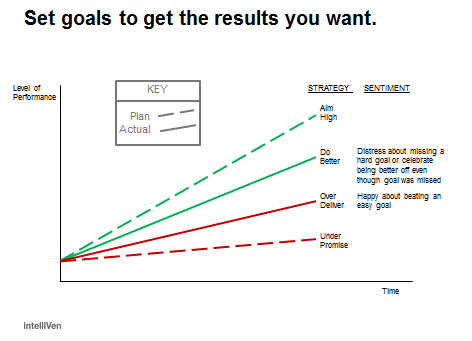
Stakeholder Plan: The Under-Promise-Over-Deliver Approach
Figure-1: Under Promise and Over Deliver
Target Audience: Board, Bankers, and Investors
Objective: Manage downside risk while maintaining credibility.
Strategy: Present conservative, achievable targets to ensure a high probability of meeting or exceeding expectations. This approach builds trust and reassures stakeholders about the management team and their investment, offering a solid foundation for the future.
Outcome: Exceeding conservative estimates provides a reason for celebration and reinforces stakeholder confidenceas suggested by the under-promiseandover-deliver lines graphed in Figure-1.
Management Plan: The Aim-High-Do-Better Method
Figure-2: Aim High and Do Better
Target Audience: Internal Management and Operating Teams
Objective: Maximize team performance and drive to achieve top-tier results.
Strategy: Set aggressive, yet attainable goals, understanding that they might be achieved 75-80% of the time. This encourages teams to stretch their capabilities and innovate, often leading to superior results compared to a conservative approach even when the goal is not attained.
Adaptation: If mid-period results deviate significantly, either above or below, from plan, be prepared to revise the goals to maintain momentum and direction through the rest of the performance period.
Outcome: Even if actual results fall slightly short of ambitious goals, the organization often ends up in a stronger position than if it had set more cautious targets as suggested by the aim-highanddo-better lines added to the graph in Figure-2.
Summary: The Dual-Faceted Approach for Business Growth
Key Insight: Leaders of growing businesses should adopt a dual strategy in goal setting. Internally, aggressive but achievable goals fuel motivation and high performance, while externally, conservative, and intelligent goal setting satisfies the risk-averse nature of bankers and investors.
Result: This balanced approach ensures robust operational performance while maintaining the confidence and support of external financial stakeholders.
When top leaders are informed, thinking critically, and engaged enough to provide guidance and direction, things tend to go pretty well. That is, things get done better, sooner, and more smoothly when leaders pay attention. This note describes an efficient way for top leaders to get and stay up-to-speed, see and understand what is going on, ask questions and think critically, develop a point-of-view, and provide advice and guidance on their organization’s most important functions, projects, and initiatives.
Nearly all of the things that cause activities and initiatives to go off track (see Kotter’s list of eight reasons initiatives fail) could be averted if someone in a position of authority had been involved enough to give guidance along the way. It is hard, though, for leaders to stay sufficiently engaged even in the most important activities and initiatives because it takes time and focused attention that is easily diverted to other urgent matters.
It Pays to Pay Attention
There are a lot of reasons why a given activity or initiative might be considered important. For example, it may be relatively large; risky; involve skills, technology, and methods that are new to the organization; have the potential for great leverage in terms of intellectual property development, revenue generation, cost savings, or skill development. When an activity or initiative is important, it is also important that the effort stays on track, on time, and on-budget!
The best way to ensure on track, on time and on-budget performance are for top leaders to regularly review with those responsible for completing the activity or initiative how things are going. Doing so provides an opportunity for:
Activity and initiative leaders to step back from the press of day-to-day in order to pull together a consolidated picture of what they are doing to share with others in a safe environment, to challenge their thinking, and to provide advice and counsel on strategy, focus, next steps, and to provide guidance, ideas, and resources that can be brought to bear so as to increase the odds of success.
Top leaders to stay in touch with what is going on with frontline activity. Any important activity (e.g., delivery, sales, development, marketing, strategic initiatives, etc.) should be reviewed regularly to keep leaders informed about what is going on and for leaders to efficiently provide guidance and direction, consolidate insights across activities, and to drive cross-sharing of resources, insights, and ideas in the best interest of the organization as a whole.
Informal communication on progress is not enough. Neither are occasional one-on-one chats. It is important that those in charge of the function or initiative need to be asked to prepare to brief others on their efforts in a scheduled forum where the activity or initiative is the only agenda. Even better is when others from across and outside the organization with a stake in performance or with relevant past experience and knowledge are also in attendance.
Review Agenda
what we said we’d do
what we did
what happened
what we learned
what we plan to do next
Leaders set the tone for reviews to ensure that they serve their intended purpose (see: Review POAD) and that they are not done just for the sake of it and to be sure they do not become a “show and tell” exercise. Reviewers must make it safe for those whose work is being discussed to embrace the process and seek input from participants because what is being reviewed is what the organization does and deserves input from the best the organization as to offer.
Leaders ask questions to:
Draw out clarity
Give advice
A review is an efficient and smart way for leaders to keep close to what is really going on and to increase the odds that important work gets done well. Reviewers must not look to find fault or assign blame. Instead, they strive to understand what is really going on and to find the best way to improve performance and learn the most.
Reviews also:
Provide visibility for key staff.
Create high-stakes circumstances that push up performance.
Create a forum for executives to model the behavior they want others to emulate.
Reveal important lessons and insights to share with other teams and initiatives.
Reviews are successful when:
The Project Manager (PM) and the project team feel:
They have successfully stepped back from the press of the usual day-to-day to pull together what they are doing into a consolidated whole and shared it with a team of supportive professionals who themselves have reviewed advance materials, showed up, paid attention, participated, and supported the team by challenging its thinking, offering the best advice, and providing access to resources that can be helpful (such as written materials, outside experts, training, and time that will help improve performance).
That the preparation process, the review meeting itself, and the follow-up will help them achieve project objectives better, faster, and more smoothly.
Management is enlightened with respect to what was reviewed; specifically, what is working, what is not, and what needs to be done and learned as a result
The organization’s best ideas, thinking, resources, and skills have been brought to bear.
Participants feel:
Supported, appreciated, enlightened, engaged, heard, and respected.
Appropriate next steps have been lined up in the face of the realities and understanding reached.
The PM understands and internalizes:
The group’s best thinking in terms of what can be done to most improve performance and/or lower risk and is committed to making that happen
The top few actions necessary to follow through
What others will specifically do to support these efforts.
An open discussion of status leads to the fertilization of ideas across the organization.
Top leaders collaborate in support of the PM on front-line work.
The work is completed successfully or it is going so well that reviews are no longer needed to ensure success!
Compusearch (now Unison) was a visionary company with visionary goals. But, as often happens with visionary companies, focus on a long-term strategy to revolutionize a market can mean that near-term execution and operationalization can suffer, creating barriers to growth.
From its founding in 1983, the company used state-of-the-art software design and development to provide solutions that streamlined and automated key steps in government procurement, purchasing, and contract management.
In 2005, the company arrived at a strategic decision point. The company’s team of owner-operators decided to sell the company and retire. The new owner, private equity firm The Carlyle Group (Carlyle), saw immense potential in the company and its pedigree of quality innovation.
But Carlyle also saw that the change in ownership was an ideal time to assess how the organization operated and to upgrade to more effective strategy execution and operations maturity. Maturing operations turned out to be essential to achieving the goal to double revenue and increasing margins to realize a 4X return on invested capital within five years.
Highly innovative companies often suffer from a lack of focus on operating fundamentals, which becomes an impediment to growing to the next stage of maturity. Carlyle saw evidence that Compusearch could benefit from a renewed and refreshed approach to turning its vision into action.
Carlyle and Compusearch engaged IntelliVen to assess the company’s operational maturity, develop a plan to implement strategy, and generate more effective performance to drive growth.
The Challenges
Like many visionary companies, Compusearch had become a decisive market leader with a strategy of continuous innovation and breaking new ground with its solution offerings.
By 2005, the company had reached $15 million per year in revenue. Its procurement and purchasing solutions were operating in nine cabinet-level departments and related agencies across the United States federal government.
It had achieved this leadership position by continually updating and innovating its solutions as software design and the underlying system capabilities evolved over two decades.
The company’s newest solution was web-based software to support government contract officers who procure, contract, and requisition the spending, granting, and moving of public funds in compliance with mandated government rules, transparency, efficiency, and control.
IntelliVen guided the company’s top team through its structured process to get clear, aligned, and then grow. Alignment came from the clarity reached by the team jointly making explicit what they each saw, and what they were each thinking, so they could then work together to come up with a consolidated view of where things were and what they needed to do.
Compusearch had reached a leadership position in its industry by pursuing a vision with continuous innovation. But oftentimes this approach can cause a company to become distracted. It ends up chasing the new technology and functionality without tuning its operations and processes to generate the most value from the innovations it has already brought to market. There were many more opportunities for the company to extend and expand the value it provided to current customers with its existing solutions at existing customers.
2. Lack of coordinated direction and team alignment
The executive team in Compusearch was made up of highly experienced managers who knew the market and their functional domains of responsibility. But there was no consistent melding of vision and strategy coordinated across functional teams, to ensure everyone was always rowing in the same direction. As a result, the company found itself often in reaction mode, not effectively promoting its current offerings to customers to generate more business. Key items fell between organizational units, resulting in unmet client needs, as well as confounded employees. In some cases, initiatives were confined to a particular unit, such as the development team, without the full benefit of coordination with other groups such as those providing customer services.
3. No clear process for strategy operationalization
Like many companies, the corporate vision for revolutionizing federal government contracting was well understood by top executives. But exactly how that vision translated into individual goals, commitments, and resource allocation was not all that clear. Each executive had to decide for themselves how best to support overall corporate goals.
4. Inconsistent and ineffective use of metrics for tracking and accountability
Compusearch executives collected and studied metrics that were relevant to their own functional domains. But they were not as effective at combining and assessing these metrics in terms of the story they told for overall corporate performance and strategy implementation. A sales leader would announce a customer win that generated widespread acclaim in the company. But it was rare for anyone to ask whether the price was aligned with the firm’s strategy or if the licensing terms would generate the most value over the long term.
The Solutions: Aligning Compusearch for Execution
IntelliVen Founder and Managing Partner, Peter DiGiammarino, worked with the new Compusearch CEO, Reid Jackson, to explore how a new, fresh approach to strategy execution and operating practices could be implemented across the company.
Together they implemented four initiatives using IntelliVen tools, workstreams, and tutorials for best practice operations.
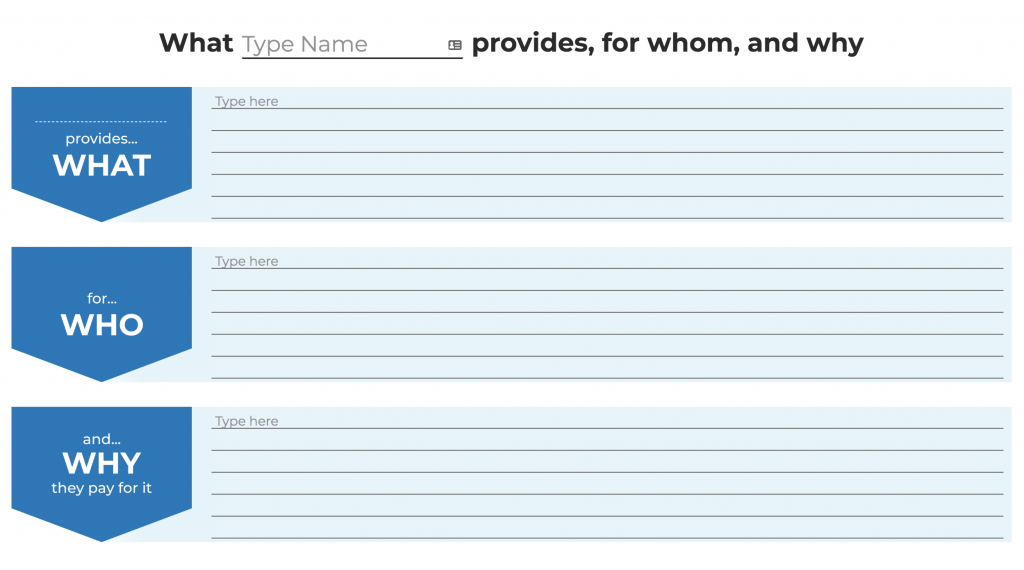
Peter introduced the W-W-W model – the exercise in which senior managers gain great clarity on
WHAT they are selling.
WHO is buying it.
WHY they buy it.
By working together to reach a common, crisp and simple understanding of the overarching purpose of the company in this way, the company core leadership team instantly become more closely aligned in terms of strategy and action. As Peter describes it, nailing down the W-W-W is the first step any organization needs to take to enable a team to, “Get clear, Align, and Grow!”
The Initiative-to-Action template helps ensure that strategic planning session outcomes are acted upon. It requires managers to connect the dots between corporate strategy, the case for change, individual goals, resource allocation, performance metrics, actions, timetable, accountability, and outcomes.
2. Core leadership team alignment: set direction, execution focus, incentives
The new model for the executive team featured cross-team communication and cross-organizational performance tracking. That way, each executive knew what was required of their group and, in turn, could clearly identify the needs they had for others. The resulting cross-team dependency tracking set the direction for the team and focused the executives on execution. The new accountability was enhanced by tying executive incentives to hitting cross-group targets in addition to individual performance goals to align resources.
Clarity on strategy and aligning the team in the same direction allowed the Compusearch team to then explore executing more effectively on the overall strategy.
For example, the team saw new opportunities for revenue expansion in existing customers with solution refinements, such as offering new billable services that previously had been a support expense.
Knowing who to count on for what made it possible to also introduce new responsibilities such as account and project management. Every employee could see clearly what they could do to step up to and help identify, develop, and deliver on every opportunity to provide more value to customers.
Lastly, the new approach to operationalization created a framework for accountability and governance. Now each executive and each member of the staff understood what was expected of them and performance against these requirements was easy to measure and track.
4. Metrics to drive and track effective operationalization
With the newfound accountability and alignment of goals and dependencies, the executive team had the ability to use key metrics to track and improve execution and operationalization.
The performance of every department – product engineering, customer support, professional services, marketing, sales – could be tracked and evaluated using metrics and benchmarks that guided team decisions and next actions.
When these metrics indicated a problem was arising in a given area, the team could readily see how each member could contribute to address the problem. The approach promoted accountability for execution and brought leadership together as a high-performance team that worked to make each other – and the company as a whole – successful.
The Outcomes: Compusearch’s organization evolution and growth
With the IntelliVen best practices guidance, Compusearch embarked on a transformation that resulted in much more effective execution and strategy operationalization.
The results were dramatic increases in top-line revenue, growing more than 200 percent in four years. Other impacts included:
Driving the EBITDA-margin plus growth-rate to over 50.
Increasing recurring revenue to more than half of total revenue.
Shifting from selling one product in a narrow market to selling multiple products into multiple markets while at the same time maximizing revenue from existing customers.
Compusearch had achieved a much more advanced stage of organization maturity. After four years of growth, the company sold for a ~4X multiple of invested capital. The company was eventually renamed Unison and, over the past fifteen years has successfully executed its business and financial plans, completed several accretive acquisitions with more on the horizon, and is on track to exceed $180 million in annual revenue. All-and-all a great win-win-win-win-win: for the company, its customers, employees, investors, and the community in which it operates.
BREAKTHROUGH PERFORMANCE IMPROVEMENT
MtL is for organization, unit, and function leaders and their teams who seek breakthrough improvement in performance and growth.
When the stakes are high, there is no substitute for getting so ready that your odds of success go way up, even if what was planned never happens.
Ten years into my career, I was running a fast-growing practice when the EVP of Consumer Lending at the Bank of America, our most important client, called to schedule a meeting with my boss about a problem. My team was working on a multi-million dollar project that was behind schedule and it looked like we might be into something well over our heads.
My boss deflected the meeting to me. At first, I tried to duck the responsibility by pointing out that BofA was so important that our CEO should take the meeting. Fortunately, he saw it instead as a growth opportunity for me!
I decided to buckle down and prepare for the most important meeting of my career. The stakes were outrageous:
If the meeting went poorly, we would likely have to un-recognize millions in revenue, which, as a newly public company would have been disastrous, and the new line of business being launched with the work we were doing would go down the tubes.
If the meeting went well, we could do business with BofA for years and launch the new line of business, which could more than double our size in short order.
If you are curious as to the angle of pursuit I planned to follow, check out this IntelliVen post: How to Handle a Disgruntled Customer (one of my most referenced and useful posts ever!)
The meeting went nothing like what I had planned, but because of diligent preparation, I was in a strong position to make things come out well. Thanks to good work by the team and conscientious follow-up (see note on review meetings), the project got back on track and was successful. We went on to do tens of millions of dollars with the bank and did indeed launch a whole new line of business.
The experience helped me learn to aggressively prepare for high-stakes interactions. Ever since, I have never regretted every minute of time spent to get in the best position possible ahead of important meetings.
By the way, this is also a great example of how using your organization as the case on which to apply an approach using the course-supplied tools helps to make the change you want through the Strategic Leadership Immersion Program.
Some of those who work with me struggle to understand how it could possibly be worth one more run-through before the big moment. Others appreciate it when you have them go through their material one more time.
The note below is based on observations made by an executive who worked with me for a year in which cases similar to the one above played out. When I left the company, he presented me with the note below so I would know he had learned much from our time together. I appreciate his appreciation and remain thoroughly impressed with what he took away from our common experience.
Anyone preparing for high-stakes action might also find his points useful:
Dear Peter,
In the dealings we have had together, I think I’ve picked up some seminal ideas from you:
Always prepare so well that you are able to cover even the most complex topic in a casual conversation. It makes you more credible and puts people in a frame of mind that makes it easy for them to listen while you just talk with them rather than walking them through a step-by-step briefing.
Always involve other people in your preparation. First of all, two (or more) heads really are better than one. Secondly, if people feel they are part of the solution, you capture their hearts along with their support for what you have set out to do. If you keep things close to the vest, those around you become suspicious and tend to put up barriers and you end up with half-hearted support at best.
You work hard to have input from others to become part of the final product. Their input enhances your own efforts. Besides, there is rarely a right answer anyway. Even an okay solution can be powerful if lots of people understand it, are bought into it and are committed to making it work.
When someone asks you to review something, you always make it worth their while because you add as much value as you can. Then you challenge them with hard questions to help push their level of readiness to even higher levels.
You create and take advantage of high-stakes opportunities for people to perform because this is when you get the best out of them and this gives you, and them, material that can be used again and again.
You always do what you honestly believe is best for your client. In the long run, that will be best for you.
You never shoot from the hip. While you are very quick on your feet when someone asks a hard question, you probe to be sure you understand what they are after and then you think things through carefully before offering a response.
After you do something, you reflect on it to figure out what worked so you can do it again and what did not work so you can keep from doing it next time.
Things never go exactly as planned, but you always perform better from having thought through how you would like things to go.
I bet you thought I wasn’t paying attention. I may not have caught everything, but at least I got some important stuff. Mostly, I just want to thank you for all that you have done in the past year. You have shown us a whole new way of doing business and many of us really appreciate it.