Tag Archives: initiatives

Maximizing the Value of Review Meetings

Periodic reviews are critical for keeping important initiatives, functions, and projects on track in an organization. However, maximizing the value from these review meetings takes thoughtful effort from both the reviewers and those presenting their work (the reviewees).

Too often, one or both do not put in the necessary preparation, resulting in an unproductive meeting. By understanding and executing on the key responsibilities for each role, reviews can be transformed into productive learning experiences.

Responsibilities of the Reviewer

  • As the reviewer, you have the vital role to create an environment conducive to an open and honest discussion. This starts well before the meeting with your careful review of pre-read materials sent ahead of time. Use this to develop informed questions and hypotheses to pressure test during the meeting itself.
  • A best practice is to share your initial questions and perspective with the reviewee in advance. This allows them to understand where you are coming from, hone their thinking, and essentially start the review meeting before it officially begins. Provide this helpful framing upfront for a much more productive dialogue in the review.
  • Once in the meeting, resist the urge to jump straight to your pre-conceived notions. Instead, actively listen to the reviewee’s presentation with an open mind. Ask clarifying questions to ensure you fully understand the current state and ask well formulated questions to push up thinking, before offering opinions or advice. The best reviewers make the reviewee feel heard and can see the situation through their eyes.
  • With this common understanding established, then it’s time for the hard questions. Don’t hold back – apply pressure to the reviewee’s thinking by challenging assumptions, identifying gaps or inconsistencies, and pushing them to consider alternative perspectives. However, do this in a constructive way, separating the person from the points.
  • Finally, provide clear guidance on the path forward, explaining your thought process. But also be open to any final thoughts from the reviewee before conclusively setting expectations. The review should be a two-way dialogue (which is, literally, a quest for truth!).

Responsibilities of the Reviewee

  • Presenting during a high-stakes review meeting is highly stressful. However, reviewees must resist the urge to treat it as a one-way presentation. Effective reviewees embrace the meeting as a collaborative problem-solving session by being vulnerable and open to feedback.
  • The preparation should focus not just on materials summarizing the current state, but also anticipating the tough questions reviewers are likely to ask. Be ready to back up your assumptions, analysis, and recommendations with data and reasoning. However, avoid being overly attached to your original ideas – maintain an open mindset to altogether change course based on the discussion.
  • During the meeting, reviewees should temporarily park their leadership responsibilities. Resist giving into the urge to justify everything. Instead, actively listen (i.e., repeat back to the speaker what you heard) to be sure you understand reviewers’ perspectives, concerns and recommendations with a beginner’s mindset, as if hearing it for the first time. Ask clarifying questions, take detailed notes, and extend the discussion with a genuine desire to learn.
  • With reviewers’ guidance absorbed, the hard work is still ahead. Reviewees must internalize and quickly implement the suggestions, updating their plans or re-doing analysis as needed. Note: a poor previous approach is no excuse for reverting – reviewing your team’s work in a new light is a vital skill.

Summary

High quality reviews are hard work for both parties. Reviewers must create a psychologically safe environment, genuinely understand the current state before reacting, and then push reviewees’ thinking while providing clear guidance.

Reviewees in turn must be vulnerable, keeping an open mind to altogether pivot based on the discussion and immediately implement the feedback through more work. Shirking these responsibilities leads to disastrous review meetings that simply check a box. Whereas, embracing the mindsets and following the suggestions above turns reviews into powerful tools for accelerating success.

See Also

How to connect the Top-of-the-House to the FrontLine

When top leaders are informed, thinking critically, and engaged enough to provide guidance and direction, things tend to go pretty well. That is, things get done better, sooner, and more smoothly when leaders pay attention. This note describes an efficient way for top leaders to get and stay up-to-speed, see and understand what is going on, ask questions and think critically, develop a point-of-view, and provide advice and guidance on their organization’s most important functions, projects, and initiatives.

Nearly all of the things that cause activities and initiatives to go off track (see Kotter’s list of eight reasons initiatives fail) could be averted if someone in a position of authority had been involved enough to give guidance along the way.  It is hard, though, for leaders to stay sufficiently engaged even in the most important activities and initiatives because it takes time and focused attention that is easily diverted to other urgent matters.

It Pays to Pay Attention

There are a lot of reasons why a given activity or initiative might be considered important.  For example, it may be relatively large; risky; involve skills, technology, and methods that are new to the organization; have the potential for great leverage in terms of intellectual property development, revenue generation, cost savings, or skill development.  When an activity or initiative is important, it is also important that the effort stays on track, on time, and on-budget!

The best way to ensure on track, on time and on-budget performance are for top leaders to regularly review with those responsible for completing the activity or initiative how things are going.  Doing so provides an opportunity for:

  • Activity and initiative leaders to step back from the press of day-to-day in order to pull together a consolidated picture of what they are doing to share with others in a safe environment, to challenge their thinking, and to provide advice and counsel on strategy, focus, next steps, and to provide guidance, ideas, and resources that can be brought to bear so as to increase the odds of success.
  • Top leaders to stay in touch with what is going on with frontline activity. Any important activity (e.g., delivery, sales, development, marketing, strategic initiatives, etc.) should be reviewed regularly to keep leaders informed about what is going on and for leaders to efficiently provide guidance and direction, consolidate insights across activities, and to drive cross-sharing of resources, insights, and ideas in the best interest of the organization as a whole.

Informal communication on progress is not enough. Neither are occasional one-on-one chats.  It is important that those in charge of the function or initiative need to be asked to prepare to brief others on their efforts in a scheduled forum where the activity or initiative is the only agenda. Even better is when others from across and outside the organization with a stake in performance or with relevant past experience and knowledge are also in attendance.

Review Agenda

  • what we said we’d do
  • what we did
  • what happened
  • what we learned
  • what we plan to do next

Leaders set the tone for reviews to ensure that they serve their intended purpose (see: Review POAD) and that they are not done just for the sake of it and to be sure they do not become a “show and tell” exercise.  Reviewers must make it safe for those whose work is being discussed to embrace the process and seek input from participants because what is being reviewed is what the organization does and deserves input from the best the organization as to offer.

Leaders ask questions to:

  • Draw out clarity
  • Give advice

A review is an efficient and smart way for leaders to keep close to what is really going on and to increase the odds that important work gets done well.  Reviewers must not look to find fault or assign blame.  Instead, they strive to understand what is really going on and to find the best way to improve performance and learn the most.

Reviews also:

  • Provide visibility for key staff.
  • Create high-stakes circumstances that push up performance.
  • Create a forum for executives to model the behavior they want others to emulate.
  • Reveal important lessons and insights to share with other teams and initiatives.

Reviews are successful when:

  • The Project Manager (PM) and the project team feel:
    • They have successfully stepped back from the press of the usual day-to-day to pull together what they are doing into a consolidated whole and shared it with a team of supportive professionals who themselves have reviewed advance materials, showed up, paid attention, participated, and supported the team by challenging its thinking, offering the best advice, and providing access to resources that can be helpful (such as written materials, outside experts, training, and time that will help improve performance).
    • That the preparation process, the review meeting itself, and the follow-up will help them achieve project objectives better, faster, and more smoothly.
  • Management is enlightened with respect to what was reviewed; specifically, what is working, what is not, and what needs to be done and learned as a result
  • The organization’s best ideas, thinking, resources, and skills have been brought to bear.
  • Participants feel:
    • Supported, appreciated, enlightened, engaged, heard, and respected.
    • Appropriate next steps have been lined up in the face of the realities and understanding reached.
  • The PM understands and internalizes:
    • The group’s best thinking in terms of what can be done to most improve performance and/or lower risk and is committed to making that happen
    • The top few actions necessary to follow through
    • What others will specifically do to support these efforts.
    • An open discussion of status leads to the fertilization of ideas across the organization.
  • Top leaders collaborate in support of the PM on front-line work.
  • The work is completed successfully or it is going so well that reviews are no longer needed to ensure success!

Related Posts

8 Reasons Why Reviews Under-perform

Notes and Tips on how to Run a Great Meeting.

Meeting Record

Editor’s note: Updated for 2020, originally posted March 2012.

How to use the Change Framework to turn initiatives into action.

If the leader thinks they know what needs to change and that everyone is aligned, ask: “How do you know your team knows what you want to do? It may be a good idea to ask them to verify. If they all say what you expect them to say, a positive step towards getting what you want done will have been taken just by bringing it to the center of their attention. If it turns out that some or all of the team are not as aligned as expected, then remedial steps can be taken.”

Survey the leader’s top team and ask them each:

  • To describe the current state, that is: how things are today.
  • What really good things happen if we change and what really bad things happen if we do not?
  • To describe how things would be in the future if their ideal changes were successfully implemented.
  • What needs to be done in order to get from where things are today to where things would ideally be next?
  • What will make it hard to do what needs to be done in order to get from today to the targeted next state?

Review results with the leader to bring him/her up to speed on the group’s data. Look for and discuss fully any points the leader finds confusing or surprising.

Convene an offsite with the leader and the leadership team to review collected data, reach consensus on each of the five topics, and decide what needs to be done. At the offsite, review survey responses one question at a time in the order above. Highlight responses that are the same or similar thereby indicating progress towards consensus. Guide the group to discuss the data until agreement is reached on how things are today, why things need to change, and how things would be if the desired change had been implemented.

The Change Framework
Use the Change Framework to make the case for each Strategic Initiative.

The Change Framework is a convenient way to visualize and store the group’s consensus using a diagram similar to that originally introduced by Richard Beckhard and Wendy Pritchard in Changing the Essence: The Art of Creating and Leading Fundamental Change in Organizations, Jossey-Bas Inc., San Francisco, 1992.

Fill out the Change Framework to make a clear and compelling case for each initiative.  Iterate with the team until all members are crystal clear about each initiative.

If participants share their thinking openly, fully, and honestly they can go a long way towards achieving clarity and alignment. An effective leader then holds the results of these efforts and furthers their development, communicates progress to stakeholders, and assigns, aligns and drives resources in their pursuit.

Figure-2: Follow the above tips to build a clear and compelling case for the change driven by each initiative.

A well formulated initiative, using the Change Framework, tells a story about where things are, why they need to change, how things would be if the intended change occurred and what must be done to get from here to there. A well crafted change framework is rational, compelling, and flows smoothly from the present through to the future.

Follow the tips in Figure-2 to piece together the context and the story for each of the initiatives the organization must do next to stay on track to long-term growth and performance.

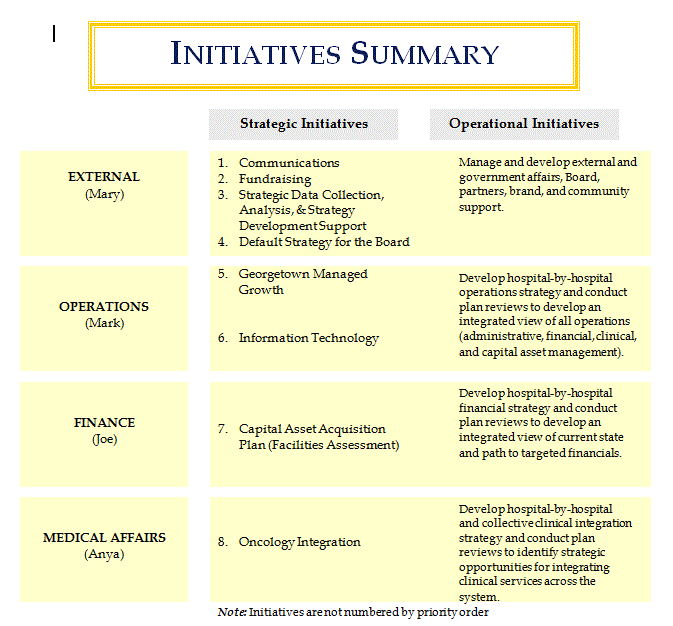
Figure-3: A classic looking list of initiatives from an executive off-site.

Many management offsites produce a list of initiatives, such as shown in Figure-3, after intense effort and exhilarating breakthroughs. A list without context, though, fails to reveal the motivation and importance behind each initiative and so makes it difficult to communicate or to muster the energy, resources, and commitment beyond the session needed to implement them.

Using the Change Framework instead of a simple list helps but even still, far too often, the same initiatives are again listed at the next offsite with little if any progress since last time simply because no one was put in charge and resources never allocated to implement them.

Upon reaching agreement, the group may feel drained but good about what it has accomplished. It is important to make sure the group knows it has done great work and come a long way but there is still more important work to be done. Their effort may be for naught unless one more step is taken.

After the list of initiatives is developed and before ending the session the leader assigns each team member to:

Figure-4: Click on the figure to fill out and submit the Initiative-to-Action form for a Strategic Initiative.


  • Take 20-minutes to fill out an Initiative-to-Action template using the link in Figure-4, for a specific initiative, preferably one the leader would like the team member to sponsor
  • Lead the group in a brief discussion about the assigned initiative.

Each team member, in turn, briefs the group on their initiative using the filled out Initiative-to-Action form. As each speaks, the rest of the leadership team adopts the mindset of close adviser and on the same team as the one speaking. Their objective is to ensure that the key points from the group’s work are captured so that the best thinking of the group is at-hand and in mind as efforts to progress with the initiative proceed on the heels of the session.

Filling out and briefing the Initiative-to-Action form launches the governance process and gets a leadership team member into the role of the initiative’s executive sponsor and on-the-hook to make progress on behalf of the group.  As such the team member becomes accountable to the group for progress on their initiative. Motivation and commitment soar and the odds of making progress go up as well. Over the ensuing performance period, the leader calls on each team member at some point to brief the group on how their initiative is progressing.

Example Change Framework:

Example Change Framework for an organization whose leaders decided to move from a functional to a cross-functional approach to client services.