Category Archives: Get Clear

Know whose problem you solve, how, and how well.

W-W-W and Go-to-Market Fit: Essential Partners for Success

As organizations grow, leaders are often faced with strategic questions that may seem similar but address different parts of the business. One question that often comes up is whether frameworks like W-W-W (WHAT-WHO-WHY) and concepts like go-to-market fit are two ways of addressing the same challenge, or if they are fundamentally different.

Given the increasing need for clarity and market readiness, it’s important to understand how these two approaches compare and when each is most useful.

The W-W-W concept (WHAT-WHO-WHY) and go-to-market fit both deal with foundational aspects of a business strategy, but they focus on different areas and serve different purposes. Let’s compare them in detail:

Definition and Purpose

  • W-W-W (WHAT-WHO-WHY)
    • WHAT: The product or service you offer.
    • WHO: The target customer or market.
    • WHY: The reason customers will pay for your offering (i.e., the value it brings).

    Purpose: The W-W-W framework is designed to ensure clarity and alignment within an organization about its offering, its target audience, and the value proposition. It helps a company articulate its strategy in a clear and focused way, ensuring that all internal and external stakeholders are on the same page about the core business model.

  • Go-to-Market Fit (GTM Fit)
    • Definition: Go-to-market fit refers to the point where a company’s product or service is well-positioned to be introduced and scaled in a target market. It implies that the product, value proposition, and messaging align with the needs and preferences of the market, ensuring that the company can effectively acquire, retain, and grow customers.

    Purpose: Go-to-market fit is about ensuring that all the components of bringing a product to market (e.g., product positioning, sales strategy, marketing, pricing, and customer acquisition channels) are in alignment with the target customer base. It’s a more dynamic and iterative concept, aimed at achieving market penetration and scalable growth.

Focus Areas

  • W-W-W:
    • Focuses on strategic clarity—understanding your offering (WHAT), your audience (WHO), and your core value (WHY).
    • It’s more about internal alignment and ensuring that the entire organization has a consistent understanding of the core business.
    • It addresses high-level strategic questions that guide decision-making.
  • Go-to-Market Fit:
    • Focuses on market execution—how well the company’s product fits the market, how well it can be positioned, and how the sales and marketing strategy can convert potential customers.
    • It’s more tactical and action-oriented, addressing the steps and processes needed to succeed in the market.
    • GTM fit deals with dynamic market factors, such as competition, customer needs, channels, and pricing.

Relationship to Product-Market Fit

  • W-W-W:
    • Helps a company define product-market fit conceptually, as it aligns what you offer (WHAT) with who needs it (WHO) and why they would pay for it (WHY).
    • It is often a precursor to developing a go-to-market strategy, ensuring that the company has a clear understanding of its core value before trying to execute in the market.
  • Go-to-Market Fit:
    • Relies on achieving product-market fit first, and then determining how to position and deliver the product effectively to the market.
    • GTM fit ensures that product-market fit scales—i.e., that the product can be sold, distributed, and adopted in a sustainable and scalable way.

Time Frame

  • W-W-W:
    • W-W-W is often a strategic exercise done early in the life cycle of a business or during significant shifts in strategy, offering a clear, enduring direction.
    • Once clarified, it can remain stable over longer periods, helping guide operations and strategy.
  • Go-to-Market Fit:
    • GTM fit is more fluid and iterative, adapting as the market changes, as competition arises, and as customer preferences evolve.
    • It often requires continuous refinement as the company gathers feedback from initial customer segments and adjusts its approach.

Metrics for Success

  • W-W-W:
    • Success is measured in terms of organizational alignment—is everyone in the company clear about what the business does, who it serves, and why it matters?
    • Indicators include consistency in messaging, understanding of the customer’s core needs, and clarity of strategic goals.
  • Go-to-Market Fit:
    • Success is measured through market performance—are we acquiring and retaining customers, are our channels efficient, and is our product resonating with the target audience?
    • Metrics could include customer acquisition cost (CAC), lifetime value (LTV), conversion rates, and revenue growth.

Examples

  • W-W-W Example:
    • A software company defines:
      • WHAT: A project management tool for distributed teams.
      • WHO: Medium-sized tech companies with remote employees.
      • WHY: These companies need a streamlined way to manage cross-team collaboration to save time and reduce friction.

    This framework helps the company ensure that everyone, from product development to marketing, is aligned on the core offering.

  • Go-to-Market Fit Example:
    • That same company achieves go-to-market fit when:
      • The sales and marketing teams have developed a clear positioning and messaging that resonates with decision-makers at tech companies.
      • The product is priced competitively and distributed effectively through the right channels (e.g., online ads, partner networks).
      • The company can scale its customer acquisition without an unmanageable increase in costs.

Overlap

While W-W-W and go-to-market fit serve different functions, they are complementary in the following ways:

  • Strategic Alignment: W-W-W provides clarity on core elements (product, target customer, value proposition) that are essential for achieving go-to-market fit.
  • Foundation for GTM: A strong W-W-W foundation can set up a company for success in achieving GTM fit, as it ensures that the internal strategy aligns with market realities.
  • Mutual Dependency: Without clarity from W-W-W, it’s hard to execute a successful go-to-market strategy. Likewise, without good execution (GTM fit), even a well-defined W-W-W won’t lead to growth.

Conclusion

  • W-W-W is about clarity and alignment within the organization regarding the product, market, and value proposition. It’s a foundational, strategic tool.
  • Go-to-Market Fit is about market readiness and execution, focusing on aligning your product and strategy with the market to drive adoption, growth, and scalability.

Both concepts are important, but they address different aspects of a company’s journey from defining its offering to scaling in the market.

Further Reading

  • Cognitive Load Theory and Decision-Making: For more on how frameworks like W-W-W help reduce cognitive load and improve strategic alignment, consider John Sweller’s work on Cognitive Load Theory.
  • Product-Market Fit and GTM Strategy: Dive deeper into concepts of go-to-market fit with Ben Horowitz’s book The Hard Thing About Hard Things, which covers execution strategies for scaling businesses.
  • Leadership in Strategic Clarity: For those interested in exploring leadership models for strategic clarity, check out Leadership in the Age of Complexity by Eric J. McNulty and Leonard J. Marcus.

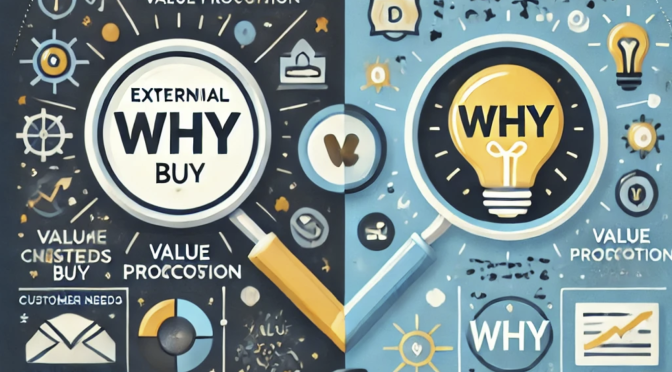
Understanding Two Perspectives: Differentiating the MtL WHY and Sinek’s Why

In business and leadership, understanding your “Why” is pivotal for success and meaningful connections. This newsletter compares two distinct perspectives—the MtL WHY and Simon Sinek’s Why—that drive your organization’s purpose and strategy.

The MtL WHY: Understanding Your Customer

The Manage to Lead (MtL) WHY is based on the principles outlined in the book Manage to Lead: Seven Truths to Help You Change the World, by Peter DiGiammarino. The MtL WHY explains why your business exists in the eyes of your customers and focuses on understanding their motivations to choose to purchase or fund what your organization provides.

Key Characteristics:

  • External Focus: Centers on your customers’ beliefs and needs.
  • Purpose: Foundation for defining your organization’s Ideal Customer Profile (ICP).
  • Application: Helps craft Unique Value Propositions (UVP) and tailored messages that connect and engage. Guides marketing, lead generation, sales, and account development efforts.

Why the MtL WHY Matters

The MtL WHY helps leaders create compelling value propositions, develop messages that resonate, and build strong customer relationships by aligning offerings with customer motivations.

Sinek’s Why: Understanding Your Team

Sinek’s Why delves into the core beliefs and values that drive your organization and its people. It focuses on understanding the internal motivations and deeper purpose beyond just making profits.

Key Characteristics:

  • Internal Focus: Centers on your organization’s core beliefs.
  • Purpose: Explains why your business exists in the eyes of its members.
  • Application: Guides leadership decisions, shapes company culture, and inspires stakeholders.

Why Sinek’s Why Matters

Sinek’s Why helps build a purpose-driven culture, attract like-minded employees, and inspire loyal customers who resonate with your organization’s beliefs.

Differences Between the MtL WHY and Sinek’s Why

  • MtL WHY: Explains the need fulfilled for prospects who become customers and why they stay—why the business exists in the eyes of its customers. 
  • Sinek’s Why: Explains what drives people to join and remain with the organization—why the business exists in the eyes of its members.

Align Purpose and Motivation for Synergy

Aligning internal motivations with external customer needs creates a holistic strategy that is meaningful and, often, unbeatable. Those who master both stand out because they understand why they matter—to themselves and to their customers.

About IntelliVen

At IntelliVen, founded by Peter DiGiammarino, we specialize in helping leaders and organizations clarify their purpose, align their strategies, and achieve their fullest potential. Through our eponymous Manage to Lead (MtL) Cohort Course, leaders and teams learn to get clear, align, and grow. Whether you’re seeking to understand your customers better or to reignite your organization’s passion, we’re here to guide you on your journey.

Learn More

Elevate Your Skills: Don’t Just Build—Create a Legacy

The most successful professionals don’t just list skills when pitching a prospect—they frame their expertise as a solution to an urgent business problem. Whether you’re laying bricks or building castles, the labor may be the same, but the way you present it changes everything. By shifting from listing tasks you will perform to solutions you will deliver, you communicate the value you bring as a strategic partner.

Imagine walking into a prospect’s office and, instead of describing what you know how to do, you present a fully formed solution to a pressing issue. When you highlight the problems you solve and the measurable outcomes achieved, you differentiate yourself as one who puts the vision into their mind, inspiring them with a clear path forward, and then gets paid a premium to bring that vision to life. Rather than deploying skills at labor rates, you’re instantiating a vision and charging full price for delivering strategic, transformative results.

Shift Focus From Tasks to Outcomes

To elevate the perception of your value, shift the focus from tasks you perform to outcomes you deliver. Here’s how:

  • Study past projects to zero in on the business goals you helped achieve.
  • Describe your skills in terms of the problems they solve.

For example, if your offering is to help people in different departments of a client organization to work together  to prepare to perform at a high level in an emergency:

  • Move beyond “meeting facilitation” by offering instead Cross-Functional Emergency Training and emphasize its role in improving interdepartmental coordination during crises.
  • Rather than “data integration,” present it as a Crisis Management Solution that uses existing technology to enable real-time decisions in high-stakes situations—at no additional cost.

By adjusting your message this way, you’re no longer just laying bricks—you’re building castles that address critical business needs.

Build Your Toolkit: Case Studies and Competency Frameworks

Once you’ve demonstrated how your expertise solves real-world problems, package it to make your value tangible and repeatable:

  • Document insights from past projects to build a knowledge base of best practices for future engagements.
  • Create frameworks that map your skills directly to specific business challenges.
  • Develop and share case studies that clearly outline the challenge, your approach, and the impact achieved.

These artifacts enable you to communicate your capabilities in a way that resonates with clients and prospects, clearly showing the value you bring.

Steps to a Sale

When communicating with prospects, focus on how your solution will transform their operations or market position. Here’s how to effectively structure your message:

  • Articulate the key challenge your solution addresses and why this issue is difficult to solve.
  • Explain what top performers in the industry do to overcome the challenges, and emphasize that your approach encapsulates these best practices—and that you’ve done it before, ideally with customers the prospect admires.
  • Reinforce your expertise with success metrics, client testimonials, and case studies, to suggest that no one can deliver the solution as quickly, efficiently, or with as little risk as you can.

At this point, your prospect has three options:

  1. Ignore your advice.
  2. Attempt to implement your suggestions on their own.
  3. Proceed with outside help. (i.e., and since you brought the solution, have a proven track record, and have established yourself as the expert, why would they go elsewhere?)

Turn Your Business into One That Can Scale

Moving from tasks to solutions makes your sales process both more efficient and more successful. Perhaps even more importantly, this shift enables you to build a business that inspires clients with the vision of a castle and then delivers on that vision. By adopting a repeatable approach, you make it easier to sell, easier to deliver what you sell, and easier to develop and deploy resources for both sales and delivery. You’re architecting a business that will stand the test of time, growing in both scale and value, with each new engagement amplifying its impact.

From Vision to Action! How to Align Your Team and Execute Your Plan

In today’s rapidly evolving landscape, having a clear and well-defined strategy to win the game you are playing is critical. It’s the roadmap that guides your organization towards its goals and ensures that every action and decision aligns with your vision.

However, crafting and implementing an effective strategy can be a complex and daunting task. This is where the IntelliVen Strategy and Planning Offsite comes into play.

Why the Strategy and Planning Offsite with IntelliVen?

If you’re at the helm of an organization, you understand the importance of strategic planning. You also know that it’s not enough to simply have a strategy; strategy needs to be translated into a practical operating plan that guides your team’s actions throughout the year. The IntelliVen Strategy and Planning Offsite helps leaders like you bridge the gap between strategy development and successful execution. 

The Strategy and Planning Offsite empowers you and your executive team with:

  • Clarity: Achieve a clear and common understanding of your organization’s current state, the case for change, and your target next state.
  • Strategic Initiatives: Identify strategic initiatives that will propel your organization from its current state to where you aspire to be next and prioritize actions that will close the gap based on their impact and feasibility, culminating in a roadmap for implementation.
  • Resource Allocation: Determine roles, responsibilities, and resource requirements for your most important initiatives. This includes allocating the staff, time, money, and other resources needed to make them a reality.
  • Financial Alignment: Align your financial and operational plans with your strategic initiatives. This ensures that your strategic initaitives are not side-jobs to be done as time permits but, instead, are woven into the mainstream of day-to-day activities.
  • Effective Communication: Develop a clear communication strategy to convey your vision and plan to all stakeholders, including your board, investors, employees, and partners.

The Outcomes

Working with IntelliVen Senior Oprating Partners, leaders will achieve key outcomes from their Strategy and Planning Offsite:

  • Alignment:  Participants agree on your current state, case for change, target state, and the necessary actions for each strategic initiative.
  • Implementation Readiness: Lay the groundwork for the successful implementation of strategic initiatives, and establish a governance process understood and agreed upon by all participants. 
  • Team Cohesion: Participants leave the offsite with a deeper understanding of each other and a stronger commitment to the organization’s mission and leadership.

Get Started with IntelliVen

If you’re ready to take your organization  to the next level, it’s time to consider the IntelliVen Strategy and Planning OffsiteContact us to learn more about how our team can help you identify and reach your strategic goals for the long-term.

Invest in your organization’s long-term future with the IntelliVen Strategy and Planning Offsite.
Contact us now!