Jose Luis Romero, who lives and works in Mexico and who is an expert in the area of Employee Performance Optimization,teaches middle and upper level managers free, simple and the most effective ways to optimize employee performance.
Jose Luis’ content is interesting and useful. For example, see his collection of mission statements and subscribe to his “Leader Newsletter” to receive – at no cost – practical leadership tools once a month. To subscribe, follow this link: https://www.Skills2Lead.com/educational_leadership_articles.html
An organization that does not know how it will meet the demands of its current customers, or
An organization that has no idea where its next customer will come from, or
An organization that does not know how it will acquire resources needed to meet a surge in demand.
Such organizations exist and they are stuck. That is, their ability to perform and grow is severely constrained.
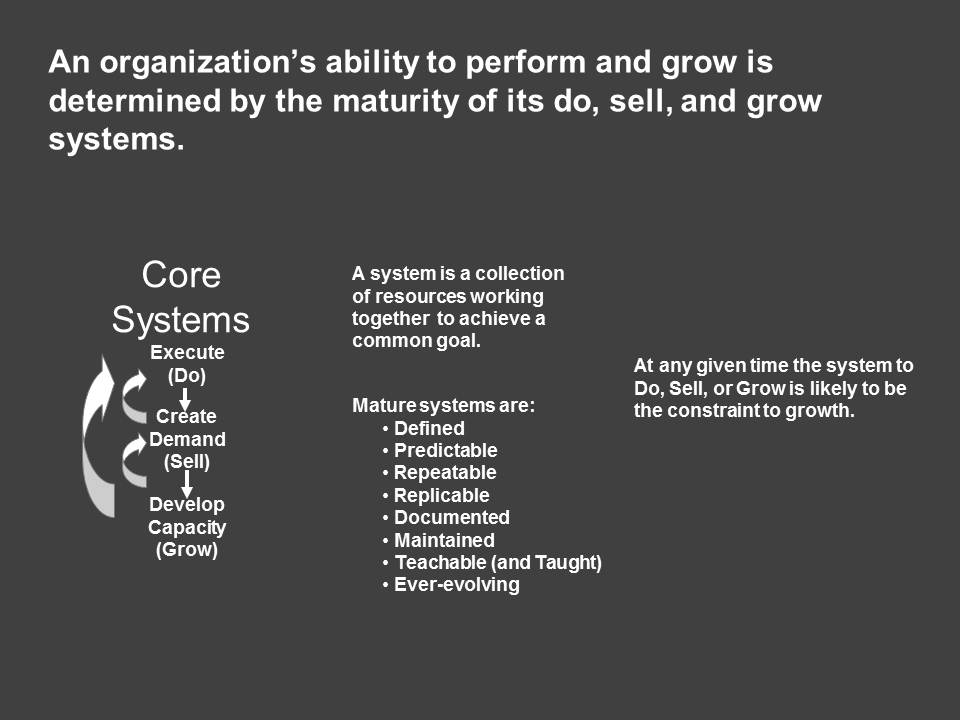
Organizations that experience sustained growth and high performance execute, create demand, and develop capacity in orderly, or systematic, ways. A system is a collection of resources working together to accomplish a common goal. The resources of an organization aggregate into three essential systems:
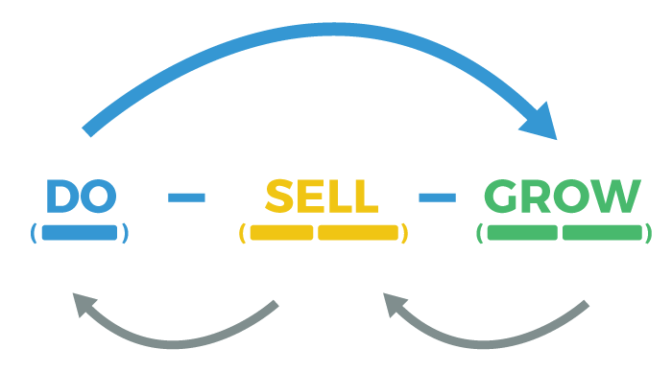
The Execution System, or what the organization does to Do what it does.
The Demand Creation System, or what the organization does to Sell what it does, including marketing, lead generation, sales, sales engineering, proposal writing, and sales support.
The Capacity Development System, or what the organization does to Grow, including training, recruiting, fund raising, performance assessment, goal setting, systems development, and process engineering.
Anything an organization does other than Do, Sell, or Grow, and that makes sense to continue doing, should be to facilitate, improve, or otherwise efficiently support its ability to Do, Sell, and Grow.
An organization that has execution problems essentially has no other problems because there is no point to growing or to landing new customers if the organization cannot even Do what it does to reliably deliver to customers it already has. Without a way to capture, organize, and distribute its collective knowledge from serving customers, an organization may have just a collection of unconnected experiences such that every new customer may be a “whole new adventure”. An organization that does not know for certain how it will meet delivery obligations runs serious risks and will find it difficult, if not impossible, to maintain control over the quality of its products and services.
Once there is a reliable way to execute, there is confidence to generate demand. However, without a way to generate demand that is predictable, repeatable, replicable, documented, maintained, taught, and ever-evolving, the organization’s ability to Do and Grow is likely to be constrained by its ability to Sell.
When new sales cause demand to exceed delivery capacity, it must Grow capacity to deliver. When capacity to deliver exceeds demand, it must Grow sales capacity. A growing organization needs to be clear about how it will add capacity to Doand how it will add capacity to Sell. For many organizations, this means identifying and cultivating sources of people, recruiting, and professional development.
At any time an organization’s ability to perform and grow tends to be constrained by one of the three core systems. Leadership’s job is to decide which system needs to evolve next and how.
For example, if a product provider generates more demand than can be handled by existing operations, then more production capacity is required. Once production capacity is in place, sales capacity may need to expand in order to put the increased production capacity to work. However, the amount of sales capacity should likely need to increase at a much slower rate than the rate of delivery capacity because a little more selling capacity should drive the need for a lot more delivery capacity.
In this sense, then, the evolution of Do, Sell, and Grow systems is iterative and staggered with execution capacity out in front of demand creation which is out in front of capacity to grow.
Leaders who are in control of operations compare their organization’s actual performance results to:
Past results to know whether their organization is trending up, down or sideways.
The results other organizations that are doing things similar to theirs achieve in order to know how well they are doing relative to industry benchmarks, especially relative to those who do best what they are doing.
Plan, budget, projection, or forecast in order to hold themselves accountable to what they said would happen.
Target or goal to know if it is time to be done with what they are doing!
The exhibit below provides precise definitions of terms leaders can use to talk about their organization’s performance with their leadership team and organization stakeholders.
The following are definitions of phrases that use the word strategy. They provide a useful way to think about the term and matters directly related to it:
Strategy is what people in an organization plan to do in order to “win” whatever game they are playing.
Strategic thinking is how decisions and actions are made in the immediate-term in a manner that is mindful of long-term implications and consistent with a strategy.
Strategic planning is the structured process that management uses to periodically engage leaders in advancing their strategy.
Strategic plan is a description of an organization as it presently exists and where it is to be in the future along with how it will go from where it is today to where it will be next on the way to achieve a long-term vision.
Strategic initiatives are projects identified as part of strategic planning and documented in the strategic plan that are to address what is most important to change next in order to increase the odds of winning.
Strategic management is what is done to deliberately operate and develop the organization in a manner that is entirely consistent with its strategy.
There are many ways to use the word strategyand it conjures up different things for different people in different contexts. What for example is the difference between strategic thinking and a strategic initiative and strategic planning? (For an answer see this taxonomy of strategic terms.)
Leaders who are asked: “What is your strategy?” might want to reply: “my strategy for what?” The reason is that every organization necessarily has many strategies.
There is a strategy for selling, a strategy for doing what the organization does, a strategy for managing and developing offerings, a strategy for recruiting, a strategy for developing people, a strategy for raising funds, and so on. Each strategy addresses how things are done now, and what must be done so as to achieve an envisioned future.
Answering the following five questions is a good way to start laying out an organization’s strategy: