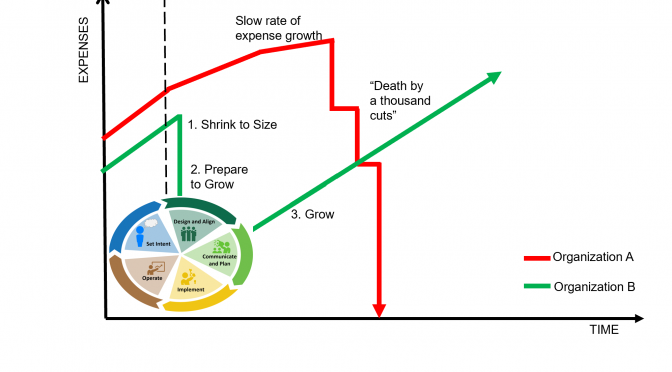
With baby boomers entering their last stages, Private Equity invested in senior residences ahead of the certain increase in demand as an aging population would surely seek community, comfort, support, and safety from communal living. COVID-19 changed the calculus overnight. WeWork and Airbnb represent two more niches that are forever changed…as are many more.
Watch this video for an explanation of how to avoid “death by a thousand cuts” and come out strong instead in a crisis!
While shrinking to size takes force of will, it can be done by just deciding to do it. Preparing to grow is harder and takes careful thought and planning.
IntelliVen is management’s guide, especially in a crisis, to maturing operations in sync with stage of venture evolution to create maximum value in minimal time.
In this time of crisis, we want to share what we have learned with you and your team. Join us for a FREE online session.
Executive Leadership Team meetings are critical to a business achieving scale. Even with infinite grit, determination, drive, and brilliance, leadership responsibilities must eventually be assigned such that a system to keep things coming together for collective leadership attention is required.
With scale comes the need for leaders to specialize and focus their span of control. ELT meetings are for leaders to connect and align across their areas of specialization. Even the best run $20M business will plateau on the path to $50M if leaders stick with an ad hoc approach to operations and governance.
The objective of a well-executed ELT meeting is to keep leaders informed, in sync, and aligned.
As a business succeeds and gets larger, so too will the ranks of its top leaders and of the next level of leaders to include junior partners who may be geographically remote. In the face of expansion, the leadership team needs a forum and orderly process for information to flow up to, and out from, the ELT. The insights, agreements and decisions of the ELT flow throughout the organization, and need to be based on accurate and relevant decision making information from across the organization.
Proper Planning, Having Discipline, and Respecting Each Other’s Time Goes a Long Way
Schedule ELT meetings at a regular time that will, more often than not, be safe from the myriad of possible interruptions. Early Monday mornings is usually a good choice because there are usually few distractions at the beginning of the day and the week and it gives the rest of the week to follow up on meeting assignments. Monday mornings also give team members the weekend to reflect and to contemplate agenda items.
During meetings, it is critical to be disciplined. It is especially important for every member, especially the CEO, to make a firm commitment to stay mentally and physically present. That is: show-up and do not allow emails, texts, calls or any other interruptions during the meeting. Respecting each other’s time will go a long way towards building a high-performance leadership team.
Create an Effective Agenda
The CEO owns the ELT agenda, but each ELT member is co-author in that each has the responsibility, opportunity, and the right to add items to the agenda. Consider these tips to running an effective ELT meeting:
Send out a draft agenda a few days ahead of the meeting and invite comment and drive preparation.
Schedule time in each meeting to discuss topics that come up on-the-fly.
Every ELT member should agree to do their best to make meetings effective and to not complain about meeting content or how it is run.
End each meeting with a draft agenda of next meeting and invite members to comment.
Keep a running list between meetings of potential topics for up-coming meetings.
ELT Meeting Best Practices
Members must prepare for agenda items they are to lead. Submit materials in advance to someone assigned to gather and distribute two-days ahead of the meeting to allow time for members to read through and develop a point of view on each topic.
If it is unavoidable, reschedule or cancel a meeting, but do not make it a habit. Only the most urgent matters should disrupt the ELT process. For example, a pending merger or acquisition or an HR catastrophe might justify disruption, but not much else.
Keep meetings to an agreed upon length; 1.5 – 2 hours is plenty of time for a well-run ELT meeting.
Start and end meetings on time. Discipline is paramount, or chaos will reign.
Agenda topics are of two types: Routine and Non-routine.
Routine items: Things that are covered in every meeting with standard advance materials conveying the state of each compiled and distributed in advance:
Upcoming key events.
Metrics
Headcount
Non-routine: One to three of the most important things going on in the business should be discussed in each meeting. Those leading each discussion need to be notified well in advance and have taken the time to prepare and distribute supporting materials in advance. For example:
ELT member 1 – walk us through the LAP business plan.
ELT member 2 – walk us through the BD plan for 2020 and 2021.
ELT member 3 – walk us through the facilities plan.
Invite non-ELT guests to prepare and present to the ELT from time to time to give up-and-coming leaders a forum in which to shine and for them to get input directly from the top team.
Examples:
Talent Management Program leader – walk us through the Talent Manager program and update us on how it is going relative to plans.
Researcher – walk us through the research unit’s scale model.
Project Manager – walk us through the implementation progress and update us on how it is going relative to plan.
Treat guests as guests (just because they are invited to one ELT does not qualify them to be ELT members). Coach them to prepare and to provide details on what they are doing and how it is going. This is a presentation and they need to take preparation and presentation seriously.
Once the organization sees how guests are involved, there will be a step-function increase in performance from the guests. It will be seen as important to be invited to present to the ELT.
Remember: discipline is paramount, or chaos will reign.
About the Author
Eric Palmer has 30+ years of outstanding success as a lead operating executive in private, public, private equity owned, and venture capital backed companies. He is particularly adept at strategy formulation, operational execution, International operations, M&A, leveraged debt, IPOs, and working with professional funders.
Most acquisitions and alliances severely underperform relative to expectations set at the time of their inception. No matter how great they look on paper, it is always a lot harder to make things come out anywhere near where they were meant to be than it seemed at the start. Fortunately, based on first-hand practical experience and learning from the experience of others, there are things that can be done to raise the odds of success.
Why Acquire or Ally
The reason for one organization to acquire or ally with another almost always boils down to one or more of the following three:
To obtain new products and services to sell to existing customers.
To secure access to new customers for existing offerings.
To acquire needed new resources such as technical skills, leadership, or industry knowledge.
Why Not Acquire or Ally
There are also three basic reasons for one organization to decide NOT to acquire or ally with another:
Most require the buyer to pay a premium price except in distressed situations in which case a bargain price is offset by high risk.
Integration and assimilation of people, processes and systems is time-consuming and difficult. Time and effort spent to overcome cultural differences is enormous and rarely successful. Despite management’s best intent, the wisdom of working together on the front-line is lost, without a lot of attention from the top, in favor of protecting turf, in-fighting, and favoritism.
Acquisitions and alliances require alarmingly high concentrations of management attention to consider, plan, execute, launch, and nurture to success. Once the deal is done, even greater amounts of time from the most senior managers is required to plan and guide the integration of people, products, services and administrative processes which diverts management attention from other important matters.
Watch video of PeterD discussing Alliance by Design at ab Intelliven Learning Community Session.
There are three steps to successfully acquire or ally with another operation with the intent to merge it with existing operations (i.e., as opposed to operating as a separate unit):
Determine whether the nature of the relationship between the two organizations is to be transactional, collaborative, innovative, or identity-shaping where who they are is defined by their relationship to each other.
Develop a picture of the way things will work when operations come together as envisioned, including:
A multi-year financial plan that lays out the target financials which justifies the terms and to serve as the foundation for performance goals.
An operating model to show who will do what to deliver the joint entity’s products and services with excellence, on time, and on budget; systematically and programmatically sell the venture’s products and services; and develop its capacity to fuel growth.
Assign an individual leader from each organization to work together to identify issues, perform analysis, and recommend actions consistent with the goals of the partnership. Success or failure to achieve targeted results must be a primary component to these individuals’ personal performance assessment and bonus compensation for the performance period.
Success Factors
Three things that dramatically improve the probability that two organizations will be successful as partners in an alliance or acquisition:
Mutual Clarity: It must be clear to people, particularly the leaders, in each organization why they have decided to work together (see: Mastering the Merger). The rationale must be written down and shared with others in both organizations each from their own perspective AND from the perspective of the other. For example, people in Organization A must be able to say why it makes sense for Organization B to have entered into the relationship as well as why it makes sense for their own organization to do the same … and vice versa.
High Stakes: There must be a lot at stake for both parties. This means there must be a lot to win if the goals are met and a lot to lose if they are not.
Accountable Leadership: Each organization must assign a senior person to represent the interests of their respective organization. This individual needs to be a leader who personally stands to gain or lose a great deal both from a financial, career, and professional perspective depending on the fate of the venture. Their number-one goal has to be the success of the initiative. They serve as gateways to their respective organizations to facilitate the successfor their counterpart who would otherwise be in a hopeless position of having to navigate how to work effectively in an alien organization. Those assigned to this key role have to be senior, seasoned, well-regarded executives who can move mountains in their own organizations, as needed, to make things work.
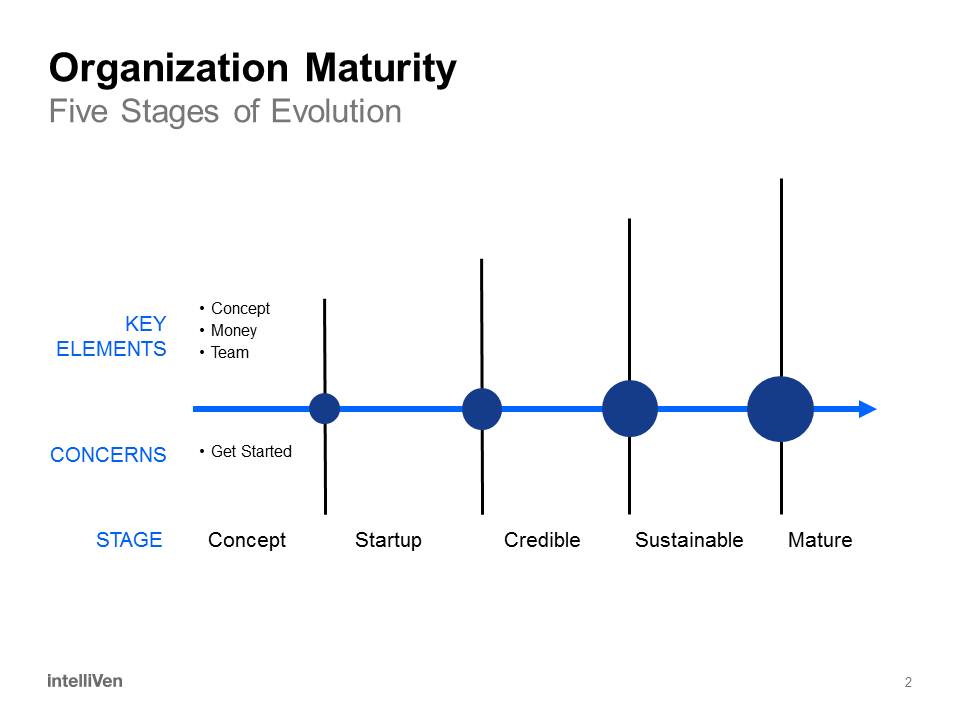
Those who cover the costs of getting started generally own the venture. Funds to get out of the gate are often provided by the one who came up with the idea along with “family, friends, and fools (which some say are, by definition, all fools!)”.
Which of the three (concept, idea, team) is most important depends on what you have and what you are missing. For example
Those with money seek good ideas and strong teams in which to invest.
Great teams search for ideas and money.
Those with good ideas seek strong teams and funding.
Nonetheless, founders with determination, energy, intelligence, wits, a sense of humor, and with a thirst to learn both from their mistakes and from others with experience, can do well.
Objectives in the Concept Stage :
Prepare a description of the envisioned organization that explains:
How revenue, costs of generating revenue, and the cost of delivery and support activities will generate, over time, financial stability and profit at increasing scale and rate.
It is most efficient (i.e., it costs less, takes less time, and is easier) to uncover and sort out challenges by thinking through and articulating a concept rather than through trial and error. It is also easier, and more likely to be unambiguous, to share a well-thought-out Concept with those who eventually join, invest in, or advise the organization.
Clarify why it makes sense to bring the Concept to reality. For example:
Wealth creation so as to become valuable and, someday, sold at a price far greater than the cost of developing it so proceeds can be shared with those who helped create that value. It helps to be clear from the start about how much wealth meets the needs of those involved so everyone is on the same page and pulling for the same result.
Income generation so as to provide sufficient resources for those employed by the organization to finance their lifestyles. It is important in this case to be clear about what income level is sufficient to meet the needs of those involved.
Contribution so as to create jobs, enhance lives, or otherwise improve the world in some specific way.
Clearly articulating which of the above, including combinations, is the driving force provides a guiding hand to what lies ahead.
Find and study existing and past organizations that have been successful doing something similar to understand what they learned it takes to be successful. Contact those who were key to such organizations and run the Concept by them to get their input on lessons learned and to arrange for their on-going help.
Organize a forum to serve as a consistent point of accountability for leaders to report on what they plan to do, what they actually do, what happened, what they learned, and what they plan to do next; get help with strategy and focus; and access to resources.
Produce evidence that the Concept makes sense and that it can perform as imagined and therefore is worth investing time and money to take to the next stage.
Make as much progress with as little outside funding as possible. The more money taken-in, the more ownership is given away in the form of equity to investors. Giving up equity is disadvantageous to those responsible in that their ultimate financial return is less and significant amounts of time will be diverted to recruiting and managing investors at the cost of making progress on what their organization seeks to accomplish. When founders give up more than 50% of the ownership they are no longer in control and essentially become a project team reporting to outside owners which is not usually what they had in mind at the outset.
Establish a leader and leadership team with relevant and complementary strengths and who get along well together. It is essential that it be clear who among the top team fills the role of leader. The leader and their team must have a common vision for what they seek to accomplish as well as the energy and drive to take action and make things happen. The team is often more important than their idea or their money because, after the first stage has played out, the team that wins is the team that learns from their experience to get it right next time.
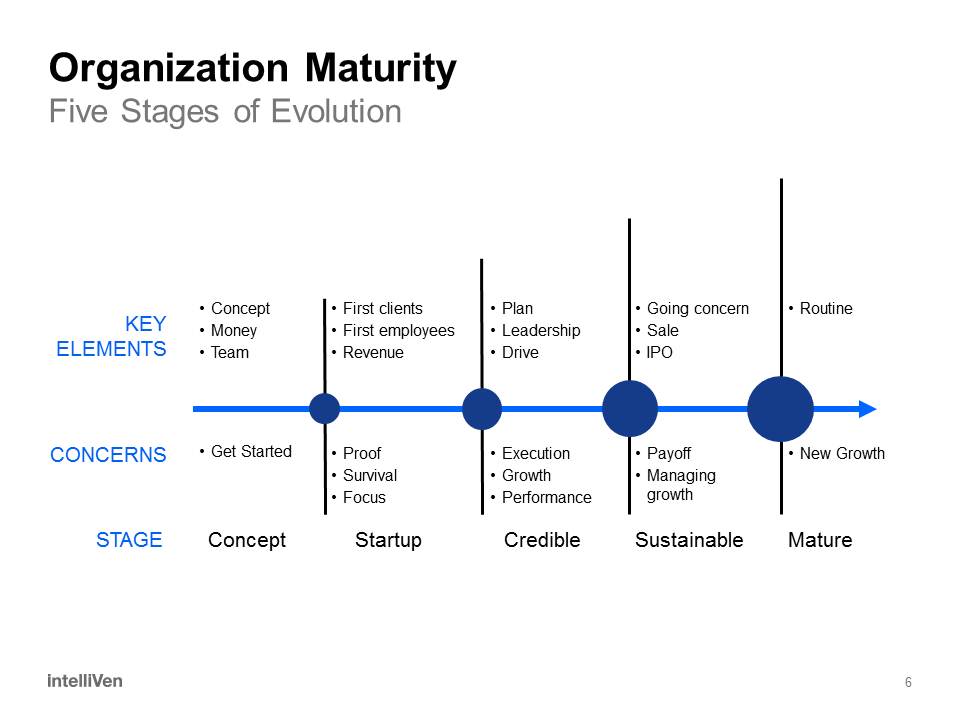
Startup Stage
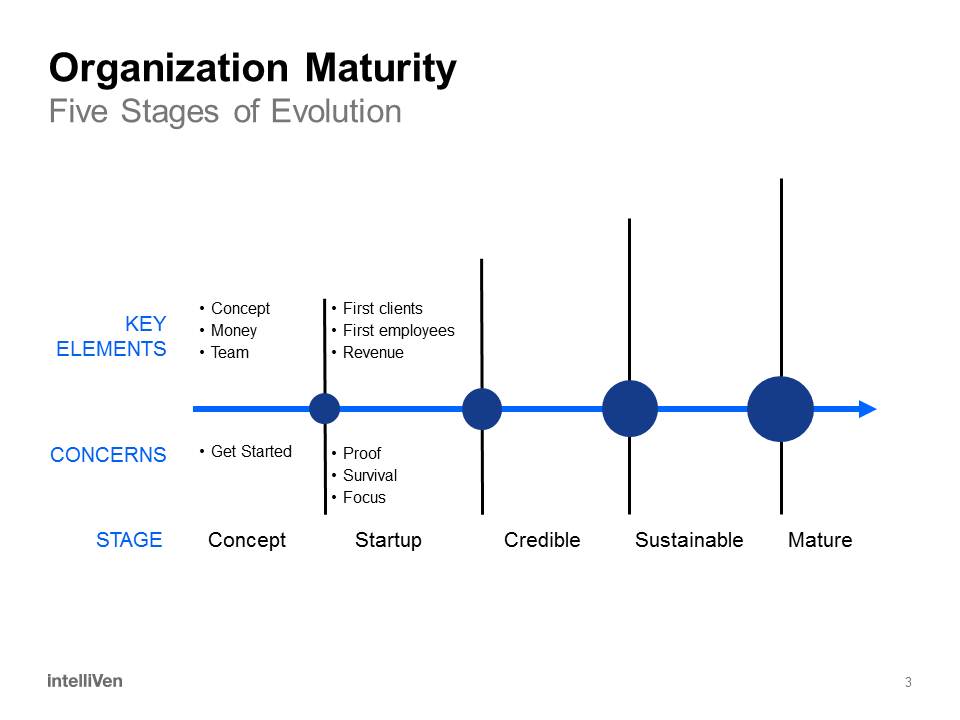
The Startuplikely has a few customer and up to a few dozen employees who are gaining confidence that what they do fills a genuine market need where no other player dominates. On the other hand, survival is far from guaranteed.
The Startup is likely to be self-funded, or a few investors may have kicked in less than a million dollars for a small equity stake. A fully-funded Startup might have one serious institutional investor, with more waiting in the wings, who has invested $1-2M in return for up to 40% of the equity. The organization uses raised funds to cover the cost of developing its offerings and its sales, delivery, and operating methods.
The principal issues for Startup organizations revolve around focus and managing scarce resources. For example,Startups often struggle to deploy scarce competent personnel to both successfully deliver on commitments to current customers and to find the next customer. The few team members who “know what they are doing” are spread precariously thin across sales and delivery activities and there never seems to be time or energy left at the end of each day to even think about setting up for the long-term.
As hectic as it is to get through the day serving customers and prospects, there may simultaneously also be a never-ending race-against-time to secure the financial resources required to continue operating. Cash to a Startup is like blood to a living being, or gas to a car, in that everything stops when it runs out. Until the organization starts making its own, there is an ever-present need to find more funds (fuel) from the outside.
While the above is all-consuming enough, Startup leaders often cannot resist the temptation to allow their attention to wander in order to explore nearby or new opportunities that could be the “big win” just around the corner. Launching such initiatives is tantamount to launching additional businesses.
A better strategy is to not “chase rainbows” and, instead, tighten focus further on the business that offers the best prospects for the most growth in the shortest amount of time so that scarce resources can be optimally deployed to efficiently drive the most value. It is hard enough to run one business well … launching others, while it may seem counter-intuitive at first, reduces the odds of any success.
Whether, and how, the organization evolves to systematically address these challenges will determine its attractiveness to current and future employees, customers and prospects, partners, suppliers, lenders, investors, and suitors.
To stabilize operations sufficient to attract customers, employees, board members, financing, and partners, leaders develop a strategic plan and an operating plan that includes:
Its mission/purpose, vision, and values.
A Profit and Loss statement that shows revenue, direct costs, gross profit, indirect labor and non-labor costs, and operating profit for past years and by quarter for the current year and by year for two or more years into the future. Accompanying the P&L is an integrated Cash Flow and Balance Sheet.
Short-term initiatives and success criteria (e.g., land a new strategic customer generating significant revenue within so many months; operate with profit as a specific percent of net revenue; etc.).
Key players and their roles, responsibilities, goals, and initiatives along with an accounting of past experiences that reveal a pattern of having achieved what each is counted on to do.
A systematic way to forecast and track:
Actual performance against plan.
Progress on initiatives.
Defined sales, delivery, governance, human resource, and financial processes.
A board of outside directors to provide:
A consistent point of accountability
Input on strategy and to help set the focus of the organization as a whole and of each operating leader
Access to key resources such as experience, best practices, training, funding, and prospective employees, customers, investors, partners, and possible acquirers.
Leadership’s mandate is to execute its strategy and operating plan while it tracks and reports on progress to establish a pattern of successful performance against the plan to achieve a targeted result in a time frame. Stakeholders (owners, founders, management, board, employees) are anxious for the Startup to achieve results that make it clear the organization is on a solid and predictable track to fulfill its mission to generate returns on financial and personal investments.
The organization’s culture, or way of working, takes shape and hardens as do its core values (i.e., its beliefs that shape behavior).
Credible Stage
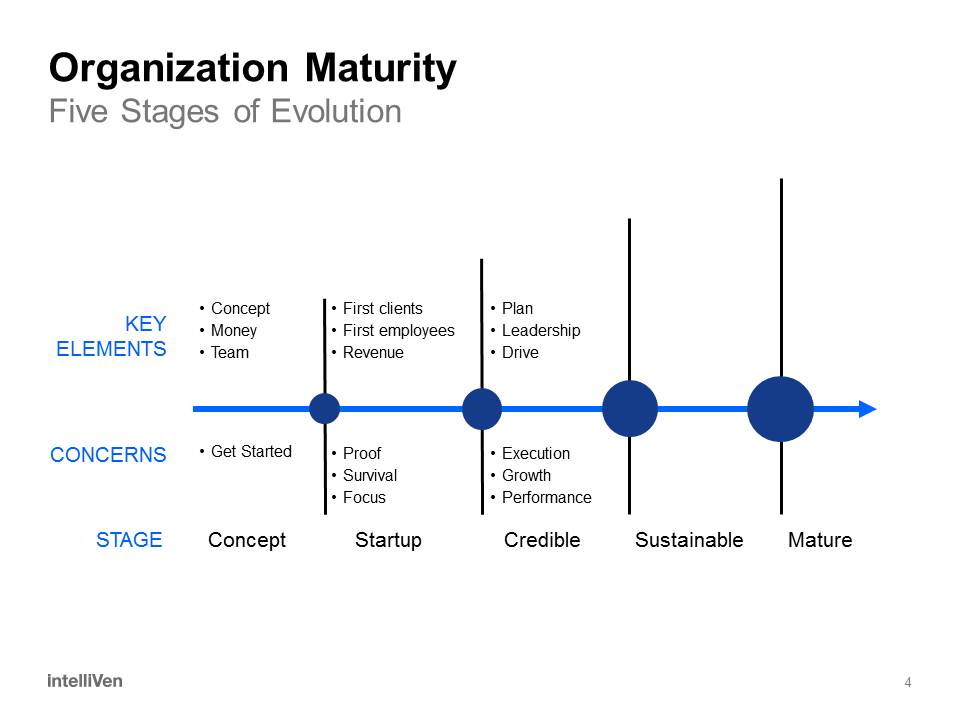
If a Startup is about making pizza, a Credible organization is about building a pizza-making business (see e-Myth Revisited by Gerber). The agenda moves from getting things done to building systems that get things done.
For example, the odds of long-term growth and profitability increase the closer the organization holds to a proven business model; such as one of the following five:
Service
Product
Operations
Channel
Exchange
and how well it executes its core delivery, sales, and capacity development (or DO, SELL, GROW) in the face of increasing scale and complexity.
More specifically, a firm’s business model determines:
The way its finances work.
Its sales and delivery processes.
The competencies it needs to develop.
Its competitive landscape.
Its target valuation as a function of prospects for operating income as a percent of revenue and growth.
Exit alternatives, potential buyers, and timing.
Expansion prospects and targets.
The degree of risk and difficulty.
It is critical to determine the primary source of revenue around which to increase the scale of operations. While it may be possible to build multiple revenue sources, it is a hard enough to do well with just one. It is best to scale multiple sources only after at least one is on a solid track for success.
To be Credible, an organization needs a financial plan and an operating plan with key players in place who are clear about what the organization is counting on from each and a track record of consistently achieving planned performance. The key players responsible for developing and delivering on the plan must also be driven to achieve their part of the plan and assured by an incentive program that rewards success for so doing.
Sustainable Stage
If a business does a few things right in its early stages of evolution, it can markedly improve the odds of sustaining accelerated growth and outstanding performance in future stages. Conversely, it is very difficult for an organization to make critical adjustments to its operating characteristics once it has achieved scale and maturity. Designing the organization well in the Startup stage improves attractiveness to all stakeholders.
A key concern of organizations that make it to the Sustainable stage is to create liquidity for those who have helped get it there.
Mature Stage
Key concerns of a mature venture are:
Continuing to perform well against plan.
Holding the attention and interest of key leaders (consider, for example, what happened in terms of new ideas and drive once the initial Core Leadership Group at Microsoft became wealthy enough to each own an island or two).
Finding new sources of growth in the face of approaching market saturation which may lead to spawning initiatives that then each progress through the five stages of organization evolution.
Next Step
Successful organizations mature operations in sync with their stage of maturity and then get ready for the next. Manage to Lead: Seven Truths to Help You Change the World is the management team’s guide to maturing operations in an orderly and systematic manner.
Each truth drives a continuum of actions. While the truths are disarmingly simple, the actions they drive are anything but easy to implement. The text is complemented by an online Toolbox with templates, instructions, and examples that make doable what is most important to get right next.
Podcast walkthrough of maturity stage characteristics, what is needed from leaders at each stage, and how to get started on the path to operating excellence:
Leadership teams that are on track to reach their potential to perform and growhave:
A written, board-approved financial plan that shows revenue, direct costs, gross margin, indirect costs by function (e.g., marketing, sales, HR, R&D, etc.), and operating profit (i.e., EBITDA), by month and quarter for the year. Approved financial plans tend to have the following characteristics:
Smooth (or otherwise rational) ramp-up (or down) of revenue and costs from the prior year closing month and quarter.
Generally upward-trending scale (i.e., ever bigger and better).
A 75% chance of being achieved by the in-place team with roughly 2/3 of planned revenue either booked or highly-probable (B&HP) and a highly-qualified pipeline of prospective, current year, revenue equal to three times the gap between B&HP and Plan (and not all in the last quarter or two!).
Identified upside-downside potential with mitigation strategies on the downside and what will be done to take full advantage of any upside.
Assumptions and triggers that explain what has to happen for planned results to occur and for planned expenses to be made.
An operating plan that covers:
Whose problem the organization solves, how it solves it, and how well compared to peers, prior years and plans.
A labor plan including sourcing, developing, managing, and deploying personnel consistent with the financial plan.
A marketdescription and market development plan.
A product (or equivalent) development road-map.
Do-Sell-Grow systems of operations and governance.
Three-to-seven initiatives to improve performance and drive growth; including who will lead each and the associated budget, work-plan, targeted results, metrics of performance, and communications plan.
A leadership team of from 3 to 7 who:
Are clear about who the team counts on for what (i.e., leadership roles and performance goals).
Are driven to achieve or exceed plan by an incentive program.
Routinely share with each other what is working and what each can do to improve.
A track record of consistently achieving planned performance.