The business case for Diversity, Equity, Inclusion, and Anti-oppression (DEIA) programs in organizations is no longer being built…it has arrived. Investors, employees, and customers are making clear to leaders that DEIA is now critical to their bottom line and that it will be so forevermore.
Consequently, leaders must learn to integrate cross-cultural skills and competencies into all levels of the system.
Education and change management plans that help leaders, managers, and employees navigate their differences and use them to achieve better business results are important and, thankfully, becoming more available.
To start, it helps to have common language and frameworks that make it possible to understand the complexities of communication dynamics posed by working across social group identities such as age, ability, gender, culture, class, race, sexual orientation, and socioeconomic status.
In her article Alliances Across Difference: Useful strategies for building effective relationships across difference, Amber Mayes does us all a tremendous service by laying out two foundational concepts to get us started:
- Levels of Human Identity
- Social Power and Group Dynamics
Amber developed and uses these concepts with leaders across sectors, industries, and geographies to resolve conflict and unleash the power of diversity in organizations for 15+ years in her role as a consultant to leaders, teams, and organizations.
Levels of Human Identity
According to Mayes, in any given moment we operate with a framework, or frameworks, with which we see human identity and differences. Two of the major difficulties we encounter when communicating with others across difference are:
- Understanding each other’s frame.
- Meeting others where they are.
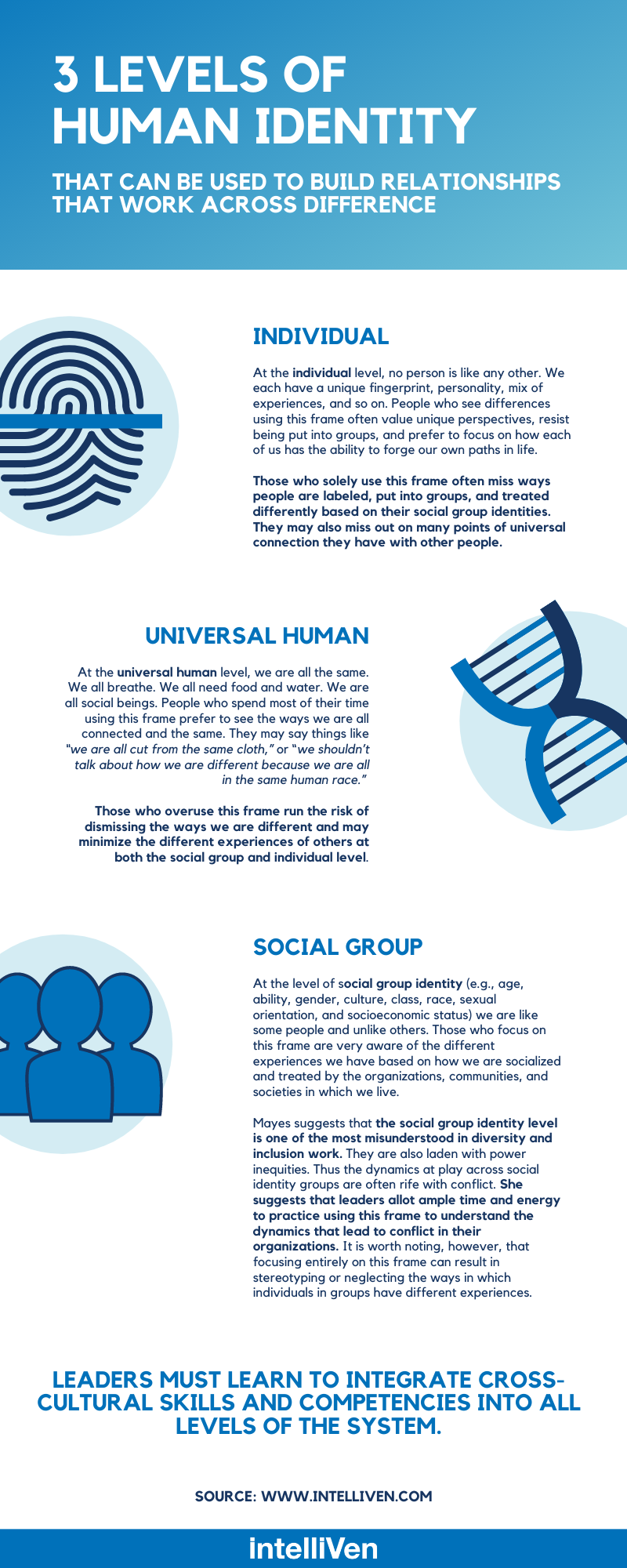
Mayes presents three levels of human identity that determine how people typically frame human diversity: Individual, Universal, and Social Group.

Individual Identity
At the individual level, no person is like any other. We each have a unique fingerprint, personality, mix of experiences, and so on. People who see differences using this frame often value unique perspectives, resist being put into groups, and prefer to focus on how each of us has the ability to forge our own paths in life. Those who solely use this frame often miss ways people are labeled, put into groups, and treated differently based on their social group identities. They may also miss out on many points of universal connection they have with other people.
Universal Human Identity
At the universal human level, we are all the same. We all breathe. We all need food and water. We are all social beings. People who spend most of their time using this frame prefer to see the ways we are all connected and the same. They may say things like “we are all cut from the same cloth,” or “we shouldn’t talk about how we are different because we are all in the same human race.” Those who overuse this frame run the risk of dismissing the ways we are different and may minimize the different experiences of others at both the social group and individual level.
Social Group Identity
At the level of social group identity (e.g., age, ability, gender, culture, class, race, sexual orientation, and socioeconomic status) we are like some people and unlike others. Those who focus on this frame are very aware of the different experiences we have based on how we are socialized and treated by the organizations, communities, and societies in which we live. Mayes suggests that the social group identity level is one of the most misunderstood in diversity and inclusion work. They are also laden with power inequities. Thus the dynamics at play across social identity groups are often rife with conflict. She suggests that leaders allot ample time and energy to practice using this frame to understand the dynamics that lead to conflict in their organizations. It is worth noting, however, that focusing entirely on this frame can result in stereotyping or neglecting the ways in which individuals in groups have different experiences.
In reality, all three of these frames exist at once and are omnipresent. To fully understand diversity dynamics, it is important to be able to accept and recognize all three. With regard to communication across differences, realizing the frame you bring to a conversation while understanding and honoring the frame of others is a crucial first step. When we can meet each other at the same level (individual, universal human, social group) we are much more likely to fully hear each other.
Societal Power and Group Dynamics
To truly understand many of the breakdowns that occur when we attempt to create inclusion in our organizations, we must have a deep understanding of the power dynamics that exist at the “social group identity level” of systems.
Within each social group identity (e.g., age, ability, gender, culture, class, race, sexual orientation, and socioeconomic status) there are dynamics that afford some people the benefits and privileges of social power while depriving others of the same. Mayes refers to these groups as “dominant” and “marginalized,” respectively, and illustrates the typical patterns of treatment and experience within each subgroup.
Her article concludes with specific recommendations for dominant and marginalized groups when communicating across the boundary of social group power. For example, when interacting with marginalized group members, it is a good idea to not make the difference the only thing to which you respond.
About the author
Amber Mayes, an OD consultant and coach with Fifth Domain Coaching, has 15+ years of experience supporting the transformation of organizations, teams, and leaders. She works with leaders in the nonprofit, government, and corporate sectors. She has taught Organization Behavior and Cross-cultural Communication at Bentley College, Northeastern University, and Georgetown University. She has a BA from Harvard University, an MSOD from the American University/NTL Institute program in Organization Development, and an advanced certificate from the Gestalt Institute of Cleveland. Contact her at ambermayes@gmail.com.
SEE ALSO
Understanding levels of identity in interaction
Changing Perspectives; Changing Views
3 Tips and 4 C’s to improve leader communication
Editors Note: Post originally published November 30, 2015 and updated for July 2020.