Tag Archives: leadership

When there’s no right answer: get input, get commitment, then decide

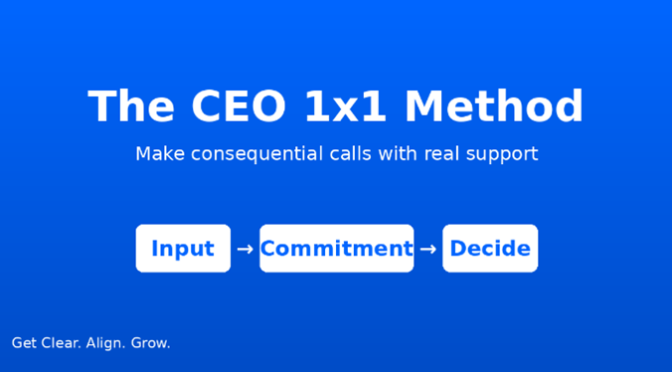
Calls about who the team counts on for what are hard. Leaders worry about making valued people feel overlooked or diminished. Direct reports mostly want clarity, fair reasoning, and as much scope and recognition as they can reasonably earn. This post offers a way to handle those tensions: get input one-on-one, secure commitment to support the outcome, then decide and lead alignment.

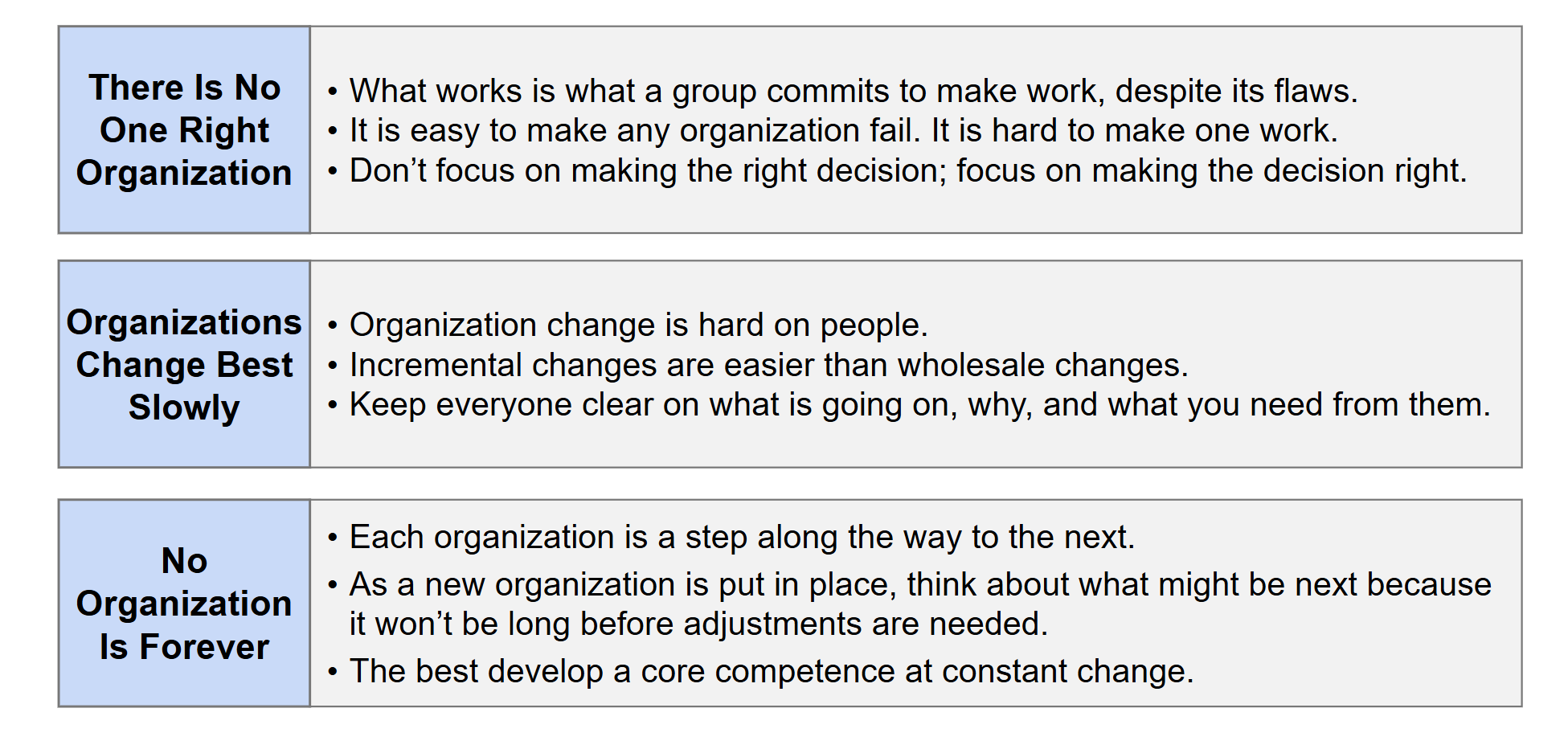
Before you decide on a consequential call about who the team counts on for what, check in one-on-one with those who will be most impacted. Use these 1x1s to get their best thinking and secure an explicit commitment to support the outcome, whichever way you go. Then decide, own it, and lead everyone to align and execute. Remember: there is no single “right” organization. What works is what your team commits to make work. Don’t chase the perfect answer; make a sound call and then make the call right.

Start each 1×1 by setting context. Explain the decision you have to make and why it matters now. Ask them to set aside self‑interest and give you their best view of what to do and why. Probe for what you may be missing, the main risks, and how they would mitigate them. Listen hard. You are not asking them to decide for you; you are gathering the input you need to make the decision you are accountable to make.

Close every 1×1 with a clear ask for commitment to support whatever you decide. Say plainly that it is your job to decide and that, when you do, you expect full support either way. Make sure they know that support means words and deeds, in the room and outside the room. If they hesitate, stay with it. Surface concerns now, while you can still use them. If after a real conversation they cannot commit, that is useful data about whether they are on this team for this next phase.

After you decide, announce the decision and the reasoning at a level that lets reasonable people understand how you got there. Remind the team of the commitments made in 1x1s. Set the expectation that leaders will be visibly and consistently supportive, especially when they share the decision with their teams. Organizations change best slowly because change is hard on people, so favor steady, incremental moves and keep everyone clear on what is happening, why, and what you need from them. Sometimes it is better to roll out a major change as a series of smaller changes over a longer period.

If support slips, use a three‑step response that matches the moment:

  • First slip: private reset. Meet one-on-one to reaffirm the decision and what support looks like—words and deeds, in the room and outside the room. Ask for explicit recommitment. If they hesitate, stay with it. Surface concerns now, while you can still use them. Leave with a clear “yes.”
  • Second slip: public correction. In the moment and in front of others, restate the decision and the expectation to align. Keep it short, neutral, and firm. Move the conversation back on track.
  • Third slip: in or out. Meet privately, with your inner circle if helpful, and make the choice explicit: be fully in and support the path we chose, or step out. This is about whether they are part of the team that moves forward in a specific way. If not, help them out.

Two mindsets make this work. First, own the call. Do not attribute the decision to advisors, the board, or the market. Once you know, own it. Second, get help without becoming dependent on it. Invite strong input and dissent, and then decide. Disagreement before the decision is input. After the decision, alignment is the standard.

How organizations evolve

Organizations are not fixed. Treat structure and roles as means to an end, and expect them to change as you grow.A short script you can adapt
  • I need to make this decision. Before I do, give me your best thinking—what do you recommend and why? What am I missing? When I decide, can I count on your full support either way?
  • If you can’t commit, tell me now and we’ll address it. After I decide, we speak with one voice and execute.

Why this works is straightforward. Everyone is heard and treated with respect. Commitment is explicit, not assumed. You show up as decisive and fair. And if misalignment appears, you handle it quickly and cleanly.

Next steps

  • Run the 1x1s. Use the script above. Capture each leader’s recommendation and explicit commitment in writing.
  • Book an IntelliVen workshop for your ELT. A focused 60–90-minute session to practice the Input → Commitment → Decide method on a real decision. Includes prep and a follow‑up plan.
  • Enroll in Manage to Lead (MtL) training. Apply the seven truths and the W‑W‑W framework to your strategy and org design.
  • Share the “How organizations evolve” section with your ELT. Ask each leader to name one risk and one action to support the change.
  • Set a cadence checkpoint. For the next four ELT meetings, include a 10‑minute alignment check on this decision.
  • Want help? Invite IntelliVen to facilitate your first round of 1x1s or the in‑or‑out conversation.

Get Clear. Align. Grow.

Process Maps Turn Confusion Into Clarity

Participants in IntelliVen’s Manage to Lead (MtL) program sometimes ask: “Why do we need to work on process maps?” It’s a fair question. The answer is that process mapping is not theory or busywork — it’s a practical tool you use on your own organization to turn hidden confusion into shared clarity. What follows explains how and why it works.

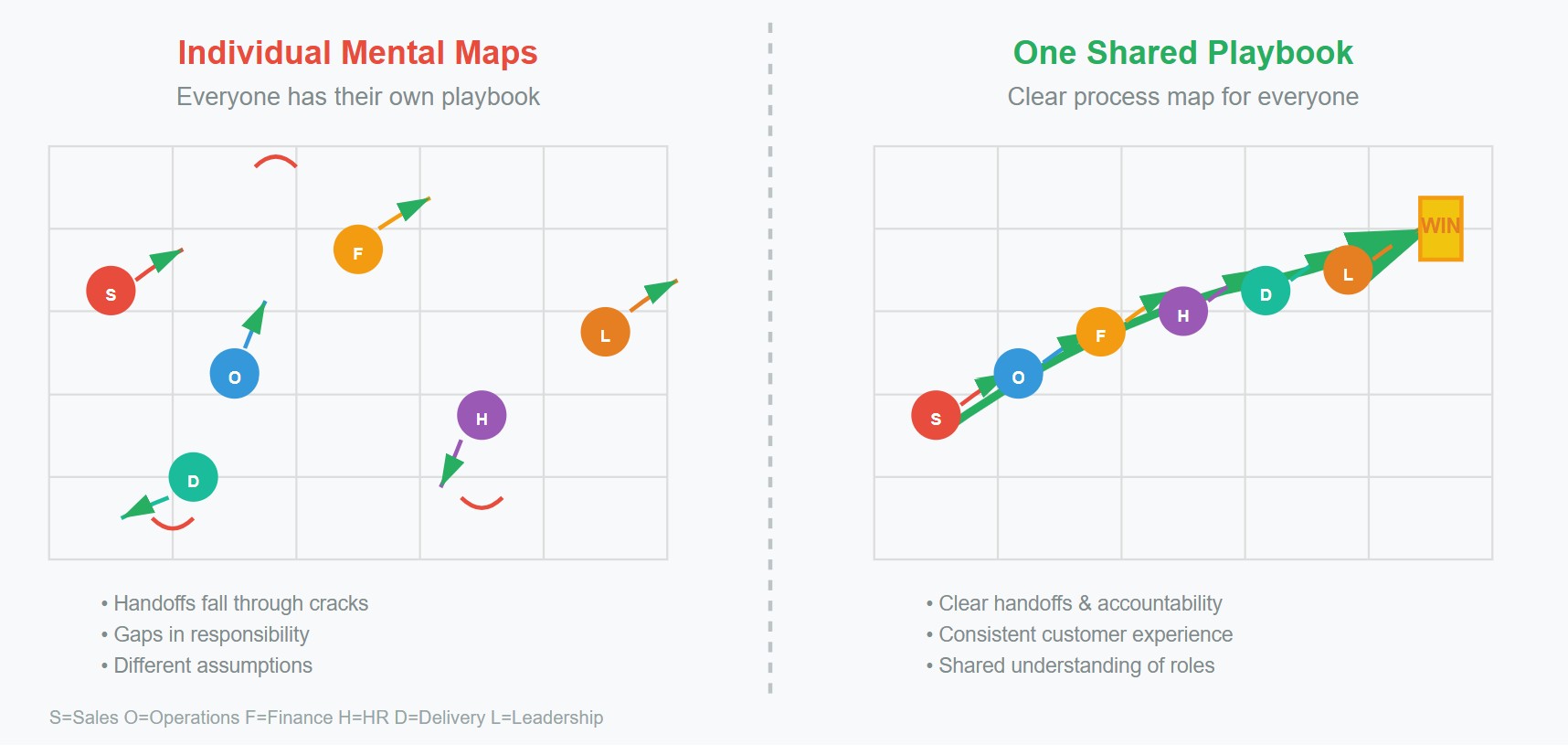
Every team member operates with their own mental map of how work gets done. The problem is, those maps rarely match. When they stay hidden, confusion builds, errors repeat, and opportunities slip away. Process maps transform scattered assumptions into one clear picture everyone can see, use, and improve together.

Turn Individual Mental Maps Into One Shared View

Organizations are an ecosystem of activities. Sales, delivery, support, finance, and HR leaders each hold pieces of the whole. Ask ten people how a key workflow happens across functions—say, onboarding a new customer—and you may hear ten different answers.

The same fragmentation shows up inside functions too: two sales reps handling similar opportunities may qualify leads or prepare proposals in completely different ways, even though the organization has learned a best practice for how it should be done.

When leaders work with their teams to draft a process map, a good first step is for each person to draw their own version of how the work gets done. Those maps reveal the similarities and differences in how people think the process works.

Looking at them side by side sparks discussion and exposes assumptions that would otherwise stay hidden. Collaborating to reconcile those views into a single, explicit picture reduces misunderstandings, strengthens alignment, and sets the stage for systematic improvement.

This aligns with the IntelliVen “Get Clear” truth: clarity is the first step to higher performance. Without it, even the best strategy gets lost in translation.

Make Handoffs, Gaps, and Choke Points Explicit

Once the flow of work is on paper (or screen), weak spots stand out. Teams can see:

  • Handoffs where work might fall between the cracks.

  • Gaps where no one is clearly responsible.

  • Choke points where one role or tool becomes a bottleneck.

  • Redundancies where two people are doing the same thing.

  • Error-prone steps where mistakes often creep in.

  • Measures—formal or informal—that indicate whether things are on track.

In day-to-day operations, these issues hide in plain sight. People learn to work around them. But a process mapping exercise surfaces them for open discussion.

This step mirrors the “NOW” stage of IntelliVen’s Change Framework. Leaders and teams must start with a clear-eyed view of how things currently work before they can chart a better “NEXT.”

Examine for Potential Breakthroughs

Mapping processes is not just about fixing problems. It’s about discovering opportunities.

When the whole flow is visible, leaders can ask:

  • What would happen if we automated this step?

  • Could two teams combine efforts to reduce time and cost?

  • Are we measuring what matters most?

  • Where could a small shift create disproportionate gains?

Sometimes, the exercise reveals breakthroughs. For example, moving a routine approval up in the process can cut cycle time in half. Or spotting a recurring customer question may inspire a new self-service product feature.

Organizations that grow successfully over time are those that consistently find and exploit such breakthroughs. Process maps are a tool to make them visible.

Ensure the Whole Team Plays the Game the Same Way to Win

Strategy is about how to win. Operations is about how to play the game. To succeed, the two must connect.

Process maps make the “playbook” explicit. They allow everyone—leaders, managers, staff, and partners—to see the same game board and understand their role on it. This alignment ensures:

  • Consistency: Consistency makes it easier to ensure everyone follows best practices and onboard new people. Consider an organization where half the professionals operate at peak effectiveness while the other half lag. If the whole team consistently applied the practices of the top performers, overall output and impact would rise dramatically. Process modeling is a step toward making that possible.
  • Efficiency: A shared map keeps teams from having to inventing steps or duplicate effort which frees time and energy for higher-value work. Efficiency in this sense isn’t just about speed — it’s about reducing rework, avoiding missteps, and channeling resources where they matter most.
  • Accountability: With a clear, shared process, everyone knows what’s expected of them and when. Instead of relying on memory, assumptions, or informal workarounds, roles and responsibilities are visible. This makes it easier to spot when something is off track and to coach or support people in real time, building trust and confidence across the team.

  • Scalability: Growth is hard when every new person has to “figure it out” on their own. A well-documented process gives newcomers a tested playbook so they can contribute faster and more reliably. It also allows leaders to delegate with confidence, knowing the approach will hold up even as volume increases or teams expand.

In IntelliVen terms, process maps help teams collaborate to “Get Clear and Get Aligned.” They make it easier for leaders to contract with their teams, govern effectively, and review performance against clear expectations.

Practical Tips for Leaders

If you’re considering introducing process mapping, here are some practical guidelines:

  • Start with one important process. Don’t try to map everything at once.

  • Involve people who do the work. They know the reality better than managers.

  • Keep it simple at first. Boxes, arrows, and labels are enough to start.

  • Use present tense. Describe how things actually happen now, not how they should.

  • Capture both formal and informal steps. Workarounds often carry key insights.

  • After mapping, ask: “What can we stop, start, or change to improve performance?”

  • Revisit maps as your organization evolves. A process that works today may need adjustment tomorrow.

Closing Thought

Working on process maps is not busywork. It is a leadership act. It shows commitment to clarity, alignment, and continuous improvement. It turns hidden assumptions into shared understanding. It shines light on bottlenecks and opportunities. And it ensures that your whole team is indeed playing the same game, the same way, to win together.

In short: process maps help leaders Get Clear. Align. Grow.

Put These Ideas Into Practice

In the Manage to Lead (MtL) program, you don’t just study tools like process mapping — you apply them directly to your own organization. YOUR CASE IS THE COURSE. By working hands-on with proven frameworks, you and your team surface hidden assumptions, sharpen execution, and accelerate performance. Learn more about the MtL program here »

Purpose and Goals: Why You Need Both W-W-W and Mandate

W-W-W and Mandate: Two Distinct Tools, Both Essential

When working on their business, leaders sometimes ask: Which sequence is right?

W-W-W → Mandate

Mandate → W-W-W

Both sequences work. You need to work on both.

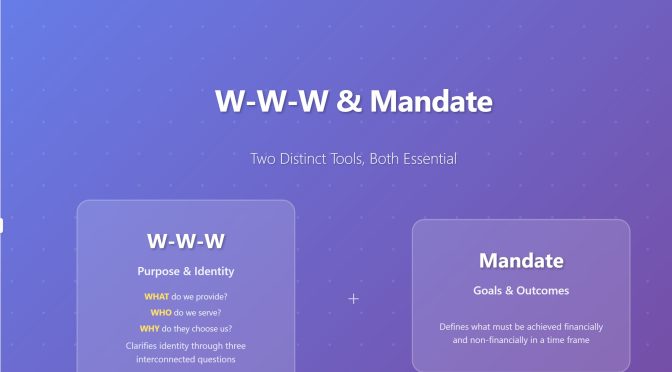
W-W-W is about purpose. It clarifies identity by answering three simple but interconnected questions:

  • WHAT do we provide?
  • WHO do we serve?
  • WHY do they choose us?

This is the cornerstone of clarity, rooted in Drucker’s insight that the purpose of a business is to solve a problem for a customer.

The Mandate is about goals. It defines what must be achieved, financially and non-financially, in a time frame. It sets targets, aspirations, and milestones. Where W-W-W establishes identity, Mandate locks in success conditions.

Though related, they require distinct lines of thinking:

  • W-W-W = identity and purpose
  • Mandate = success conditions and commitments

Which comes first? Both sequences work:

  • Mandate first: If you like Covey’s “Begin with the end in mind,” Mandate lays out the outcomes that guide everything else.
  • W-W-W first: Ensures that goals tie back to a clearly expressed purpose.

What matters more is that teams use both. W-W-W brings clarity of purpose. Mandate brings clarity of outcomes. Together, they create a foundation for alignment, prioritization, and growth.

W-W-W and Mandate aren’t one-and-done — they evolve together and become the backbone of the story you tell, tailored to what you need to say and to whom.

So, whether you start with W-W-W or Mandate, don’t stop until you’ve done both. And remember, they aren’t “one and done.” As your organization grows, work on one will often lead you to refine the other. Together, they form the backbone of your storyboard — a foundation you can adapt depending on what you need to say, and to whom.

Put These Ideas Into Practice

In the Manage to Lead (MtL) program, you don’t just study tools like Mandate and WHAT-WHO-WHY, you apply them directly to your own organization. YOUR CASE IS THE COURSE. By working hands-on with proven frameworks, you and your team surface hidden assumptions, sharpen execution, and accelerate performance. Learn more about the MtL program here »

Timeless Leadership Lessons for Success

Certain principles stand out as fundamental to achieving sustained success in leadership and team performance. They offer practical guidance to help leaders, teams, and organizations reach their potential to perform and grow. Here are ten such principles to apply for long-term growth and performance:

  • Complement your strengths with those of others. No one achieves much alone. There’s a unique energy that comes from the diversity of a team. The best leaders understand that by surrounding themselves with complementary skill sets, they elevate everyone’s potential.
  • Teams fail when someone gets greedy or insecure. Every member must be confident in their independence, freeing them to build interdependent networks with other strong players. Secure teams built on mutual respect and trust are more resilient and effective.
  • Work on the business, not just in the business. Teams that take time to reflect, assess, strategize, and plan always outperform those that only act in response to the press of the day-to-day. Sustainable success requires not just execution, but thoughtful direction.
  • Try new things. It’s always worth experimenting. If it works, do more. If it doesn’t, learn and move on. Sticking only to what’s worked before guarantees eventual failure. Experimentation is what reveals the next breakthrough.
  • Seek feedback actively and sincerely. People are always forming opinions about performance—creating a safe environment for open feedback ensures that valuable insights are shared directly. Mastering the art of receiving feedback paves the way to giving it effectively.
  • Look for the greatest upside in everything and everyone. When potential is attractive, move in that direction. Don’t be afraid to stop if things don’t go well, but don’t hesitate to succeed either. This mindset encourages growth and keeps opportunities alive.
  • Manage yourself like any other resource. Be who you need to be to succeed. Self-management is key to personal and professional growth. Furthermore, never act just because you’re told to—act because you understand, believe in it, and want to do it. If any of these elements are missing, ask questions until they align.
  • Out of chaos comes opportunity. When things are out of balance, change is easier. Recognize the moments when disruption creates openings for innovation and improvement. Successful leaders seize those moments to drive progress.
  • Make time for quiet reflection. Some of the best ideas surface when the mind is at rest. Turn off the noise, reflect, and let creativity rise in moments of quiet. Whether in nature, in a quiet room, or even during routine tasks, reflection breeds innovation.
  • Make decisions from the top-down. Whenever possible, operate with the perspective of those in charge. Acting in line with the best interests of leadership builds trust and often leads to more responsibility. Think and act like a leader to become one.

These principles provide a roadmap for personal and team success. Each serves as a foundation for growth, innovation, and leadership. For those who take them to heart, they offer timeless wisdom that can drive sustainable progress and long-term achievement.


W-W-W and Go-to-Market Fit: Essential Partners for Success

As organizations grow, leaders are often faced with strategic questions that may seem similar but address different parts of the business. One question that often comes up is whether frameworks like W-W-W (WHAT-WHO-WHY) and concepts like go-to-market fit are two ways of addressing the same challenge, or if they are fundamentally different.

Given the increasing need for clarity and market readiness, it’s important to understand how these two approaches compare and when each is most useful.

The W-W-W concept (WHAT-WHO-WHY) and go-to-market fit both deal with foundational aspects of a business strategy, but they focus on different areas and serve different purposes. Let’s compare them in detail:

Definition and Purpose

  • W-W-W (WHAT-WHO-WHY)
    • WHAT: The product or service you offer.
    • WHO: The target customer or market.
    • WHY: The reason customers will pay for your offering (i.e., the value it brings).

    Purpose: The W-W-W framework is designed to ensure clarity and alignment within an organization about its offering, its target audience, and the value proposition. It helps a company articulate its strategy in a clear and focused way, ensuring that all internal and external stakeholders are on the same page about the core business model.

  • Go-to-Market Fit (GTM Fit)
    • Definition: Go-to-market fit refers to the point where a company’s product or service is well-positioned to be introduced and scaled in a target market. It implies that the product, value proposition, and messaging align with the needs and preferences of the market, ensuring that the company can effectively acquire, retain, and grow customers.

    Purpose: Go-to-market fit is about ensuring that all the components of bringing a product to market (e.g., product positioning, sales strategy, marketing, pricing, and customer acquisition channels) are in alignment with the target customer base. It’s a more dynamic and iterative concept, aimed at achieving market penetration and scalable growth.

Focus Areas

  • W-W-W:
    • Focuses on strategic clarity—understanding your offering (WHAT), your audience (WHO), and your core value (WHY).
    • It’s more about internal alignment and ensuring that the entire organization has a consistent understanding of the core business.
    • It addresses high-level strategic questions that guide decision-making.
  • Go-to-Market Fit:
    • Focuses on market execution—how well the company’s product fits the market, how well it can be positioned, and how the sales and marketing strategy can convert potential customers.
    • It’s more tactical and action-oriented, addressing the steps and processes needed to succeed in the market.
    • GTM fit deals with dynamic market factors, such as competition, customer needs, channels, and pricing.

Relationship to Product-Market Fit

  • W-W-W:
    • Helps a company define product-market fit conceptually, as it aligns what you offer (WHAT) with who needs it (WHO) and why they would pay for it (WHY).
    • It is often a precursor to developing a go-to-market strategy, ensuring that the company has a clear understanding of its core value before trying to execute in the market.
  • Go-to-Market Fit:
    • Relies on achieving product-market fit first, and then determining how to position and deliver the product effectively to the market.
    • GTM fit ensures that product-market fit scales—i.e., that the product can be sold, distributed, and adopted in a sustainable and scalable way.

Time Frame

  • W-W-W:
    • W-W-W is often a strategic exercise done early in the life cycle of a business or during significant shifts in strategy, offering a clear, enduring direction.
    • Once clarified, it can remain stable over longer periods, helping guide operations and strategy.
  • Go-to-Market Fit:
    • GTM fit is more fluid and iterative, adapting as the market changes, as competition arises, and as customer preferences evolve.
    • It often requires continuous refinement as the company gathers feedback from initial customer segments and adjusts its approach.

Metrics for Success

  • W-W-W:
    • Success is measured in terms of organizational alignment—is everyone in the company clear about what the business does, who it serves, and why it matters?
    • Indicators include consistency in messaging, understanding of the customer’s core needs, and clarity of strategic goals.
  • Go-to-Market Fit:
    • Success is measured through market performance—are we acquiring and retaining customers, are our channels efficient, and is our product resonating with the target audience?
    • Metrics could include customer acquisition cost (CAC), lifetime value (LTV), conversion rates, and revenue growth.

Examples

  • W-W-W Example:
    • A software company defines:
      • WHAT: A project management tool for distributed teams.
      • WHO: Medium-sized tech companies with remote employees.
      • WHY: These companies need a streamlined way to manage cross-team collaboration to save time and reduce friction.

    This framework helps the company ensure that everyone, from product development to marketing, is aligned on the core offering.

  • Go-to-Market Fit Example:
    • That same company achieves go-to-market fit when:
      • The sales and marketing teams have developed a clear positioning and messaging that resonates with decision-makers at tech companies.
      • The product is priced competitively and distributed effectively through the right channels (e.g., online ads, partner networks).
      • The company can scale its customer acquisition without an unmanageable increase in costs.

Overlap

While W-W-W and go-to-market fit serve different functions, they are complementary in the following ways:

  • Strategic Alignment: W-W-W provides clarity on core elements (product, target customer, value proposition) that are essential for achieving go-to-market fit.
  • Foundation for GTM: A strong W-W-W foundation can set up a company for success in achieving GTM fit, as it ensures that the internal strategy aligns with market realities.
  • Mutual Dependency: Without clarity from W-W-W, it’s hard to execute a successful go-to-market strategy. Likewise, without good execution (GTM fit), even a well-defined W-W-W won’t lead to growth.

Conclusion

  • W-W-W is about clarity and alignment within the organization regarding the product, market, and value proposition. It’s a foundational, strategic tool.
  • Go-to-Market Fit is about market readiness and execution, focusing on aligning your product and strategy with the market to drive adoption, growth, and scalability.

Both concepts are important, but they address different aspects of a company’s journey from defining its offering to scaling in the market.

Further Reading

  • Cognitive Load Theory and Decision-Making: For more on how frameworks like W-W-W help reduce cognitive load and improve strategic alignment, consider John Sweller’s work on Cognitive Load Theory.
  • Product-Market Fit and GTM Strategy: Dive deeper into concepts of go-to-market fit with Ben Horowitz’s book The Hard Thing About Hard Things, which covers execution strategies for scaling businesses.
  • Leadership in Strategic Clarity: For those interested in exploring leadership models for strategic clarity, check out Leadership in the Age of Complexity by Eric J. McNulty and Leonard J. Marcus.