Tag Archives: leadership

The Leadership Team’s Most Important Asset

Leadership teams talk for hours on strategy, priorities, budgets, talent, and performance. Turning those discussions into coordinated action is agonizingly difficult.

The core reason is simple: leaders rarely operate from a shared reality.

Even large, well-run organizations are known to spend significant time and money, including on consultants, to evaluate whether they are “ready for change.” Change readiness, it turns out, comes down to a shared state of mind.

Specifically, organizations perform best when their leadership teams share a common understanding across four critical dimensions:

  • What they seek to accomplish
  • The reality they face
  • What should happen next
  • How they will guide and govern execution

Shared understanding is a leadership team’s most vital asset. The larger and more distributed an organization becomes, the less it can rely on proximity, hierarchy, or informal conversations to create alignment.

Unlike capital, technology, or top talent, it cannot be bought, borrowed, or commissioned. Shared understanding must be built. It develops when leaders make their own thinking visible, become genuinely curious about the thinking of others, and continually refine their perspective until the team shares one vision.

Teams can survive on fragmented understanding, but they also waste immense energy overcoming the friction it creates. Today, as leadership teams become more diverse, distributed, and specialized, shared understanding can no longer be left to circumstance. Leaders have to create and sustain it deliberately.

Why Shared Understanding Matters

Imagine four members of a leadership team leaving a strategy meeting after missing their Q1 plan, realizing Q2 and Q3 are now at risk. The team agrees the organization should move into the higher end of its market. Each leader leaves with a different understanding of what is required:

  • The CEO believes the priority is to immediately pursue opportunities in high-end target prospects.

  • The CFO believes the organization should either secure incremental funds to invest or expand its credit facility.

  • The COO believes success depends on upskilling customer success personnel to manage large-scale projects.

  • The Chief People Officer launches a search for experienced enterprise salespeople and account management leadership talent.

None of these actions is unreasonable. Each reflects the legitimate perspective of a functional leader. The problem is that the team has not developed a shared understanding of what success requires from each of them right now.

The Two Futures

Without Shared Understanding

Over the following weeks, each executive makes sound decisions within their own domain, but those decisions clash. The CEO commits to opportunities the organization cannot yet deliver. The CFO holds off on approving needed investments until financing is secured. The COO strives to force large-scale project management onto a team lacking aptitude for it. The Chief People Officer sets up interviews before the team agrees on required capabilities.

Resources are committed before demand is validated. Opportunities stall, capabilities are built for customers who have yet to appear, and confidence erodes as another quarter slips away.

With Shared Understanding 

Suppose, instead, the leadership team agrees on a unified principle where the organization moves into the higher end of the market only as customer demand is validated and revenue leads investment.

  • The CEO works closely with prospective customers to validate demand before committing.

  • The CFO expands borrowing capacity so financing is available should demand warrant it.

  • The COO strengthens delivery capabilities in step with demonstrated customer needs.

  • The Chief People Officer pipelines talent, timing actual hires to match validated demand.

Shared understanding enables leaders to exercise sound independent judgment that reinforces the judgment of others. As uncertainty unfolds, the organization responds coherently.

Shared understanding is a leadership team’s most important asset.

Building Shared Understanding

Shared understanding rarely emerges from a single meeting or off-site. It develops gradually as leaders make their thinking visible, test assumptions, draw each other out, and challenge one another respectfully.

High-performing leadership teams continually use an explicit diagnostic to evaluate their alignment:

Questions High-Performing Teams Constantly Re-Answer

  1. What are we trying to accomplish?

  2. What business are we really in?

  3. What must change right now?

  4. What should we do next?

  5. How will we know whether we are succeeding?

  6. How will we maintain alignment as conditions change?

Organizations usually struggle because leaders answer these key questions differently, even in subtle ways, without realizing it. These differences can cause big problems downstream. The work of leadership is to bring individual answers into the open, compare them candidly, and refine them until they become a shared understanding.

Leadership conversations are investments of valuable time and energy. To extract maximum value from these meetings, leaders need to learn to deliberately prepare, heighten consciousness and behavior during conversation, and ensure disciplined follow-up. Each conversation leaves the team with a stronger, weaker, or unchanged shared understanding. High-performing leadership teams are intentional about ensuring it is stronger.

Every Leadership Team Has a Choice

How leaders respond to differing perspectives largely determines how the organization performs:

  • Assuming: Some leaders are content to be oblivious to differences in perspective, taking alignment for granted until conflicting priorities and failed execution force the issue.

  • Living with it: Others recognize differences but accept friction as the inevitable cost of doing business.

  • Prescribing: Others dictate what everyone should think. That may produce compliance, but it rarely produces the richer understanding that emerges when diverse perspectives are explored and refined together.

  • Cultivating: High-performing leaders actively seek out the thinking of their peers while making their own explicit. They foster an environment where executives continuously share, test, and refine their views to build a collective perspective far richer than any individual could create alone.

A Leadership Imperative

Leadership’s responsibility is to continually improve the understanding from which decisions and actions flow.

Organizations that do this well develop a different way of working together. Thinking becomes more visible. Curiosity becomes habitual. Assumptions are tested rather than protected. Disagreements become more productive. Decisions and actions increasingly reinforce one another.

Over time, those behaviors become the organization’s leadership culture.

That culture, built one leadership conversation at a time, may become a leadership team’s most enduring competitive advantage.

Manage to Lead Essays
Essays exploring how leadership teams build shared understanding and improve organizational performance.

This essay introduces why shared understanding is leadership’s most important asset. The next essay explores how leadership conversations develop and strengthen that shared understanding.
Your Team’s Leadership Workspace is Now Available

For years, IntelliVen has helped leaders:

Get Clear. Align. Grow. Together.

Effective leadership requires clear thinking, disciplined execution, and alignment across decisions and actions.

With this post, we announce the availability of the IntelliVen Leadership Workspace, a collaborative environment that brings together the Manage to Lead tools with AI-guided support to help leadership teams draw out and share their thinking, decide what to do, and act together.

The Leadership Workspace gives teams a shared place to develop, refine, communicate, and govern the core elements that drive organization performance and growth.

Work begins with the organization’s Mandate and Purpose through WHAT-WHO-WHY. It continues through Enterprise and Initiative Change Frameworks, strategic initiatives, heat maps, governance, executive reviews, and performance management.

Organizations today operate in a distributed, networked world. Teams span functions, locations, and increasingly, different ways of working. As organizations grow, maintaining alignment and shared understanding becomes a leadership challenge in its own right.

The Leadership Workspace helps teams create and maintain structured coherence across leadership, strategy, initiatives, execution, and governance. Leaders compare thinking, surface differences, refine ideas, and build shared understanding. Over time, teams develop common language, strong decision-making habits, and a more disciplined way of working that manifests as an evolution in leadership culture.

Each Workspace combines the proven Manage to Lead tools with AI-guided assessment, refinement, inference, consolidation, and collaboration support. Teams use it to strengthen their thinking, improve alignment, guide execution, and govern performance.

The result is a practical environment where leadership teams can sustain alignment and coordinated action in a distributed, networked world.

Leadership teams are invited to create and collaborate in their own Workspace to:

• Define and refine their Mandate

• Clarify purpose using WHAT-WHO-WHY

• Develop and communicate Enterprise and Initiative Change Frameworks

• Launch, guide, support, and govern strategic initiatives

• Visualize priorities and tradeoffs with Heat Maps

• Conduct Executive Reviews

• Compare thinking across leaders

• Surface hidden misalignment

• Consolidate toward shared positions

• Assess, challenge, refine, infer, and improve thinking with AI

• Generate recommendations for moving from NOW to NEXT

The Leadership Workspace helps teams get clear, align, and execute through periods of growth, change, and inflection.

Getting started is simple:

• Select WORKSPACE from the IntelliVen menu

• Create an account and an organization code of your choice

• Invite others into your Workspace

• Start working

No setup project.

No implementation effort.

Simply enter your thinking and submit it for assessment, feedback, and suggestions.

Substantial usage capacity is available at no cost. Organizations that require additional capacity may upgrade as needed. Organizations with unique requirements are welcome to contact IntelliVen to discuss tailored arrangements.

For those who want to accelerate adoption, training is available through the Manage to Lead Enterprise Leadership System for Governance and Operations.

We built the Leadership Workspace to help leadership teams develop the clarity, alignment, governance, and execution capability required to thrive in today’s distributed world.

Get Clear. Align. Grow. Together.

We hope you find it useful.

Peter DiGiammarino

When there’s no right answer: get input, get commitment, then decide

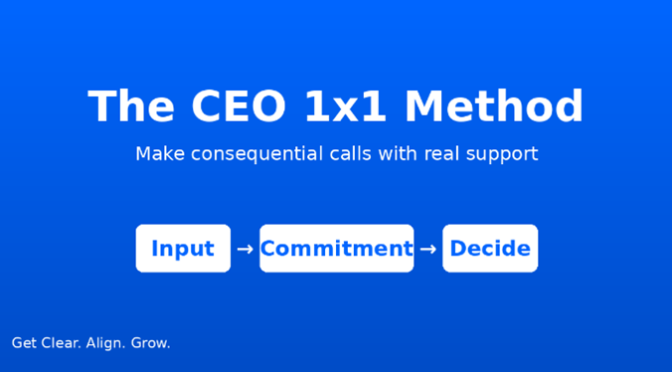
Calls about who the team counts on for what are hard. Leaders worry about making valued people feel overlooked or diminished. Direct reports mostly want clarity, fair reasoning, and as much scope and recognition as they can reasonably earn. This post offers a way to handle those tensions: get input one-on-one, secure commitment to support the outcome, then decide and lead alignment.

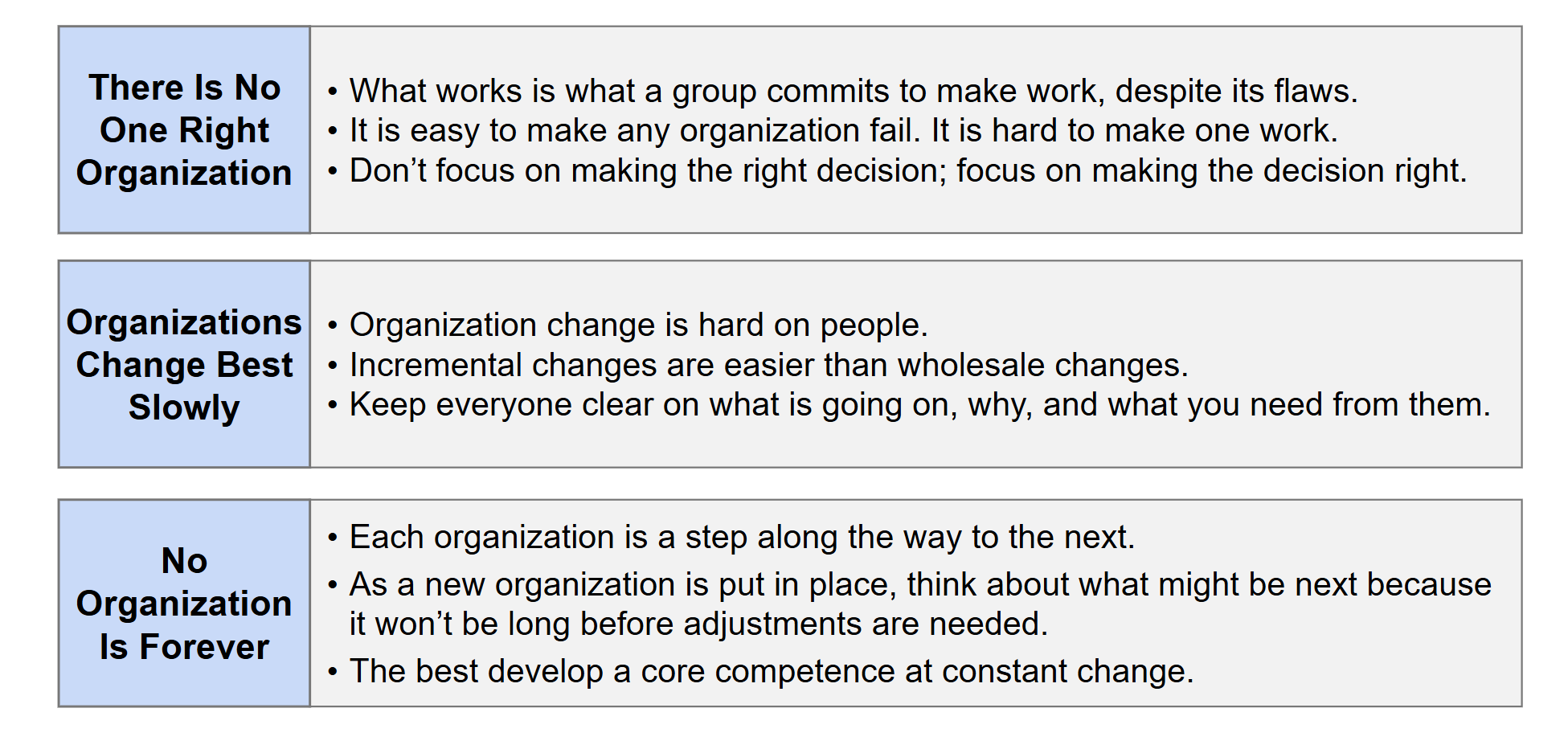
Before you decide on a consequential call about who the team counts on for what, check in one-on-one with those who will be most impacted. Use these 1x1s to get their best thinking and secure an explicit commitment to support the outcome, whichever way you go. Then decide, own it, and lead everyone to align and execute. Remember: there is no single “right” organization. What works is what your team commits to make work. Don’t chase the perfect answer; make a sound call and then make the call right.

Start each 1×1 by setting context. Explain the decision you have to make and why it matters now. Ask them to set aside self‑interest and give you their best view of what to do and why. Probe for what you may be missing, the main risks, and how they would mitigate them. Listen hard. You are not asking them to decide for you; you are gathering the input you need to make the decision you are accountable to make.

Close every 1×1 with a clear ask for commitment to support whatever you decide. Say plainly that it is your job to decide and that, when you do, you expect full support either way. Make sure they know that support means words and deeds, in the room and outside the room. If they hesitate, stay with it. Surface concerns now, while you can still use them. If after a real conversation they cannot commit, that is useful data about whether they are on this team for this next phase.

After you decide, announce the decision and the reasoning at a level that lets reasonable people understand how you got there. Remind the team of the commitments made in 1x1s. Set the expectation that leaders will be visibly and consistently supportive, especially when they share the decision with their teams. Organizations change best slowly because change is hard on people, so favor steady, incremental moves and keep everyone clear on what is happening, why, and what you need from them. Sometimes it is better to roll out a major change as a series of smaller changes over a longer period.

If support slips, use a three‑step response that matches the moment:

  • First slip: private reset. Meet one-on-one to reaffirm the decision and what support looks like—words and deeds, in the room and outside the room. Ask for explicit recommitment. If they hesitate, stay with it. Surface concerns now, while you can still use them. Leave with a clear “yes.”
  • Second slip: public correction. In the moment and in front of others, restate the decision and the expectation to align. Keep it short, neutral, and firm. Move the conversation back on track.
  • Third slip: in or out. Meet privately, with your inner circle if helpful, and make the choice explicit: be fully in and support the path we chose, or step out. This is about whether they are part of the team that moves forward in a specific way. If not, help them out.

Two mindsets make this work. First, own the call. Do not attribute the decision to advisors, the board, or the market. Once you know, own it. Second, get help without becoming dependent on it. Invite strong input and dissent, and then decide. Disagreement before the decision is input. After the decision, alignment is the standard.

How organizations evolve

Organizations are not fixed. Treat structure and roles as means to an end, and expect them to change as you grow.A short script you can adapt

  • I need to make this decision. Before I do, give me your best thinking—what do you recommend and why? What am I missing? When I decide, can I count on your full support either way?
  • If you can’t commit, tell me now and we’ll address it. After I decide, we speak with one voice and execute.

Why this works is straightforward. Everyone is heard and treated with respect. Commitment is explicit, not assumed. You show up as decisive and fair. And if misalignment appears, you handle it quickly and cleanly.

Next steps

  • Run the 1x1s. Use the script above. Capture each leader’s recommendation and explicit commitment in writing.
  • Book an IntelliVen workshop for your ELT. A focused 60–90-minute session to practice the Input → Commitment → Decide method on a real decision. Includes prep and a follow‑up plan.
  • Enroll in Manage to Lead (MtL) training. Apply the seven truths and the W‑W‑W framework to your strategy and org design.
  • Share the “How organizations evolve” section with your ELT. Ask each leader to name one risk and one action to support the change.
  • Set a cadence checkpoint. For the next four ELT meetings, include a 10‑minute alignment check on this decision.
  • Want help? Invite IntelliVen to facilitate your first round of 1x1s or the in‑or‑out conversation.

Get Clear. Align. Grow.

Process Maps Turn Confusion Into Clarity

Participants in IntelliVen’s Manage to Lead (MtL) program sometimes ask: “Why do we need to work on process maps?” It’s a fair question. The answer is that process mapping is not theory or busywork — it’s a practical tool you use on your own organization to turn hidden confusion into shared clarity. What follows explains how and why it works.

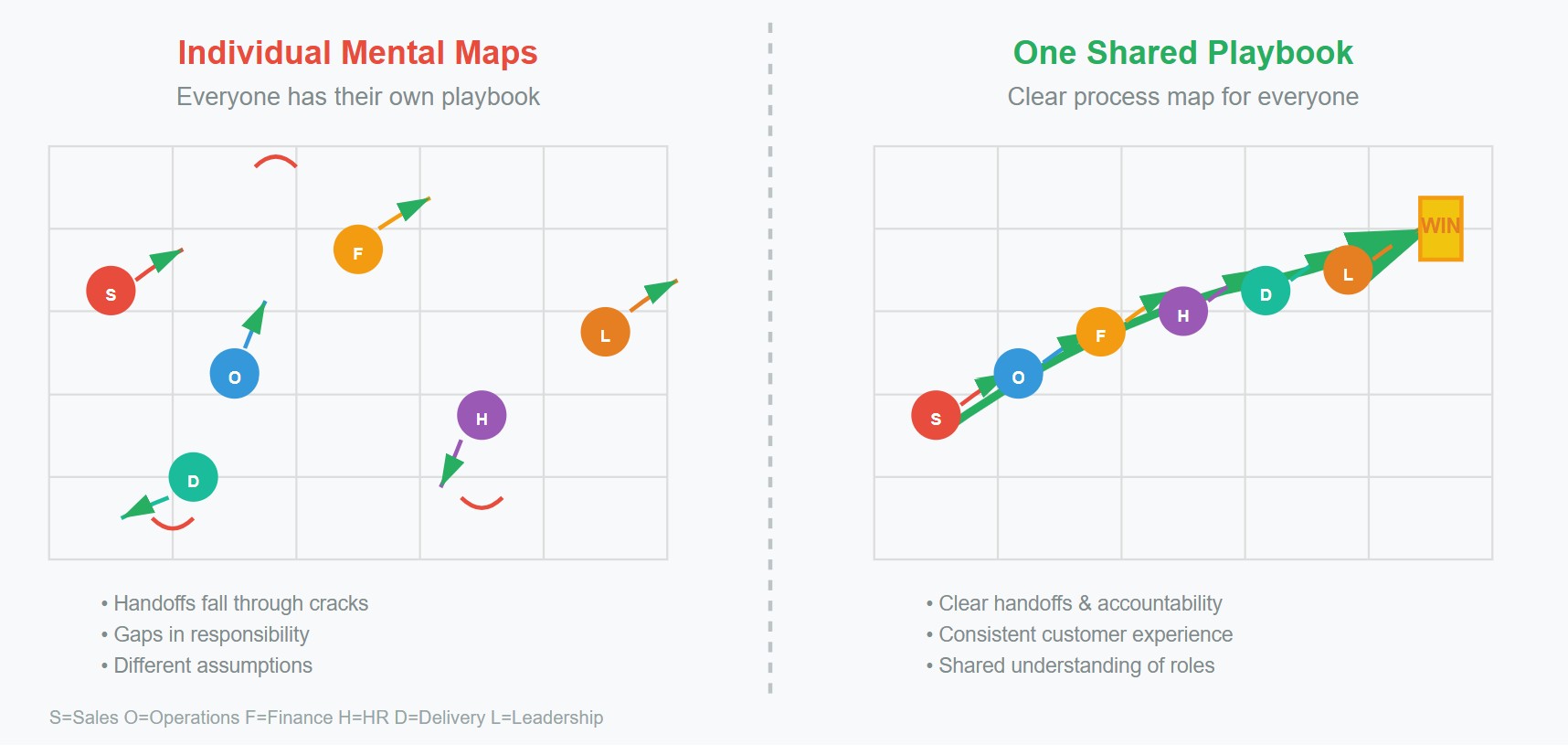
Every team member operates with their own mental map of how work gets done. The problem is, those maps rarely match. When they stay hidden, confusion builds, errors repeat, and opportunities slip away. Process maps transform scattered assumptions into one clear picture everyone can see, use, and improve together.

Turn Individual Mental Maps Into One Shared View

Organizations are an ecosystem of activities. Sales, delivery, support, finance, and HR leaders each hold pieces of the whole. Ask ten people how a key workflow happens across functions—say, onboarding a new customer—and you may hear ten different answers.

The same fragmentation shows up inside functions too: two sales reps handling similar opportunities may qualify leads or prepare proposals in completely different ways, even though the organization has learned a best practice for how it should be done.

When leaders work with their teams to draft a process map, a good first step is for each person to draw their own version of how the work gets done. Those maps reveal the similarities and differences in how people think the process works.

Looking at them side by side sparks discussion and exposes assumptions that would otherwise stay hidden. Collaborating to reconcile those views into a single, explicit picture reduces misunderstandings, strengthens alignment, and sets the stage for systematic improvement.

This aligns with the IntelliVen “Get Clear” truth: clarity is the first step to higher performance. Without it, even the best strategy gets lost in translation.

Make Handoffs, Gaps, and Choke Points Explicit

Once the flow of work is on paper (or screen), weak spots stand out. Teams can see:

  • Handoffs where work might fall between the cracks.

  • Gaps where no one is clearly responsible.

  • Choke points where one role or tool becomes a bottleneck.

  • Redundancies where two people are doing the same thing.

  • Error-prone steps where mistakes often creep in.

  • Measures—formal or informal—that indicate whether things are on track.

In day-to-day operations, these issues hide in plain sight. People learn to work around them. But a process mapping exercise surfaces them for open discussion.

This step mirrors the “NOW” stage of IntelliVen’s Change Framework. Leaders and teams must start with a clear-eyed view of how things currently work before they can chart a better “NEXT.”

Examine for Potential Breakthroughs

Mapping processes is not just about fixing problems. It’s about discovering opportunities.

When the whole flow is visible, leaders can ask:

  • What would happen if we automated this step?

  • Could two teams combine efforts to reduce time and cost?

  • Are we measuring what matters most?

  • Where could a small shift create disproportionate gains?

Sometimes, the exercise reveals breakthroughs. For example, moving a routine approval up in the process can cut cycle time in half. Or spotting a recurring customer question may inspire a new self-service product feature.

Organizations that grow successfully over time are those that consistently find and exploit such breakthroughs. Process maps are a tool to make them visible.

Ensure the Whole Team Plays the Game the Same Way to Win

Strategy is about how to win. Operations is about how to play the game. To succeed, the two must connect.

Process maps make the “playbook” explicit. They allow everyone—leaders, managers, staff, and partners—to see the same game board and understand their role on it. This alignment ensures:

  • Consistency: Consistency makes it easier to ensure everyone follows best practices and onboard new people. Consider an organization where half the professionals operate at peak effectiveness while the other half lag. If the whole team consistently applied the practices of the top performers, overall output and impact would rise dramatically. Process modeling is a step toward making that possible.
  • Efficiency: A shared map keeps teams from having to inventing steps or duplicate effort which frees time and energy for higher-value work. Efficiency in this sense isn’t just about speed — it’s about reducing rework, avoiding missteps, and channeling resources where they matter most.
  • Accountability: With a clear, shared process, everyone knows what’s expected of them and when. Instead of relying on memory, assumptions, or informal workarounds, roles and responsibilities are visible. This makes it easier to spot when something is off track and to coach or support people in real time, building trust and confidence across the team.

  • Scalability: Growth is hard when every new person has to “figure it out” on their own. A well-documented process gives newcomers a tested playbook so they can contribute faster and more reliably. It also allows leaders to delegate with confidence, knowing the approach will hold up even as volume increases or teams expand.

In IntelliVen terms, process maps help teams collaborate to “Get Clear and Get Aligned.” They make it easier for leaders to contract with their teams, govern effectively, and review performance against clear expectations.

Practical Tips for Leaders

If you’re considering introducing process mapping, here are some practical guidelines:

  • Start with one important process. Don’t try to map everything at once.

  • Involve people who do the work. They know the reality better than managers.

  • Keep it simple at first. Boxes, arrows, and labels are enough to start.

  • Use present tense. Describe how things actually happen now, not how they should.

  • Capture both formal and informal steps. Workarounds often carry key insights.

  • After mapping, ask: “What can we stop, start, or change to improve performance?”

  • Revisit maps as your organization evolves. A process that works today may need adjustment tomorrow.

Closing Thought

Working on process maps is not busywork. It is a leadership act. It shows commitment to clarity, alignment, and continuous improvement. It turns hidden assumptions into shared understanding. It shines light on bottlenecks and opportunities. And it ensures that your whole team is indeed playing the same game, the same way, to win together.

In short: process maps help leaders Get Clear. Align. Grow.

Put These Ideas Into Practice

In the Manage to Lead (MtL) program, you don’t just study tools like process mapping — you apply them directly to your own organization. YOUR CASE IS THE COURSE. By working hands-on with proven frameworks, you and your team surface hidden assumptions, sharpen execution, and accelerate performance. Learn more about the MtL program here »

Purpose and Goals: Why You Need Both W-W-W and Mandate

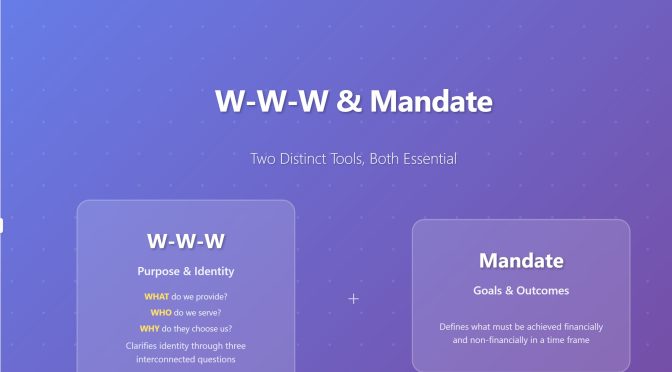
W-W-W and Mandate: Two Distinct Tools, Both Essential

When working on their business, leaders sometimes ask: Which sequence is right?

W-W-W → Mandate

Mandate → W-W-W

Both sequences work. You need to work on both.

W-W-W is about purpose. It clarifies identity by answering three simple but interconnected questions:

  • WHAT do we provide?
  • WHO do we serve?
  • WHY do they choose us?

This is the cornerstone of clarity, rooted in Drucker’s insight that the purpose of a business is to solve a problem for a customer.

The Mandate is about goals. It defines what must be achieved, financially and non-financially, in a time frame. It sets targets, aspirations, and milestones. Where W-W-W establishes identity, Mandate locks in success conditions.

Though related, they require distinct lines of thinking:

  • W-W-W = identity and purpose
  • Mandate = success conditions and commitments

Which comes first? Both sequences work:

  • Mandate first: If you like Covey’s “Begin with the end in mind,” Mandate lays out the outcomes that guide everything else.
  • W-W-W first: Ensures that goals tie back to a clearly expressed purpose.

What matters more is that teams use both. W-W-W brings clarity of purpose. Mandate brings clarity of outcomes. Together, they create a foundation for alignment, prioritization, and growth.

W-W-W and Mandate aren’t one-and-done — they evolve together and become the backbone of the story you tell, tailored to what you need to say and to whom.

So, whether you start with W-W-W or Mandate, don’t stop until you’ve done both. And remember, they aren’t “one and done.” As your organization grows, work on one will often lead you to refine the other. Together, they form the backbone of your storyboard — a foundation you can adapt depending on what you need to say, and to whom.

Put These Ideas Into Practice

In the Manage to Lead (MtL) program, you don’t just study tools like Mandate and WHAT-WHO-WHY, you apply them directly to your own organization. YOUR CASE IS THE COURSE. By working hands-on with proven frameworks, you and your team surface hidden assumptions, sharpen execution, and accelerate performance. Learn more about the MtL program here »