Many intelliven.com blog posts are based on the slides and lecture notes from a masters class in Organization Development called Organization Analysis and Strategy offered at American University and taught by Peter DiGiammarino. These posts and other material from class, including:
Work problems,
Templates,
Graphics,
Slide shows, and
Assessments
are available from Amazon as a softcover workbook or from iTunes as an iBook titledManage to Lead: Seven Truths to Help You Change the World.
Selected intelliven.com blog content is now available as a workbook from Amazon or as an iBook from iTunes.
Whether one wants to change personal habits, implement a new information system, improve a business process, get team members to work together, increase a community’s appreciation for diversity, or even to topple a monarchy, taking seven actions driven by seven disarmingly simple truths will individually and collectively help achieve the goal.
Manage to Lead presents a framework to describe and assess any organization. It also provides a structured approach to plan and implement next steps for an organization as it strives for long-term growth and performance.
Readers are invited to select a familiar organization on which to apply the tools and templates introduced throughout the workbook. Exercises in each chapter produce essential elements for the organization’s annual strategic plan and lay the groundwork for implementing that plan.
Readers can package the key elements from Organization Exercises to form a strategic plan that communicates how the organization sees itself and where it is headed. At the end of the year leaders can compare actual results with what was described in the strategic plan to study what happened, why what happened was different than plan, what is to be learned from that, and what to do differently going forward as a result.
Repeat the process over several years and compare actual to planned results year-to-year to see the organization mature, perform, and grow to its full potential.
Deep: Look for an extraordinary depth of competence in a functional or technical area or a methodology that is essential to the organization’s business;
Conceptual: The best leaders have an ability to abstract fully-formed concepts from a collection of parts and are able to communicate complex concepts clearly even to those who are not conceptual;
Connected: Target those who have strong interpersonal relationships with prospective or current clients, employees, partners, or funding sources; and
Driven: Look for an extraordinary inner commitment to achieve targeted results on time, on target, and on budget.
A diverse team of deep, conceptual, connected, and driven leaders who really like working with each other and who seek to accomplish the same end-result for the same reason and in the same way, have the collective capacity to accomplish nearly anything!
Whether one wants to change personal habits, implement a new information system, improve a business process, get team members to work together, increase a community’s appreciation for diversity, or even to topple a monarchy, taking seven actions driven by seven disarmingly simple truths will individually and collectively help achieve the goal.
If the leader thinks they know what needs to change and that everyone is aligned, ask: “How do you know your team knows what you want to do? It may be a good idea to ask them to verify. If they all say what you expect them to say, a positive step towards getting what you want done will have been taken just by bringing it to the center of their attention. If it turns out that some or all of the team are not as aligned as expected, then remedial steps can be taken.”
Survey the leader’s top team and ask them each:
To describe the current state, that is: how things are today.
What really good things happen if we change and what really bad things happen if we do not?
To describe how things would be in the future if their ideal changes were successfully implemented.
What needs to be done in order to get from where things are today to where things would ideally be next?
What will make it hard to do what needs to be done in order to get from today to the targeted next state?
Review results with the leader to bring him/her up to speed on the group’s data. Look for and discuss fully any points the leader finds confusing or surprising.
Convene an offsite with the leader and the leadership team to review collected data, reach consensus on each of the five topics, and decide what needs to be done. At the offsite, review survey responses one question at a time in the order above. Highlight responses that are the same or similar thereby indicating progress towards consensus. Guide the group to discuss the data until agreement is reached on how things are today, why things need to change, and how things would be if the desired change had been implemented.
Use the Change Framework to make the case for each Strategic Initiative.
The Change Framework is a convenient way to visualize and store the group’s consensus using a diagram similar to that originally introduced by Richard Beckhard and Wendy Pritchard in Changing the Essence: The Art of Creating and Leading Fundamental Change in Organizations, Jossey-Bas Inc., San Francisco, 1992.
Fill out the Change Framework to make a clear and compelling case for each initiative. Iterate with the team until all members are crystal clear about each initiative.
If participants share their thinking openly, fully, and honestly they can go a long way towards achieving clarity and alignment. An effective leader then holds the results of these efforts and furthers their development, communicates progress to stakeholders, and assigns, aligns and drives resources in their pursuit.
Figure-2: Follow the above tips to build a clear and compelling case for the change driven by each initiative.
A well formulated initiative, using the Change Framework, tells a story about where things are, why they need to change, how things would be if the intended change occurred and what must be done to get from here to there. A well crafted change framework is rational, compelling, and flows smoothly from the present through to the future.
Follow the tips in Figure-2 to piece together the context and the story for each of the initiatives the organization must do next to stay on track to long-term growth and performance.
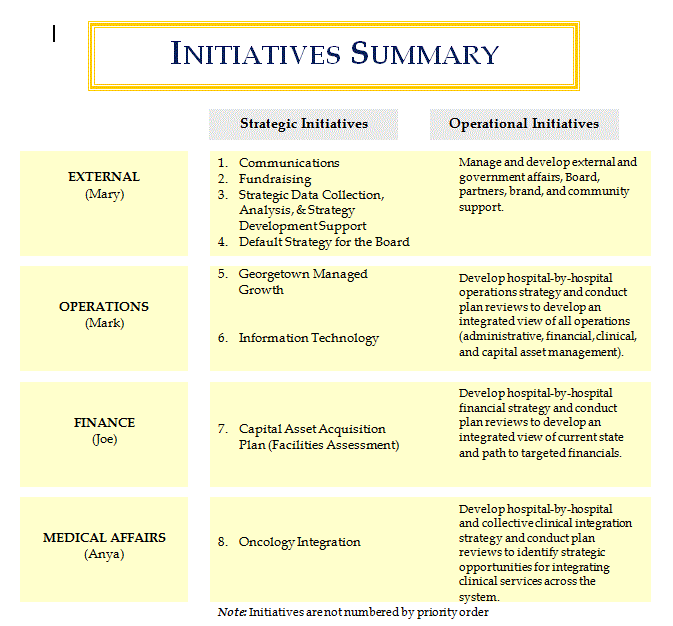
Figure-3: A classic looking list of initiatives from an executive off-site.
Many management offsites produce a list of initiatives, such as shown in Figure-3, after intense effort and exhilarating breakthroughs. A list without context, though, fails to reveal the motivation and importance behind each initiative and so makes it difficult to communicate or to muster the energy, resources, and commitment beyond the session needed to implement them.
Using the Change Framework instead of a simple list helps but even still, far too often, the same initiatives are again listed at the next offsite with little if any progress since last time simply because no one was put in charge and resources never allocated to implement them.
Upon reaching agreement, the group may feel drained but good about what it has accomplished. It is important to make sure the group knows it has done great work and come a long way but there is still more important work to be done. Their effort may be for naught unless one more step is taken.
After the list of initiatives is developed and before ending the session the leader assigns each team member to:
Figure-4: Click on the figure to fill out and submit the Initiative-to-Action form for a Strategic Initiative.
Take 20-minutes to fill out an Initiative-to-Action template using the link in Figure-4, for a specific initiative, preferably one the leader would like the team member to sponsor
Lead the group in a brief discussion about the assigned initiative.
Each team member, in turn, briefs the group on their initiative using the filled out Initiative-to-Action form. As each speaks, the rest of the leadership team adopts the mindset of close adviser and on the same team as the one speaking. Their objective is to ensure that the key points from the group’s work are captured so that the best thinking of the group is at-hand and in mind as efforts to progress with the initiative proceed on the heels of the session.
Filling out and briefing the Initiative-to-Action form launches the governance process and gets a leadership team member into the role of the initiative’s executive sponsor and on-the-hook to make progress on behalf of the group. As such the team member becomes accountable to the group for progress on their initiative. Motivation and commitment soar and the odds of making progress go up as well. Over the ensuing performance period, the leader calls on each team member at some point to brief the group on how their initiative is progressing.
Example Change Framework:
Example Change Framework for an organization whose leaders decided to move from a functional to a cross-functional approach to client services.
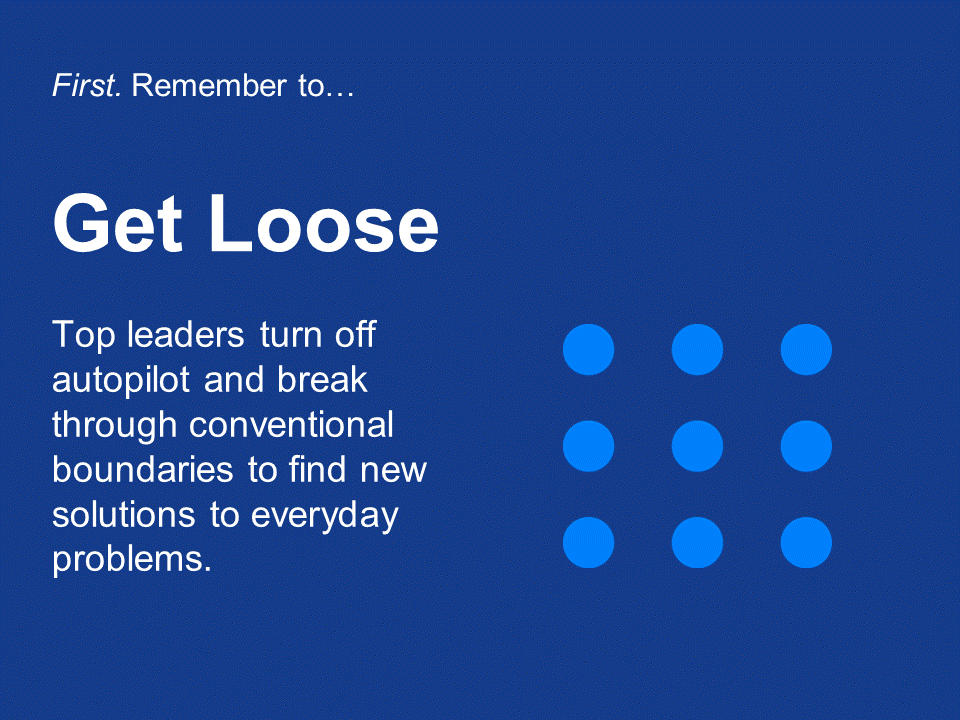
Most people find it is hard to connect all nine dots in the figure at left with four straight lines, without retracing any lines, and without lifting their writing implement.
The reason it is hard to do is because in order to solve the puzzle a person has to think and operate in ways that are different than normal; or outside the box, as they say.