

Category Archives: Get Clear

Know whose problem you solve, how, and how well.

Process Maps Turn Confusion Into Clarity

Participants in IntelliVen’s Manage to Lead (MtL) program sometimes ask: “Why do we need to work on process maps?” It’s a fair question. The answer is that process mapping is not theory or busywork — it’s a practical tool you use on your own organization to turn hidden confusion into shared clarity. What follows explains how and why it works.

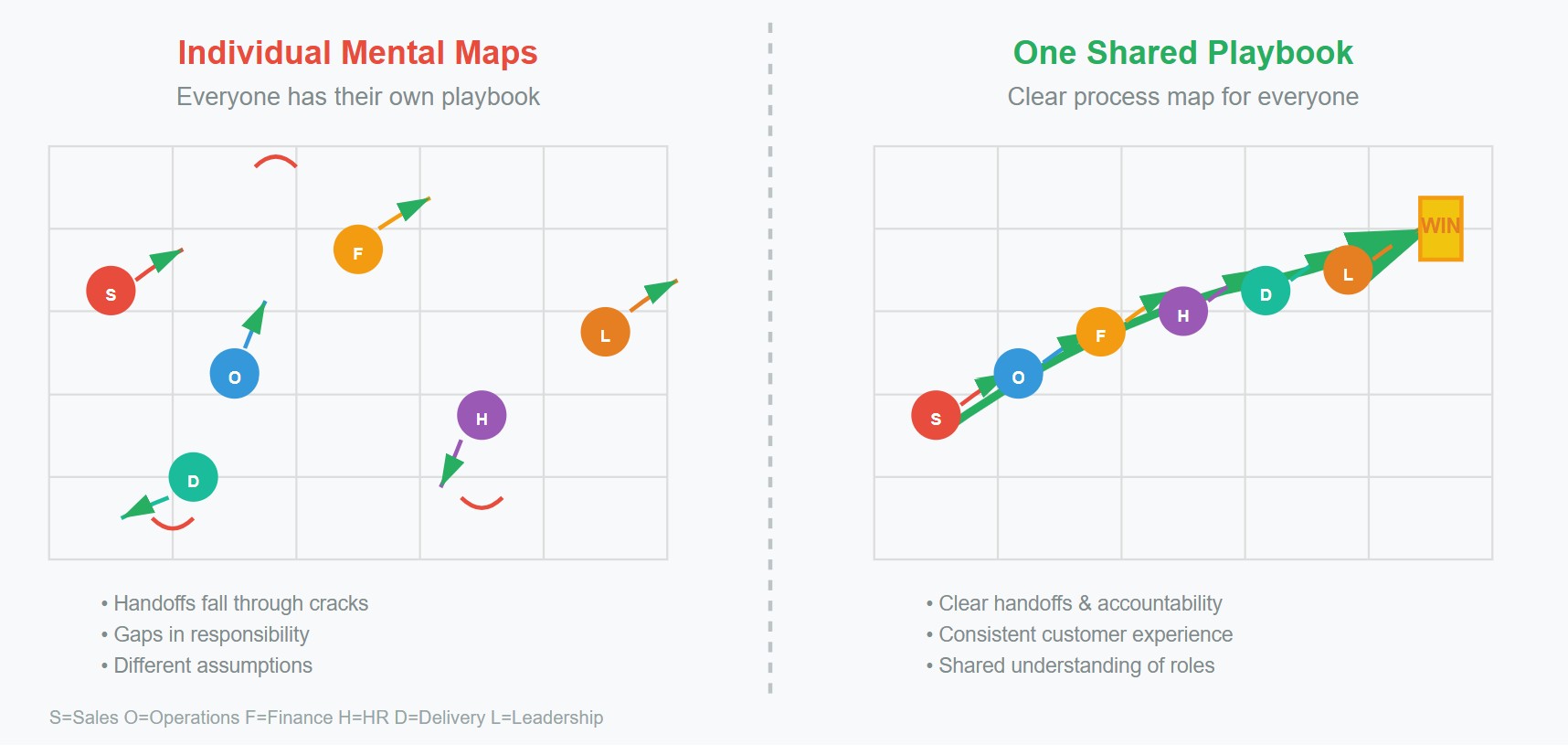
Every team member operates with their own mental map of how work gets done. The problem is, those maps rarely match. When they stay hidden, confusion builds, errors repeat, and opportunities slip away. Process maps transform scattered assumptions into one clear picture everyone can see, use, and improve together.

Turn Individual Mental Maps Into One Shared View

Organizations are an ecosystem of activities. Sales, delivery, support, finance, and HR leaders each hold pieces of the whole. Ask ten people how a key workflow happens across functions—say, onboarding a new customer—and you may hear ten different answers.

The same fragmentation shows up inside functions too: two sales reps handling similar opportunities may qualify leads or prepare proposals in completely different ways, even though the organization has learned a best practice for how it should be done.

When leaders work with their teams to draft a process map, a good first step is for each person to draw their own version of how the work gets done. Those maps reveal the similarities and differences in how people think the process works.

Looking at them side by side sparks discussion and exposes assumptions that would otherwise stay hidden. Collaborating to reconcile those views into a single, explicit picture reduces misunderstandings, strengthens alignment, and sets the stage for systematic improvement.

This aligns with the IntelliVen “Get Clear” truth: clarity is the first step to higher performance. Without it, even the best strategy gets lost in translation.

Make Handoffs, Gaps, and Choke Points Explicit

Once the flow of work is on paper (or screen), weak spots stand out. Teams can see:

  • Handoffs where work might fall between the cracks.

  • Gaps where no one is clearly responsible.

  • Choke points where one role or tool becomes a bottleneck.

  • Redundancies where two people are doing the same thing.

  • Error-prone steps where mistakes often creep in.

  • Measures—formal or informal—that indicate whether things are on track.

In day-to-day operations, these issues hide in plain sight. People learn to work around them. But a process mapping exercise surfaces them for open discussion.

This step mirrors the “NOW” stage of IntelliVen’s Change Framework. Leaders and teams must start with a clear-eyed view of how things currently work before they can chart a better “NEXT.”

Examine for Potential Breakthroughs

Mapping processes is not just about fixing problems. It’s about discovering opportunities.

When the whole flow is visible, leaders can ask:

  • What would happen if we automated this step?

  • Could two teams combine efforts to reduce time and cost?

  • Are we measuring what matters most?

  • Where could a small shift create disproportionate gains?

Sometimes, the exercise reveals breakthroughs. For example, moving a routine approval up in the process can cut cycle time in half. Or spotting a recurring customer question may inspire a new self-service product feature.

Organizations that grow successfully over time are those that consistently find and exploit such breakthroughs. Process maps are a tool to make them visible.
Ensure the Whole Team Plays the Game the Same Way to Win

Strategy is about how to win. Operations is about how to play the game. To succeed, the two must connect.

Process maps make the “playbook” explicit. They allow everyone—leaders, managers, staff, and partners—to see the same game board and understand their role on it. This alignment ensures:

  • Consistency: Consistency makes it easier to ensure everyone follows best practices and onboard new people. Consider an organization where half the professionals operate at peak effectiveness while the other half lag. If the whole team consistently applied the practices of the top performers, overall output and impact would rise dramatically. Process modeling is a step toward making that possible.
  • Efficiency: A shared map keeps teams from having to inventing steps or duplicate effort which frees time and energy for higher-value work. Efficiency in this sense isn’t just about speed — it’s about reducing rework, avoiding missteps, and channeling resources where they matter most.
  • Accountability: With a clear, shared process, everyone knows what’s expected of them and when. Instead of relying on memory, assumptions, or informal workarounds, roles and responsibilities are visible. This makes it easier to spot when something is off track and to coach or support people in real time, building trust and confidence across the team.

  • Scalability: Growth is hard when every new person has to “figure it out” on their own. A well-documented process gives newcomers a tested playbook so they can contribute faster and more reliably. It also allows leaders to delegate with confidence, knowing the approach will hold up even as volume increases or teams expand.

In IntelliVen terms, process maps help teams collaborate to “Get Clear and Get Aligned.” They make it easier for leaders to contract with their teams, govern effectively, and review performance against clear expectations.

Practical Tips for Leaders

If you’re considering introducing process mapping, here are some practical guidelines:

  • Start with one important process. Don’t try to map everything at once.

  • Involve people who do the work. They know the reality better than managers.

  • Keep it simple at first. Boxes, arrows, and labels are enough to start.

  • Use present tense. Describe how things actually happen now, not how they should.

  • Capture both formal and informal steps. Workarounds often carry key insights.

  • After mapping, ask: “What can we stop, start, or change to improve performance?”

  • Revisit maps as your organization evolves. A process that works today may need adjustment tomorrow.

Closing Thought

Working on process maps is not busywork. It is a leadership act. It shows commitment to clarity, alignment, and continuous improvement. It turns hidden assumptions into shared understanding. It shines light on bottlenecks and opportunities. And it ensures that your whole team is indeed playing the same game, the same way, to win together.

In short: process maps help leaders Get Clear. Align. Grow.

Put These Ideas Into Practice

In the Manage to Lead (MtL) program, you don’t just study tools like process mapping — you apply them directly to your own organization. YOUR CASE IS THE COURSE. By working hands-on with proven frameworks, you and your team surface hidden assumptions, sharpen execution, and accelerate performance. Learn more about the MtL program here »
Purpose and Goals: Why You Need Both W-W-W and Mandate

W-W-W and Mandate: Two Distinct Tools, Both Essential

When working on their business, leaders sometimes ask: Which sequence is right?

W-W-W → Mandate

Mandate → W-W-W

Both sequences work. You need to work on both.

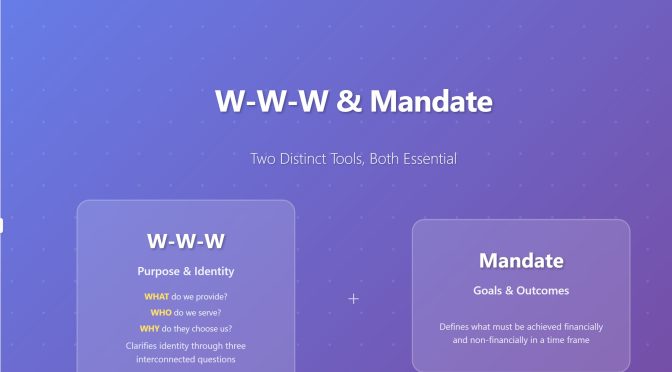
W-W-W is about purpose. It clarifies identity by answering three simple but interconnected questions:

  • WHAT do we provide?
  • WHO do we serve?
  • WHY do they choose us?

This is the cornerstone of clarity, rooted in Drucker’s insight that the purpose of a business is to solve a problem for a customer.

The Mandate is about goals. It defines what must be achieved, financially and non-financially, in a time frame. It sets targets, aspirations, and milestones. Where W-W-W establishes identity, Mandate locks in success conditions.

Though related, they require distinct lines of thinking:

  • W-W-W = identity and purpose
  • Mandate = success conditions and commitments

Which comes first? Both sequences work:

  • Mandate first: If you like Covey’s “Begin with the end in mind,” Mandate lays out the outcomes that guide everything else.
  • W-W-W first: Ensures that goals tie back to a clearly expressed purpose.

What matters more is that teams use both. W-W-W brings clarity of purpose. Mandate brings clarity of outcomes. Together, they create a foundation for alignment, prioritization, and growth.

W-W-W and Mandate aren’t one-and-done — they evolve together and become the backbone of the story you tell, tailored to what you need to say and to whom.

So, whether you start with W-W-W or Mandate, don’t stop until you’ve done both. And remember, they aren’t “one and done.” As your organization grows, work on one will often lead you to refine the other. Together, they form the backbone of your storyboard — a foundation you can adapt depending on what you need to say, and to whom.

Put These Ideas Into Practice

In the Manage to Lead (MtL) program, you don’t just study tools like Mandate and WHAT-WHO-WHY, you apply them directly to your own organization. YOUR CASE IS THE COURSE. By working hands-on with proven frameworks, you and your team surface hidden assumptions, sharpen execution, and accelerate performance. Learn more about the MtL program here »

What Would Peter Drucker Think of Your ICP?

TL;DR

  • Investors’ first question is always your Ideal Customer Profile (ICP). If you can’t answer crisply, nothing else matters.

  • Most teams treat ICP as one question, but it’s really three:

WHAT do you provide?

WHO must have it now?

WHY do they choose you over alternatives?

  • Mis-alignment on any leg stalls growth—marketing targets the wrong buyers, product builds the wrong features, sales can’t close.

  • Drucker’s biographer calls IntelliVen’s WHAT–WHO–WHY framework “an innovation that changes the value of leadership.” It’s exactly the clarity Drucker preached.

  • Why teams still struggle: cognitive overload, functional bias (product vs. sales vs. vision), and thinking ICP is “one-and-done.”

  • IntelliVen’s MtL System + AI-powered IVOA Sandbox crowdsources input, exposes misalignment, and guides teams to a shared ICP they revisit continuously.

  • Results when everyone shares the same ICP: faster sales ramps, sharper product decisions, lower CAC, higher LTV—one enterprise software firm grew from start-up to a valuation of $2+ B.

  • Takeaway: Treat your ICP as a living strategic asset. Use WHAT–WHO–WHY to align your team, revisit it often, and growth will follow.

The Hidden Failure Pattern

Pursue any professional financing or acquisition, and you’ll face the same first question: “Who’s your ideal customer?” It sounds like a simple question deserving a simple answer. But it’s not.

Most funding requests and transactions stall right here. Without a crisp answer, investors and buyers move on. What’s more troubling is that even after securing funding or sale, ICP clarity remains the make-or-break factor for sustained success. CB Insights, for example, found that more than a third of all startup failures stem from unclear market fit: companies that never nailed their Ideal Customer Profile.

It turns out that even seasoned executives struggle with the ICP challenge. As a result, they’re inefficiently burning resources in predictable ways:

  • Selling to customers who will never buy.
  • Wasting time closing sales with customers who will not reach target Lifetime Value.
  • Building features for people who don’t need them.
  • Crafting messages that resonate with no one in particular because they’re trying not to exclude anyone rather than focusing on the ideal.

The right solution for the wrong customer fails. The wrong solution for the right customer fails. While these may seem like execution problems, they are really clarity and alignment problems.

Most people think that a query to describe their ICP is one question requiring one answer, whereas it is really three interconnected questions at once:

  • WHAT do you deliver?
  • WHO needs it most?
  • WHY do they choose you?

Like a three-legged stool, if answers to any of the three is out of sync with one or both of the others, the cornerstone of the business caves-in. Marketing targets the wrong prospects. Sales struggles to close strategic deals in preference for deals of no strategic value (i.e., they are a waste of time!). Product builds features nobody wants. Teams pull in different directions, and so on.

What Would Drucker Say?

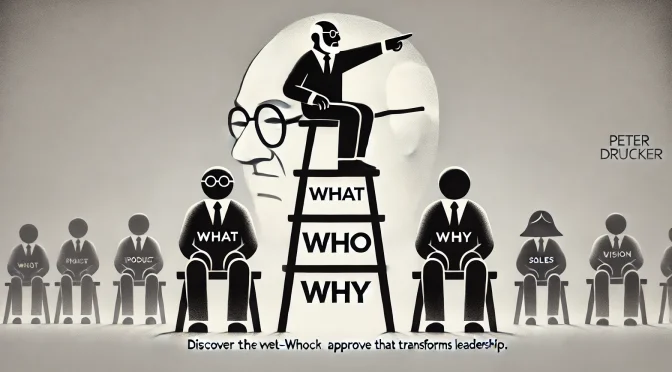
Peter Drucker, the father of management science, famously said, “The purpose of a business is to create a customer.” But what would the father of modern management think of our approach to tackling today’s ICP challenge?

We didn’t have to guess. Dr. Elizabeth Haas Edersheim (Drucker’s personally chosen biographer, former McKinsey senior partner, and MIT Sloan Ph.D.) joined our recent workshop. When asked what Drucker would think of our WHAT-WHO-WHY framework, her response was immediate:

“Peter defined innovation not as having a new idea, but by how much it changes the value delivered to customers. Your WHAT-WHO-WHY approach does exactly that—it fundamentally enhances the value leaders deliver. Drucker would have loved this because it clarifies purpose, aligns teams, and dramatically amplifies their collective impact.”

She continued:

“Drucker was deeply human-centric. Your method of bringing everyone to shared understanding of WHAT, WHO, and WHY doesn’t just clarify strategy—it unlocks human energy inside organizations. People can finally work with real purpose and clarity.”

Why Smart Teams Still Struggle

If the framework is straightforward, why do even experienced leaders find ICP clarity elusive? Three reasons:

Cognitive overload. Holding three interconnected dimensions in mind at once is mental work. Teams unconscious simplify, losing crucial nuance.

Functional bias. People gravitate toward their expertise. Product leaders obsess over WHAT. Sales focuses on WHO. Visionaries champion WHY. Without deliberate integration, teams optimize their piece while missing the whole.

Static thinking. Most treat ICP as a one-time exercise. But your ideal customer evolves as you do. The best-performing organizations revisit and refine their WHAT-WHO-WHY with regularity: embedding the framework into leadership rhythms, strategy sessions, and go-to-market planning.

Case Example

Here’s what happens when teams get the framework right. A consulting firm was stuck at $9M revenue, walking away from acquisition offers because they couldn’t get to their $12M target. Their WHAT-WHO-WHY was “we do stuff for money.”

After defining their true WHAT-WHO-WHY (visually stimulating strategy facilitation for U.S. Federal Government leaders who want to make a difference, accomplish missions, and get promoted), everything changed.

Four years later, they sold for $30M+.

But that’s just the beginning. Another company started using WHAT-WHO-WHY clarity at $15M revenue. They kept refining the framework through five private equity hold cycles. Today? North of $2 billion valuation.

The pattern isn’t luck. It’s what happens when organizations use clarity as a strategic asset, not a checkbox.

Whether you’re leading a startup seeking Series A, a nonprofit pursuing major donors, a church building community engagement, or a Fortune 500 division defending market share, the challenge remains the same. Every organization at every stage needs to answer the same three questions with precision. The framework works across all business models, capital structures, and geographies because the fundamental human need for clarity and alignment is universal.

Beyond the Foundation

Here’s what most people miss: WHAT-WHO-WHY clarity is powerful, but the framework is just the first element of what high-performing teams need.

Think of it as Truth #2 in our Manage to Lead system. It’s preceded by understanding your current context and followed by five more integrated truths about how teams actually execute and scale. Each builds on the others. Skip one, and even the best strategy stumbles.

The companies that outperform don’t just get their ICP right. They master the full sequence: how to assess where they stand, align everyone around the right priorities, plan change that works, execute without losing momentum, and remove the barriers that stop most teams from reaching their potential.

The Real Test

Your WHAT-WHO-WHY isn’t just a statement. The framework is a decision-making filter. When the framework is right, tough choices become obvious. Resource allocation gets clearer. Teams move faster because they’re no longer debating fundamentals.

When teams at inflection points (scaling, pivoting, fundraising, integrating new leadership) start with WHAT-WHO-WHY clarity, they compress months of alignment work into weeks. Not because the framework is magic, but because it surfaces and resolves the disconnects that otherwise create expensive detours.

Your Next Move

If you’re leading through change, start with the foundation. Download our WHAT-WHO-WHY template, or request access to the IntelliVen Sandbox where your team can work through this together—with AI-powered feedback that accelerates the iteration process.

But remember: the framework is just the beginning. The teams that win understand that clarity is built, not discovered. And building clarity requires more than one framework. Building clarity requires a system.

Get Clear. Align. Grow.

Ready to see what aligned clarity can unlock for your team?
• Explore the full Manage-to-Lead System at IntelliVen.com
• Request a 10-day IVOA Sandbox trial—just contact us and we’ll set you up
• Watch the 40-minute workshop Dr. Edersheim attended and hear her remarks firsthand

About the Author

Peter DiGiammarino has helped hundreds of leadership teams architect breakthrough performance across private, public, VC-backed, and PE-owned companies. His Manage to Lead system distills decades of operating experience into seven enduring truths and 60+ practical tools that guide teams through critical inflection points.

Why It’s Hard to Keep Three Things in Mind at Once—and How W-W-W Makes It Possible

Leaders and teams often juggle multiple priorities at once, but maintaining focus on three completely different things simultaneously—especially for extended periods—is much harder than it seems. This challenge isn’t just anecdotal; it’s rooted in how our brains process information. And this is precisely why frameworks like W-W-W (WHAT-WHO-WHY) are so critical, yet often underutilized.

The Cognitive Challenge of W-W-W

The W-W-W framework asks leaders to simultaneously keep in mind:

  • WHAT they are offering (the product or service).
  • WHO the target customer is (the market or audience).
  • WHY customers will pay for it (the core value proposition).

Each element of W-W-W engages a different type of thinking:

  • WHAT is tangible … it’s a thing you can point to or name.
  • WHO is a person with a profile in a specific role, job, or situation.
  • WHY is intangible, rooted in beliefs and outcomes, emotional and value-laden.

While W-W-W seems like a simple, logical exercise, it’s incredibly difficult for leaders and teams to hold all three aspects in their heads at the same time. Why? Because of our brain’s cognitive load limitations.

Cognitive Load and Why W-W-W Is So Hard

Research shows that the human brain has a limited working memory, meaning it can only handle a few items at once before it becomes overwhelmed. The more different types of thinking required—tangible, relational, and emotional—the harder it is to maintain focus.

Trying to balance all three components of W-W-W without a clear framework leads to mental fatigue, decision fatigue, and scattered thinking. This is why W-W-W is so important: it provides structure to help leaders navigate these three distinct but essential aspects without cognitive overload.

Yet, W-W-W is rarely done well because it has never been formalized in such a way before. Traditional business models often focus on only one or two of these elements, like defining the product (WHAT) or understanding the market (WHO), without explicitly tying in the WHY—the core reason customers value the offering. Without this alignment, even good strategies fall short.

Practical Demonstration: Proving the Point with Examples

To demonstrate how challenging it is to hold three vastly different concepts in mind, try to do the following three things all at the same time:

  • WHAT: Imagine walking through the booth your marketing manager will set up at your next trade show.
  • WHO: Write what your marketing manager is most concerned about.
  • WHY: Say the emotion that motivated the manger to choose their CRM.

Collectively these tasks force participants to switch between thinking about something tangible (WHAT), defining a specific role (WHO), and tapping into emotions and motivations (WHY). It illustrates how cognitively overwhelming it is to keep track of all three at once, much like the challenge of managing a strategy that isn’t aligned across W-W-W.

Why W-W-W Is So Important

W-W-W forces leaders to align their thinking across three critical dimensions—what they do, who they serve, and why it matters. This alignment is not only difficult to achieve but is also essential for strategic clarity and execution.

Without a clear W-W-W, teams and team members might:

  • Focus too much on the WHAT (over-engineering the product or service) without understanding the needs of the WHO (the customer).
  • Overemphasize the WHO without knowing why the customer would actually pay for the offering (the WHY).
  • Misalign their messaging, product development, and go-to-market strategies because they haven’t clearly articulated the WHY to the market.

W-W-W isn’t just important—it’s revolutionary in its simplicity. It’s hard to achieve because balancing these three factors is a cognitive challenge that leaders often underestimate. But when done right, W-W-W provides the foundation for everything else, from product development to go-to-market fit.

Conclusion: A New Way Forward

The W-W-W framework helps solve the mental balancing act of holding three critical business elements in mind—something most leaders struggle with. It’s important because it forces clarity and alignment, and it’s hard because it requires constant attention to three different types of thinking.

W-W-W has never been done quite like this before, but now that it’s been formalized, leaders have a tool to organize their thinking, reduce cognitive overload, and execute more effectively.

See Also:

W-W-W and Go-to-Market Fit: Essential Partners for Success

As organizations grow, leaders are often faced with strategic questions that may seem similar but address different parts of the business. One question that often comes up is whether frameworks like W-W-W (WHAT-WHO-WHY) and concepts like go-to-market fit are two ways of addressing the same challenge, or if they are fundamentally different.

Given the increasing need for clarity and market readiness, it’s important to understand how these two approaches compare and when each is most useful.

The W-W-W concept (WHAT-WHO-WHY) and go-to-market fit both deal with foundational aspects of a business strategy, but they focus on different areas and serve different purposes. Let’s compare them in detail:

Definition and Purpose

  • W-W-W (WHAT-WHO-WHY)
    • WHAT: The product or service you offer.
    • WHO: The target customer or market.
    • WHY: The reason customers will pay for your offering (i.e., the value it brings).

    Purpose: The W-W-W framework is designed to ensure clarity and alignment within an organization about its offering, its target audience, and the value proposition. It helps a company articulate its strategy in a clear and focused way, ensuring that all internal and external stakeholders are on the same page about the core business model.

  • Go-to-Market Fit (GTM Fit)
    • Definition: Go-to-market fit refers to the point where a company’s product or service is well-positioned to be introduced and scaled in a target market. It implies that the product, value proposition, and messaging align with the needs and preferences of the market, ensuring that the company can effectively acquire, retain, and grow customers.

    Purpose: Go-to-market fit is about ensuring that all the components of bringing a product to market (e.g., product positioning, sales strategy, marketing, pricing, and customer acquisition channels) are in alignment with the target customer base. It’s a more dynamic and iterative concept, aimed at achieving market penetration and scalable growth.

Focus Areas

  • W-W-W:
    • Focuses on strategic clarity—understanding your offering (WHAT), your audience (WHO), and your core value (WHY).
    • It’s more about internal alignment and ensuring that the entire organization has a consistent understanding of the core business.
    • It addresses high-level strategic questions that guide decision-making.
  • Go-to-Market Fit:
    • Focuses on market execution—how well the company’s product fits the market, how well it can be positioned, and how the sales and marketing strategy can convert potential customers.
    • It’s more tactical and action-oriented, addressing the steps and processes needed to succeed in the market.
    • GTM fit deals with dynamic market factors, such as competition, customer needs, channels, and pricing.

Relationship to Product-Market Fit

  • W-W-W:
    • Helps a company define product-market fit conceptually, as it aligns what you offer (WHAT) with who needs it (WHO) and why they would pay for it (WHY).
    • It is often a precursor to developing a go-to-market strategy, ensuring that the company has a clear understanding of its core value before trying to execute in the market.
  • Go-to-Market Fit:
    • Relies on achieving product-market fit first, and then determining how to position and deliver the product effectively to the market.
    • GTM fit ensures that product-market fit scales—i.e., that the product can be sold, distributed, and adopted in a sustainable and scalable way.

Time Frame

  • W-W-W:
    • W-W-W is often a strategic exercise done early in the life cycle of a business or during significant shifts in strategy, offering a clear, enduring direction.
    • Once clarified, it can remain stable over longer periods, helping guide operations and strategy.
  • Go-to-Market Fit:
    • GTM fit is more fluid and iterative, adapting as the market changes, as competition arises, and as customer preferences evolve.
    • It often requires continuous refinement as the company gathers feedback from initial customer segments and adjusts its approach.

Metrics for Success

  • W-W-W:
    • Success is measured in terms of organizational alignment—is everyone in the company clear about what the business does, who it serves, and why it matters?
    • Indicators include consistency in messaging, understanding of the customer’s core needs, and clarity of strategic goals.
  • Go-to-Market Fit:
    • Success is measured through market performance—are we acquiring and retaining customers, are our channels efficient, and is our product resonating with the target audience?
    • Metrics could include customer acquisition cost (CAC), lifetime value (LTV), conversion rates, and revenue growth.

Examples

  • W-W-W Example:
    • A software company defines:
      • WHAT: A project management tool for distributed teams.
      • WHO: Medium-sized tech companies with remote employees.
      • WHY: These companies need a streamlined way to manage cross-team collaboration to save time and reduce friction.

    This framework helps the company ensure that everyone, from product development to marketing, is aligned on the core offering.

  • Go-to-Market Fit Example:
    • That same company achieves go-to-market fit when:
      • The sales and marketing teams have developed a clear positioning and messaging that resonates with decision-makers at tech companies.
      • The product is priced competitively and distributed effectively through the right channels (e.g., online ads, partner networks).
      • The company can scale its customer acquisition without an unmanageable increase in costs.

Overlap

While W-W-W and go-to-market fit serve different functions, they are complementary in the following ways:

  • Strategic Alignment: W-W-W provides clarity on core elements (product, target customer, value proposition) that are essential for achieving go-to-market fit.
  • Foundation for GTM: A strong W-W-W foundation can set up a company for success in achieving GTM fit, as it ensures that the internal strategy aligns with market realities.
  • Mutual Dependency: Without clarity from W-W-W, it’s hard to execute a successful go-to-market strategy. Likewise, without good execution (GTM fit), even a well-defined W-W-W won’t lead to growth.

Conclusion

  • W-W-W is about clarity and alignment within the organization regarding the product, market, and value proposition. It’s a foundational, strategic tool.
  • Go-to-Market Fit is about market readiness and execution, focusing on aligning your product and strategy with the market to drive adoption, growth, and scalability.

Both concepts are important, but they address different aspects of a company’s journey from defining its offering to scaling in the market.

Further Reading

  • Cognitive Load Theory and Decision-Making: For more on how frameworks like W-W-W help reduce cognitive load and improve strategic alignment, consider John Sweller’s work on Cognitive Load Theory.
  • Product-Market Fit and GTM Strategy: Dive deeper into concepts of go-to-market fit with Ben Horowitz’s book The Hard Thing About Hard Things, which covers execution strategies for scaling businesses.
  • Leadership in Strategic Clarity: For those interested in exploring leadership models for strategic clarity, check out Leadership in the Age of Complexity by Eric J. McNulty and Leonard J. Marcus.