Category Archives: People Matters

Posts related to the people side of strategy and operations

Know the definition of strategy to help everyone stay on the same page.

The following are definitions of phrases that use the word strategy. They provide a useful way to think about the term and matters directly related to it:

  • Strategy is what people in an organization plan to do in order to “win” whatever game they are playing.
  • Strategic thinking is how decisions and actions are made in the immediate-term in a manner that is mindful of long-term implications and consistent with a strategy.
  • Strategic planning is the structured process that management uses to periodically engage leaders in advancing their strategy.
  • Strategic plan is a description of an organization as it presently exists and where it is to be in the future along with how it will go from where it is today to where it will be next on the way to achieve a long-term vision.
  • Strategic initiatives are projects identified as part of strategic planning and documented in the strategic plan that are to address what is most important to change next in order to increase the odds of winning.
  • Strategic management is what is done to deliberately operate and develop the organization in a manner that is entirely consistent with its strategy.

UMass Commonwealth Honors College Awards Presentation Dinner Speaker

UMass Commonwealth Honors College Awards Presentation

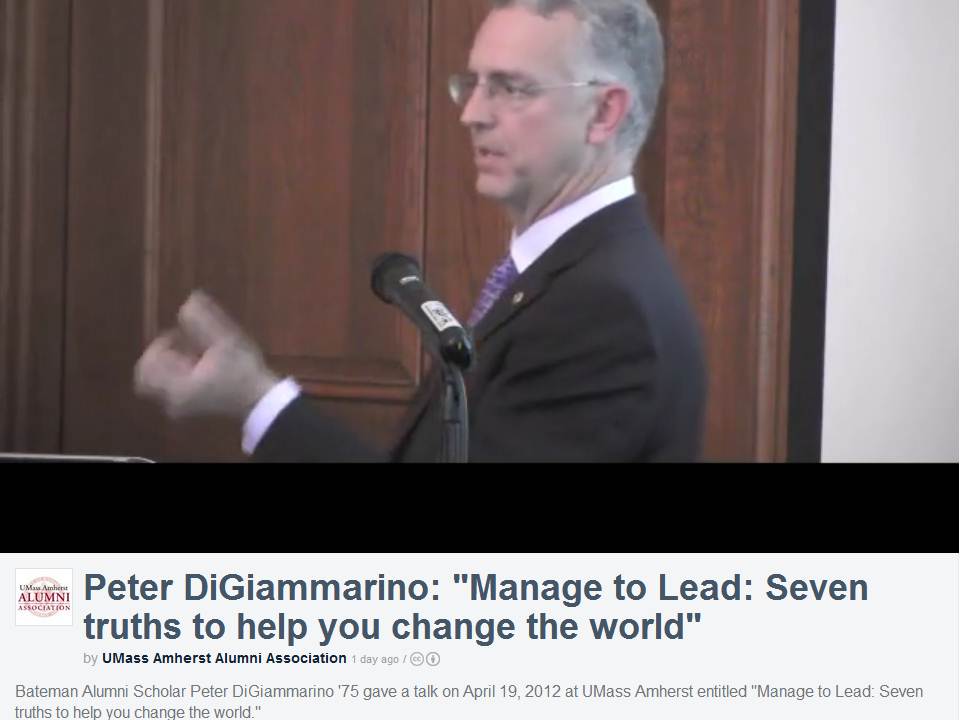
Whether on campus or in the workplace, effective leadership involves seven disarmingly simple truths, says alumnus Peter F. DiGiammarino ’75. As the Eleanor Bateman Alumni Scholar in Residence for spring 2012, DiGiammarino led two events during which he offered advice on becoming an effective leader.

Peter DiGiammarino makes keynote dinner speech
Peter DiGiammarino makes keynote dinner speech at awards function for Commonwealth College Honors students.

Leaders, he explained, “get loose.” Top leaders break through conventional boundaries to find new solutions to everyday problems. They also follow a set of powerful guidelines, which DiGiammarino breaks into actions driven by seven simple truths that he says can help facilitate change at any level.

These truths are:

1. An organization exists to solve a problem for people.

2. It takes a team. Continue reading UMass Commonwealth Honors College Awards Presentation Dinner Speaker →

University of Massachusetts 2012 Bateman Scholar in Residence Public Lecture

At University of Massachusetts 2012 Bateman Scholar Public Lecture, IntelliVen founder and CEO PeterD presented a 45 minute lecture that summarizes 35 years of insight gleaned from successfully helping dozens of organizations get on track to long-term growth and performance, generally in the role of leader or an adviser to the founder, owner, investor, and/or the CEO of ventures with between 2 and 20 people positioning to grow to 200 to 2000.

These insights have been honed while teaching at a number of universities, most recently at American University where he serves as an adjunct professor teaching Master’s Students in Organization Development about leadership and organization analysis and strategy and at the UMass Commonwealth Honors College where he has served as guest lecturer on Leadership.

Now, in the hope of helping you Manage to Lead, please see him present about 50, from a  library of more than 400, slides that summarize ever-evolving insights and lessons learned by clicking on the image below:

Click above to see and hear the 45 minute lecture: Manage to Lead: Seven Truths to Help You Change the World

Slides for Manage to Lead Seven Truths to Help You Change the World

How to quit a job you love.

It is not easy to quit a job you love. Even with a new dream job in-hand, cutting the cord that connects you to a place you have become part of can be one of the most difficult challenges you ever face in your career. While there is no surefire method, the steps below reflect lessons from the experience of those who have been successful in so doing.

To quit, follow the steps below in order and precisely. Make sure first, though, that you have really decided to quit and that it is not just a ploy to get your employer to talk you in to staying and giving you a bump in compensation.

NOTE: If what you really want is an offer to stay (even though when you then decide to stay management will, from then on, question your loyalty and motives which may be a fatal blow to a thriving upward trajectory) then this is not the method to follow.

  1. Be loyal first to yourself  Your loyalty is to you, not to your employer or your colleagues, no matter how much they have done for you up to now. Almost everyone thinks their own departure will be more catastrophic for their organization, its employees, and its customers than it will turn out to be. Any one of us, in any role, leaves a hole upon departure about the size of the hole left in a pitcher of water when a clenched fist is pulled out from it.
  2. Three iron-clad reasons. Three reasons are all you need to explain why you have decided to quit. Any more than three leaves you open to having the weakest refuted, allowing your employer to claw their way back to convincing you to stay … and human instinct is such that they will try to talk you into doing exactly that. Memorize your three reasons and get glib with them.
  3. Practice. Say outloud that you are leaving and why, over and over, in front of a mirror so you will have heard and felt yourself speak the words in a safe and unemotional setting. The last thing you want at the moment of truth is for a tear to come to your eye or for your lip to quiver. Practice with a few close friends, family members, and advisers. Ask them to help you state your points more firmly, with more authority, with less emotion, and to tighten up the message.
  4. Do something to manifest your decision. A day or so ahead of announcing, for example, exercise and sell all of your vested stock options, take your favorite knickknacks out of the office, give up your parking space, or something along these lines to convince yourself and to show colleagues and management that you really have checked out.
  5. Set up a time to speak with your manager. It is best to meet in person but electronically works if it is the only option. Use the departure letter template to draft your resignation letter that says:
    • You resign as of a specific date to pursue a specific other opportunity.
    • You have strong positive feelings for your time at the organization.
    • You are committed to do all you can to orchestrate a smooth transition.
  6. Turn in a signed departure letter. At the start of your meeting, allow time for your manager to read and absorb the contents of your letter. Offer to talk through the three reasons why you have decided to quit and explain what you have already done to mentally and physically checkout. When they attack your reasons for leaving it is important to say exactly this: “I appreciate you helping me to rethink my decision but it is my decision to leave”.
  7. Navigate to acceptance. What will follow is a gradual progression through a series of predictable stages: shock, denial, pain, anger, bargaining, depression, and finally acceptance. Stay calm and help orchestrate the progression through the stages until acceptance is reached.

Good luck departing!

SEE ALSO

Tips on how to get all you can from your last job.

How to orchestrate the best entry to your new position.

How to write the perfect goodbye note.

Alternatives to a COO

Responsibilities shouldered by the Chief Executive Officer (aka: CEO, Managing Partner, Managing Director, or Executive Director) of a successful venture increase with growth in scale and complexity. The tension between the need to get things done, get others to do things, bridge the “white space” between organization units, and to represent the organization externally (e.g. to customers, investors, partners, suppliers, etc.) eventually reaches a breaking point.

Most, especially first time CEOs, get the idea to install a Chief Operating Officer (COO) as it seems an obvious way to spread the workload and ease the burden.

While adding a COO to the management team may be the right thing to do over the long-term, it is a difficult, time consuming, expensive, and risky move that is not likely to pay off in the short-term because:

  • It’s a stretch: The ideal candidate is rarely already in-house. The most capable executives in the organization are typically too vital in their current role or not appropriate given their abilities and interests. Moving them into the COO role leaves too big a hole and may be too much like asking a rabbit to swim.
  • It’s expensive: The cost to find, recruit, hire, and on-board the ideal candidate from outside the organization is significant. It takes a long elapsed time, consumes precious management time, and is expensive both in terms of search fees and the incremental cost to compensate the new person.
  • It’s risky: The odds of successfully bringing in someone from the outside are low. The failure rate of such placements is high because of how hard it is to bring a new senior player into an existing team of executives, prepare an organization for a new COO, and support the new COO in getting up to speed and powerfully assuming the role.

In light of the above, it is a good idea to consider the following alternative approaches, at least in the immediate term and certainly before taking the leap to hire a COO.

The Deputy

While the forward-thinking CEO can and should work on a long-term strategy to address their needs, there is an alternate approach to installing a COO that nets short-term improvement that may be adequate for quite some time. The approach is to define a staff role to the CEO that facilitates and drives the management operating framework thereby offloading an enormous operating burden. A person in such a role is often called a Deputy Senior Officer or a Chief of Staff and is common in military and government organizations, and in organizations that serve governments.

The Deputy can be someone with competencies that range from high-end administrative to those of a near-COO or someone who could someday be a COO or CEO.

The best strategy is to assign, from inside or hired-in, a low-ego, high-skilled person who is liked by, and non-threatening to, existing leaders and who is positioned for maximum benefit, and long-term potential, to the organization. The higher the skill level, the higher the price, the harder to find, and the more risk of sparks flying when existing leaders realize there is another strong(er) player in their midst.

The Analyst

An even less risky, less expensive, and more easily accomplished solution in the short-term is to fill the staff position with a Business Analyst that:

  • Has a high-bandwidth intellect with deep knowledge of at least one important part of the organization and who has interest and energy for all parts of the organization.
  • Has energy, capacity, and drive.
  • Is conceptual and articulate so as to be able to develop an accurate big picture from a myriad of details and to communicate complex concepts even to those who are not conceptual.
  • Has acumen for management and leadership.
  • Has a disposition that is compatible with the CEO, and who has a “long runway”; i.e., is early in their career, bright, and who is an ambitious person likely to go far.

Assigning top business analysts to staff roles is common to organizations such as IBM, Apple, and Motorola where top-flight young professionals, often graduates of top business schools with just a few years experience, are assigned as Executive Assistants to top executives for a year or two before returning to other roles in the organization. The executives get extraordinary service and the up-and-coming assistant gets a front-line education and unsurpassed opportunities to perform and grow.

To increase the odds of having such talent on staff, hire MBAs fresh-out of the top schools and groom them in the business for a few years and then assign the best to staff top executives.

On the other hand, the best MBAs have probably already been courted and hired by top consulting firms. Consequently, a shortcut is to find and retain a business analyst from a top firm on a consulting basis to work full-time in the Analyst role for a top executive. If they work out well, hire them as an employees. If not, place them elsewhere or cycle them back to where they came from and try again. I personally successfully followed this strategy as the top executive at a $200M public software company with an MBA from a top school that I retained from a top consulting firm. My assistant later went on to top roles in her own organizations including, eventually, the role of CEO.

Summary

With either approach the course of action is to define the role, conduct a search, and then design and drive a process to work with the alternative to the COO, the CEO, and the management team to bring all stakeholders on board and on track for success.

SEE ALSO

Leadership Support

Why top leaders tell everyone to never do what they are told.