Tag Archives: organization development

What an organization must do in order to perform and grow.

Imagine:

  • An organization that does not know how it will meet the demands of its current customers, or
  • An organization that has no idea where its next customer will come from, or
  • An organization that does not know how it will acquire resources needed to meet a surge in demand.

Such organizations exist and they are stuck. That is, their ability to perform and grow is severely constrained.

Organizations that experience sustained growth and high performance execute, create demand, and develop capacity in orderly, or systematic, ways. A system is a collection of resources working together to accomplish a common goal. The resources of an organization aggregate into three essential systems:

  • The Execution System, or what the organization does to Do what it does.
  • The Demand Creation System, or what the organization does to Sell what it does, including marketing, lead generation, sales, sales engineering, proposal writing, and sales support.
  • The Capacity Development System, or what the organization does to Grow, including training, recruiting, fund raising, performance assessment, goal setting, systems development, and process engineering.

Anything an organization does other than Do, Sell, or Grow, and that makes sense to continue doing, should be to facilitate, improve, or otherwise efficiently support its ability to Do, Sell, and Grow.

An organization that has execution problems essentially has no other problems because there is no point to growing or to landing new customers if the organization cannot even Do what it does to reliably deliver to customers it already has.  Without a way to capture, organize, and distribute its collective knowledge from serving customers, an organization may have just a collection of unconnected experiences such that every new customer may be a “whole new adventure”.  An organization that does not know for certain how it will meet delivery obligations runs serious risks and will find it difficult, if not impossible, to maintain control over the quality of its products and services.

Once there is a reliable way to execute, there is confidence to generate demand.  However, without a way to generate demand that is predictable, repeatable, replicable, documented, maintained, taught, and ever-evolving, the organization’s ability to Do and Grow is likely to be constrained by its ability to Sell.

When new sales cause demand to exceed delivery capacity, it must Grow capacity to deliver.  When capacity to deliver exceeds demand, it must Grow sales capacity.  A growing organization needs to be clear about how it will add capacity to Do and how it will add capacity to Sell.  For many organizations, this means identifying and cultivating sources of people, recruiting, and professional development.

At any time an organization’s ability to perform and grow tends to be constrained by one of the three core systems. Leadership’s job is to decide which system needs to evolve next and how.

For example, if a product provider generates more demand than can be handled by existing operations, then more production capacity is required.  Once production capacity is in place, sales capacity may need to expand in order to put the increased production capacity to work.  However, the amount of sales capacity should likely need to increase at a much slower rate than the rate of delivery capacity because a little more selling capacity should drive the need for a lot more delivery capacity.

In this sense, then, the evolution of Do, Sell, and Grow systems is iterative and staggered with execution capacity out in front of demand creation which is out in front of capacity to grow.

The larger and more complex an organization is, the more important it is for it to Do, Sell, and Grow in ways that are characteristic of more mature systems(see prior post on How growing organizations should go about evolving systems and processes); that is they need to be more:

  • defined,
  • predictable,
  • repeatable,
  • replicable,
  • documented,
  • maintained,
  • taught, and
  • revised to reflect lessons learned from experience.
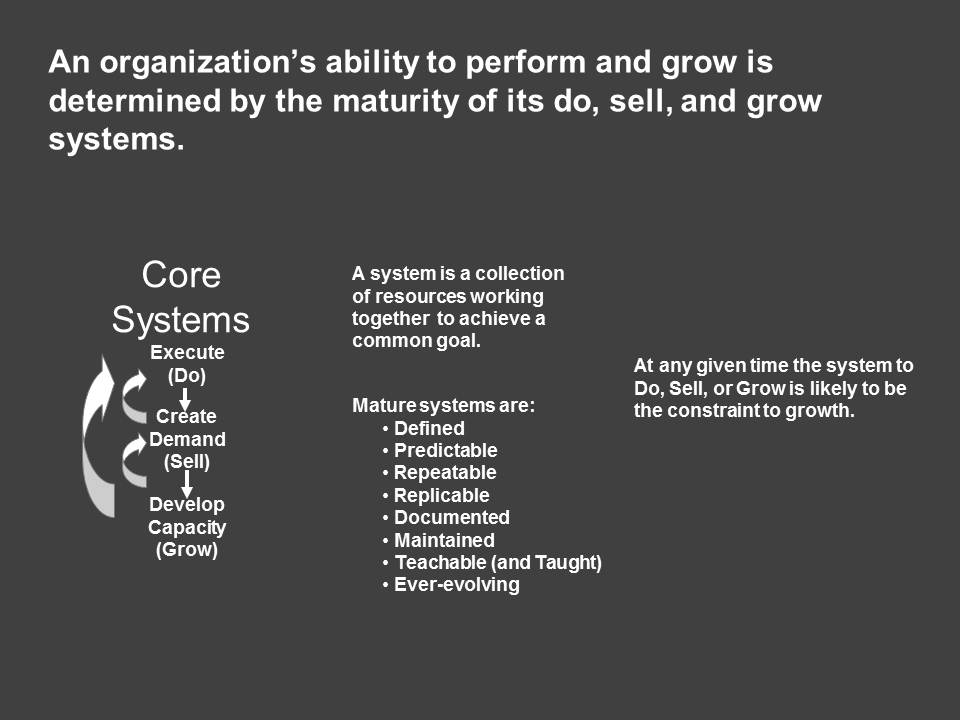
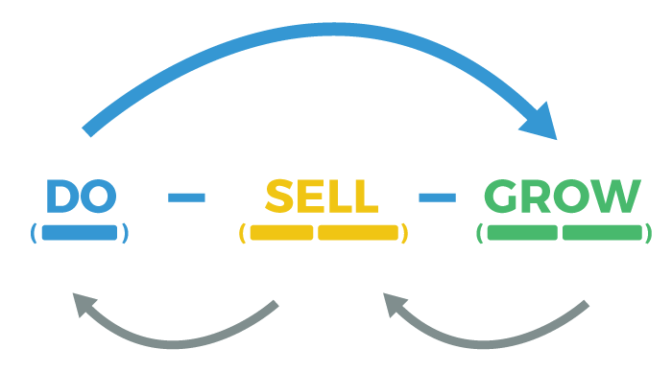
Successful organizations systematically Do, Sell, and Grow
Figure 1: Successful organizations systematically Do, Sell, and Grow.

As summarized in Figure 1:

  • Organizations have three core systems to Do, Sell, and Grow what they do.
  • At any time one of the three core systems is likely constraining growth.
  • Leadership’s job is to determine which system is constraining growth and to develop that system to the point where it is no longer the constraint.
  • As an organization grows in size and/or complexity it is important for their Do, Sell, and Grow systems to mature.

See also: ISO 9000 (https://www.iso.org/iso/iso_9000/), Baldridge award program (https://www.nist.gov/baldrige/), CMMi (https://www.sei.cmu.edu/cmmi/), and other programs that encourage and help organization to improve the maturity of their systems and processes.

How growing organizations should go about adding systems and processes.

One way to think about an organization is in terms of both how good it is at doing what it does, that is its effectiveness, and how mature are its systems and processes for doing what it does.  Figure-1 shows a way to map organizations into a framework that uses both dimensions. Continue reading How growing organizations should go about adding systems and processes.

The next big lift in performance!

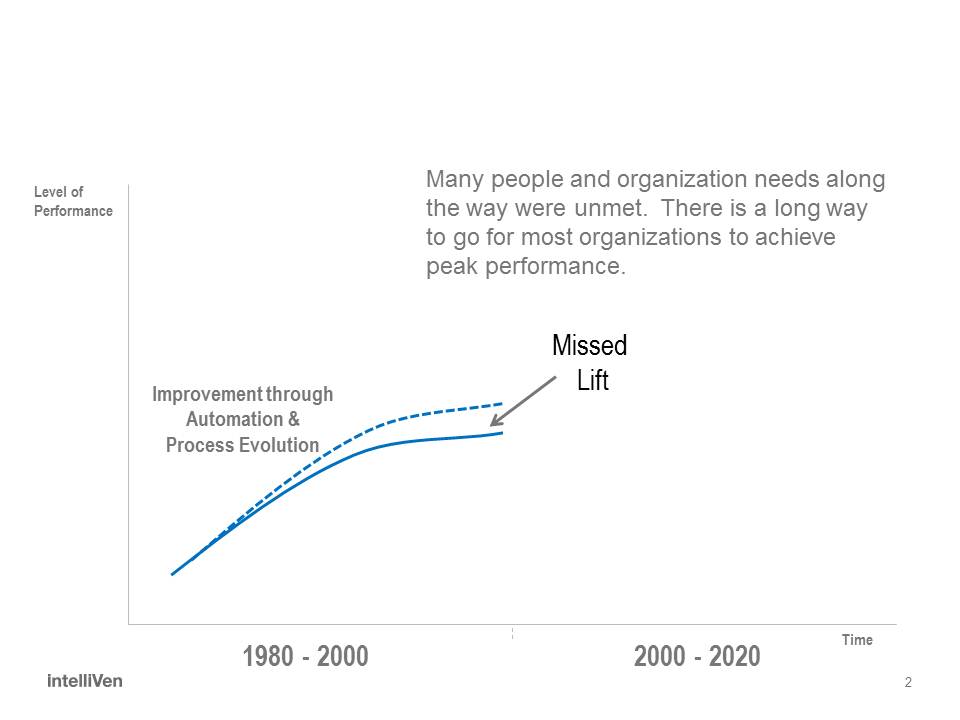
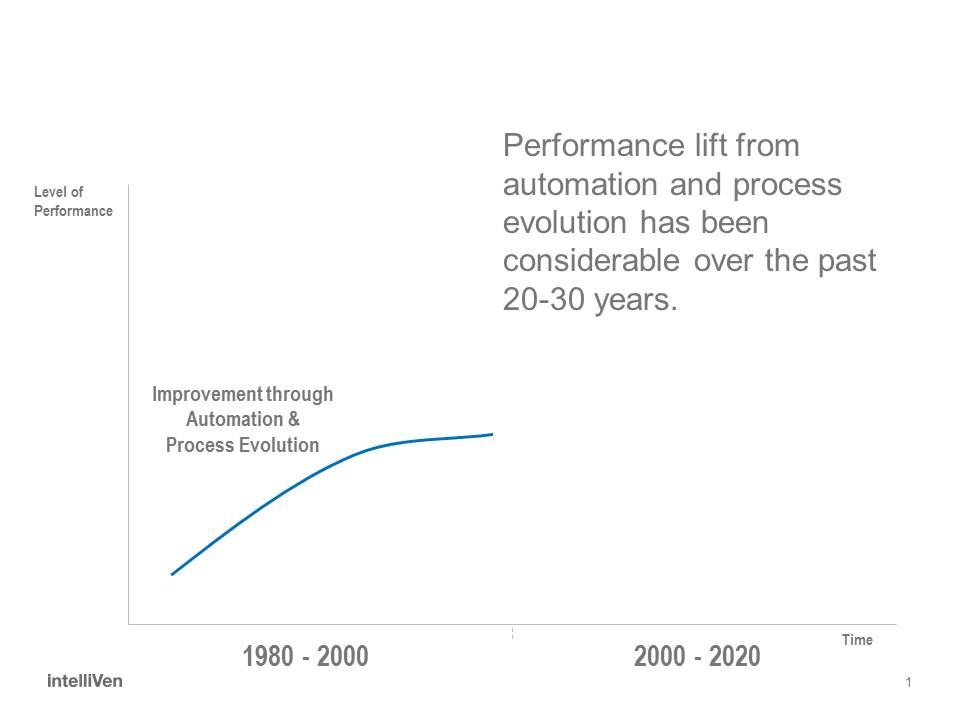
For decades organizations have sought and achieved productivity and performance improvement through information technology and process engineering initiatives. While these efforts streamlined and automated what organizations do to provide services and products, they failed to address many people and organization needs along the way. As a result, we still have a long way to go in order to achieve peak performance as suggested by figures 1 and 2 below.

 Automation and process evolution improve performance
Figure 1: Automation and process evolution improve performance.
There is a long way to go to achieve peak performance
Figure 2: There is a long way to go to achieve peak performance.

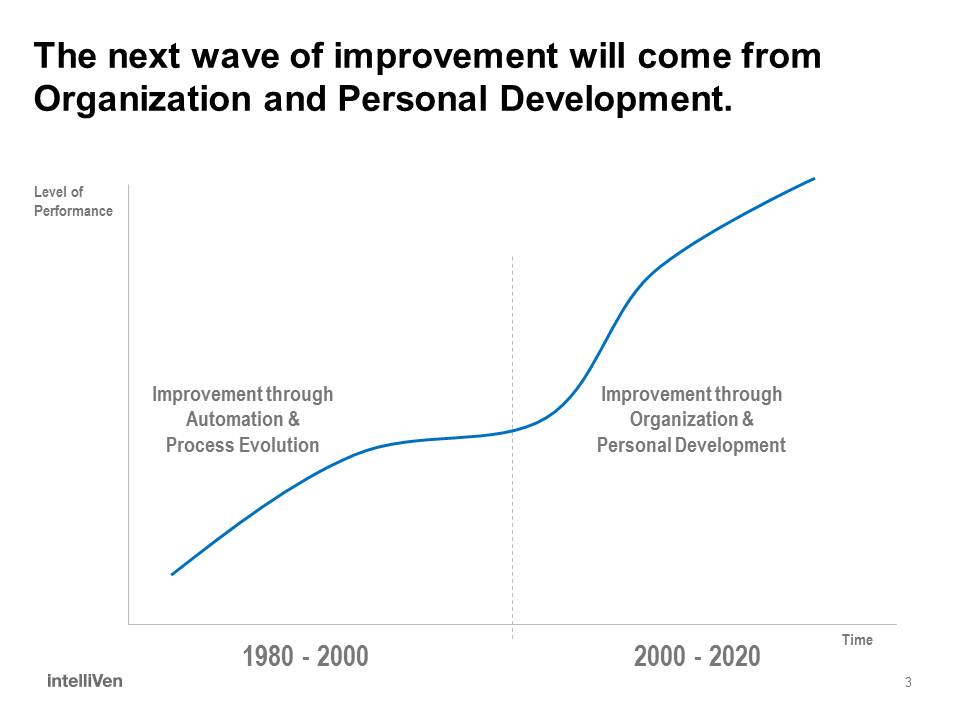
While the next wave of performance improvement may come from augmented reality, artificial intelligence, the internet-of-things, or any number of other things, it can also come, as suggested in figure 3, from enhancing the way people perform as individuals and together in groups, teams, and organization units. Leaders at all levels are challenged to get the most from their organizations and change initiatives by developing each person and their teams to fulfill their potential to perform and grow.

Organization & personal development provide the next wave of improvement
Figure 3: Organization & personal development provide the next wave of improvement.

Unfortunately, the skills to effectively lead this wave are not yet widely known or effectively taught and are difficult to figure out on-the-job even among bright and highly motivated professionals.  These skills can, however, be learned and immediately put to work to improve performance in any organization.

IntelliVen content is rooted in the discipline of Behavioral Science as applied to real-world experiences by pioneering executives and cutting-edge executive coaches in public, private, venture-backed, and private-equity-owned for-profit, not-for-profit organizations.

Leaders and coaches can put the tools, methods, and principles posted on the IntelliVen site into highly effective practice and success in social, public, and commercial sector organizations of all sizes and stages of evolution.

It is hard to interest organization leaders in lifting performance through improved interpersonal dynamics. The reason is that it is harder to grasp than, say, buying a system or changing a business process.

As such it is incumbent upon those who sell and deliver improvement through upgrading behavior, to package and describe offerings in tangible terms. For example, rather than pitching Manage to Lead as tools, methods, and principles that help an organization to achieve its potential to perform and grow, it may be more tangible, and therefore more “buyable” if it is introduced as the Manage to Lead System and delivered in a staged, systematic, deliberate way.

The other key is to sell the benefit delivered, not the process by which it is achieved. For example, following the Manage to Lead System will increase growth rates and improve profit margins. That it does so principally by getting people and teams to work better together is incidental to the final result though it is an extraordinarily efficient way to achieve it.

SEE ALSO

Toolbox

Insights

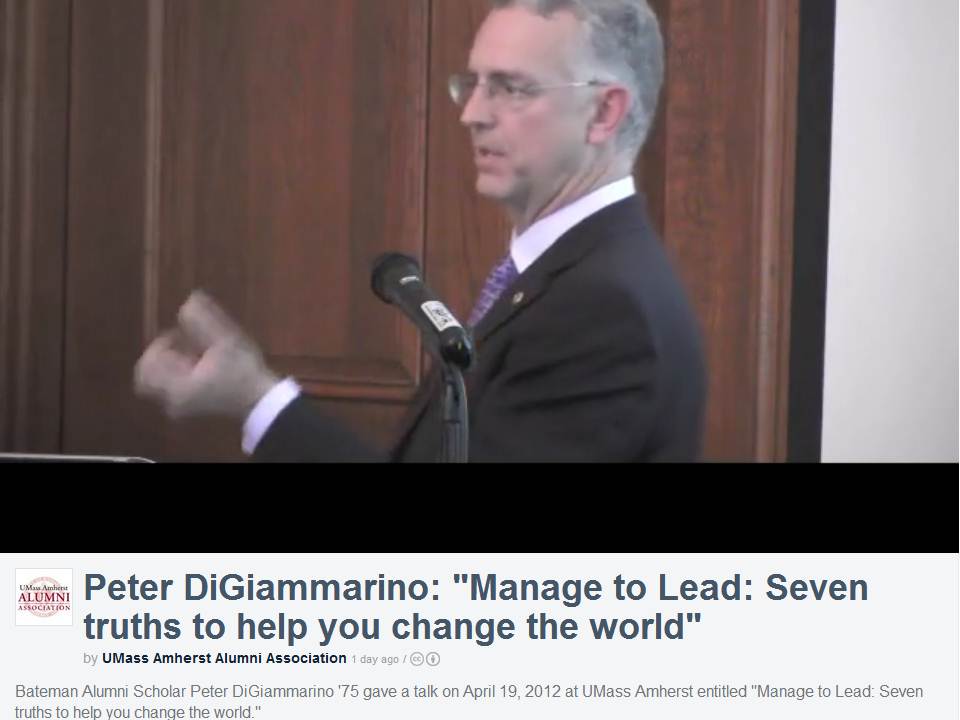
University of Massachusetts 2012 Bateman Scholar in Residence Public Lecture

At University of Massachusetts 2012 Bateman Scholar Public Lecture, IntelliVen founder and CEO PeterD presented a 45 minute lecture that summarizes 35 years of insight gleaned from successfully helping dozens of organizations get on track to long-term growth and performance, generally in the role of leader or an adviser to the founder, owner, investor, and/or the CEO of ventures with between 2 and 20 people positioning to grow to 200 to 2000.

These insights have been honed while teaching at a number of universities, most recently at American University where he serves as an adjunct professor teaching Master’s Students in Organization Development about leadership and organization analysis and strategy and at the UMass Commonwealth Honors College where he has served as guest lecturer on Leadership.

Now, in the hope of helping you Manage to Lead, please see him present about 50, from a  library of more than 400, slides that summarize ever-evolving insights and lessons learned by clicking on the image below:

Click above to see and hear the 45 minute lecture: Manage to Lead: Seven Truths to Help You Change the World

Slides for Manage to Lead Seven Truths to Help You Change the World