Category Archives: Get Aligned

Decide what kind of leader to be and collect followers.

Gain the Ultimate Leadership Edge: The Art of Helicoptering Up

As an emerging leader, you’re likely facing a number of high-stakes situations – important meetings, presentations, negotiations, and other career-defining moments. In these pressure-filled scenarios, it’s easy to get caught up in the moment, reacting instinctively rather than consciously guiding your actions toward your desired outcomes.

This is where the leadership technique of “helicoptering up” can be a game-changer. By learning to periodically step back and observe yourself objectively from an outsider’s perspective, you can gain invaluable insight that allows you to course-correct in real time and maximize your performance.

Here’s how it works:

Imagine you’re in the middle of a crucial meeting with a potential client. As you’re speaking, making arguments, and responding to questions, take a mental pause and picture yourself floating up above the room, watching the scene unfold from a distance. What do you see?

Are you demonstrating the confidence, poise, and command of the situation that you had envisioned? Or are you coming across as anxious, uncertain, or unfocused? Are you effectively guiding the conversation toward your objectives, or getting sidetracked by tangents?

This “helicopter” view gives you crucial objectivity that’s difficult to achieve when you’re fully immersed in the action. It allows you to see yourself as others see you, to identify areas where you may be falling short, and to make immediate adjustments to your approach.

Perhaps you realize you’re speaking too quickly out of nerves, causing you to stumble over your words. Or you notice your body language is closed off, causing the client to seem disengaged. By making a conscious effort to slow down, make more eye contact, and project an air of relaxed confidence, you can steer the meeting back on track.

The benefits of this practice extend beyond the moment at hand. After the high-stakes situation has concluded, take a few minutes to again “helicopter up” and reflect on how it went.:

  • What did you do well?
  • Where could you have improved?
  • What will you do differently next time?

This after action assessment is critical for continuous improvement. The more you consciously practice helicoptering up, both during and after key events, the more instinctive and valuable the technique will become. Over time, you’ll find yourself naturally shifting into that elevated perspective, allowing you to make real-time adjustments that elevate your performance.

Of course, developing this skill doesn’t happen overnight. It takes concerted effort and practice. One effective strategy is to set periodic mental “alarms” during important meetings or interviews – perhaps every 10 or 15 minutes. When that alarm goes off, immediately shift into helicopter mode and assess the situation.

Don’t just observe passively, though. Be prepared to take action. If you identify an area that needs improvement, make a concrete plan to address it. Maybe it’s making a point to ask more engaging questions, or to speak more slowly and clearly. Perhaps you realize you need to be more assertive in steering the conversation. Whatever the case, use that elevated perspective to inform tangible steps you can take to get things back on track.

The key is to avoid simply observing the situation objectively, then falling back into the same patterns. Helicopter up, identify areas for improvement, and then immediately implement those changes. This active, iterative process is what transforms the helicopter technique from a passive exercise into a powerful leadership tool.

Mastering this skill takes time and practice, but the payoff is immense. By regularly stepping back to view yourself and the situation with clear-eyed objectivity, you gain an invaluable superpower as an emerging leader. You’re able to monitor your performance, make real-time adjustments, and keep yourself firmly centered on your goals – even in the midst of high-pressure, high-stakes scenarios.

So the next time you find yourself in a critical meeting, presentation, or negotiation, don’t get caught up in the intensity of the moment. It just might be the difference between an average performance and an exceptional one.


See Also

Emerging Leaders: Mastering Group Process for Success

As an emerging leader, the ability to effectively navigate group work is a critical skill. Too often, we find ourselves in situations where groups become mired in the easy tasks, neglecting the more challenging but equally important aspects of the work. In this post, we will explore key strategies to help you and your teams break this pattern and achieve greater success in group settings.

Allocate Time for Reflection

Groups frequently struggle to allocate time for “reflecting” at the end of a task. The tendency is to focus on the more tangible “sharing” component, leaving little room for the deeper contemplation that can unlock valuable insights. As an emerging leader, it is essential to recognize the importance of this reflective phase and ensure that it is intentionally built into your group’s process so that you glean the lessons learned.

Proactive Process Planning

Groups assigned a task need to take ownership of managing their time and process (see next point) during breakout sessions, rather than relying on external instructions. This speaks to the crucial skill of proactive process planning. Effective groups take the time upfront to outline their approach (see below), allocate time for each step, and establish mechanisms for monitoring progress. This not only ensures that all necessary tasks are completed but also fosters a sense of shared responsibility and accountability within the team.

Balancing Time and Priorities

To illustrate this point, here is a sample time allocation for a group task:

  • 1′ Confirm team common understanding of the breakout task/outcome
  • 1′ Agree on the process to use and how to monitor it (i.e., assign roles for timekeeping and notetaking)
  • [allotted time less 5′ for process steps shown above and below]’ 
  • 1′ Decide who will report and how (if needed to save the whiteboard when working in a Zoom breakout room)
  • 2′ Reflect as a team on your process before returning to the larger group

This example demonstrates the importance of carefully balancing time and priorities. By allocating specific durations for each step, the group ensures that they not only complete the core task but also set aside time for the vital reflection phase. As an emerging leader, you can adapt and apply this approach to your own group contexts, tailoring the time allotments to suit your specific needs and the task to be completed.

Leadership Through Process Ownership

Effective groups take ownership of their process. Rather than relying on external prompts or instructions, successful groups proactively plan, monitor, and adjust their approach as needed. This, in itself, is an act of leadership. By guiding your group through this process, you demonstrate your ability to facilitate productive collaboration, foster a sense of shared responsibility, and drive meaningful outcomes.

As an emerging leader, mastering group dynamics is a crucial step in your professional development. By embracing the strategies outlined in this post – recognizing the importance of reflection, proactively planning your process, balancing time and priorities, and taking ownership of your group’s approach – you can position yourself and your teams for greater success in collaborative settings. Remember, leadership is not just about individual performance; it is about empowering and guiding others to achieve their full potential.

See Also

From Vision to Action! How to Align Your Team and Execute Your Plan

In today’s rapidly evolving landscape, having a clear and well-defined strategy to win the game you are playing is critical. It’s the roadmap that guides your organization towards its goals and ensures that every action and decision aligns with your vision.

However, crafting and implementing an effective strategy can be a complex and daunting task. This is where the IntelliVen Strategy and Planning Offsite comes into play.

Why the Strategy and Planning Offsite with IntelliVen?

If you’re at the helm of an organization, you understand the importance of strategic planning. You also know that it’s not enough to simply have a strategy; strategy needs to be translated into a practical operating plan that guides your team’s actions throughout the year. The IntelliVen Strategy and Planning Offsite helps leaders like you bridge the gap between strategy development and successful execution. 

The Strategy and Planning Offsite empowers you and your executive team with:

  • Clarity: Achieve a clear and common understanding of your organization’s current state, the case for change, and your target next state.
  • Strategic Initiatives: Identify strategic initiatives that will propel your organization from its current state to where you aspire to be next and prioritize actions that will close the gap based on their impact and feasibility, culminating in a roadmap for implementation.
  • Resource Allocation: Determine roles, responsibilities, and resource requirements for your most important initiatives. This includes allocating the staff, time, money, and other resources needed to make them a reality.
  • Financial Alignment: Align your financial and operational plans with your strategic initiatives. This ensures that your strategic initaitives are not side-jobs to be done as time permits but, instead, are woven into the mainstream of day-to-day activities.
  • Effective Communication: Develop a clear communication strategy to convey your vision and plan to all stakeholders, including your board, investors, employees, and partners.

The Outcomes

Working with IntelliVen Senior Oprating Partners, leaders will achieve key outcomes from their Strategy and Planning Offsite:

  • Alignment:  Participants agree on your current state, case for change, target state, and the necessary actions for each strategic initiative.
  • Implementation Readiness: Lay the groundwork for the successful implementation of strategic initiatives, and establish a governance process understood and agreed upon by all participants. 
  • Team Cohesion: Participants leave the offsite with a deeper understanding of each other and a stronger commitment to the organization’s mission and leadership.

Get Started with IntelliVen

If you’re ready to take your organization  to the next level, it’s time to consider the IntelliVen Strategy and Planning OffsiteContact us to learn more about how our team can help you identify and reach your strategic goals for the long-term.

Invest in your organization’s long-term future with the IntelliVen Strategy and Planning Offsite.
Contact us now!

Five Steps to Turn a Prospect into a Sale

Developing a systematic approach to cultivating demand for its products and services is a key step in the evolution of every successful organization. Many early-stage leaders long for a silver-bullet solution; that is, they look to hire someone with a lot of contacts and an extroverted personality to hit the market and drum-up demand.  Such efforts usually fail.

Leaders cannot count on building a scalable demand creation system by hiring one super-salesman after another. There are simply not enough to go around. A better strategy is to figure out for themselves how to create demand for their offerings and then hire and train others to follow their lead.

What follows is a sure-fire method to systematically turn prospects into customers that every executive, client manager, product manager, and sales professional can and should add to their tool set.  It takes a lot of work to prepare properly and to execute well in a teaching-mindset, instead of a selling one, but those who are up to the task will be well-rewarded.

Step-1: Describe what you think your prospect is trying to accomplish.

Use all the data about a top prospect you can get your hands on to describe what problem they seeks to solve that your organization can help with.

Arrange a face-to-face meeting with the person in charge of solving the problem, for whom solving it is strategic, and who has the budget and business case to do so. After opening pleasantries, ask the following question in a nice way: Would you like to know what I think you think is the most important thing you are trying to do right now?”.

You can be sure of a positive response. It is human nature to want to know what someone else thinks you think. At the same time, no one expects what gets said to be 100% correct. They might even chuckle at that thought that you could come close knowing what they think. As a result, your prospect is sure to be interested in hearing what you have to say, even if just for the entertainment value!

This gives you a safe opening to lay out your best articulation of what you think they are trying to do. The beauty of this approach is that to the extent you get it right you gain credibility and, if you get it wrong, you get credit for trying and you will almost always get helpful input to get it right!  If you are right, or reasonably close, continue on to Step-2.

Step-2: Describe what others who have done the same found difficult.

Resist the temptation to sell at this point. Do not talk about how hard or important it is for the prospect to do what they are trying to do.  Doing so will invite resistance and cause the conversation to come to a grinding halt. Instead, talk about others to keep the conversation in a safe space and to invite the prospect to fully engage. Odds are they will lean forward and listen intently because you just might know what you are talking about and say something important.

Now is the time for you to make a good impression with a clear and articulate summary of what you know about the subject. Do not talk about your own organization or your products and services (i.e., resist the urge to start selling) and do not talk about the prospect’s organization or problems. Focus the conversation only on other organizations and what they have struggled with in a way that brings home just how hard it is to do this important thing well and to reveal that you know a great deal about how to do what needs to be done.

Sprinkle specific details about others with whom your prospect is likely to be familiar. Even better is if the examples relate to feared or hated competitors or to organizations the prospect admires and would like to emulate. While it does not matter in general if what you share comes from first-hand experience, from others you know or have worked with, or even from case literature, it is more genuine and adds more to your credibility if it is clear that you have had personal involvement.

In addition to building credibility, the objective of this step is to confirm that your prospect does indeed have the problem you are prepared to solve. If you start by saying:

Do you have problem X?

You run the risk that the prospect is reluctant to share the truth.  Instead, say:

Organization A had problem X”

Thereby creating the opportunity for your prospect to volunteer:

That’s amazing … we have the same issue!”

The net effect is to build your credibility while drawing out important information for you to use later.

Step-3: Describe how the best have succeeded.

Lay out the approach that the best use to accomplish what the prospect is trying to do. Odds are thatthey will be all ears as you help them see what important things they do not already know, but that they could know if you were on the team. On the other hand, if it turns out that they already know, and are already doing, what the best do then they may not be a good prospect after all.

Here, too, mention how you have personally been involved in some of the “best” cases. Remember that you always have three things to possibly sell:

  • Your company.
  • Your service or product offering.
  • Yourself.

Selling yourself is the easiest and most important of the three and this is your chance to sell yourself and make the sale. Your competence, engaging approach, and evidence of your experience make or break the sale at this point.

Step-4: Describe alternative courses of action.

Given what you know now about your prospect and what others have done, you are now in position to share alternative courses of action that could be followed. There are almost always at least three choices:

  • Continue as if you had never appeared.
  • Try to  follow the best practices you have presented without outside help.
  • Work with a knowledgeable third party to navigate the course you have outlined.

If what the prospect seeks to accomplish is truly important and the stakes are high, it would be foolish to continue as if you had never appeared. If it is hard to go it alone, then the obvious decision should be to get outside help assuming outside help is available and at a price that makes sense relative to the value of accomplishing the objective and the cost of failure.

The prospect could search for others to work with or they could work with you because you are:

  • Present in-person at that very moment.
  • The one who revealed the best path.
  • Brimming with credibility due to the way you made the case.

At this point, you have masterfully created the right time and place to share your approach to addressing the problem with high odds of landing a new customer in the following final step.

Step-5: Recommend next steps.

Use your best judgment to recommend which of the alternatives they should follow. Lay out what the prospect should do, what the prospect should have you do or provide, and what value that leads to for their organization. Make clear that what you would do is an important part of what your organization does and that it would be an honor to turn them from a prospect into a customer and under what terms.

If the prospect says: “no”, to retaining you then it is time to start selling. As they say: “selling begins when you hear the word ‘no’!” While so doing, be sure to learn the basis for resistance so you can factor it into your approach for next time.

On the other hand, if you hear:  “yes”, then you have made a sale by teaching and not by selling. Celebrate briefly and then proceed to package what you have done for future use and train others to so the same.

Example

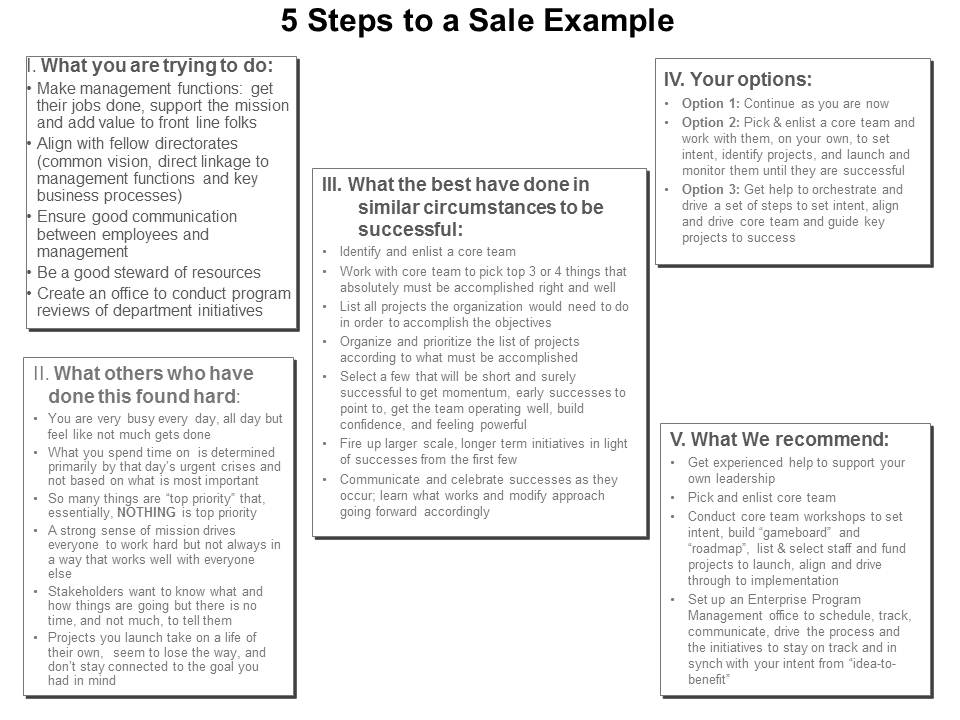
The graphic below presents key points related to each of the five steps in a real example used by a firm that sold program management and governance services to top government agencies.

See Also

Five Steps to a Sale slide presentation

Three Steps to Selling a Services Work Plan

Whose problem is sales

Prospect to Customer Marketing

Ten Steps to Drive Change from the Inside

If you are frustrated by an organization resistant to embracing a change you believe is right, consider using the following steps as a road map to seeing your ideas through to reality:

Get Clear.

Write-up and share your point of view. While what you have in mind may seem clear to you, it likely is not yet to others. Writing about what you want to happen forces you to work out the logical progression of thought and to fill in the details to tell the story in a way others can understand. Share what you write with others to test for clarity and ask for help to make it clearer.

Focus on value.

Emphasize the business value your change would generate in terms others, especially those in positions of authority, can understand and appreciate.

Set the context for change.

Use the change framework to explain how what you have in mind to change exists today, why it needs to change, how it will be in the future, what must be done to get from here to there, and what will be difficult about effecting the change.

Continue reading Ten Steps to Drive Change from the Inside