If a team member performing poorly relative to expectation, the team’s leader should first make sure basic tenets for success have been established using best contracting and governance practices.
As the team’s leader, ensure that you:
Know what the team counts on the team member to do
Believe s/he has the ability do it.
Want him/her to do it.
Validate that s/he:
Knows what the team is counting on him/her to do
Believes s/he has the ability do it.
Wants to do it.
Verify s/he has what is needed for success; including resources (e.g., time, money, space), knowledge, experience, systems, and access to experienced advisors.
Ensure there is sufficient incentive to perform up to expectation.
Provide governance; i.e., every month or so, ask him/her to tell you:
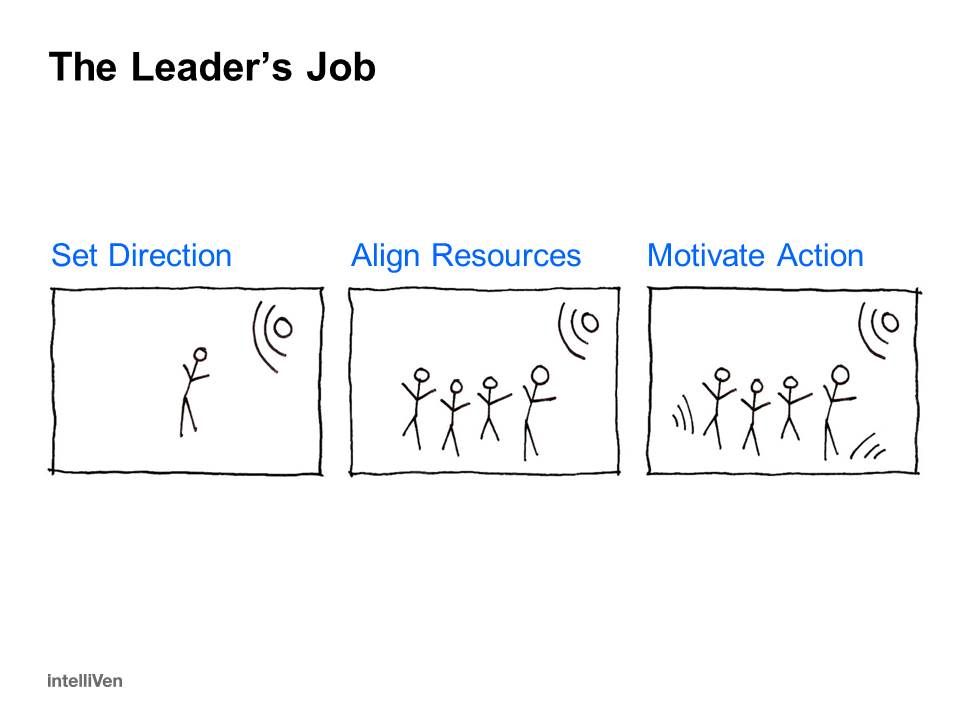
As suggested by the illustration in Figure 1, a leader:
Sets direction represented in the first panel by the target with a bull’s-eye in the middle.
Aligns resources; that is, the leader collects followers who all look to hit the same target.
Motivates action, as suggested by the radio bars in the lower corners of the third figure, which causes the resources to progress towards the target.
Figure 1: A leader sets direction, aligns resources, and motivates action.
Another way to say it, as summarized in Figure 2, is that a leader develops, holds, nurtures, communicates, and drives to achieve a vision. Like Harry Potter’s Marauder’s map, the leader holds a map that is always changing, making sense of it, and navigating the course accordingly with the team looking over his/her shoulder. Continue reading How to decide what kind of leader to be.→
Most people cannot listen until they have been heard. As a consequence, wise leaders who want to affect thinking and behavior learn to first be a great listener to those they aim to impact.
Holding back from jumping-in when a key point comes to mind in the middle of a fast-paced conversation can be a challenge but it is also essential in order to avoid being written-off as one who does not listen or understand, especially if the leader is new to the organization.
The following steps help a leader stay in-tune and attuned and dramatically improve their odds of success:
Pay attention. When someone talks, give undivided attention and do not interrupt. While s/he is talking you may think you know what s/he is going to say and what you want to say next rushes to mind. In that instant you experience an irrepressible urge to interrupt and jump-in. Following the urge causes many bright, successful senior executives to often unintentionally and repeatedly use the power of their position to hijack conversations. The pattern wears on those in the organization and soon the leader is written-off as one who never listens and who does not get, or care about, those s/he leads.
Don’t jump-in. Set thoughts aside in your mind or make a note of what you plan to share when the time comes. Force yourself, instead, to concentrate on precisely what is being said. Do not evaluate what is being said and do not begin to formulate a response. Just listen word-for-word with the objective to repeat back exactly what you heard to be sure you got it right. To force yourself to listen, try to write-down what is being said exactly as you hear it in the moment. Strive to hear and understand each word as well as the overall point being made.
Say what was said. When the speaker stops, ask for permission to repeat back what was heard. Follow with an opening phrase such as: “What I heard you say is:…” and then say back what you heard, word-for-word. When done, ask for confirmation that you heard correctly.
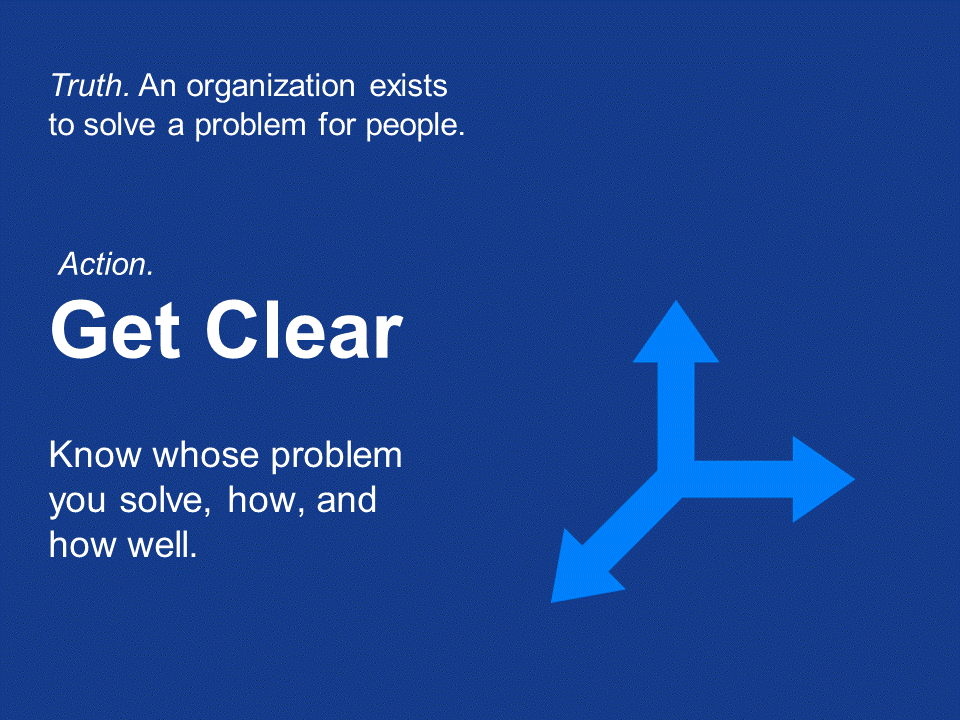
Leaders often struggle to reach a good, a better, or even a best solution to countless such questions. More important than the right answer, though, is all team members having the sameanswer.
Core Leaders who all describe the problem their organization solves for whom in the same way are apt to provide more consistent guidance and direction and so increase the odds of better performance across the board.
To get clear or to test for clarity, invite each Core Leader to:
Collect and consolidate input from each leader. Note points of alignment and departure.
Convene a Core Leadership Group session to share and discuss collected input. Encourage leaders to iterate to a consolidated articulation; possibly over several sessions.
Share consolidated articulation with Management Team.
Edit to reflect refinements based on input from managers.
Review with All Hands in written and stand-up presentations to inform, guide; solicit reaction and collect suggestions for improvement.
Revise as appropriate after review with Core Leaders and Management Team.
Finalize and publish for use in internal and external communications as a constant reminder, and to re-enforce clarity about, what the organization does for whom and why as well as to be clear about what the organization does not do.
Review and revise annually to reflect updated and expanded thinking in the face of experience