Tag Archives: growth

How to use the Change Framework to turn initiatives into action.

If the leader thinks they know what needs to change and that everyone is aligned, ask: “How do you know your team knows what you want to do? It may be a good idea to ask them to verify. If they all say what you expect them to say, a positive step towards getting what you want done will have been taken just by bringing it to the center of their attention. If it turns out that some or all of the team are not as aligned as expected, then remedial steps can be taken.”

Survey the leader’s top team and ask them each:

  • To describe the current state, that is: how things are today.
  • What really good things happen if we change and what really bad things happen if we do not?
  • To describe how things would be in the future if their ideal changes were successfully implemented.
  • What needs to be done in order to get from where things are today to where things would ideally be next?
  • What will make it hard to do what needs to be done in order to get from today to the targeted next state?

Review results with the leader to bring him/her up to speed on the group’s data. Look for and discuss fully any points the leader finds confusing or surprising.

Convene an offsite with the leader and the leadership team to review collected data, reach consensus on each of the five topics, and decide what needs to be done. At the offsite, review survey responses one question at a time in the order above. Highlight responses that are the same or similar thereby indicating progress towards consensus. Guide the group to discuss the data until agreement is reached on how things are today, why things need to change, and how things would be if the desired change had been implemented.

The Change Framework
Use the Change Framework to make the case for each Strategic Initiative.

The Change Framework is a convenient way to visualize and store the group’s consensus using a diagram similar to that originally introduced by Richard Beckhard and Wendy Pritchard in Changing the Essence: The Art of Creating and Leading Fundamental Change in Organizations, Jossey-Bas Inc., San Francisco, 1992.

Fill out the Change Framework to make a clear and compelling case for each initiative.  Iterate with the team until all members are crystal clear about each initiative.

If participants share their thinking openly, fully, and honestly they can go a long way towards achieving clarity and alignment. An effective leader then holds the results of these efforts and furthers their development, communicates progress to stakeholders, and assigns, aligns and drives resources in their pursuit.

Figure-2: Follow the above tips to build a clear and compelling case for the change driven by each initiative.

A well formulated initiative, using the Change Framework, tells a story about where things are, why they need to change, how things would be if the intended change occurred and what must be done to get from here to there. A well crafted change framework is rational, compelling, and flows smoothly from the present through to the future.

Follow the tips in Figure-2 to piece together the context and the story for each of the initiatives the organization must do next to stay on track to long-term growth and performance.
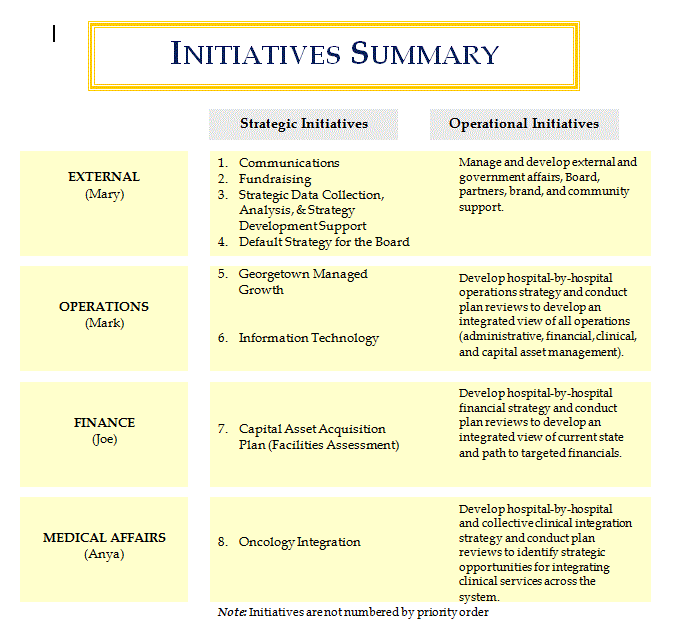
Figure-3: A classic looking list of initiatives from an executive off-site.

Many management offsites produce a list of initiatives, such as shown in Figure-3, after intense effort and exhilarating breakthroughs. A list without context, though, fails to reveal the motivation and importance behind each initiative and so makes it difficult to communicate or to muster the energy, resources, and commitment beyond the session needed to implement them.

Using the Change Framework instead of a simple list helps but even still, far too often, the same initiatives are again listed at the next offsite with little if any progress since last time simply because no one was put in charge and resources never allocated to implement them.

Upon reaching agreement, the group may feel drained but good about what it has accomplished. It is important to make sure the group knows it has done great work and come a long way but there is still more important work to be done. Their effort may be for naught unless one more step is taken.

After the list of initiatives is developed and before ending the session the leader assigns each team member to:

Figure-4: Click on the figure to fill out and submit the Initiative-to-Action form for a Strategic Initiative.


  • Take 20-minutes to fill out an Initiative-to-Action template using the link in Figure-4, for a specific initiative, preferably one the leader would like the team member to sponsor
  • Lead the group in a brief discussion about the assigned initiative.

Each team member, in turn, briefs the group on their initiative using the filled out Initiative-to-Action form. As each speaks, the rest of the leadership team adopts the mindset of close adviser and on the same team as the one speaking. Their objective is to ensure that the key points from the group’s work are captured so that the best thinking of the group is at-hand and in mind as efforts to progress with the initiative proceed on the heels of the session.

Filling out and briefing the Initiative-to-Action form launches the governance process and gets a leadership team member into the role of the initiative’s executive sponsor and on-the-hook to make progress on behalf of the group.  As such the team member becomes accountable to the group for progress on their initiative. Motivation and commitment soar and the odds of making progress go up as well. Over the ensuing performance period, the leader calls on each team member at some point to brief the group on how their initiative is progressing.

Example Change Framework:

Example Change Framework for an organization whose leaders decided to move from a functional to a cross-functional approach to client services.

Four questions an organization needs to ask every performance period in order to perform, learn, and grow to its full potential.

It is impossible to control what you cannot, and what you do not, measure. For every important thing that the organization does, decide what is most important to monitor and then watch carefully to know how things are going.

If what to monitor is not known then:

  • Watch everything and whittle away what turns out to not be useful and keep watching what turns out to be useful.
  • Study similar organizations to learn what they track.
  • Look up industry analysts and market researchers to find out what they watch.

Continue reading Four questions an organization needs to ask every performance period in order to perform, learn, and grow to its full potential.

Growth is Good and Money Matters

Some students preparing to enter the work force and some early-stage professionals launching their career seek lines of pursuit that steer clear of what they believe to be the seamy, cut-throat, greedy world of business.

A course of study in, for example, Organization Development that leads to a career in Human Resources for a non-profit, government, education, or health organization seems like a path in which one might earn a living and have a positive impact on the world while avoiding matters related to money and growth. Even for those in support roles and for organizations not known for profit, however, growth is good and money matters!

Figure 1: Growth is Good

With growth (see Figure-1) an organization that does good can do it on a larger scale and have even greater impact; offer employees opportunities to do new and different things often with greater scope and scale of responsibility and so also at higher levels of compensation; and generate societal lift from the new jobs it creates, Continue reading Growth is Good and Money Matters

How growing organizations should go about adding systems and processes.

One way to think about an organization is in terms of both how good it is at doing what it does, that is its effectiveness, and how mature are its systems and processes for doing what it does.  Figure-1 shows a way to map organizations into a framework that uses both dimensions. Continue reading How growing organizations should go about adding systems and processes.

The next big lift in performance!

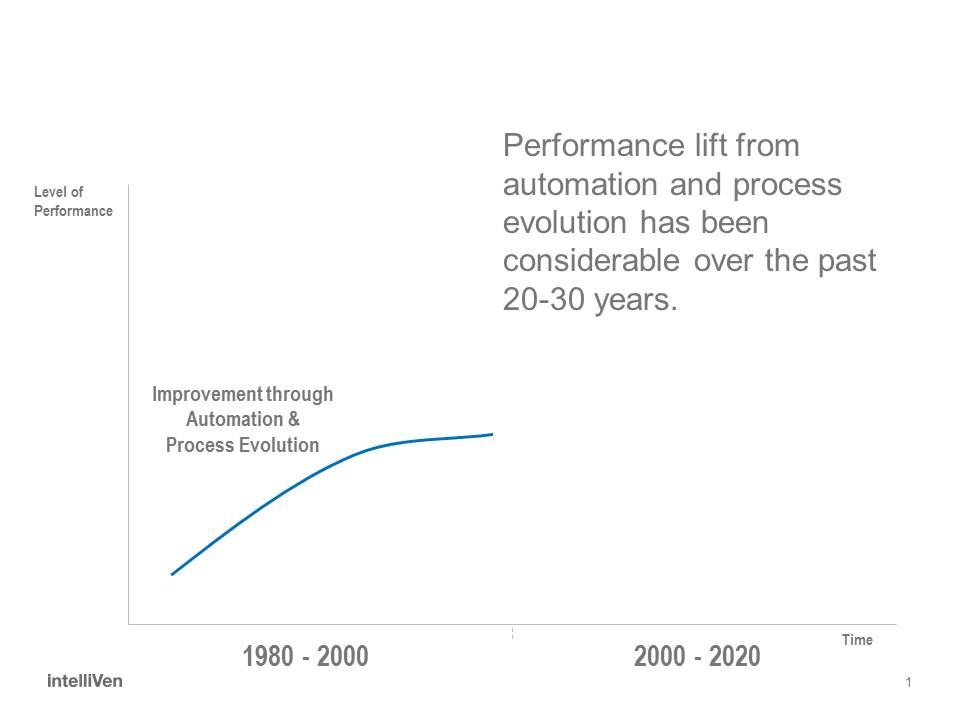
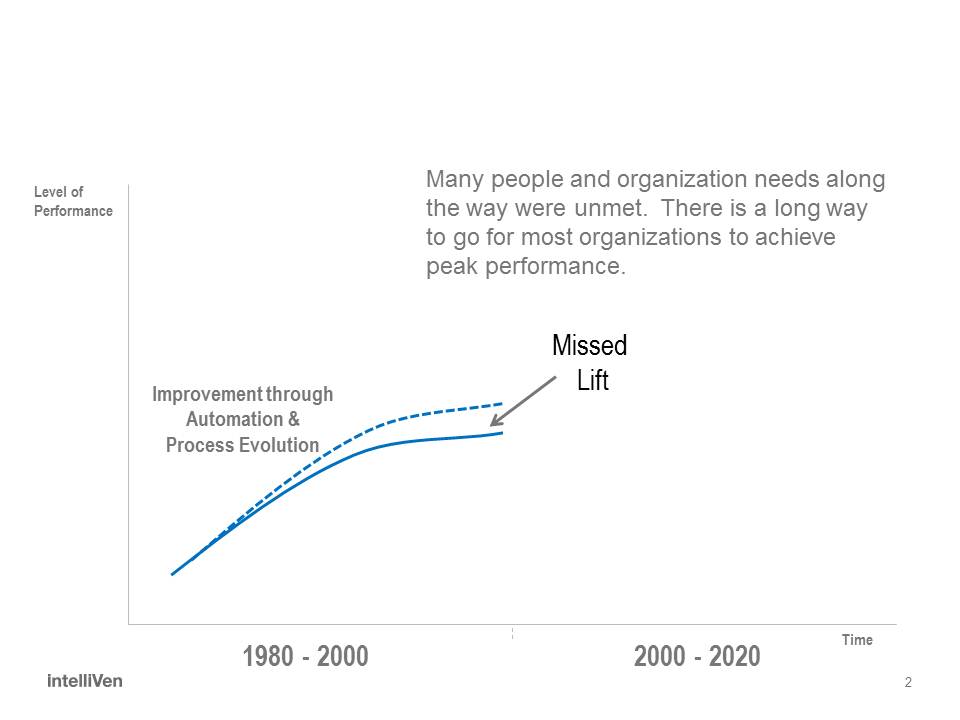
For decades organizations have sought and achieved productivity and performance improvement through information technology and process engineering initiatives. While these efforts streamlined and automated what organizations do to provide services and products, they failed to address many people and organization needs along the way. As a result, we still have a long way to go in order to achieve peak performance as suggested by figures 1 and 2 below.

 Automation and process evolution improve performance
Figure 1: Automation and process evolution improve performance.
There is a long way to go to achieve peak performance
Figure 2: There is a long way to go to achieve peak performance.

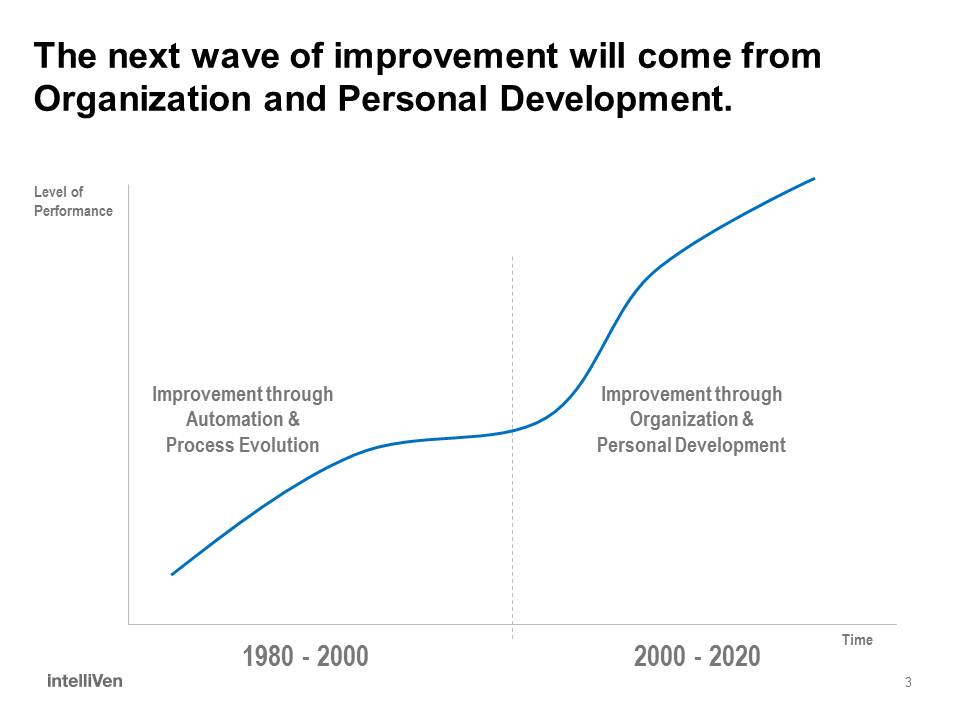
While the next wave of performance improvement may come from augmented reality, artificial intelligence, the internet-of-things, or any number of other things, it can also come, as suggested in figure 3, from enhancing the way people perform as individuals and together in groups, teams, and organization units. Leaders at all levels are challenged to get the most from their organizations and change initiatives by developing each person and their teams to fulfill their potential to perform and grow.

Organization & personal development provide the next wave of improvement
Figure 3: Organization & personal development provide the next wave of improvement.

Unfortunately, the skills to effectively lead this wave are not yet widely known or effectively taught and are difficult to figure out on-the-job even among bright and highly motivated professionals.  These skills can, however, be learned and immediately put to work to improve performance in any organization.

IntelliVen content is rooted in the discipline of Behavioral Science as applied to real-world experiences by pioneering executives and cutting-edge executive coaches in public, private, venture-backed, and private-equity-owned for-profit, not-for-profit organizations.

Leaders and coaches can put the tools, methods, and principles posted on the IntelliVen site into highly effective practice and success in social, public, and commercial sector organizations of all sizes and stages of evolution.

It is hard to interest organization leaders in lifting performance through improved interpersonal dynamics. The reason is that it is harder to grasp than, say, buying a system or changing a business process.

As such it is incumbent upon those who sell and deliver improvement through upgrading behavior, to package and describe offerings in tangible terms. For example, rather than pitching Manage to Lead as tools, methods, and principles that help an organization to achieve its potential to perform and grow, it may be more tangible, and therefore more “buyable” if it is introduced as the Manage to Lead System and delivered in a staged, systematic, deliberate way.

The other key is to sell the benefit delivered, not the process by which it is achieved. For example, following the Manage to Lead System will increase growth rates and improve profit margins. That it does so principally by getting people and teams to work better together is incidental to the final result though it is an extraordinarily efficient way to achieve it.

SEE ALSO

Toolbox

Insights