Tag Archives: strategy

Purpose and Goals: Why You Need Both W-W-W and Mandate

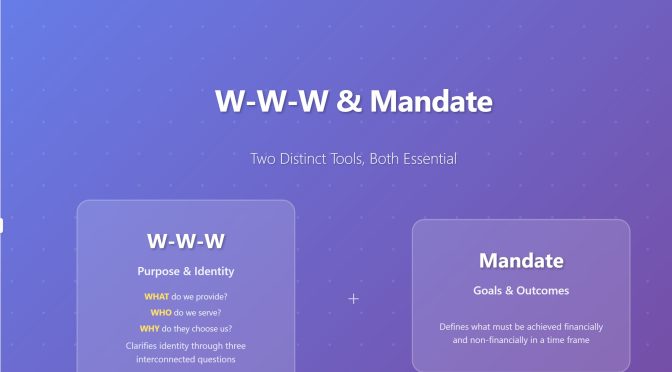
W-W-W and Mandate: Two Distinct Tools, Both Essential

When working on their business, leaders sometimes ask: Which sequence is right?

W-W-W → Mandate

Mandate → W-W-W

Both sequences work. You need to work on both.

W-W-W is about purpose. It clarifies identity by answering three simple but interconnected questions:

  • WHAT do we provide?
  • WHO do we serve?
  • WHY do they choose us?

This is the cornerstone of clarity, rooted in Drucker’s insight that the purpose of a business is to solve a problem for a customer.

The Mandate is about goals. It defines what must be achieved, financially and non-financially, in a time frame. It sets targets, aspirations, and milestones. Where W-W-W establishes identity, Mandate locks in success conditions.

Though related, they require distinct lines of thinking:

  • W-W-W = identity and purpose
  • Mandate = success conditions and commitments

Which comes first? Both sequences work:

  • Mandate first: If you like Covey’s “Begin with the end in mind,” Mandate lays out the outcomes that guide everything else.
  • W-W-W first: Ensures that goals tie back to a clearly expressed purpose.

What matters more is that teams use both. W-W-W brings clarity of purpose. Mandate brings clarity of outcomes. Together, they create a foundation for alignment, prioritization, and growth.

W-W-W and Mandate aren’t one-and-done — they evolve together and become the backbone of the story you tell, tailored to what you need to say and to whom.

So, whether you start with W-W-W or Mandate, don’t stop until you’ve done both. And remember, they aren’t “one and done.” As your organization grows, work on one will often lead you to refine the other. Together, they form the backbone of your storyboard — a foundation you can adapt depending on what you need to say, and to whom.

Put These Ideas Into Practice

In the Manage to Lead (MtL) program, you don’t just study tools like Mandate and WHAT-WHO-WHY, you apply them directly to your own organization. YOUR CASE IS THE COURSE. By working hands-on with proven frameworks, you and your team surface hidden assumptions, sharpen execution, and accelerate performance. Learn more about the MtL program here »

How to Access Manage to Lead System Workstreams and Tutorials

Manage to Lead (MtL) is a system of integrated tools, methods, and principles that executive teams use to pave and follow a reliable path to architect, build, govern, and change their organization for breakthrough improvements in performance and growth.

Users frequently comment on how helpful MtL Tools are when preparing:

  • A Business Plan
  • An Investor Pitch Deck / Management Presentation, Confidential Information Memorandum, Financial Model, and Teaser
  • Website and marketing collateral
  • New board and executive team member indoctrination
  • Strategic Initiatives

Access the Complete MtL System

To make MtL even more useable, you are invited to access the complete MtL System 24/7 for everything you need to apply MtL tools, methods, and principles on your own, including:

  • Ten Workstreams with step-by-step instructions that show how to deploy MtL tools and templates to prepare what your business needs.
  • Additional resources for enriching your use of the tools and templates.

MtL Workstreams and Tutorials

With a valid Username, you can access and apply MtL Tools on your own with the help of MtL System Workstreams and Tutorials accessible from the IntelliVen website menu:

See how MtL Workstreams and Tutorials address everyday business needs in this demonstration.

Next Steps

Contact peterd@intelliven.com to:

  • Arrange a live demo.
  • Activate your subscription for a modest annual fee.

Driving new growth: Don’t assume your team’s skills are right for what’s next

In mountain climbing, reaching a mid-mountain plateau is not as fulfilling as ascending to the summit. Rarely will any climber start out to scale a mountain with the idea of stopping at a plateau below the summit.

But in planning the assault on the mountain, veteran climbers know that different skills and capabilities are needed at each step along the way. The skills that enabled you to reach Base Camp on Mt. Everest – such as the ability to navigate rocky terrain in a relatively oxygen-rich environment – won’t be enough to reach the summit, where climbing in snow and ice with little oxygen is the challenge. 

Your organization faces a similar circumstance. SETD program

The executive leadership skills that got your organization to its current level of success may not be the skills needed to get it to the next stage. 

Reaching a growth plateau

Organizations often hit a “growth pause” – a point at which their current executive leadership’s expertise goals have been realized, revenues and profits plateau, and growth slows or stalls altogether. 

An executive team leading a pre-product startup requires a different set of skills than the knowhow needed to optimize operations for a credible, sustainable, or mature business. At this point, leadership abilities need to be reevaluated to determine what is needed for continued ascendance. 

Organizations must ask themselves several questions: 

  • What mix of skills do we need  to succeed at our current stage and to get ready for the next? 
  • Does our team have the mix of skills needed? 
  • Will gaps in executive team skills hamper growth? 
  • Can our team’s skill set be developed or enhanced for success now, such as through hiring or culling, and to get ready for the next stage? 

In almost every case, the right mix of leadership team skills can address stalled growth and get you back on track. Earlier needed skills may no longer be helping, and necessary new skills may be missing. Or, the skill development strategy may need to be overhauled. 

Assessing the pause cause

IntelliVen has constructed a one-of-a-kind, tailored, thorough and immersive program to provide answers and solutions to these questions and more. 

The Strategic Executive Team Development Program provides a leader and team with unique insight into the needed skill sets at each stage of an organization’s development, based on 24,000 data points gathered over decades of research

The program approach is  rooted in an extensive study of the best mix of skills in executive leadership for each stage of organization maturity, from pre-market concept to mature going concern. 

IntelliVen Principal consultant Dr. Brent Green and the IntelliVen team offer a unique executive team skills assessment and gap analysis. This offering pinpoints the capabilities needed to spark new growth for your organization by assessing your team’s skills, then comparing them to your organization’s benchmark stage. 

Assessments are conducted using data collected in one-on-one sessions with the CEO, and confidential interviews and electronic surveys with each team member. Insights and recommendations are shared with the CEO ahead of interactive, facilitated sessions that explore results and implications with the team. 

Unblocking growth

The process reveals executive team members’ individual and collective proficiencies in a mix of nine competencies across three categories: 

  • Knowledge of industry, technology and organizational capabilities
  • Ability to analyze and synthesize what they know
  • Planning and execution. 

We refer to the three areas as KNOW, THINK, and ACT.

The results reveal deficiencies in skills that likely block growth and hinder the evolution of the organization to the next stage.

Most importantly, the program offers custom executive team development action plans, for each team member and for the team as a whole, that address gaps and opportunities for development specific to your venture and team, help them evolve, rekindle growth, and put them back on a “hockey stick” growth curve.

Based on the IntelliVen Manage to Lead System, the action plans align your team members and focus them on evolving the business to address performance and growth blockers.

The MtL tools, templates, and methods are taught in an Immersion Program that is unique in that it is team-based leadership development that captures proven best practices for driving change as applied to your organization’s case.

MtL distills the lessons of a team of highly successful leaders over decades into a clear and concise series of modules and accompanying tools. Elements of it have been taught at MIT, Stanford, University of Maryland, George Mason University, Golden Gate University, and the University of Massachusetts at Amherst.

Learn more about the new program here:  Strategic Executive Team Development Program 

Get Clear

The purpose of a business is to solve a problem for a customer…which begs this question:

WHAT solution does your organization provide to

WHO and

WHY do they pay for it?

A way to think about it is that there are three dimensions to any business: WHAT, WHO, and WHY or in terms of Market (WHO), Problem (WHY), and Solution (WHAT).


Leaders tend to describe their organization in terms of one or two, but rarely all three, dimensions. The reason may be because thinking about  any three things at the same time challenges the mind. If anyone does think three completely different things all at once, it is hard to do it for any length of time.

The 2:56′ video above uses the graphic below to present a way to visualize an organization in terms of the problem it solves (or WHY anyone needs what the organization provides), for WHO (market), and with Continue reading Get Clear

How to develop leaders, teams, and organizations that perform to their potential.

If you’ve been in charge for a while and it feels like performance and growth are not where you want them to be, you probably know that you are likely headed in the wrong direction.

Every leader, team, and organization eventually hits an inflection point. There IS a solution.

The first step is to take stock of how things are going, why things need to change, and how they would be if things were going well.

A management offsite is an excellent way to engage the top team along these lines. However, to prepare for and facilitate a high-powered executive offsite takes careful planning, data collection, analysis, and design effort.

Approach

Most leaders find it difficult to adequately prepare—assuming they even know how—for their offsite. Further, it is nearly impossible for a leader to facilitate and participate in, let alone also lead, their own offsite. A better strategy is to hire experts who use proven approaches, tools, and methods to prepare and facilitate.

Continue reading How to develop leaders, teams, and organizations that perform to their potential.