Leaders often say:
- “We don’t have enough time.”
- “We’re far from our goals.”
- “Everything feels urgent.”
Most of the time, the issue is not time.
It is a mismatch between the decision and the planning horizon.
Manage to Lead is built on clarity and disciplined change. Time horizon discipline is part of that clarity.
Different Decisions Require Different Clocks
Not every decision should run on the same timeline.
When leaders use one clock for everything, they either:
- Overreact in the short term, or
- Drift in the long term.
High-performing organizations operate with multiple time horizons.
Each clock answers a different question:
- Where are we going?
- How will we win over this bounded period?
- What must change next?
- Are we doing what we said we would do?
If those questions collapse into one timeframe, confusion follows.
If they contradict one another, stress follows.
If they are coherent and nested, focus follows.
The Mandate Horizon Is Contextual
The Mandate answers:
What are we trying to accomplish, by when?
There is no universal duration.
A Mandate horizon should be:
- Long enough to require real capability building.
- Short enough that the current leadership team owns the outcome.
- Explicitly bounded so capital allocation decisions can be evaluated against it.
For many organizations, that is about three years.
For some, it is shorter.
For others, longer.
Three years is common because it is often long enough to require meaningful change and short enough to sustain accountability. But it is not doctrine.
The discipline is not in picking “three.”
The discipline is in making the horizon explicit and holding it steady long enough for strategy and investment decisions to compound.
Multiple Clocks Must Be Coherent
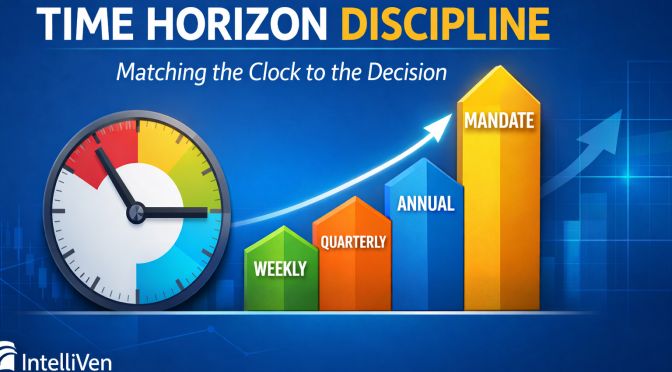
One common architecture looks like this:
- Mandate horizon → Defines destination
- Strategy horizon → Defines directional choices
- Initiative horizon → Defines staged change
- Management horizon → Ensures execution discipline
For many organizations, that might roughly translate into:
- Multi-year Mandate
- Annual strategy framing
- Quarterly initiatives
- Monthly management cadence
But this is an example, not a rule.
- Different organizations legitimately design different clock speeds.
- What matters is not the exact durations.
- What matters is coherence across them.
Match Capital Commitment with Time Horizon
The longer capital is tied up, the longer the planning lens must be.
Examples:
- Hiring a senior executive → Mandate lens
- Entering a new vertical → Mandate lens
- Building a new sales discipline → Initiative lens
- Running a marketing experiment → Management lens
Short-horizon thinking applied to long-horizon commitments produces fear and underinvestment.
Long-horizon thinking applied to short-cycle execution produces drift and lack of accountability.
Match the clock to the decision.
NOW and NEXT Must Be Far Enough Apart
In the Change Framework:
NOW → WHY → NEXT → WHAT MUST BE DONE → BARRIERS
NEXT must relieve the constraints of NOW.
If NEXT is too close:
- You get incremental improvement.
- The system remains fundamentally unchanged.
If NEXT is too far:
- It becomes aspirational.
- The team cannot see the path.
A disciplined principle:
Choose a future state far enough out that you can think beyond current constraints, but close enough that the current leadership team is accountable for reaching it.
That balance creates energy without fantasy.
Why Leaders Feel “Short on Time”
When leaders say they are short on time, often one of three things is happening:
- The Mandate horizon is unclear.
- Too many initiatives are competing at once.
- The management clock is crowding out strategic thinking.
Clarity of horizon reduces emotional noise.
When the Mandate is explicit and bounded, urgency becomes focus rather than pressure.
Bottom Line
- Time is not the problem.
- Unbounded thinking is the problem.
- Use multiple clocks.
- Make each explicit.
- Ensure they are coherent.
Let the longer horizon guide capital allocation.
Let staged initiatives translate direction into change.
Let disciplined review reinforce commitments rather than override them.
Get Clear. Align. Grow.