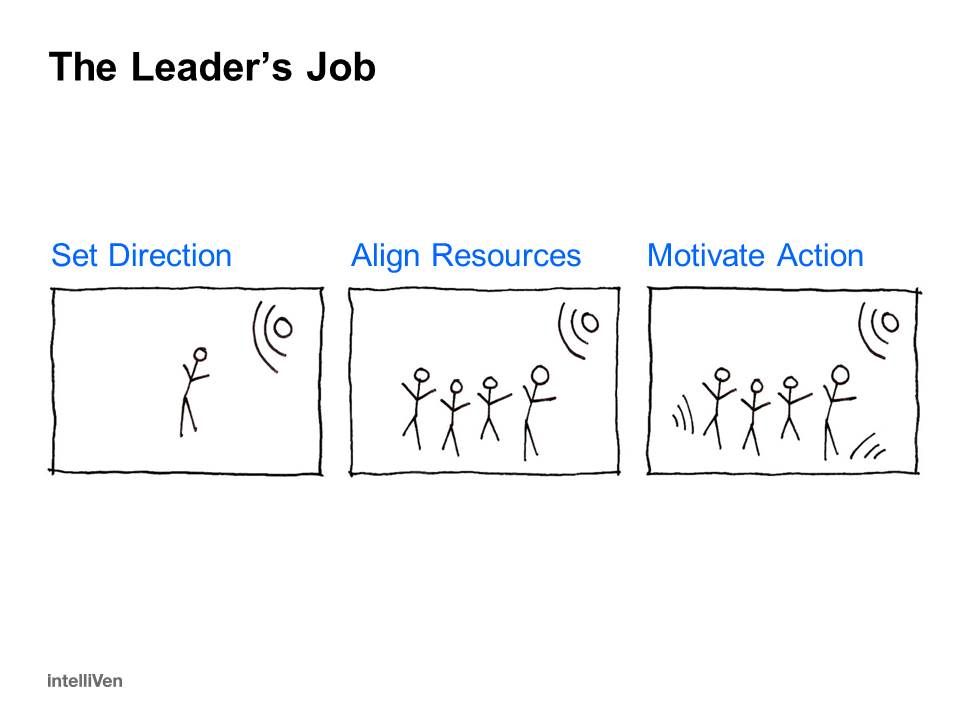
Leaders set direction, align resources, and motivate action as suggested by the panels in Figure 1. Another way to put it is that a leader develops, holds, nurtures, communicates, and drives to achieve a vision.
Figure 1: A leader sets direction, aligns resources, and motivates action.
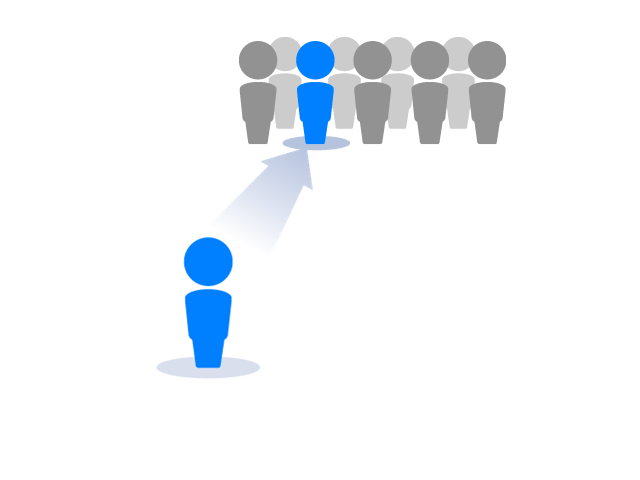
As in Figure 2, it helps to think of the leader holding a map, like Harry Potter’s Marauder’s map that is always changing, making sense of it, and navigating the course with those led looking on over the shoulders. The best leaders constantly check with their top team to confirm that they are headed toward the same goals, in the same way, and for the same reasons.
Figure 2: A leader develops, holds, nurtures, communicates, and drives to achieve a vision.
We wrote a post about how to make a graceful exit (especially when it’s involuntary) that explored what steps to take when leaving your position. This post is the follow-up that dives into how to identify, assess, and consolidate lessons learned to find the right next job. We’ll explore three key steps to a successful transition plan for CEOs.
After reviewing the draft news release announcing my latest promotion (many years back) and offering her congratulations, our press agent exclaimed with some dismay that: “…now you’ll have even LESS time than ever!”
I remember remarking smartly in reply that she was wrong,and that I still had just as much time as I’d always had. In fact, I had the same amount of time each day that both Da Vinci and Einstein had, and that my job, same as ever, was to make the most of it!
Of all the things that top CEOs and leaders do well, managing their time is the most hailed productivity hack there is. How is it possible that those with the greatest demands on their time are so productive when so many are not?
Top CEOs and leaders all have one thing in common: they manage their own time well. And, doing so is no easy feat.
Every CEO has an especially full plate, including the responsibility to:
Set direction
Build, align, develop, and motivate the leadership team
Model target culture
Amass, manage, and deploy organization resources for optimum performance
Find and develop opportunities for improvements in performance and growth
Decide what is most important to do differently next
Communicate plans, progress, and status with stakeholders
We all have 24 hours each and every day. How we spend it depends on whether we are Interrupt-Driven or Self-Driven.
Interrupt-Driven leaders are reactive. They allow their attention to be directed or stolen away by whatever comes along. They simply react to one input stimuli after another, permitting their energy to be diverted by the next call, text, email, tweet, knock at the door, etc.
This explains why some leaders constantly feel overwhelmed by their workload, spend their days in crisis-du-jour, and complain that they do not have enough time in the day. By the end of an interrupt-driven day, of course you feel exhausted! With infinitely active input sources there is never a chance you’ll have nothing to do, but there’s a high likelihood that you won’t get anything important done.
Self-Driven leaders, in comparison, are proactive. They determine the most important things to do next, decide which to do when, and do them! They acknowledge external stimuli, but don’t allow them to determine their actions. Self-Driven behavior requires conscious effort and, so, is harder to pursue than Interrupt-Driven, because it requires you to consistently manage your environment, priority list, and (especially) yourself to decide what to do next. But without this important distinction, your day is entirely decided by whatever comes up and not by you.
The first thing a good leader learns is how to manage him/herself, the focus of my book Manage to Lead, and the only way to manage oneself productively is through Self-Driven behavior. This is why Self-Driven CEOs and leaders are in control of themselves, and get an incredible amount of work done as a result. While working with and studying highly effective CEOs for over 35⁺ years, I’ve collected the best time management tips that really make a difference.
1 | Assess
If time management is a problem for you or your team, start by tracking where time is spent. Effective leaders pay attention to how their time is allocated, with whom, the amount of time, and the results of that time investment. With this data, you can assess and diagnose what’s working and what’s not to take appropriate actions that treat the cause, not just the symptoms.
2 | Prioritize
Most leaders don’t use a to-do list. Instead, they’re clear and intentional about their overall goals. With those goals in mind, they set three non-negotiable “must-dos”, big rocks, or 3-Wins for each day.
Every action and activity they spend time on throughout the day is in pursuit of the 3-Wins. By replacing an ever-growing to-do list with just 3-Wins per day, you’ll be more productive and accomplish your big goals faster.
3 | Take Care of Yourself First
The rise in the self-care movement is popular for good reason: there’s value in creating time for personal well-being. CEOs, especially, have all-consuming responsibilities and often work weekends and holidays.
Which is why most leaders carve out time to exercise, get a good night’s sleep, and spend time with friends and family. They use this time to refuel themselves, so they can attack their work with fresh minds.
4 | Eliminate Time Wasters
With a time audit under your belt, you’ll find current activities that don’t further your goals. CEOs and leaders are ruthless with their time; once they identify time-wasting activities, they cut them out immediately, allowing that time to be better used for priority items.
The most popular time-wasters will vary based on your industry and personality, but most leaders inevitably cut out (or down) on email, social media, and repetitive tasks that can be easily automated, shortened, or assigned to others.
5 | Time-block
Schedule blocking is a great way to intentionally design an ideal week. When you schedule blocks of time for specific activities, such as processing emails, making phone calls, or even just thinking, you reduce the amount of time spent on non-essential, yet necessary activities.
Time-blocking helps leaders limit time on social media, for example, by setting a time limit per day. Likewise, CEOs can read, organize and respond to emails during a bulk time block, effectively reducing the overall amount of time spent in email limbo.
6 | Use an App
The number of time management apps and systems available at the click of a button is astounding, making it easier than ever to implement a new process. Systems like the Pomodoro Method help leaders schedule breaks, allowing them to refresh their minds before diving back into important tasks that take a long time and a lot of concentration.
7 | Schedule Batch
CEOs are most commonly found in meetings. A Harvard study found that 72% of total CEO work time is in meetings. Given the amount of time required to context-switch between an investor call and an internal meeting, schedule batching can save a tremendous amount of time.
By batching all of your internal meetings on one day and external meetings on another, you can reduce the time needed for context switching. Likewise, batching all of your phone calls into a single time-block can save hours. Leaders can work more efficiently to solve problems or ideate with their teams.
8 | Develop Routines
Leaders are notorious for their infamous morning and evening routines. As they should be! Routines help to prepare us for the week and jumpstart our day. Top CEOs use this time to set intentions for the day, spend time on personal well-being, and create their 3-Wins.
Your routine can consist of anything you like and works best when the activities help to prepare your mindset and energize you for what’s ahead.
9 | Delegate Everything
A CEO’s responsibilities are vast, working with both the internal operations teams and external stakeholders including customers, partners, investors, and media. When asked how they do it all, inevitably the answer is always some form of ”I don’t.”
CEOs delegate heavily to their reporting directors and managers, especially when it comes to routine tasks. And when that’s not possible, they bring in outside help to tackle the workload.
10 | Say “No”
Because leaders have clearly identified their overarching goals along with their daily 3-Wins, they say “no” a lot. With so many demands on their time, it’s simply not feasible to accept invitations or opportunities that don’t align with their top priorities.
A polite, but firm “no” reinforces a proactive time management approach versus a reactive one. And when the opportunity is aligned with your priorities, you’ll have the available calendar space (from all of those “no”s) to dedicate time to it.
11 | Create Systems
Every organization does three things. It does what it does, it creates demand for what it does, and it grows; or DO-SELL-GROW. The key to success is not to “make pizza”; it’s to “build a pizza making business!” Cultivating a company culture, creating demand, delighting customers, and inspiring a growing team all at once is no easy trick.
Effective time management is just one tool in the toolbelt to becoming a better leader. The leaders who learn to harness that time by taking action are the ones who grow their organizations faster and perform better.
Related Points
Having too many things to do gives a great excuse for not being successful at any particular thing. Top CEOs ensure their leadership team is responsible for one important thing at a time.
Being productive and authentic isn’t mutually exclusive. Great leaders know they can show up as themselves and be effective; it’s just a matter of acting intentionally and persisting variously.
Being busy and being productive are two very different things; the former can lead to Hero’s Complex. Self-Driven leaders measure their success with metrics and evidence.
Time management is just one aspect of managing to be a better leader.
Are you interested in learning even more about how to manage yourself to be a better leader?
Watch the video below about the IntelliVen Manage to Lead Immersion Program or head to the Program’s landing page to learn how to become a better leader.
Every leader stands to benefit from the opportunity to meet monthly in a professionally facilitated session with about a dozen non-competitive peers who are in similar roles, in similar organizations, and at a similar stage of evolution.
Leaders who make the one decision to join, as long as they show up, get six distinct benefits that are hard to achieve any other way:
Leaders can be genuinely open to input and be vulnerable, even wrong, in front of each other; no need to put on airs or skirt around the hard stuff.
Peers really know and understand each other, personally and professionally, and the challenges each faces in meeting associated goals; feelings of loneliness and depression are less common among participants.
IntelliVen is pleased to announce that Richard Franzi will interview Peter DiGiammarino, CEO of IntelliVen, live on his Critical Mass for Business Radio Show on Tuesday, October 14, 2014 at 4:00 Pacific time. Peter will be the show’s featured guest and will talk about his book Manage to Lead: Seven Truths to Help You Change the World.
As a leader who has served successful companies in the role of CEO, Peter knows how to develop and lead teams of high-powered, driven professionals. His emphasis is to create and implement plans that are true to the organization’s market, offerings, competence, and purpose. Today, as CEO of IntelliVen, Peter and his team help middle market companies achieve their full potential to perform and grow.
On Critical Mass for Business, Peter will talk about the seven truths every leader must acknowledge and wrap into his or her life. These truths emerged in a career that spans business, not-for-profits, government, and academia – and Peter will talk about how they can make the difference between success and failure.
About Critical Mass Radio Show
Critical Mass for Business Radio Show airs three times a week on radio station OCTalkRadio.net Richard hosts the popular internet-based business talk radio focused on topics of interest to CEOs running middle market firms across North America. Critical Mass for Business Radio Show is available on iTunes, Stitcher.com and www.ceopeergroups.podbean.com. Learn more at www.CriticalMassforBusiness.com.