There are many ways to provide value to leaders who seek to turn ideas into benefits. Leaders of services firms need to get and stay clear about how they help leaders in order to perform and grow to their full potential.
Click the figure below to view a presentation on how to think about helping leaders turn ideas into benefits.
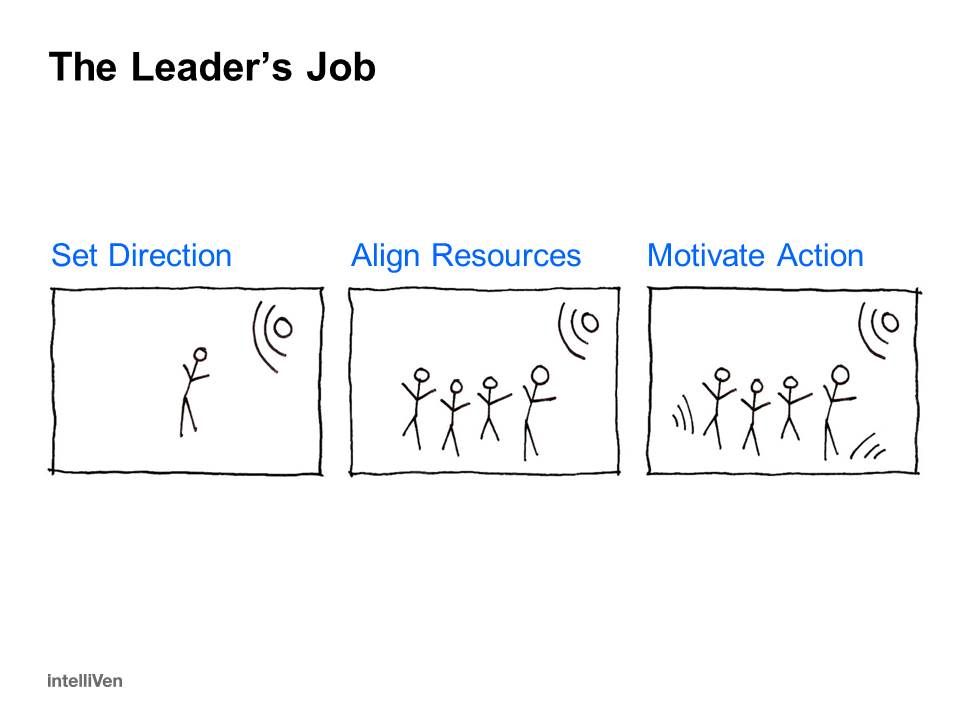
As suggested by the illustration in Figure 1, a leader:
Sets direction represented in the first panel by the target with a bull’s-eye in the middle.
Aligns resources; that is, the leader collects followers who all look to hit the same target.
Motivates action, as suggested by the radio bars in the lower corners of the third figure, which causes the resources to progress towards the target.
Figure 1: A leader sets direction, aligns resources, and motivates action.
Another way to say it, as summarized in Figure 2, is that a leader develops, holds, nurtures, communicates, and drives to achieve a vision. Like Harry Potter’s Marauder’s map, the leader holds a map that is always changing, making sense of it, and navigating the course accordingly with the team looking over his/her shoulder. Continue reading How to decide what kind of leader to be.→
Most people cannot listen until they have been heard. As a consequence, wise leaders who want to affect thinking and behavior learn to first be a great listener to those they aim to impact.
Holding back from jumping-in when a key point comes to mind in the middle of a fast-paced conversation can be a challenge but it is also essential in order to avoid being written-off as one who does not listen or understand, especially if the leader is new to the organization.
The following steps help a leader stay in-tune and attuned and dramatically improve their odds of success:
Pay attention. When someone talks, give undivided attention and do not interrupt. While s/he is talking you may think you know what s/he is going to say and what you want to say next rushes to mind. In that instant you experience an irrepressible urge to interrupt and jump-in. Following the urge causes many bright, successful senior executives to often unintentionally and repeatedly use the power of their position to hijack conversations. The pattern wears on those in the organization and soon the leader is written-off as one who never listens and who does not get, or care about, those s/he leads.
Don’t jump-in. Set thoughts aside in your mind or make a note of what you plan to share when the time comes. Force yourself, instead, to concentrate on precisely what is being said. Do not evaluate what is being said and do not begin to formulate a response. Just listen word-for-word with the objective to repeat back exactly what you heard to be sure you got it right. To force yourself to listen, try to write-down what is being said exactly as you hear it in the moment. Strive to hear and understand each word as well as the overall point being made.
Say what was said. When the speaker stops, ask for permission to repeat back what was heard. Follow with an opening phrase such as: “What I heard you say is:…” and then say back what you heard, word-for-word. When done, ask for confirmation that you heard correctly.
Leaders often struggle to reach a good, a better, or even a best solution to countless such questions. More important than the right answer, though, is all team members having the sameanswer.
Many intelliven.com blog posts are based on the slides and lecture notes from a masters class in Organization Development called Organization Analysis and Strategy offered at American University and taught by Peter DiGiammarino. These posts and other material from class, including:
Work problems,
Templates,
Graphics,
Slide shows, and
Assessments
are available from Amazon as a softcover workbook or from iTunes as an iBook titledManage to Lead: Seven Truths to Help You Change the World.
Selected intelliven.com blog content is now available as a workbook from Amazon or as an iBook from iTunes.
Whether one wants to change personal habits, implement a new information system, improve a business process, get team members to work together, increase a community’s appreciation for diversity, or even to topple a monarchy, taking seven actions driven by seven disarmingly simple truths will individually and collectively help achieve the goal.
Manage to Lead presents a framework to describe and assess any organization. It also provides a structured approach to plan and implement next steps for an organization as it strives for long-term growth and performance.
Readers are invited to select a familiar organization on which to apply the tools and templates introduced throughout the workbook. Exercises in each chapter produce essential elements for the organization’s annual strategic plan and lay the groundwork for implementing that plan.
Readers can package the key elements from Organization Exercises to form a strategic plan that communicates how the organization sees itself and where it is headed. At the end of the year leaders can compare actual results with what was described in the strategic plan to study what happened, why what happened was different than plan, what is to be learned from that, and what to do differently going forward as a result.
Repeat the process over several years and compare actual to planned results year-to-year to see the organization mature, perform, and grow to its full potential.