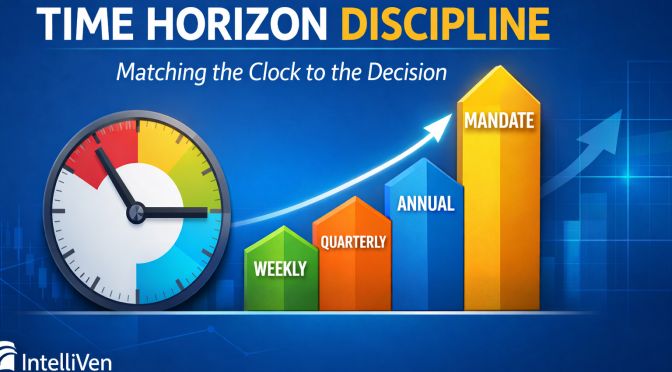
It is a mismatch between the decision and the planning horizon.
Manage to Lead is built on clarity and disciplined change. Time horizon discipline is part of that clarity.
Different Decisions Require Different Clocks
Not every decision should run on the same timeline.
When leaders use one clock for everything, they either:
Overreact in the short term, or
Drift in the long term.
High-performing organizations operate with multiple time horizons.
Each clock answers a different question:
Where are we going?
How will we win over this bounded period?
What must change next?
Are we doing what we said we would do?
If those questions collapse into one timeframe, confusion follows.
If they contradict one another, stress follows.
If they are coherent and nested, focus follows.
The Mandate Horizon Is Contextual
The Mandate answers:
What are we trying to accomplish, by when?
There is no universal duration.
A Mandate horizon should be:
Long enough to require real capability building.
Short enough that the current leadership team owns the outcome.
Explicitly bounded so capital allocation decisions can be evaluated against it.
For many organizations, that is about three years.
For some, it is shorter.
For others, longer.
Three years is common because it is often long enough to require meaningful change and short enough to sustain accountability. But it is not doctrine.
The discipline is not in picking “three.”
The discipline is in making the horizon explicit and holding it steady long enough for strategy and investment decisions to compound.
Multiple Clocks Must Be Coherent
One common architecture looks like this:
Mandate horizon → Defines destination
Strategy horizon → Defines directional choices
Initiative horizon → Defines staged change
Management horizon → Ensures execution discipline
For many organizations, that might roughly translate into:
Multi-year Mandate
Annual strategy framing
Quarterly initiatives
Monthly management cadence
But this is an example, not a rule.
Different organizations legitimately design different clock speeds.
What matters is not the exact durations.
What matters is coherence across them.
Match Capital Commitment with Time Horizon
The longer capital is tied up, the longer the planning lens must be.
Examples:
Hiring a senior executive → Mandate lens
Entering a new vertical → Mandate lens
Building a new sales discipline → Initiative lens
Running a marketing experiment → Management lens
Short-horizon thinking applied to long-horizon commitments produces fear and underinvestment.
Long-horizon thinking applied to short-cycle execution produces drift and lack of accountability.
Match the clock to the decision.
NOW and NEXT Must Be Far Enough Apart
In the Change Framework:
NOW → WHY → NEXT → WHAT MUST BE DONE → BARRIERS
NEXT must relieve the constraints of NOW.
If NEXT is too close:
You get incremental improvement.
The system remains fundamentally unchanged.
If NEXT is too far:
It becomes aspirational.
The team cannot see the path.
A disciplined principle:
Choose a future state far enough out that you can think beyond current constraints, but close enough that the current leadership team is accountable for reaching it.
That balance creates energy without fantasy.
Why Leaders Feel “Short on Time”
When leaders say they are short on time, often one of three things is happening:
The Mandate horizon is unclear.
Too many initiatives are competing at once.
The management clock is crowding out strategic thinking.
Clarity of horizon reduces emotional noise.
When the Mandate is explicit and bounded, urgency becomes focus rather than pressure.
Bottom Line
Time is not the problem.
Unbounded thinking is the problem.
Use multiple clocks.
Make each explicit.
Ensure they are coherent.
Let the longer horizon guide capital allocation.
Let staged initiatives translate direction into change.
Let disciplined review reinforce commitments rather than override them.
Note: A complementary reading for MtL Module 8 Get Help
Leaders who “get help” know success comes not from going it alone but from surrounding themselves with structures that strengthen thinking, accountability, and action. In Manage to Lead, we emphasize the value of an Accountability Board, Advisory Board, Coach, and Peer Group.
There is another form of outside help that deserves equal attention, especially for initiatives that affect customers, partners, or community stakeholders: the Steering Committee.
What a Steering Committee Is
A steering committee brings together stakeholders who represent the organizations, communities, or customer segments that will be most directly affected by what your organization or initiative produces. Unlike an advisory board, which offers expertise, or a governing board, which ensures accountability, a steering committee co-creates success by helping shape priorities, decisions, and outcomes.
Why Steering Committees Matter
They give leaders direct access to the voices of those who will live with the results of decisions.
Members often have decision-making authority and access to resources within their own organizations, allowing them to influence adoption, funding, and partnership.
They help leaders anticipate resistance, discover alignment opportunities, and stay connected to real-world needs.
When members see that their guidance has been heard and acted upon, they become even more committed to the success of the effort—often becoming early adopters, users, and buyers of what is produced.
How Steering Committees Add Value
Guidance and Direction: Members provide grounded input, helping leaders avoid blind spots and adjust course before costly mistakes occur.
Legitimacy and Endorsement: Their involvement signals credibility to others in the ecosystem.
Acceleration: Members help open doors, clear obstacles, and facilitate decisions that move implementation faster.
Sustained Alignment: Regular engagement ensures the organization’s goals stay relevant to stakeholder priorities and that everyone is working from a shared picture of success.
How to Form and Manage One
Identify six to ten individuals who represent the key stakeholder groups your initiative depends on.
Be explicit that their role is to advise and connect, not to manage day-to-day execution.
Meet quarterly or at major decision points with focused materials and specific questions.
Listen deeply. Summarize and report back on how their input has influenced what you do next—this simple feedback loop builds extraordinary trust and advocacy.
Keep the tone collegial, practical, and forward-looking. Participation should feel rewarding and consequential.
How It Fits in the Leader’s Support Structure
Adding a steering committee complements the existing support framework:
Accountability Board: Keeps leadership focused on plans, performance, and resources.
Advisory Board: Provides wisdom from experienced operators.
Coach: Strengthens the leader’s use of self and interpersonal effectiveness.
Peer Group: Offers perspective, learning, and accountability from equals.
Steering Committee: Connects leadership directly to those who will benefit from, and champion, the organization’s results.
The Payoff
When stakeholders see their fingerprints in your output, they work harder to make it succeed. Their ownership translates into faster adoption, greater influence, and more sustainable results. A well-run steering committee transforms external stakeholders into allies, advocates, and extensions of your leadership team.
Call to Action
As you design your leadership support structure, ask:
“Who outside the organization has the most to gain from our success… and how can we bring them inside the tent?”
Form your steering committee early, engage them often, and show them how their voices shape your outcomes. You will multiply your leadership capacity and set your organization up for enduring success.
Keep Growing with Manage to Lead
Steering committees are one of many ways leaders can expand their impact by bringing others into the process of thinking, managing, and acting strategically. If this approach resonates with you, explore how the Manage to Lead (MtL) System helps organizations like yours:
• Get clear about purpose and priorities. • Align leadership teams and stakeholders. • Drive change that sustains performance and growth.
Visit intelliven.com to learn more about the Manage to Lead framework, download tools, or join an upcoming session to practice applying MtL methods to your organization’s real-world challenges.
Every leader eventually finds they have a toxic executive team member who behaves poorly, spreads discontent, or otherwise goes off track and holds the core leadership team, and the organization, hostage indefinitely.
As the leader, it is up to you to do something, but you avoid confronting the offender perhaps because you are averse to conflict or perhaps s/he is a longtime friend, co-founder, or even a family member. Instead, you hope things will work themselves out, but they never do; things just get worse.
Do you give up, let the organization wallow forever, or act? Such a dilemma!
We wrote a post about how to make a graceful exit (especially when it’s involuntary) that explored what steps to take when leaving your position. This post is the follow-up that dives into how to identify, assess, and consolidate lessons learned to find the right next job. We’ll explore three key steps to a successful transition plan for CEOs.
After reviewing the draft news release announcing my latest promotion (many years back) and offering her congratulations, our press agent exclaimed with some dismay that: “…now you’ll have even LESS time than ever!”
I remember remarking smartly in reply that she was wrong,and that I still had just as much time as I’d always had. In fact, I had the same amount of time each day that both Da Vinci and Einstein had, and that my job, same as ever, was to make the most of it!
Of all the things that top CEOs and leaders do well, managing their time is the most hailed productivity hack there is. How is it possible that those with the greatest demands on their time are so productive when so many are not?
Top CEOs and leaders all have one thing in common: they manage their own time well. And, doing so is no easy feat.
Every CEO has an especially full plate, including the responsibility to:
Set direction
Build, align, develop, and motivate the leadership team
Model target culture
Amass, manage, and deploy organization resources for optimum performance
Find and develop opportunities for improvements in performance and growth
Decide what is most important to do differently next
Communicate plans, progress, and status with stakeholders
We all have 24 hours each and every day. How we spend it depends on whether we are Interrupt-Driven or Self-Driven.
Interrupt-Driven leaders are reactive. They allow their attention to be directed or stolen away by whatever comes along. They simply react to one input stimuli after another, permitting their energy to be diverted by the next call, text, email, tweet, knock at the door, etc.
This explains why some leaders constantly feel overwhelmed by their workload, spend their days in crisis-du-jour, and complain that they do not have enough time in the day. By the end of an interrupt-driven day, of course you feel exhausted! With infinitely active input sources there is never a chance you’ll have nothing to do, but there’s a high likelihood that you won’t get anything important done.
Self-Driven leaders, in comparison, are proactive. They determine the most important things to do next, decide which to do when, and do them! They acknowledge external stimuli, but don’t allow them to determine their actions. Self-Driven behavior requires conscious effort and, so, is harder to pursue than Interrupt-Driven, because it requires you to consistently manage your environment, priority list, and (especially) yourself to decide what to do next. But without this important distinction, your day is entirely decided by whatever comes up and not by you.
The first thing a good leader learns is how to manage him/herself, the focus of my book Manage to Lead, and the only way to manage oneself productively is through Self-Driven behavior. This is why Self-Driven CEOs and leaders are in control of themselves, and get an incredible amount of work done as a result. While working with and studying highly effective CEOs for over 35⁺ years, I’ve collected the best time management tips that really make a difference.
1 | Assess
If time management is a problem for you or your team, start by tracking where time is spent. Effective leaders pay attention to how their time is allocated, with whom, the amount of time, and the results of that time investment. With this data, you can assess and diagnose what’s working and what’s not to take appropriate actions that treat the cause, not just the symptoms.
2 | Prioritize
Most leaders don’t use a to-do list. Instead, they’re clear and intentional about their overall goals. With those goals in mind, they set three non-negotiable “must-dos”, big rocks, or 3-Wins for each day.
Every action and activity they spend time on throughout the day is in pursuit of the 3-Wins. By replacing an ever-growing to-do list with just 3-Wins per day, you’ll be more productive and accomplish your big goals faster.
3 | Take Care of Yourself First
The rise in the self-care movement is popular for good reason: there’s value in creating time for personal well-being. CEOs, especially, have all-consuming responsibilities and often work weekends and holidays.
Which is why most leaders carve out time to exercise, get a good night’s sleep, and spend time with friends and family. They use this time to refuel themselves, so they can attack their work with fresh minds.
4 | Eliminate Time Wasters
With a time audit under your belt, you’ll find current activities that don’t further your goals. CEOs and leaders are ruthless with their time; once they identify time-wasting activities, they cut them out immediately, allowing that time to be better used for priority items.
The most popular time-wasters will vary based on your industry and personality, but most leaders inevitably cut out (or down) on email, social media, and repetitive tasks that can be easily automated, shortened, or assigned to others.
5 | Time-block
Schedule blocking is a great way to intentionally design an ideal week. When you schedule blocks of time for specific activities, such as processing emails, making phone calls, or even just thinking, you reduce the amount of time spent on non-essential, yet necessary activities.
Time-blocking helps leaders limit time on social media, for example, by setting a time limit per day. Likewise, CEOs can read, organize and respond to emails during a bulk time block, effectively reducing the overall amount of time spent in email limbo.
6 | Use an App
The number of time management apps and systems available at the click of a button is astounding, making it easier than ever to implement a new process. Systems like the Pomodoro Method help leaders schedule breaks, allowing them to refresh their minds before diving back into important tasks that take a long time and a lot of concentration.
7 | Schedule Batch
CEOs are most commonly found in meetings. A Harvard study found that 72% of total CEO work time is in meetings. Given the amount of time required to context-switch between an investor call and an internal meeting, schedule batching can save a tremendous amount of time.
By batching all of your internal meetings on one day and external meetings on another, you can reduce the time needed for context switching. Likewise, batching all of your phone calls into a single time-block can save hours. Leaders can work more efficiently to solve problems or ideate with their teams.
8 | Develop Routines
Leaders are notorious for their infamous morning and evening routines. As they should be! Routines help to prepare us for the week and jumpstart our day. Top CEOs use this time to set intentions for the day, spend time on personal well-being, and create their 3-Wins.
Your routine can consist of anything you like and works best when the activities help to prepare your mindset and energize you for what’s ahead.
9 | Delegate Everything
A CEO’s responsibilities are vast, working with both the internal operations teams and external stakeholders including customers, partners, investors, and media. When asked how they do it all, inevitably the answer is always some form of ”I don’t.”
CEOs delegate heavily to their reporting directors and managers, especially when it comes to routine tasks. And when that’s not possible, they bring in outside help to tackle the workload.
10 | Say “No”
Because leaders have clearly identified their overarching goals along with their daily 3-Wins, they say “no” a lot. With so many demands on their time, it’s simply not feasible to accept invitations or opportunities that don’t align with their top priorities.
A polite, but firm “no” reinforces a proactive time management approach versus a reactive one. And when the opportunity is aligned with your priorities, you’ll have the available calendar space (from all of those “no”s) to dedicate time to it.
11 | Create Systems
Every organization does three things. It does what it does, it creates demand for what it does, and it grows; or DO-SELL-GROW. The key to success is not to “make pizza”; it’s to “build a pizza making business!” Cultivating a company culture, creating demand, delighting customers, and inspiring a growing team all at once is no easy trick.
Effective time management is just one tool in the toolbelt to becoming a better leader. The leaders who learn to harness that time by taking action are the ones who grow their organizations faster and perform better.
Related Points
Having too many things to do gives a great excuse for not being successful at any particular thing. Top CEOs ensure their leadership team is responsible for one important thing at a time.
Being productive and authentic isn’t mutually exclusive. Great leaders know they can show up as themselves and be effective; it’s just a matter of acting intentionally and persisting variously.
Being busy and being productive are two very different things; the former can lead to Hero’s Complex. Self-Driven leaders measure their success with metrics and evidence.
Time management is just one aspect of managing to be a better leader.
Are you interested in learning even more about how to manage yourself to be a better leader?
Watch the video below about the IntelliVen Manage to Lead Immersion Program or head to the Program’s landing page to learn how to become a better leader.