In today’s rapidly evolving landscape, having a clear and well-defined strategy to win the game you are playing is critical. It’s the roadmap that guides your organization towards its goals and ensures that every action and decision aligns with your vision.
However, crafting and implementing an effective strategy can be a complex and daunting task. This is where the IntelliVen Strategy and Planning Offsite comes into play.
Why the Strategy and Planning Offsite with IntelliVen?
If you’re at the helm of an organization, you understand the importance of strategic planning. You also know that it’s not enough to simply have a strategy; strategy needs to be translated into a practical operating plan that guides your team’s actions throughout the year. The IntelliVen Strategy and Planning Offsite helps leaders like you bridge the gap between strategy development and successful execution.
The Strategy and Planning Offsite empowers you and your executive team with:
Clarity: Achieve a clear and common understanding of your organization’s current state, the case for change, and your target next state.
Strategic Initiatives: Identify strategic initiatives that will propel your organization from its current state to where you aspire to be next and prioritize actions that will close the gap based on their impact and feasibility, culminating in a roadmap for implementation.
Resource Allocation: Determine roles, responsibilities, and resource requirements for your most important initiatives. This includes allocating the staff, time, money, and other resources needed to make them a reality.
Financial Alignment: Align your financial and operational plans with your strategic initiatives. This ensures that your strategic initaitives are not side-jobs to be done as time permits but, instead, are woven into the mainstream of day-to-day activities.
Effective Communication: Develop a clear communication strategy to convey your vision and plan to all stakeholders, including your board, investors, employees, and partners.
The Outcomes
Working with IntelliVen Senior Oprating Partners, leaders will achieve key outcomes from their Strategy and Planning Offsite:
Alignment: Participants agree on your current state, case for change, target state, and the necessary actions for each strategic initiative.
Implementation Readiness: Lay the groundwork for the successful implementation of strategic initiatives, and establish a governance process understood and agreed upon by all participants.
Team Cohesion: Participants leave the offsite with a deeper understanding of each other and a stronger commitment to the organization’s mission and leadership.
Get Started with IntelliVen
If you’re ready to take your organization to the next level, it’s time to consider the IntelliVen Strategy and Planning Offsite. Contact us to learn more about how our team can help you identify and reach your strategic goals for the long-term.
Invest in your organization’s long-term future with the IntelliVen Strategy and Planning Offsite. Contact us now!
In mountain climbing, reaching a mid-mountain plateau is not as fulfilling as ascending to the summit. Rarely will any climber start out to scale a mountain with the idea of stopping at a plateau below the summit.
But in planning the assault on the mountain, veteran climbers know that different skills and capabilities are needed at each step along the way. The skills that enabled you to reach Base Camp on Mt. Everest – such as the ability to navigate rocky terrain in a relatively oxygen-rich environment – won’t be enough to reach the summit, where climbing in snow and ice with little oxygen is the challenge.
Your organization faces a similar circumstance.
The executive leadership skills that got your organization to its current level of success may not be the skills needed to get it to the next stage.
Reaching a growth plateau
Organizations often hit a “growth pause” – a point at which their current executive leadership’s expertise goals have been realized, revenues and profits plateau, and growth slows or stalls altogether.
An executive team leading a pre-product startup requires a different set of skills than the knowhow needed to optimize operations for a credible, sustainable, or mature business. At this point, leadership abilities need to be reevaluated to determine what is needed for continued ascendance.
Organizations must ask themselves several questions:
What mix of skills do we need to succeed at our current stage and to get ready for the next?
Does our team have the mix of skills needed?
Will gaps in executive team skills hamper growth?
Can our team’s skill set be developed or enhanced for success now, such as through hiring or culling, and to get ready for the next stage?
In almost every case, the right mix of leadership team skills can address stalled growth and get you back on track. Earlier needed skills may no longer be helping, and necessary new skills may be missing. Or, the skill development strategy may need to be overhauled.
Assessing the pause cause
IntelliVen has constructed a one-of-a-kind, tailored, thorough and immersive program to provide answers and solutions to these questions and more.
The program approach is rooted in an extensive study of the best mix of skills in executive leadership for each stage of organization maturity, from pre-market concept to mature going concern.
IntelliVen Principal consultant Dr. Brent Green and the IntelliVen team offer a unique executive team skills assessment and gap analysis. This offering pinpoints the capabilities needed to spark new growth for your organization by assessing your team’s skills, then comparing them to your organization’s benchmark stage.
Assessments are conducted using data collected in one-on-one sessions with the CEO, and confidential interviews and electronic surveys with each team member. Insights and recommendations are shared with the CEO ahead of interactive, facilitated sessions that explore results and implications with the team.
Unblocking growth
The process reveals executive team members’ individual and collective proficiencies in a mix of nine competencies across three categories:
Knowledge of industry, technology and organizational capabilities
Ability to analyze and synthesize what they know
Planning and execution.
We refer to the three areas as KNOW, THINK, and ACT.
The results reveal deficiencies in skills that likely block growth and hinder the evolution of the organization to the next stage.
Most importantly, the program offers custom executive team development action plans, for each team member and for the team as a whole, that address gaps and opportunities for development specific to your venture and team, help them evolve, rekindle growth, and put them back on a “hockey stick” growth curve.
Based on the IntelliVen Manage to Lead System, the action plans align your team members and focus them on evolving the business to address performance and growth blockers.
The MtL tools, templates, and methods are taught in an Immersion Program that is unique in that it is team-based leadership development that captures proven best practices for driving change as applied to your organization’s case.
MtL distills the lessons of a team of highly successful leaders over decades into a clear and concise series of modules and accompanying tools. Elements of it have been taught at MIT, Stanford, University of Maryland, George Mason University, Golden Gate University, and the University of Massachusetts at Amherst.
Leaders of fast-growing, early-stage organizations operate at a fast pace. Often, the last thing there is time to do is to assess the top team’s skills and performance to determine how to prepare them for the next stage of growth.
Most team members know each other pretty well. They have a good idea about:
What each other is good at doing.
What each has contributed.
How each has grown.
What each should focus on next to improve.
However, team members rarely have the time, energy, training, or nerve to share what they know in a forthright, supportive conversation with one another.
Yet there are serious consequences to not providing feedback when it is needed most. As highlighted in the Wall Street Journal article, “How To Tell If You Are a Jerk in the Office” (C-Suite Strategies, Journal Report, Feb 23, 2015), confidential feedback for executives is important. Not only are leaders and co-workers affected adversely by dysfunctional behavior, but business performance and customer service can be damaged, often permanently, if poor behavior continues.
IntelliVen, a San Francisco-based executive development organization, uses a proprietary approach to help top leaders and their teams address executive feedback issues head-on. For example, IntelliVen worked with a fast-paced, $10M financial analytics firm serving Freddie Mac, U.S. Treasury, and Capital One among other leading financial institutions. The IntelliVen approach was used to assess the firm’s top team of senior executives relative to norms for successful organizations at a similar stage of evolution and to identify individual and team opportunities for learning.
After reviewing the draft news release announcing my latest promotion (many years back) and offering her congratulations, our press agent exclaimed with some dismay that: “…now you’ll have even LESS time than ever!”
I remember remarking smartly in reply that she was wrong,and that I still had just as much time as I’d always had. In fact, I had the same amount of time each day that both Da Vinci and Einstein had, and that my job, same as ever, was to make the most of it!
Of all the things that top CEOs and leaders do well, managing their time is the most hailed productivity hack there is. How is it possible that those with the greatest demands on their time are so productive when so many are not?
Top CEOs and leaders all have one thing in common: they manage their own time well. And, doing so is no easy feat.
Every CEO has an especially full plate, including the responsibility to:
Set direction
Build, align, develop, and motivate the leadership team
Model target culture
Amass, manage, and deploy organization resources for optimum performance
Find and develop opportunities for improvements in performance and growth
Decide what is most important to do differently next
Communicate plans, progress, and status with stakeholders
We all have 24 hours each and every day. How we spend it depends on whether we are Interrupt-Driven or Self-Driven.
Interrupt-Driven leaders are reactive. They allow their attention to be directed or stolen away by whatever comes along. They simply react to one input stimuli after another, permitting their energy to be diverted by the next call, text, email, tweet, knock at the door, etc.
This explains why some leaders constantly feel overwhelmed by their workload, spend their days in crisis-du-jour, and complain that they do not have enough time in the day. By the end of an interrupt-driven day, of course you feel exhausted! With infinitely active input sources there is never a chance you’ll have nothing to do, but there’s a high likelihood that you won’t get anything important done.
Self-Driven leaders, in comparison, are proactive. They determine the most important things to do next, decide which to do when, and do them! They acknowledge external stimuli, but don’t allow them to determine their actions. Self-Driven behavior requires conscious effort and, so, is harder to pursue than Interrupt-Driven, because it requires you to consistently manage your environment, priority list, and (especially) yourself to decide what to do next. But without this important distinction, your day is entirely decided by whatever comes up and not by you.
The first thing a good leader learns is how to manage him/herself, the focus of my book Manage to Lead, and the only way to manage oneself productively is through Self-Driven behavior. This is why Self-Driven CEOs and leaders are in control of themselves, and get an incredible amount of work done as a result. While working with and studying highly effective CEOs for over 35⁺ years, I’ve collected the best time management tips that really make a difference.
1 | Assess
If time management is a problem for you or your team, start by tracking where time is spent. Effective leaders pay attention to how their time is allocated, with whom, the amount of time, and the results of that time investment. With this data, you can assess and diagnose what’s working and what’s not to take appropriate actions that treat the cause, not just the symptoms.
2 | Prioritize
Most leaders don’t use a to-do list. Instead, they’re clear and intentional about their overall goals. With those goals in mind, they set three non-negotiable “must-dos”, big rocks, or 3-Wins for each day.
Every action and activity they spend time on throughout the day is in pursuit of the 3-Wins. By replacing an ever-growing to-do list with just 3-Wins per day, you’ll be more productive and accomplish your big goals faster.
3 | Take Care of Yourself First
The rise in the self-care movement is popular for good reason: there’s value in creating time for personal well-being. CEOs, especially, have all-consuming responsibilities and often work weekends and holidays.
Which is why most leaders carve out time to exercise, get a good night’s sleep, and spend time with friends and family. They use this time to refuel themselves, so they can attack their work with fresh minds.
4 | Eliminate Time Wasters
With a time audit under your belt, you’ll find current activities that don’t further your goals. CEOs and leaders are ruthless with their time; once they identify time-wasting activities, they cut them out immediately, allowing that time to be better used for priority items.
The most popular time-wasters will vary based on your industry and personality, but most leaders inevitably cut out (or down) on email, social media, and repetitive tasks that can be easily automated, shortened, or assigned to others.
5 | Time-block
Schedule blocking is a great way to intentionally design an ideal week. When you schedule blocks of time for specific activities, such as processing emails, making phone calls, or even just thinking, you reduce the amount of time spent on non-essential, yet necessary activities.
Time-blocking helps leaders limit time on social media, for example, by setting a time limit per day. Likewise, CEOs can read, organize and respond to emails during a bulk time block, effectively reducing the overall amount of time spent in email limbo.
6 | Use an App
The number of time management apps and systems available at the click of a button is astounding, making it easier than ever to implement a new process. Systems like the Pomodoro Method help leaders schedule breaks, allowing them to refresh their minds before diving back into important tasks that take a long time and a lot of concentration.
7 | Schedule Batch
CEOs are most commonly found in meetings. A Harvard study found that 72% of total CEO work time is in meetings. Given the amount of time required to context-switch between an investor call and an internal meeting, schedule batching can save a tremendous amount of time.
By batching all of your internal meetings on one day and external meetings on another, you can reduce the time needed for context switching. Likewise, batching all of your phone calls into a single time-block can save hours. Leaders can work more efficiently to solve problems or ideate with their teams.
8 | Develop Routines
Leaders are notorious for their infamous morning and evening routines. As they should be! Routines help to prepare us for the week and jumpstart our day. Top CEOs use this time to set intentions for the day, spend time on personal well-being, and create their 3-Wins.
Your routine can consist of anything you like and works best when the activities help to prepare your mindset and energize you for what’s ahead.
9 | Delegate Everything
A CEO’s responsibilities are vast, working with both the internal operations teams and external stakeholders including customers, partners, investors, and media. When asked how they do it all, inevitably the answer is always some form of ”I don’t.”
CEOs delegate heavily to their reporting directors and managers, especially when it comes to routine tasks. And when that’s not possible, they bring in outside help to tackle the workload.
10 | Say “No”
Because leaders have clearly identified their overarching goals along with their daily 3-Wins, they say “no” a lot. With so many demands on their time, it’s simply not feasible to accept invitations or opportunities that don’t align with their top priorities.
A polite, but firm “no” reinforces a proactive time management approach versus a reactive one. And when the opportunity is aligned with your priorities, you’ll have the available calendar space (from all of those “no”s) to dedicate time to it.
11 | Create Systems
Every organization does three things. It does what it does, it creates demand for what it does, and it grows; or DO-SELL-GROW. The key to success is not to “make pizza”; it’s to “build a pizza making business!” Cultivating a company culture, creating demand, delighting customers, and inspiring a growing team all at once is no easy trick.
Effective time management is just one tool in the toolbelt to becoming a better leader. The leaders who learn to harness that time by taking action are the ones who grow their organizations faster and perform better.
Related Points
Having too many things to do gives a great excuse for not being successful at any particular thing. Top CEOs ensure their leadership team is responsible for one important thing at a time.
Being productive and authentic isn’t mutually exclusive. Great leaders know they can show up as themselves and be effective; it’s just a matter of acting intentionally and persisting variously.
Being busy and being productive are two very different things; the former can lead to Hero’s Complex. Self-Driven leaders measure their success with metrics and evidence.
Time management is just one aspect of managing to be a better leader.
Are you interested in learning even more about how to manage yourself to be a better leader?
Watch the video below about the IntelliVen Manage to Lead Immersion Program or head to the Program’s landing page to learn how to become a better leader.
Strategic Leadership is to change your organization the way you want. You don’t just want change, though, because change means different, not necessarily better.
We could say develop, which implies better, but towards what end? More specifically we want to improve, but in what ways? What we want is to improve how well we do what we do, or performance, and how much of it we do, or growth.
In the end, a leader’s aim is almost always to perform better and grow faster. And that’s what the IntelliVen Manage to Lead Immersion Program is about. We give you the power to change your organization so that it performs better and grows faster.
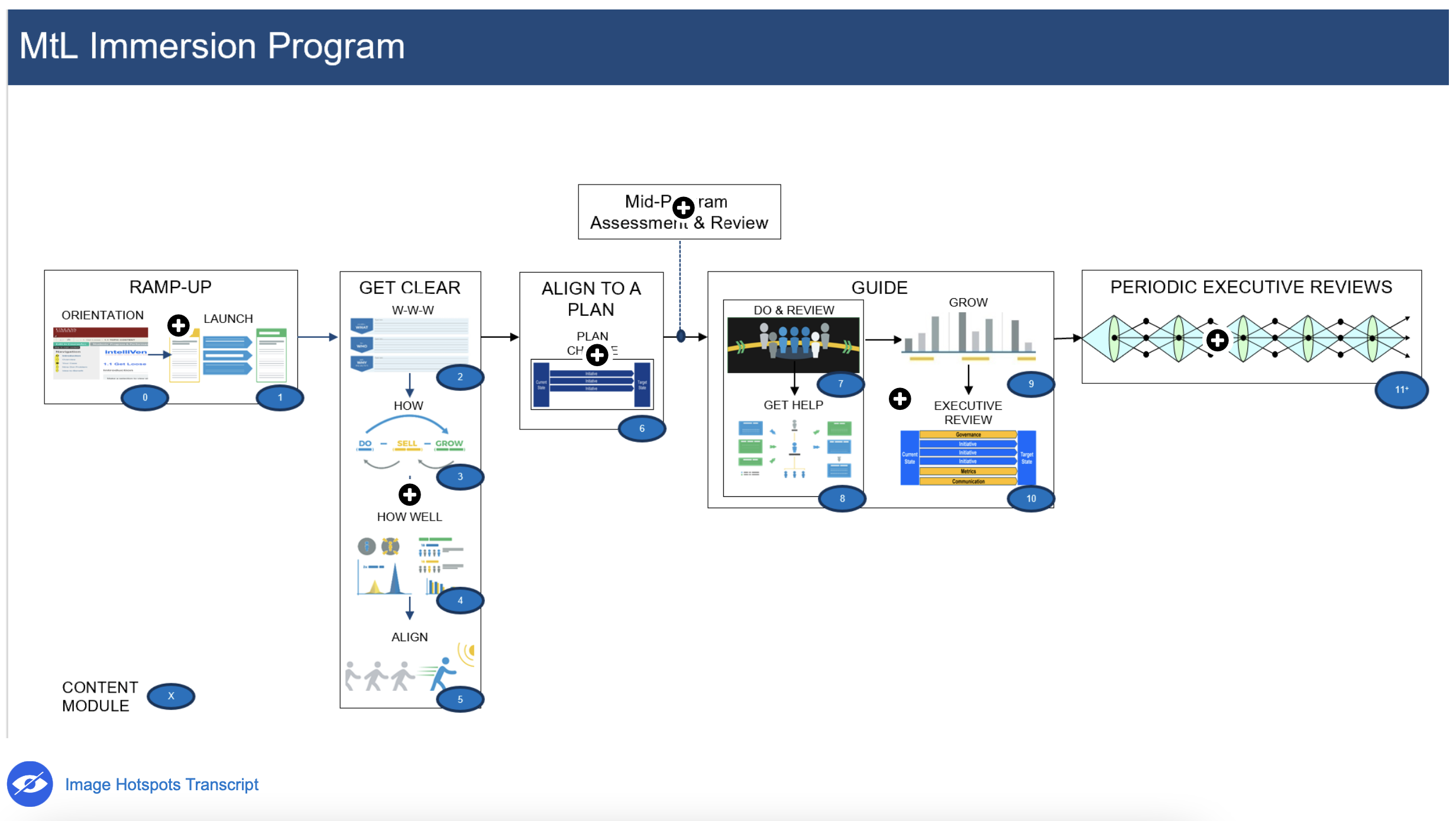
Our mission is to help you as leaders, teams, and organizations get clear, aligned, and on track toreach your potential to perform and grow. The program road map shows how we do it.
The MtL Immersion Program is ten modules organized into three segments:
Get Ready Modules 1-5 reveal how to describe an organization as it exists in the present and prioritize ways to improve its performance and growth.
GO Modules 6 – 8, address how to plan and govern Strategic Initiatives to effect intended change.
Guide Modules 9 and 10 are about how to efficiently keep track of progress and provide management attention for success.
Every module includes new material, accessed via a Learning Management System hosted by a major university, thay you apply on a practice case and then on your case, first on your own, then with your team, then across teams and with outside executives and, finally, with instructors.
Certificates of completion, competence, and distinction are awarded based on preparation, participation, and quality of your Final Project submission.