Tag Archives: leadership team

Introducing Manage to Lead: Seven Truths to Help You Change the World as an interactive digital workbook.

Many intelliven.com blog posts are based on the slides and lecture notes from a masters class in Organization Development called Organization Analysis and Strategy offered at American University and taught by Peter DiGiammarino.  These posts and other material from class, including:

  • Work problems,
  • Templates,
  • Graphics,
  • Slide shows, and
  • Assessments

are available  from Amazon as a softcover workbook or from iTunes as an iBook titled Manage to Lead: Seven Truths to Help You Change the World.

Selected intelliven.com blog content is now available as a workbook from Amazon or as an iBook from iTunes.

Whether one wants to change personal habits, implement a new information system, improve a business process, get team members to work together, increase a community’s appreciation for diversity, or even to topple a monarchy, taking seven actions driven by seven disarmingly simple truths will individually and collectively help achieve the goal.

Manage to Lead presents a framework to describe and assess any organization. It also provides a structured approach to plan and implement next steps for an organization as it strives for long-term growth and performance.

Readers are invited to select a familiar organization on which to apply the tools and templates introduced throughout the workbook. Exercises in each chapter produce essential elements for the organization’s annual strategic plan and lay the groundwork for implementing that plan.

Readers can package the key elements from Organization Exercises to form a strategic plan that communicates how the organization sees itself and where it is headed. At the end of the year leaders can compare actual results with what was described in the strategic plan to study what happened, why what happened was different than plan, what is to be learned from that, and what to do differently going forward as a result.

Repeat the process over several years and compare actual to planned results year-to-year to see the organization mature, perform, and grow to its full potential.

Building a High-Performance Leadership Team: Embracing Depth, Conceptual Thinking, Connectivity, and Drive for Exceptional Results

When building a core leadership team target for each team member to be:

  • Deep: Look for an extraordinary depth of competence in a functional or technical area or a methodology that is essential to the organization’s business;
  • Conceptual: The best leaders have an ability to abstract fully-formed concepts from a collection of parts and are able to communicate complex concepts clearly even to those who are not conceptual;
  • Connected: Target those who have strong interpersonal relationships with prospective or current clients, employees, partners, or funding sources; and
  • Driven: Look for an extraordinary inner commitment to achieve targeted results on time, on target, and on budget.

A diverse team of deep, conceptual, connected, and driven leaders who really like working with each other and who seek to accomplish the same end-result for the same reason and in the same way, have the collective capacity to accomplish nearly anything!

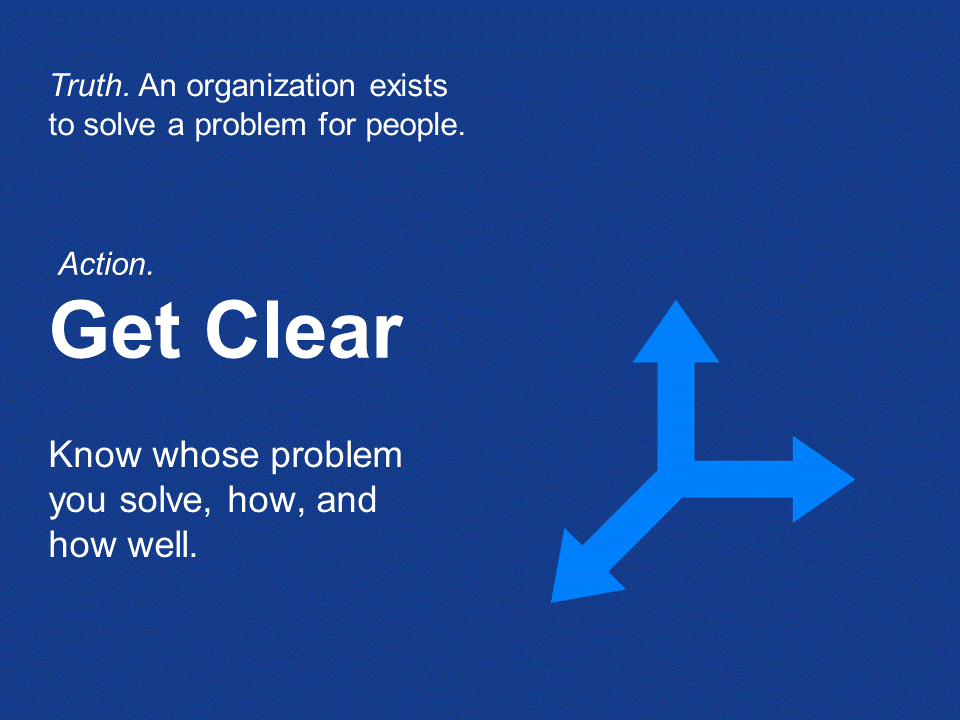
How Core Leaders get clear about what problem their organization solves for whom.

Core Leaders who all describe the problem their organization solves for whom in the same way are apt to provide more consistent guidance and direction and so increase the odds of better performance across the board.

To get clear or to test for clarity, invite each Core Leader to:

  • Collect and consolidate input from each leader.  Note points of alignment and departure.
  • Convene a Core Leadership Group session to share and discuss collected input.  Encourage leaders to iterate to a consolidated articulation; possibly over several sessions.
  • OPTION: Submit consolidated statement for review and comment by select certified IntelliVen students, clients, and followers by filling out and submitting theabove template.
  • Share consolidated articulation with Management Team.
  • Edit to reflect refinements based on input from managers.
  • Review with All Hands in written and stand-up presentations to inform, guide; solicit reaction and collect suggestions for improvement.
  • Revise as appropriate after review with Core Leaders and Management Team.
  • Finalize and publish for use in internal and external communications as a constant reminder, and to re-enforce clarity about, what the organization does for whom and why as well as to be clear about what the organization does not do.
  • Review and revise annually to reflect updated and expanded thinking in the face of experience

See also:

How organization leaders can make important changes while also developing the next generation of leaders.

Every organization has room to improve.  Most organization leaders know improvement is needed as well as how specifically they would like to evolve but do not have the time or energy to bring their clear ideas to fruition because they are short on leadership capacity.

There is almost always a great deal of untapped capacity right under their noses embodied in those in their organization who are itching for a way to make a difference and who are ready to step up and lead the way to making things better.

Action Committees are a great way to both develop future leaders and to implement needed change.  Below are listed key elements that if embraced will put Action Committees on track to success. Continue reading How organization leaders can make important changes while also developing the next generation of leaders.

How to make sure every top team member does one thing right.

CEOs should consider the following when assigning tasks to leadership team members:

  • Members of the leadership team are likely to be the most capable people in the organization and therefore among the most important to deploy optimally.
  • Each needs to be especially clear about what is most important for them to do and then spend the lion-share of their time doing it.
  • If something is important to do, then someone important ought to be in charge of getting it done.
  • Each member of the top team ought to be in charge of something important.
  • It is not possible to be personally responsible for more than one or two important things at a time.

The idea is to ensure that at least what well-deployed leaders focus on goes well and to model how things should be done for the rest of the organization. Think of it this way: leadership team members don’t have to get everything right, but they each have to get something right.

The Problem

Most people, including even most top leaders, instinctively choose to spend their time doing many more than one or two things, possibly because in their minds:

  • Doing many things increases the odds that something will go well.
  • Having too many things to do gives a great excuse for not being successful at any particular thing.
  • The need to think hard about how to spend time is replaced by the much easier rule to spend time based on demands of the next email, text, tweet, phone call, conversation, knock on the door, etc.
  • Having so many things vying for attention makes a leader feel powerful and busy, often to the point of having a “Hero complex”.

On the other hand, having many things to do means the most important people do not meet their goals because:

  • Each task gets too little time, attention, and effort.
  • Each leader works hard, but gets little done, gets tired, loses confidence, and feels ineffective yet has an inflated sense of self importance.

The CEO’s job is to make clear what is most important for each leadership team member to do and to arrange for them to do it, and little-to-nothing else, even though it may cause leadership team members to feel a greater risk of failure.

The Solution

To solve the problem, the CEO should:

  • Work with each leader to rank their assignments in priority order.
  • Ask if the odds of success on the most important task would go up if the leadership team member were to spend more time on it.  The answer will likely be “Yes”.
  • Tell the leader to spend all their time on their top priority task until the odds of success would not get any better with any more time on it.

Most leaders will shudder at the thought of having so little to do as they realize it is now incumbent on them to be successful at just one important task. It occurs quickly that they might not be successful.  When they ask: “What if I fail?” the CEO should express so much confidence that the leader will succeed that s/he will absolve her/him of such risk and promise to assign yet another important task should she/he fail at this one.

The CEO should add that if the leader puts everything into completing an assigned task, but fails on six different tasks in sequencethen, and only then, maybe it will be time to discuss whether there is good fit with the organization.

The intent is to put the fear of failure far into the future to free the the leader to concentrate on the task they have been asked to do and not on the downside consequences of failure. The fear of failure thus moves from the leader to the CEO who is then highly motivated to provide assistance, resources, governance, and incentives to maximize the odds of success.

Related Points

  • When a matter comes up for discussion, ask if it is important.  If it is, then ask who is in charge of making sure it goes well.  If no one comes to mind then assign someone or second guess its importance.
  • When speaking with someone on the leadership team, ask what important thing they are responsible for completing.  If nothing comes to mind then it is fair to wonder why they are on the leadership team.
  • If something is not important then no one should even be thinking about it.
  • The points presented in this post align well with Steven Covey’s parable about Big Rocks. and the first three principles of his 7 Habits for Effective People: end in mind, first things first, and be proactive.