SUBJECT: Input on an opportunity to bid for a strategic project
I just got off the phone with the President of the top player in our target vertical market west of the Mississippi:
Opportunity: They are going to let an RFP in two weeks to six or fewer strategy consulting firms.
Scope: Strategy, culture, change management, marketing, and messaging. (Yes; they’ve combined it all; and Yes they want one winner to be their partner as they transform).
Budget: Over $1M in first-year contracted services.
Term: It’s a multi-year award.
Qualifications: It’s right up our alley, the CEO know us (me) but has never been a client, our lack of local presence is a good thing because they want a firm with great experience and NOT just someone local.
Process: Responses will be due six weeks after the RFP is issued, and orals will be in two months with the winner selected by year-end.
Please share thoughts on how to think this through. We want to win as always and this has big implications for our firm if we do win. We have NOT decided to bid. We will do a bid/no-bid process once we see the RFP.
Many intelliven.com blog posts are based on the slides and lecture notes from a masters class in Organization Development called Organization Analysis and Strategy offered at American University and taught by Peter DiGiammarino. These posts and other material from class, including:
Work problems,
Templates,
Graphics,
Slide shows, and
Assessments
are available from Amazon as a softcover workbook or from iTunes as an iBook titledManage to Lead: Seven Truths to Help You Change the World.
Selected intelliven.com blog content is now available as a workbook from Amazon or as an iBook from iTunes.
Whether one wants to change personal habits, implement a new information system, improve a business process, get team members to work together, increase a community’s appreciation for diversity, or even to topple a monarchy, taking seven actions driven by seven disarmingly simple truths will individually and collectively help achieve the goal.
Manage to Lead presents a framework to describe and assess any organization. It also provides a structured approach to plan and implement next steps for an organization as it strives for long-term growth and performance.
Readers are invited to select a familiar organization on which to apply the tools and templates introduced throughout the workbook. Exercises in each chapter produce essential elements for the organization’s annual strategic plan and lay the groundwork for implementing that plan.
Readers can package the key elements from Organization Exercises to form a strategic plan that communicates how the organization sees itself and where it is headed. At the end of the year leaders can compare actual results with what was described in the strategic plan to study what happened, why what happened was different than plan, what is to be learned from that, and what to do differently going forward as a result.
Repeat the process over several years and compare actual to planned results year-to-year to see the organization mature, perform, and grow to its full potential.
If the leader thinks they know what needs to change and that everyone is aligned, ask: “How do you know your team knows what you want to do? It may be a good idea to ask them to verify. If they all say what you expect them to say, a positive step towards getting what you want done will have been taken just by bringing it to the center of their attention. If it turns out that some or all of the team are not as aligned as expected, then remedial steps can be taken.”
Survey the leader’s top team and ask them each:
To describe the current state, that is: how things are today.
What really good things happen if we change and what really bad things happen if we do not?
To describe how things would be in the future if their ideal changes were successfully implemented.
What needs to be done in order to get from where things are today to where things would ideally be next?
What will make it hard to do what needs to be done in order to get from today to the targeted next state?
Review results with the leader to bring him/her up to speed on the group’s data. Look for and discuss fully any points the leader finds confusing or surprising.
Convene an offsite with the leader and the leadership team to review collected data, reach consensus on each of the five topics, and decide what needs to be done. At the offsite, review survey responses one question at a time in the order above. Highlight responses that are the same or similar thereby indicating progress towards consensus. Guide the group to discuss the data until agreement is reached on how things are today, why things need to change, and how things would be if the desired change had been implemented.
Use the Change Framework to make the case for each Strategic Initiative.
The Change Framework is a convenient way to visualize and store the group’s consensus using a diagram similar to that originally introduced by Richard Beckhard and Wendy Pritchard in Changing the Essence: The Art of Creating and Leading Fundamental Change in Organizations, Jossey-Bas Inc., San Francisco, 1992.
Fill out the Change Framework to make a clear and compelling case for each initiative. Iterate with the team until all members are crystal clear about each initiative.
If participants share their thinking openly, fully, and honestly they can go a long way towards achieving clarity and alignment. An effective leader then holds the results of these efforts and furthers their development, communicates progress to stakeholders, and assigns, aligns and drives resources in their pursuit.
Figure-2: Follow the above tips to build a clear and compelling case for the change driven by each initiative.
A well formulated initiative, using the Change Framework, tells a story about where things are, why they need to change, how things would be if the intended change occurred and what must be done to get from here to there. A well crafted change framework is rational, compelling, and flows smoothly from the present through to the future.
Follow the tips in Figure-2 to piece together the context and the story for each of the initiatives the organization must do next to stay on track to long-term growth and performance.
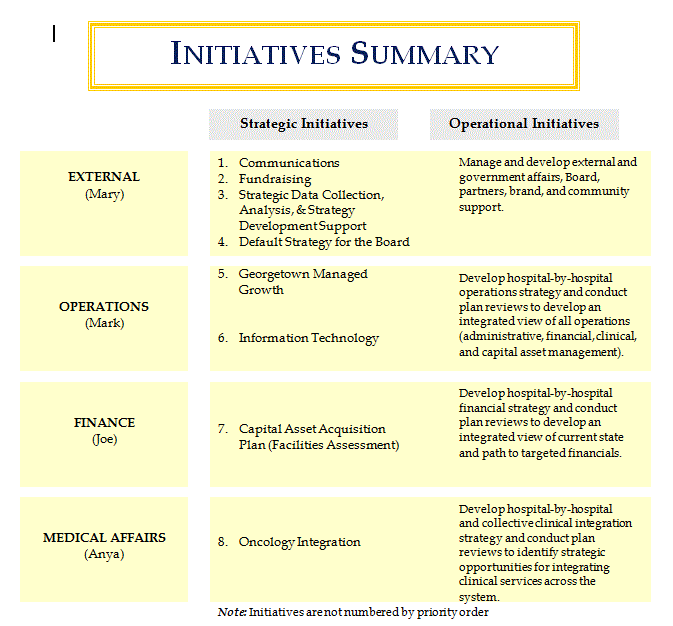
Figure-3: A classic looking list of initiatives from an executive off-site.
Many management offsites produce a list of initiatives, such as shown in Figure-3, after intense effort and exhilarating breakthroughs. A list without context, though, fails to reveal the motivation and importance behind each initiative and so makes it difficult to communicate or to muster the energy, resources, and commitment beyond the session needed to implement them.
Using the Change Framework instead of a simple list helps but even still, far too often, the same initiatives are again listed at the next offsite with little if any progress since last time simply because no one was put in charge and resources never allocated to implement them.
Upon reaching agreement, the group may feel drained but good about what it has accomplished. It is important to make sure the group knows it has done great work and come a long way but there is still more important work to be done. Their effort may be for naught unless one more step is taken.
After the list of initiatives is developed and before ending the session the leader assigns each team member to:
Figure-4: Click on the figure to fill out and submit the Initiative-to-Action form for a Strategic Initiative.
Take 20-minutes to fill out an Initiative-to-Action template using the link in Figure-4, for a specific initiative, preferably one the leader would like the team member to sponsor
Lead the group in a brief discussion about the assigned initiative.
Each team member, in turn, briefs the group on their initiative using the filled out Initiative-to-Action form. As each speaks, the rest of the leadership team adopts the mindset of close adviser and on the same team as the one speaking. Their objective is to ensure that the key points from the group’s work are captured so that the best thinking of the group is at-hand and in mind as efforts to progress with the initiative proceed on the heels of the session.
Filling out and briefing the Initiative-to-Action form launches the governance process and gets a leadership team member into the role of the initiative’s executive sponsor and on-the-hook to make progress on behalf of the group. As such the team member becomes accountable to the group for progress on their initiative. Motivation and commitment soar and the odds of making progress go up as well. Over the ensuing performance period, the leader calls on each team member at some point to brief the group on how their initiative is progressing.
Example Change Framework:
Example Change Framework for an organization whose leaders decided to move from a functional to a cross-functional approach to client services.
Good questions of customers and prospects can dramatically increase the odds of developing opportunities to deliver value. Questions that engage and that allow the customer or prospect to reveal and expand their realities and the opportunities to provide value are ideal.
It takes conscious effort to plan for, create, and to make the most of opportunities to engage. The best practice is to think ahead, develop a collection of stock questions, and pay attention to find, cultivate, and take advantage of opportunities to engage.
Below are characteristics of well-phrased questions followed by some examples.
A well-phrased question:
Is not answerable in a single word, i.e. it is open-ended and inspires an engaging dialogue on a broad agenda.
The following are definitions of phrases that use the word strategy. They provide a useful way to think about the term and matters directly related to it:
Strategy is what people in an organization plan to do in order to “win” whatever game they are playing.
Strategic thinking is how decisions and actions are made in the immediate-term in a manner that is mindful of long-term implications and consistent with a strategy.
Strategic planning is the structured process that management uses to periodically engage leaders in advancing their strategy.
Strategic plan is a description of an organization as it presently exists and where it is to be in the future along with how it will go from where it is today to where it will be next on the way to achieve a long-term vision.
Strategic initiatives are projects identified as part of strategic planning and documented in the strategic plan that are to address what is most important to change next in order to increase the odds of winning.
Strategic management is what is done to deliberately operate and develop the organization in a manner that is entirely consistent with its strategy.